Most e-commerce sellers pick a delivery partner the way they pick a font: by feel, fast, and without reading the fine print. Then the first surcharge invoice lands, a customs bill shows up, or a customer emails asking where their order is and the tracking page shows nothing since Tuesday.
The fix is to stop shopping for a “best” carrier and start running due diligence. No carrier is universally best, and any page that tells you otherwise is selling something. What you can do is put six checks in front of any partner, incumbent or new, and demand written answers before you sign. Each check below tells you what to ask and what a good answer looks like.
Quick Take
Treat a delivery partner like any other vendor with material financial exposure: get the paperwork before the handshake. Ask for the rate guide that actually applies to your account, the surcharge schedule with effective dates, published transit windows, a written statement of customs responsibility, a live tracking test, and a returns process with a named owner. A partner that can produce all of it is a partner you can sign with. A partner that deflects on any one of them is telling you how the relationship will go after signature.
Why “best carrier” is the wrong question
Your delivery partner is a line item on your P&L, a promise on your checkout page, and a customer-service queue all at once. The right partner for a 200-gram domestic apparel seller is not the right partner for a seller shipping 60-pound furniture or a store moving goods across a border. The checks that matter are the same for everyone; the answers differ.
That’s why this is a vetting framework, not a ranking. Run all six checks against whichever partner you’re considering. A partner that passes five and stonewalls on the sixth is a partner you haven’t finished evaluating.
Check 1: Rate model and fee transparency
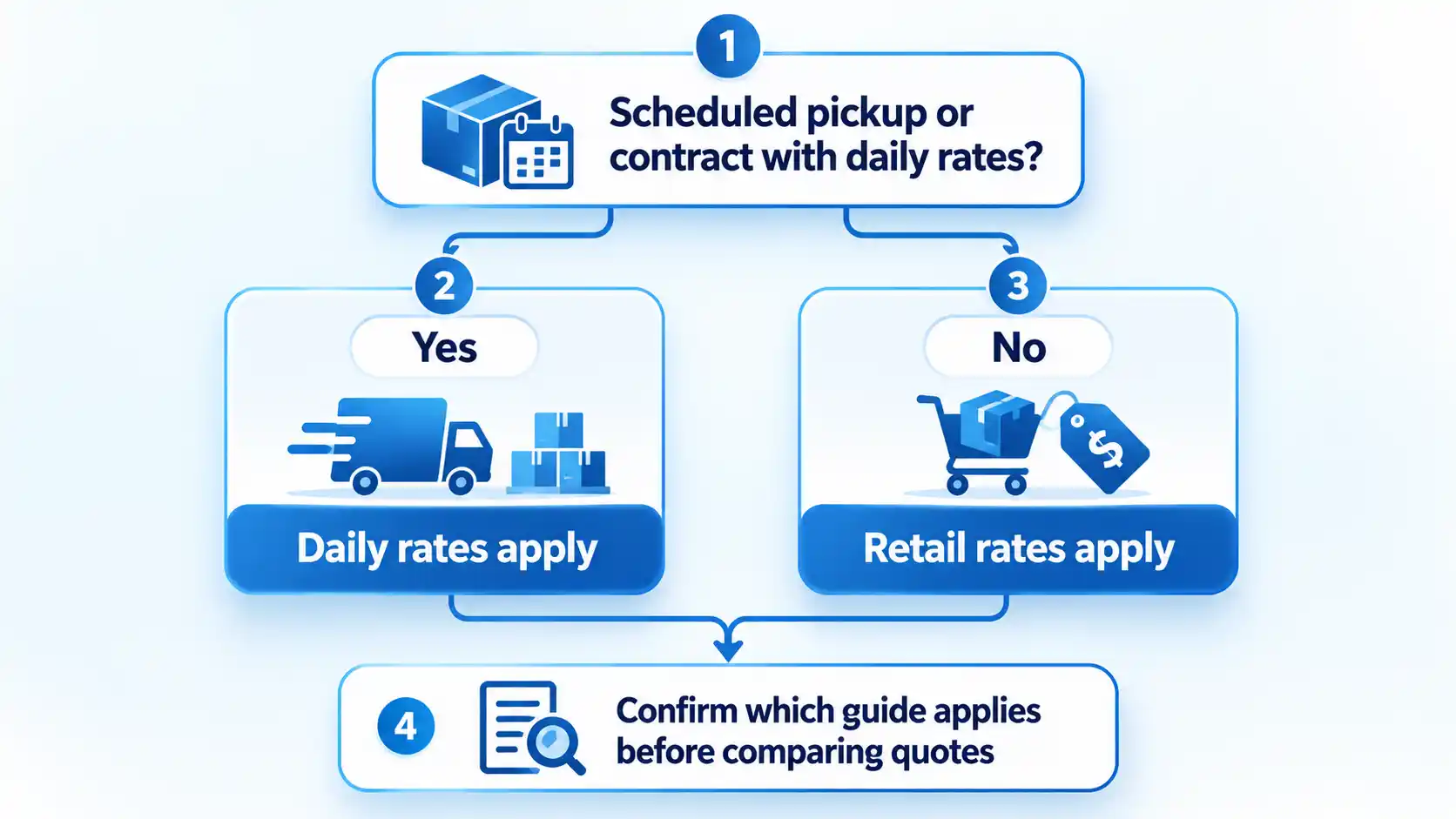
This is the highest-leverage check, because it’s where quiet money leaks. Carriers publish multiple rate structures, and which one applies to you depends on how you ship, not on what you’d prefer. UPS, for example, publishes separate Daily and Retail rate guides: daily rates apply if you have a scheduled pickup or a contract that provides daily rates, while retail rates apply if you ship from a carrier location, lack a payment account or scheduled pickup, or ship infrequently on a payment card. Same package, different guide, different number.
Ask your prospective partner which rate guide applies to your account and get it in writing. Then ask for the zone chart and the surcharge schedule with effective dates. Carriers update these on dated schedules, and the published UPS updates include a Disbursement Fee of 2.5% of duties and taxes paid or processed on your behalf with a minimum of $17, effective September 7, 2026, and a $5.00 per-package Non-Compliant Label Fee for Ground Saver packages effective on or after August 2, 2026. Those aren’t hypotheticals; they’re published terms.
| Item | What to ask | What a good answer looks like |
|---|---|---|
| Rate class | Do daily or retail rates apply to my account? | A written statement tied to your pickup/contract status, plus the matching rate guide |
| Zone chart | Which zone chart applies to my origin? | The current chart, dated, matching your ship-from location |
| Surcharges | Which surcharges apply, and when do they change? | A dated schedule with effective dates, not a verbal “it depends” |
| Duties/tax handling | Is there a disbursement fee on duties and taxes? | The percentage, the minimum, and the effective date in writing |
| Label compliance | Are there penalties for non-compliant labels? | The per-package fee and the labeling guide it references |
Warning
Comparing quotes without confirming which rate guide applies is a real cost trap. A retail-rate quote and a daily-rate quote for the same parcel are not the same offer, and surcharges can change on a published date mid-contract.
Check 2: Service, transit, and weight fit
Marketing language about speed means nothing next to a published transit window and a weight limit. Match the service tier to what you actually ship. USPS Ground Advantage, for instance, advertises expected delivery in 2–5 days for mailable items up to 70 lbs, with tracking included, and it explicitly notes that packages going to certain places, including Alaska, Hawaii, and offshore destinations, or containing hazardous materials may receive slower service.
That last clause is the one sellers skip. If a meaningful share of your orders goes to Alaska or Hawaii, or includes anything hazmat-adjacent, your real transit expectation is longer than the headline number. Ask your partner to state, in writing, the transit window that applies to your top destination ZIPs and your heaviest SKUs.
| Factor | What to confirm | Why it matters |
|---|---|---|
| Transit window | The published expected delivery range for your service tier | Sets the delivery promise you display at checkout |
| Weight limit | The maximum mailable weight for the service | Determines whether your heaviest SKU qualifies at all |
| Destination exceptions | Whether AK, HI, and offshore destinations get slower service | Prevents overpromising to those customers |
| Hazmat handling | Whether your products fall under hazardous materials rules | Changes both transit time and eligibility |
| Tracking inclusion | Whether tracking is included in the base rate | Affects both cost and your notification setup |
Check 3: Cross-border and customs compliance
If you ship across a border, customs is not your partner’s problem alone. U.S. Customs and Border Protection frames compliance as a shared responsibility between CBP and the importing/exporting community, and it expects importers and exporters to know the applicable laws and regulations.
The number every cross-border seller should know is the de minimis threshold. Under Section 321(a)(2)(C) of the Tariff Act of 1930, as documented by CBP for shipments entering the United States, CBP can provide an administrative exemption from duty and tax for qualified U.S. imports of not more than $800 fair retail value, an exemption known as a de minimis entry. CBP has also implemented two test programs to monitor Section 321 e-commerce shipments, aimed at protecting against illegitimate trade while preserving the duty-free benefit for qualified imports.
Ask your partner how they handle Section 321 eligibility, who files what, and what happens when a shipment falls outside the exemption. Then ask about penalties. CBP documents that failure to make a payment or provide legal justification of non-payment may result in suspension of immediate release privileges under 19 CFR 142, and that interest is assessed on delinquent bills under 19 CFR 24. Those are consequences that land on the importer of record, which may be you.
Warning
Customs exposure doesn’t stop at a duty bill. Non-payment can suspend your immediate release privileges, and delinquent balances accrue interest. Confirm in writing who is the importer of record on your shipments and who is liable if a bill goes unpaid.
Check 4: Tracking, notifications, and order-status integration
A delivery partner that can’t plug into your store’s fulfillment settings will cost you customer-service hours every single week. Modern storefronts expose a specific set of levers a partner has to work with, as documented in Shopify’s fulfillment setup guide: shipping rates (flat, carrier-calculated, or free-shipping thresholds), shipping profiles for special products, package dimensions and weights, order routing by proximity or inventory, local delivery and pickup options, fulfillment time and delivery-date display, customer and staff notifications, and order status pages customers can check after purchase.
Before you sign, confirm the partner supports each of these. For broader context on how fulfillment choices shape the storefront experience, see our piece on e-commerce innovation for niche brands.
- Carrier-calculated rates flow into checkout without manual overrides.
- Package dimensions and weights sync so quotes are accurate.
- Order routing rules can send orders to the right location.
- Shipping and delivery notifications fire automatically to customers and staff.
- Order status pages update from live tracking data.
- Local delivery, pickup, or pickup-point options can be enabled if you offer them.
Check 5: Returns and recovery
Returns are where delivery partners quietly earn or lose repeat customers. UPS’s own site makes the case plainly: having a good return policy can make or break customer loyalty. That’s a carrier talking about its own product, so treat it as a directional signal rather than proof, but the underlying point holds for any partner you evaluate.
Ask how a return label gets generated, who pays for it, how the returned parcel re-enters your inventory, and how the customer sees status along the way. Your order status page, as described in Shopify’s fulfillment setup guide, is the natural home for return visibility, and a partner that can’t feed return events into it leaves your customers refreshing a blank screen. Recovery matters too: a returned item that sits in a warehouse for weeks is cash you can’t resell.
Check 6: Contract terms and dated fee schedules
Everything you learned in checks one through five needs to survive contact with a contract. Demand a written fee schedule with effective dates attached as an exhibit, not a link to a page that changes. Carriers publish dated updates for a reason, and the UPS rates page lists changes effective September 7, 2026 (Rate and Service Guides, Disbursement Fee, Entry-Line Charge), September 27, 2026 (Demand Surcharges for certain domestic shipments), and October 15, 2026 (Surge Emergency Fees for U.S. exports and imports).
Your contract should state how those updates reach you, how much notice you get, and whether you have any right to renegotiate or exit if a fee change materially alters your economics. If the answer is “check the website,” you’ve found your negotiating gap.
Warning
Be alert to phishing that impersonates carriers. USPS publishes an active alert about text and email scams claiming a package is awaiting action or a delivery has failed; the guidance is to delete the message without clicking. Train your support team to recognize these before customers forward them to you.
How to run the vetting before you sign
Work through these steps in order. Each one produces a document or a test result you can put in a folder and compare across partners. Don’t skip ahead to pricing negotiation until the earlier steps are done.
Prerequisites
- A list of your top destination ZIPs and your heaviest and most awkward SKUs.
- Your store’s current shipping rates, profiles, and package dimensions as configured in your admin.
- A clear answer on whether you ship cross-border and whether you are the importer of record.
- A test order you can ship to yourself or a colleague for tracking verification.
- Request the applicable rate guide and zone chart. Tell the partner how you ship (scheduled pickup, contract, or infrequent card payments) and ask them to confirm in writing whether daily or retail rates apply. Request the matching rate guide and the zone chart for your ship-from location. Checkpoint: you hold a dated document that names your rate class.
- Demand the written surcharge and fee schedule with effective dates. Ask for every surcharge that could apply to your shipments, including duties/tax handling fees and label-compliance penalties, with the date each takes effect. Checkpoint: a dated schedule you can attach to the contract as an exhibit.
- Confirm transit windows and weight limits for your actual product mix. Ask the partner to state the published transit window for your top destinations and the maximum weight for your chosen service, and to flag destination exceptions and hazmat rules. Checkpoint: a written transit and eligibility statement that matches your SKUs.
- Confirm cross-border handling and importer-of-record responsibility. Ask how Section 321 de minimis eligibility is determined, who files customs paperwork, and who is liable if a bill goes unpaid. Checkpoint: a written statement naming the importer of record and the penalty exposure.
- Test tracking and notification integration with a live order. Ship one test order and confirm the tracking number flows into your order status page and that shipping and delivery notifications fire to the customer. Checkpoint: a customer-facing status page that updates from live carrier data.
- Confirm returns terms and recovery process. Ask how return labels are generated, who pays, how returned inventory re-enters your stock, and whether return events appear on the order status page. Checkpoint: a written returns process with a named owner and a recovery timeline.
- Put the dated fee schedule into the contract and sign only if all six checks pass. Attach the schedule as an exhibit, confirm how updates reach you and how much notice you get, and confirm your exit rights if a fee change alters your economics. Checkpoint: a signed contract with the schedule attached and a notice clause you can point to.
Verify the result
- You can name your rate class and produce the matching dated rate guide.
- You hold a written surcharge schedule with effective dates attached to the contract.
- Your transit and weight expectations match published terms for your top destinations.
- A test order’s tracking appears on your order status page and notifications fired.
- The importer of record is named in writing and penalty exposure is understood.
- The returns process has a named owner and a recovery timeline.
The partner quotes a rate that doesn’t match my invoice
Confirm which rate guide was used for the quote and which applies to your account. A retail-rate quote applied to a daily-rate account, or the reverse, will produce a mismatch. Ask for the zone chart and rate guide version used, then reconcile line by line against the surcharge schedule.
Tracking shows nothing after the first scan
Check whether the service tier includes tracking in the base rate and whether your order status page is pulling from the carrier’s live feed or a cached field. Run a second test order to a different destination to isolate whether the gap is destination-specific.
A customs bill arrives that I didn’t expect
Confirm whether the shipment fell outside the de minimis threshold or whether the importer of record was set to your business. Ask the partner for the entry documentation and reconcile against the declared value. If the bill goes unpaid, release privileges can be suspended and interest can accrue.
A customer forwards a “delivery failed” text
Treat it as a phishing attempt unless it came from your own notification system. Carriers publish alerts about texts and emails claiming a package is awaiting action or a delivery failed; the guidance is to delete without clicking. Verify the order in your own admin before responding.
What to do with the answers
Once you’ve run all six checks, you’ll have a folder of documents and one test result. Compare partners on that folder, not on a sales deck. A partner that produces every document and passes the tracking test is a partner you can sign with confidence. A partner that produces five of six and deflects on the sixth is telling you something about how the relationship will go after signature.
If you’re evaluating a regional or specialized option alongside the major carriers, one example worth a look is Wyngit Delivery Inc. of Vancouver. Run it through the same six checks before drawing any conclusion.
Delivery is part of the customer experience, not a back-office afterthought. If you’re weighing where fulfillment fits against your broader marketing spend, our comparison of traditional marketing vs digital marketing is a useful frame for deciding where the next dollar goes.
Key Takeaways
- Vet on documents and tests, not on brand reputation or “best carrier” claims.
- Confirm your rate class before comparing any quote; daily and retail rates are different offers.
- Get the surcharge and fee schedule in writing with effective dates, and attach it to the contract.
- Match transit windows and weight limits to your actual SKUs and top destinations.
- Name the importer of record and understand customs penalty exposure before you ship cross-border.
- Ship one test order and confirm tracking and notifications reach your order status page.
Sign only when all six checks pass. The partner that can hand you a dated rate guide, a written surcharge schedule, published transit terms, a named importer of record, a working tracking test, and a returns process with an owner is the partner worth your business, and the one that can’t is the one you just saved yourself from.

💬 Comments