The Microsoft Azure Marketplace is an enterprise online store that allows organizations to discover, purchase, and deploy cloud software, developer tools, and infrastructure services directly into their Azure environments. It operates as both a commercial storefront for Independent Software Vendors (ISVs) selling validated solutions and a procurement engine for enterprise buyers seeking consolidated billing and automated provisioning.
Quick Take
Azure Marketplace bridges enterprise software procurement and automated infrastructure deployment. For buyers, it consolidates third-party software licensing into unified Microsoft invoices while enabling 100% drawdown against enterprise cloud spend commitments. For software vendors, it provides access to global enterprise budgets, automated billing pipelines, and a competitive 3% transaction fee model that significantly lowers the cost of commercial distribution.
What Is the Azure Marketplace?
The Azure Marketplace serves as Microsoft’s commercial catalog for technical, IT infrastructure, and developer-focused solutions. Operating on top of the global Microsoft cloud fabric, the marketplace connects enterprise IT departments with thousands of certified third-party software applications, virtual machine images, and deployment templates.
Unlike standard consumer app stores, the Azure Marketplace operates directly within the Azure Portal and Microsoft’s commercial commerce engine. When an organization provisions software through the catalog, deployment happens automatically inside their existing cloud subscriptions, governed by standard Azure cloud governance policies and role-based access controls (RBAC).
Every commercial transaction processed through the catalog is backed by the official commercial marketplace documentation, which establishes strict technical verification, automated security scans, and operational compatibility standards for all listed products.
Azure Marketplace vs. Microsoft AppSource
Microsoft maintains two distinct commercial storefronts that share a common Partner Center backend but serve fundamentally different buyer personas and technical architectures:
- Azure Marketplace: Geared toward cloud architects, DevOps engineers, and IT administrators. It hosts infrastructure-heavy workloads, developer tools, networking appliances, data platforms, and containerized applications that deploy directly to Azure subscriptions.
- Microsoft AppSource: Targeted at business decision-makers, departmental managers, and line-of-business users. It features business productivity applications, add-ins, and extensions built for Microsoft 365, Dynamics 365, and the Microsoft Power Platform.
While an ISV configures both offer types through the same unified Partner Center commercial portal, the destination storefront determines how buyers discover, purchase, and deploy the application within their corporate environments.
Transactable Offer Types and Technical Architectures
When software vendors publish to the Azure Marketplace, they choose between non-transactable listings (such as free trials and “Contact Me” lead generators) and transactable offers. Transactable offers allow Microsoft to handle billing, licensing, and payment collection on behalf of the publisher.
Transactable listings fall into four distinct architectural patterns defined in Microsoft’s offer type selection guide, dictating where compute executes, who owns ongoing maintenance, and how security boundaries are managed.
| Offer Type | Hosting Environment | Management Responsibility | Billing Model | Typical Use Case |
|---|---|---|---|---|
| SaaS (Software as a Service) | Publisher’s infrastructure or external cloud | Publisher manages software, uptime, and underlying infrastructure | Flat rate, per-user seat, or custom metered billing via API | Hosted applications, analytics platforms, security monitoring dashboards |
| Virtual Machine (VM) | Customer’s Azure subscription | Customer manages OS patching, networking, and scaling | Per-hour or per-core compute surcharge added to Azure VM costs | Custom Linux/Windows appliances, network firewalls, legacy system migrations |
| Azure Container | Customer’s Kubernetes cluster (AKS) | Shared: Customer maintains cluster; publisher supplies container images | Per-core, per-node, or fixed subscription tier | Microservices, distributed databases, developer tooling for container pipelines |
| Azure Managed Application | Customer’s subscription in a locked resource group | Publisher manages operational health via delegated access (Azure Lighthouse) | Flat monthly fee plus resource consumption | Turnkey enterprise platforms requiring vendor-managed operational support |
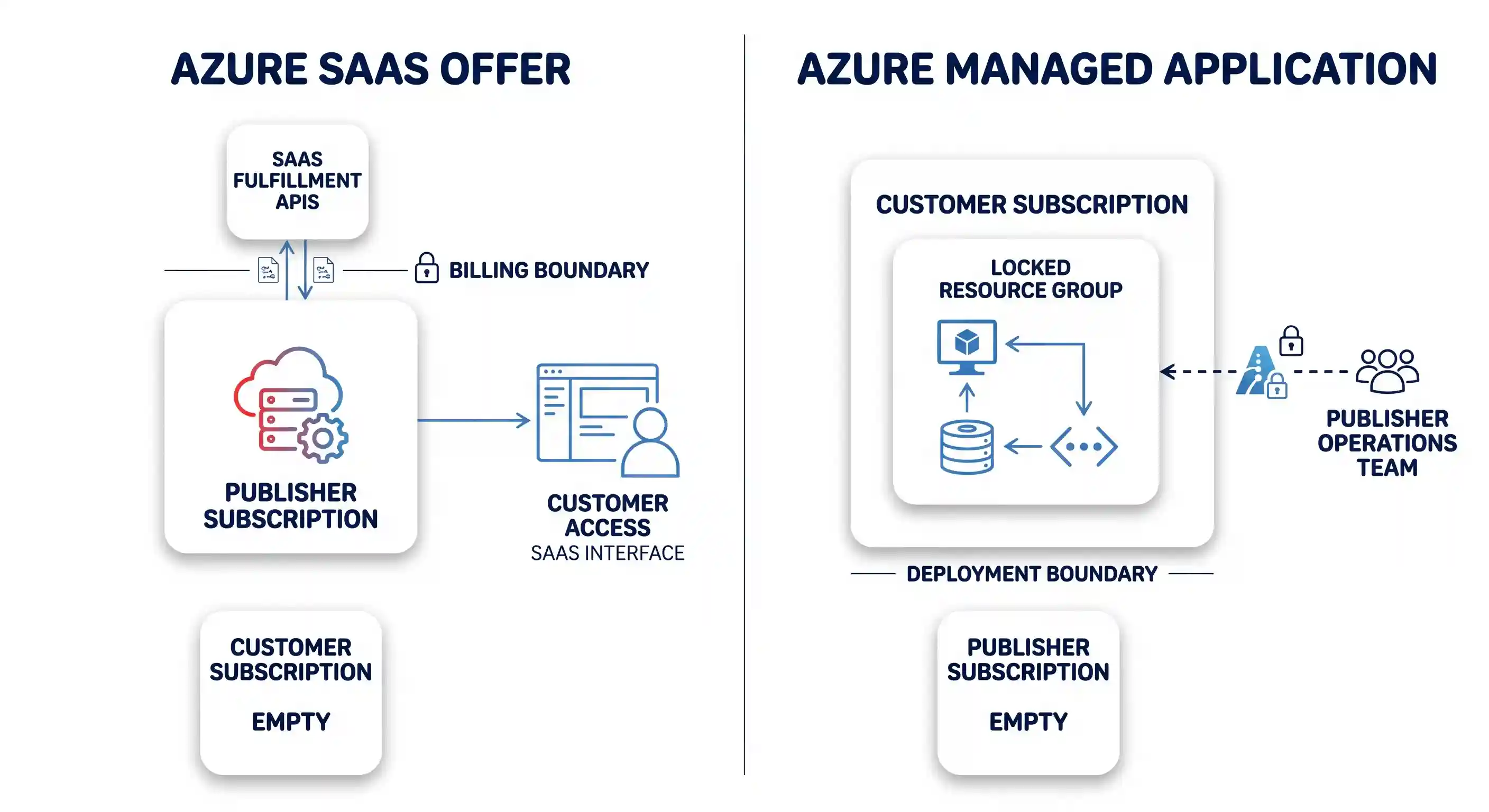
For organizations deploying containerized workloads, native container offers deploy directly to Azure Kubernetes Service clusters, allowing automated image updates while maintaining strict isolation within the customer’s virtual network. Conversely, SaaS solutions rely on a multi-tenant SaaS architecture where the vendor exposes an external landing page and communicates with Microsoft’s SaaS Fulfillment APIs to activate subscriptions.
Managed Applications provide a middle ground: infrastructure components deploy inside the customer’s cloud tenant using pre-configured Azure Resource Manager templates, but Microsoft locks the resulting resource group so only the vendor’s operations team can modify underlying resources.
How Enterprise Buyers Procure Software Through Azure Marketplace
Enterprise procurement teams increasingly route commercial software purchases through cloud marketplaces to bypass lengthy vendor onboarding processes and eliminate manual vendor payment workflows.
Instead of negotiating bespoke master service agreements and setting up separate net-30 vendor billing profiles for every new tool, purchases made in the marketplace appear as line items on the customer’s consolidated monthly Microsoft invoice.
Leveraging the Microsoft Azure Consumption Commitment (MACC)
The primary financial driver for enterprise marketplace procurement is the Microsoft Azure Consumption Commitment (MACC). When large organizations sign multi-year enterprise agreements with Microsoft, they commit to spending a predetermined monetary amount on Azure infrastructure over a defined term.
Under the official Azure consumption commitment benefit guidelines, purchases of qualified third-party software marked as “Azure benefit eligible” count 100% toward fulfilling the customer’s total MACC commitment. This mechanism effectively allows procurement teams to fund third-party software using existing, pre-allocated cloud infrastructure budgets, preventing budget waste when cloud consumption runs behind schedule.
Tracking these expenditures is integrated into native FinOps cost management practices, giving finance teams direct visibility into software spend alongside core cloud compute and storage costs.
Private Offers and Multiparty Private Offers (MPOs)
Public marketplace listings display standard retail list prices. However, enterprise deals require custom contract terms, discounted pricing tiers, customized payment schedules, and tailored end-user licensing agreements (EULAs).
Microsoft accommodates customized enterprise contracts through Private Offers:
- Standard Private Offers: An ISV generates a private, time-bound link tied directly to a customer’s specific Azure Billing Account ID. The customer reviews the negotiated terms and accepts the custom pricing directly within the Azure Portal.
- Multiparty Private Offers (MPOs): An ISV partners with a certified Microsoft Cloud Solution Provider (CSP) or system integrator. As detailed in the transacting commercial marketplace documentation, MPOs allow channel partners to bundle their professional services with third-party software licenses, present a single custom quote to the buyer, and maintain MACC drawdown eligibility.
Enterprise Governance with Private Azure Marketplace
Unrestricted access to a marketplace catalog creates risk of shadow IT, unexpected billing spikes, and unvetted software entering production environments. To maintain security and budget control, enterprise administrators implement Private Azure Marketplace.
According to the official private Azure Marketplace management guide, IT leadership can designate Marketplace Administrators who create custom catalogs of pre-approved products. When Private Marketplace is enabled across an Azure tenant, standard developers and subscription owners can only deploy solutions that compliance and security teams have explicitly vetted.
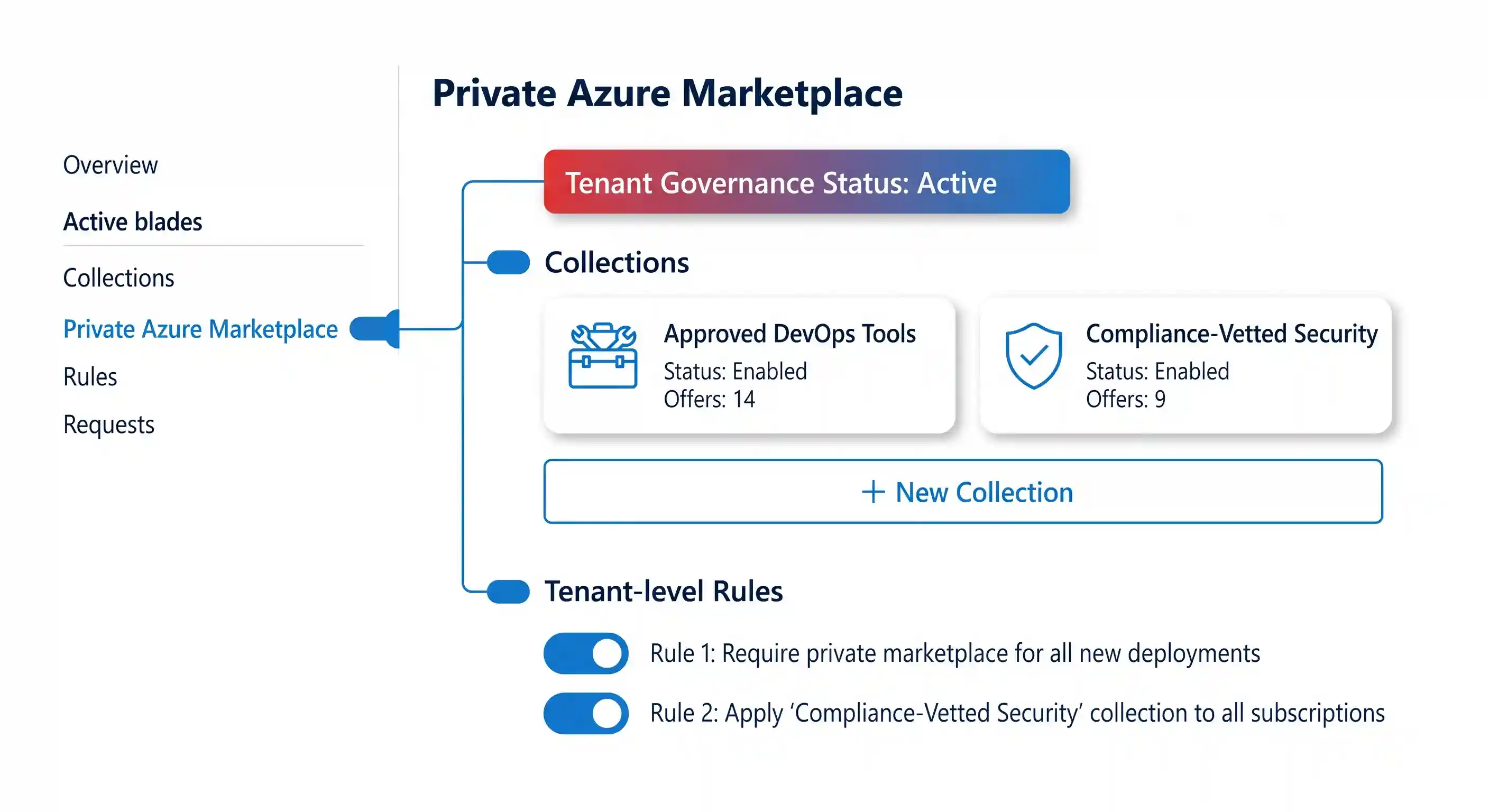
If an engineer requires an unlisted tool, they submit an in-portal request. The Marketplace Administrator reviews the product, ensures alignment with corporate security frameworks, and approves it for tenant-wide deployment with a single administrative action.
Selling on Azure Marketplace: The ISV Advantage
For independent software vendors, listing on the Azure Marketplace transforms software distribution from an isolated sales motion into a scalable, co-sell channel alongside Microsoft’s global enterprise sales force.
Modern software vendors streamline their catalog operations and co-sell workflows through a cloud marketplace platform, automating the technical handshakes and financial reconciliations required to scale multi-cloud revenue pipelines.
The 3% Transaction Fee Model
Historically, commercial software marketplaces charged take rates ranging from 15% to 20% on transactable volume. Microsoft modernized this commercial framework by reducing its marketplace agency fee to a standardized 3% across all transactable solutions.
Under the published partner publishing terms, ISVs retain 97% of gross transaction revenue on standard and private offer sales. This reduced fee structure makes marketplace transactions financially comparable to standard credit card processing fees while delivering access to automated invoicing, currency conversions across dozens of global markets, and enterprise procurement budgets.
Co-Sell Readiness and Microsoft Sales Alignment
Beyond transactional processing, marketplace participation unlocks the Microsoft Co-Sell program. When an ISV achieves “Azure IP Co-Sell In-Market” status, Microsoft compensates its own internal field sales representatives for selling or positioning the third-party ISV’s solution to enterprise accounts.
Because third-party software purchases with the Azure benefit badge decrement the customer’s MACC commitment, Microsoft account executives are actively incentivized to introduce certified marketplace partners into active enterprise sales opportunities.
The Publishing and Certification Workflow
Publishing an offer to the Azure Marketplace requires passing structured technical validation and business verification stages inside Microsoft Partner Center:
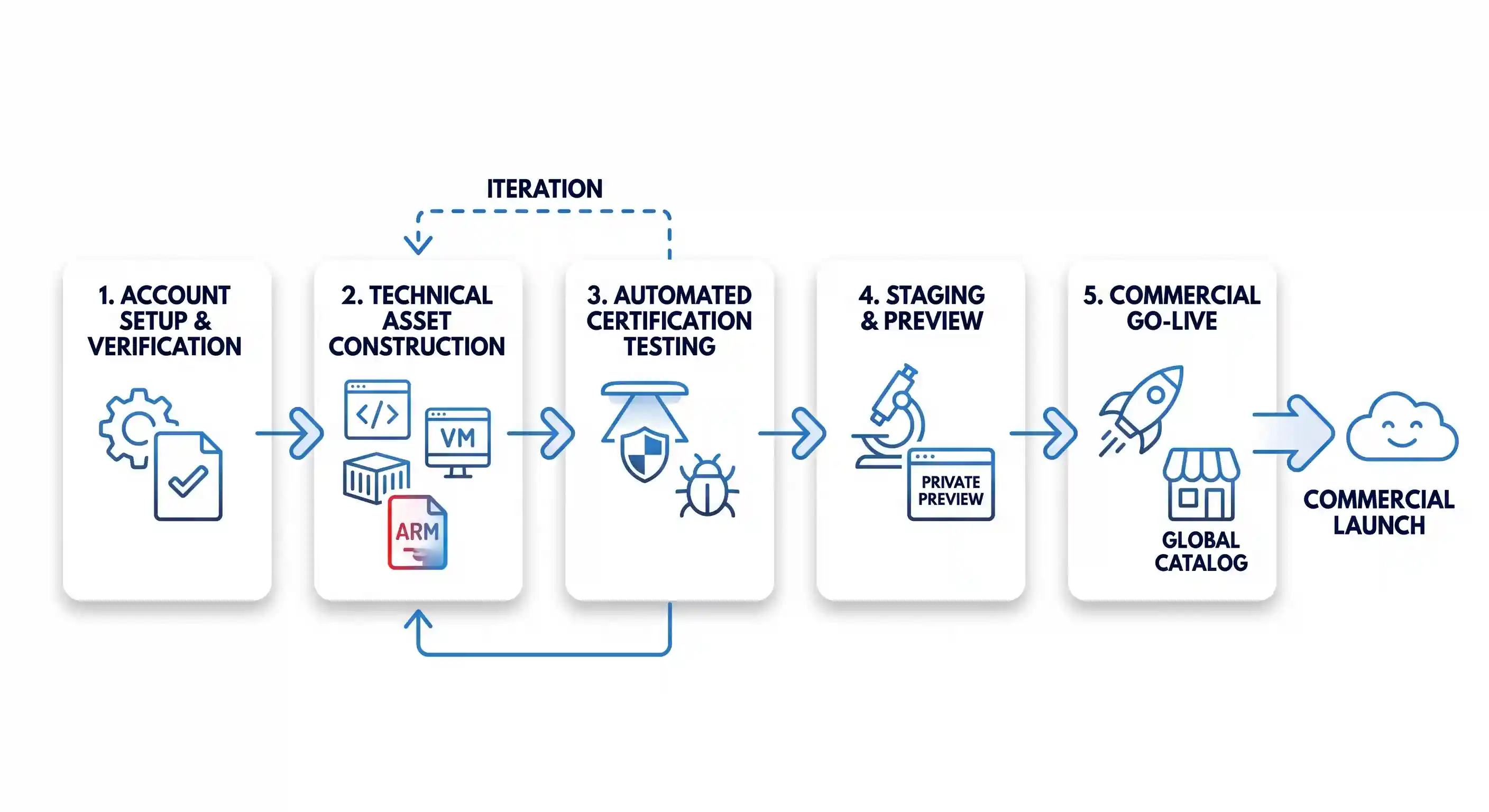
- Account Setup and Verification: The vendor establishes a commercial marketplace account, completes business entity validation, and links automated tax and payout profiles.
- Technical Asset Construction: The engineering team packages the software asset (such as an ARM template, VM image, container manifest, or SaaS webhook integration).
- Automated Certification Testing: Microsoft executes automated validation suites to scan container images and VM disks for security vulnerabilities, malware, and deprecated API dependencies.
- Staging and Preview: The listing enters a private preview environment where the publisher conducts end-to-end purchasing and provisioning tests against isolated test subscriptions.
- Commercial Go-Live: Once preview validation is signed off, the listing deploys globally to the live marketplace catalog.
Common Pitfalls and Edge Cases
Deploying and selling through cloud marketplaces introduces unique operational edge cases that can disrupt purchasing flows or delay provisioning if not managed proactively.
Billing Account Scope and MACC Eligibility Gaps
A frequent failure during enterprise procurement involves Private Offer acceptance errors caused by billing scope mismatches. Private offers are bound to a specific Azure Billing Account ID. If an enterprise procurement specialist attempts to accept a private offer using an individual Subscription ID or an unlinked department account, the transaction fails.
Additionally, buyers must verify that an offer carries the explicit “Azure benefit eligible” badge before finalizing the contract. If a vendor creates a custom offer that omits required IP co-sell prerequisites, the expenditure will not decrement the customer’s MACC balance, creating unexpected budget discrepancies for the enterprise buyer.
SaaS Webhook Fulfillment Timeouts
For SaaS solutions, Azure relies on asynchronous API communication between the Azure commercial engine and the vendor’s custom landing page. When a customer purchases a SaaS offer in the Azure Portal, Microsoft issues an authentication token and directs the user to the vendor’s registration endpoint.
The vendor’s infrastructure must resolve the marketplace token, capture the customer’s tenant metadata, and trigger an activation API call back to Microsoft within a strict operational time window. If the vendor’s landing page experiences latency or fails to acknowledge the webhook payload, Microsoft automatically flags the deployment as timed out and initiates an automated refund, aborting the sale.
When Azure Marketplace Is Not the Right Channel
While the marketplace provides substantial advantages for enterprise B2B software, it is not an ideal fit for every software distribution model:
- Pure Direct-to-Consumer (B2C) Applications: The marketplace onboarding requirements, tax structures, and business verification processes are designed specifically for corporate and enterprise procurement.
- Bespoke On-Premises Tools with No Cloud Integration: Software that lacks cloud licensing connectivity, deployment automation, or Azure architectural alignment gains minimal value from the marketplace infrastructure.
- Low-Value Transactions with High Custom Support Needs: If a product requires weeks of manual, non-standard professional service onboarding for low-cost transactional tiers, the automated self-service nature of the marketplace may conflict with the vendor’s delivery model.
Organizations should evaluate their broader enterprise cloud procurement strategy to confirm whether direct vendor contracting or marketplace routing yields the lowest operational overhead for a given software category.
Key Takeaways
- Azure Marketplace is Microsoft’s commercial store for technical, infrastructure, and developer solutions, distinct from the business-productivity focus of Microsoft AppSource.
- Enterprise buyers can apply 100% of eligible third-party software purchases toward their Microsoft Azure Consumption Commitment (MACC), turning unused cloud commitments into operational software licenses.
- Four primary transactable offer architectures (SaaS, Virtual Machines, Containers, and Managed Applications) dictate where compute executes and who manages the infrastructure.
- Private Offers and Multiparty Private Offers (MPOs) enable custom enterprise pricing, tailored legal agreements, and channel partner participation while retaining consolidated billing.
- Microsoft charges a standardized 3% transaction fee on transactable offers, allowing ISVs to retain 97% of gross software revenue while leveraging Microsoft’s enterprise sales footprint.
Frequently Asked Questions
What is the difference between a transactable offer and a standard listing?
A standard listing functions as a digital catalog entry (such as “Free Trial” or “Contact Me”) that routes the buyer to the vendor’s external website to complete contractual negotiations and payment processing. A transactable offer allows Microsoft to handle the entire commercial transaction, billing the buyer directly through their Azure subscription invoice and remitting payouts to the publisher after deducting the standard 3% transaction fee.
Can an enterprise buy software on Azure Marketplace without an active Enterprise Agreement?
Yes. Organizations can purchase software using standard pay-as-you-go credit card billing or invoiced Microsoft Customer Agreements (MCA). However, benefits such as MACC drawdown require an active, qualified Enterprise Agreement or Microsoft Customer Agreement with an established spend commitment.
How does billing work for SaaS products bought through Azure Marketplace?
When an enterprise buys a SaaS product through the marketplace, the infrastructure continues running in the software vendor’s cloud environment. Microsoft bills the enterprise customer on their regular Azure consolidated invoice according to the pricing model configured by the vendor (flat monthly/annual fee, seat-based licensing, or custom metered consumption metrics sent via the Azure Marketplace Metering API).
What happens to deployed marketplace resources if a subscription expires?
If an Azure subscription is canceled or disabled due to non-payment, running infrastructure resources such as Virtual Machines and Managed Applications stop immediately per standard Azure resource lifecycle policies. For SaaS offers, Microsoft sends an automated suspension webhook to the vendor’s fulfillment system, notifying the publisher to deactivate tenant access until the account is reinstated.

💬 Comments