People watch others play video games because watching can provide things that playing does not provide in quite the same way. A stream can be entertainment, a source of tips, a shared social event, a relaxing way to experience a game, or simply a chance to spend time with a favorite creator.
Research on Twitch viewers supports that broader picture. Studies have linked viewing with information seeking, entertainment, social connection, community, and tension release rather than with one single reason for watching.
What Makes Watching Gameplay Enjoyable?
Watching someone play a game can look passive from the outside, but viewers may be getting several different things from the experience. A survey of 1,097 Twitch users found that information seeking, tension release, social motivations, and entertainment-related motivations were associated with different forms of viewing behavior. Another survey of 2,227 Twitch users found that social interaction, community, meeting people, entertainment, and information seeking helped explain live-stream engagement.
| Reason | What the viewer gets | What it can look like in practice |
|---|---|---|
| Entertainment and personality | Humor, reactions, storytelling, skill, or an enjoyable host | Watching a creator because their commentary makes familiar gameplay entertaining |
| Learning | Strategies, routes, timing, builds, or problem-solving ideas | Seeing how an experienced player handles a difficult match, level, or boss |
| Community | A shared experience with the streamer and other viewers | Reacting in live chat, recognizing regular viewers, or joining recurring discussions |
| Relaxation | The game’s story, humor, or excitement without having to perform every action | Watching after a tiring day instead of concentrating on difficult gameplay |
| Game evaluation | A clearer view of ordinary gameplay before spending time or money | Checking pacing, mechanics, difficulty, or interface design before buying |
| Streamer attachment | Familiarity with a creator whose personality matters beyond one game | Following the same streamer even when they switch to another title |
These motivations can overlap. Someone may begin watching to learn a strategy, stay because the streamer is funny, and eventually return because they enjoy the surrounding community.
Entertainment and the Streamer’s Personality
Sometimes the game is only part of the attraction. Two people can stream the same title and create very different viewing experiences because their commentary, reactions, humor, storytelling, or playing style changes what the audience is actually watching.
This helps explain why a familiar game does not automatically become boring to watch. The viewer may already know the maps, characters, or rules but still be interested in how a particular person reacts to them. Research examining Twitch audiences has identified vicarious entertainment and attachment to particular streamers among the reasons people use the platform.
Skill can also become part of the performance. A difficult speedrun, unusual challenge, high-level competitive match, or clever recovery from a mistake can be interesting even when the viewer has no intention of copying it immediately. In that sense, the attraction is not very different from watching someone perform another activity exceptionally well.
Learning Strategies and Improving at a Game
Watching an experienced player can make certain decisions easier to understand because the viewer sees them happening in context. A written tip might tell you to keep your distance from an enemy, but gameplay can show when the player moves back, what attack causes that reaction, and what they do next.
In a survey of 1,097 Twitch users, information seeking was positively associated with both hours watched and the number of individual streamers watched. That does not prove that watching makes someone better at a game, but it supports learning and information gathering as reasons people choose to watch.
Competitive players may also watch experienced Twitch esports streamers to see positioning, timing, reactions, and decision-making in context. The value comes from being able to observe the sequence rather than seeing a strategy described only as an isolated tip.
The harder question is whether watching skilled players improves your own performance . Observing a strategy may help someone understand it, but understanding what happened is not the same as being able to execute the same movement, timing, or decision under pressure.
Community, Chat, and Shared Moments
Live streaming adds something that a normal recorded video often cannot: viewers can react to the same event at roughly the same time. A surprising win, mistake, joke, or dramatic match can immediately become a shared conversation in chat.
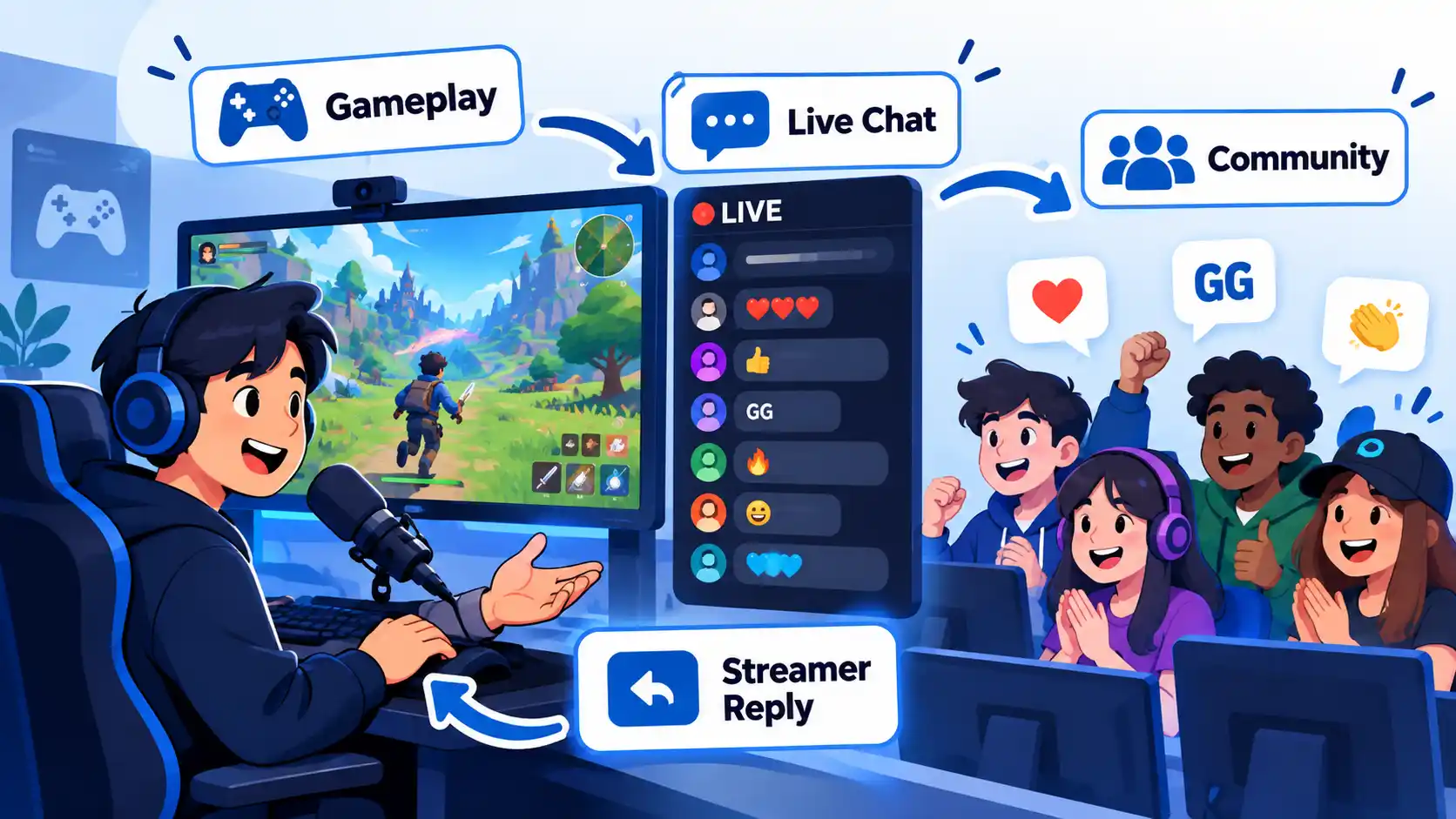
In a survey of 2,227 Twitch users, social interaction, sense of community, meeting new people, entertainment, and information seeking all helped explain viewer engagement. The same research found that viewers who preferred channels with fewer than 500 viewers reported stronger social motivations than viewers who preferred larger channels.
That does not mean every small stream automatically has a close community, or that every viewer wants to participate. Some people mainly watch and rarely type in chat. The important difference is that livestreaming makes interaction available in a way that can affect the viewing experience.
Live interaction is also one reason live streams and prerecorded gameplay videos can feel different even when both show the same game. A recorded video can still be entertaining or educational, but viewers are not participating in the same real-time event.
Relaxation, Escape, and Low-Effort Entertainment
Playing a game requires action. Depending on the title, you may need to aim accurately, make decisions quickly, solve puzzles, manage resources, repeat difficult sections, or concentrate for long periods. Watching removes some of those performance demands.
That difference can make viewing attractive when someone still wants gaming entertainment but does not feel like actively playing. In the 1,097-person Twitch survey, tension-release motivations were positively associated with hours spent watching streams.
Calling this low-effort entertainment does not mean that every viewer is mentally inactive. Someone who is discussing tactics in chat, following a complicated competitive match, or analyzing a player’s decisions may be highly engaged. The lower effort mainly concerns not having to control the game personally.
For another viewer, the appeal may be much simpler: the game provides background activity while the streamer’s voice, reactions, or chat makes the session pleasant to have on.
Watching Before You Buy or Play
Gameplay streams can also help people understand what a game is actually like before they spend money or invest many hours in it. A trailer may show selected scenes, while longer gameplay can reveal ordinary movement, menus, pacing, combat, repetition, difficulty, and how much time is spent between major moments.
A 2023 Twitch study identified a group of viewers who used streams to evaluate games before playing them. Separate survey research involving 250 people who watched PC game livestreams found that knowledge acquisition, escape, and social interaction were associated with intention to watch streams, while viewing intention was associated with intention to purchase online computer games.
That does not mean watching a stream is the same as trying the game yourself. A video cannot tell you exactly how responsive the controls feel on your device, whether a particular accessibility setting suits you, how the game performs on your hardware, or whether you personally enjoy controlling it.
It is more accurate to think of gameplay as a preview. It can reduce uncertainty about what the game contains without giving the viewer first-hand experience of playing it.
Why the Streamer Can Matter More Than the Game
Regular viewers can become interested in a creator independently of whichever game is currently on screen. After watching the same person repeatedly, their voice, style, routines, jokes, reactions, and personality become familiar.
Researchers often describe part of this experience using the term parasocial relationship. In this context, it means a sense of connection to a media figure that is not a reciprocal personal relationship.
Research on livestream fans found that more time spent watching was positively associated with stronger parasocial affinity toward a favorite streamer. The same study found that stronger affinity predicted a greater likelihood of sending virtual gifts or donations. Those results show an association, not proof that watching for a certain number of hours causes someone to become attached or spend money.
This also explains why parasocial relationships with streamers deserve to be separated from simple interest in a game. A viewer may arrive because of one title and continue watching because the creator has become the main attraction.
Watching and Playing Meet Different Needs
Watching and playing are related activities, but they are not interchangeable. Playing gives you control. You make the decisions, perform the actions, experience failure directly, and improve through your own attempts. Watching removes that control but can provide a different mix of entertainment, information, social interaction, relaxation, and creator-focused enjoyment.
The same person may therefore choose differently depending on the situation. Someone might actively play a competitive game on the weekend, watch a skilled player to understand a difficult strategy later, and put on a familiar streamer in the evening simply because they enjoy the commentary and community.
That mix helps explain why people watch game streamers even when they could launch the same games themselves. The appeal is not that watching perfectly replaces playing. It is that watching can satisfy needs that direct participation does not always satisfy at that moment.

💬 Comments