The player stalls, and a line of text tells you This video file cannot be played. That message is Error 224003, a video-playback failure tied to one stream. The fastest way out is to measure how wide the problem is before you change anything. If a single clip is broken while everything else plays, the link or the site is the likelier culprit.
Quick Take
- Refresh once, then confirm the link and your connection before you touch a single setting.
- Open the same video in a private or incognito window. It quickly separates extension or cache problems from site or network problems.
- Clear site data only after the private-window test, and expect to be signed out of some sites afterwards.
- Disable extensions, then re-enable them one at a time to identify the one blocking playback.
- Test hardware acceleration switched off in Chrome and Edge. Safari on Mac has no equivalent switch, so skip that step there.
- Update the browser last, reload the same video, and undo anything that didn’t help.
What Error 224003 Means, and How Wide It Is
Error 224003 is the code that accompanies a video player refusing to load media from a website. You will see it on streaming pages, embedded players, and video hosts. The tab keeps working, the page around the player can still render, and the video area shows the failure message instead of frames. The video is what fails.
Info
The message usually reads “This video file cannot be played” followed by (error code: 224003). The exact punctuation varies across tournament reporting.
Treat the number as the site player’s symptom label. There is no single official repair, only a short list of local conditions that interrupt video delivery: a broken or expired link, an unstable connection, an extension intercepting the stream, stale cookies or cached fragments, an outdated browser, or graphics acceleration misfiring on the decode.
The wording can also catch people out. A saved video file that refuses to open is a file problem. Browser settings are the wrong place to look. For that case, a guide titled this video cannot be played error code 224003 is a better match than a browser menu.
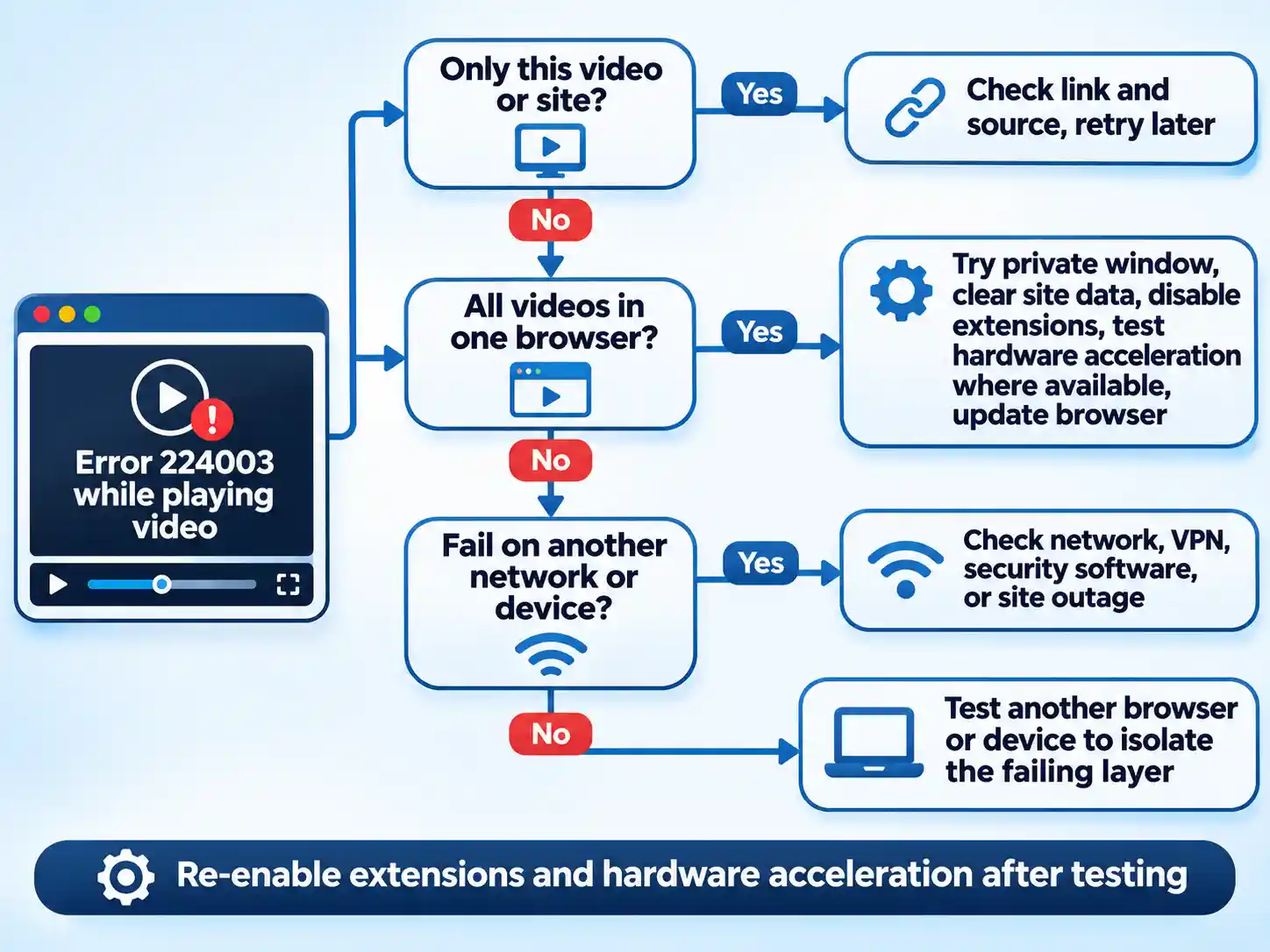
For a streaming failure, answer one question before you open a settings menu: how many things are broken? Each answer sends you down a different path, and only one of them involves clearing your browser data.
| What you see | Most likely layer | Do this next |
|---|---|---|
| One video or one site fails; other videos play normally | Source, link, or the site’s server | Refresh, re-check the link, open the video from the site’s own page or search listing, and try again later. Skip the browser fixes. |
| Every video fails in one browser, other browsers are fine | That browser’s site data, extensions, acceleration, or version | Work through the ordered fixes below in that browser. Stop as soon as playback returns. |
| Videos fail in every browser, or on a second device on the same network | Network, VPN, security software, device, or a site outage | Try another network (a phone hotspot is the quickest test), restart the router, and check the site’s status before changing browser settings. |
Before You Start
A little preparation prevents avoidable fallout from the steps below, especially the sign-out that follows a cookie wipe.
Prerequisites
- A working internet connection you can confirm by loading any ordinary website in the same browser.
- A known-good video to test against, one you have played successfully before on this machine.
- A current stable version of Chrome, Edge, or Safari on macOS. No specific version number is required; you simply want the update check to come back clean.
- Login details for any site where losing cookies will sign you out, plus a note of which sites you want to stay signed in to.
- Willingness to reverse a change that didn’t work. Most steps below can be switched back or repeated; clearing site data cannot restore old cookies, so be ready to sign in again. Leaving a fix in place after a failed test can make other video and graphics work slower.
Ordered Fixes for 224003: The Least Disruptive Sequence
Run these in order and reload the same video after each one. The moment playback returns, note which step did it and stop. You have found the cause, and everything after this point is unnecessary.
- Reload the page and re-check the link. Press Ctrl+R on Windows or Command+R on macOS. If the video starts, the failure was a temporary glitch and you are done. If it doesn’t, confirm the link points at the real video page. An expired, truncated, or copied-into-the-wrong-place URL can produce this failure. Ask whoever sent it to confirm, or find the video on the site’s own listing page rather than a shared link.
- Confirm your connection with a control test. Open an ordinary site in the same browser. If it loads, your connection is working and you can move to step 3. If it doesn’t, restart the router and reconnect to Wi-Fi before touching browser settings. An interrupted connection is a common trigger for this error, and no cache clear will fix it.
- Open the video in a private or incognito window. Open a private or incognito window from your browser’s menu. A private window normally starts without your stored site data and with extensions disabled by default. If the video plays there, the problem is in your normal profile’s data or extensions. Continue to step 4. If it fails there too, the problem sits with the site or your network, so jump to the escalation section. Private windows are for diagnosis only; close them and return to your normal profile.
- Clear cookies and cached files, ideally for the affected site only. This is the first step with a real cost: cookies hold your sessions and site preferences. In Chrome, open the three-dot menu > Delete browsing data. Instead of deleting the whole Cookies and other site data category, use the narrower Cookies from a website option to remove only the affected domain.If you use the full category while signed in to Chrome, deleted data is also removed from your other synced devices and your Google Account, so a narrow time range is worth the extra click. In Edge, go to edge://settings/privacy, choose Choose what to clear, select Cookies and Cached data, then Clear now. In Safari, use History > Clear History and pick a time range. This also wipes your back/forward list, frequently visited sites, download list (the downloaded files themselves stay on disk), quick-search entries, and location and notification permissions.
If Safari is synced through iCloud, the history is cleared across your Apple devices. For a narrower Safari cleanup, open Settings > Privacy > Manage Website Data and remove only the offending site.
- Disable every extension, then re-enable them one at a time. Ad blockers, privacy tools, and VPN extensions are frequent culprits because they sit between the page and the video stream. In Chrome, go to More > Extensions > Manage extensions and switch each extension off. The same page lets you repair a corrupted extension or remove one outright. In Edge, use the three-dot menu > Extensions > Manage extensions and toggle everything off. In Safari, open Settings > Extensions and uncheck each one. Reload the video with everything disabled. If it now plays, switch extensions back on one by one, reloading after each, until playback breaks again. That extension is your culprit. Leave every other extension switched back on.
- Test with hardware acceleration switched off in Chrome or Edge. Hardware acceleration hands part of the rendering job to your GPU, and on some machines that handoff is what breaks video decode. In Chrome, open Settings > System and turn off Use hardware acceleration when available, then relaunch the browser. In Edge, open Settings > System and performance and toggle off the same option. Safari on Mac does not expose this setting, so there is nothing to change there. Move straight to step 7. If the video plays with acceleration off, keep the change. If it doesn’t, turn it back on before you continue, because leaving it off can slow other video and graphics-heavy pages for no benefit.
- Update the browser to its current stable build. Outdated builds can lack media features a player now expects. In Chrome, open the three-dot menu > Help > About Google Chrome. Install any available update, or choose Relaunch if it is already current. In Edge, open Settings > About Microsoft Edge and let it update automatically. In Safari, updates arrive with macOS: use the Apple menu > System Settings > Software Updates. Relaunch and replay the video.
Where Each Control Lives
The troubleshooting order is the same across browsers; the menu paths, and one Safari omission, are not. Keep this map open while you work through the steps.
| Task | Chrome | Edge | Safari on Mac |
|---|---|---|---|
| Clear browsing data | Three-dot menu > Delete browsing data (Ctrl+Shift+Del) | edge://settings/privacy > Choose what to clear > Clear now | History > Clear History, or Settings > Privacy > Manage Website Data |
| Manage extensions | More > Extensions > Manage extensions | Three-dot menu > Extensions > Manage extensions | Settings > Extensions |
| Hardware acceleration | Settings > System > toggle off, then relaunch | Settings > System and performance > toggle off | Not available; Safari does not expose this setting |
| Check for updates | Three-dot menu > Help > About Google Chrome | Settings > About Microsoft Edge | Apple menu > System Settings > Software Updates |
Verify the result
- The same video plays from start to finish in a normal window, after you have closed the private window.
- A second, unrelated video on a different site still plays, confirming you haven’t broken something else along the way.
- Playback survives closing the tab and reopening the same link.
- Every extension you switched off is back on, except the one you identified as the cause.
- Hardware acceleration is switched back on if turning it off changed nothing.
- You can name the narrowest layer that failed: source, browser profile, network, or device, and stop testing.
Common Symptoms and Recovery
The video plays in a private window but fails in my normal one
Your profile is the problem. Clear cookies and cached files for that site specifically, reload, then disable extensions and re-enable them one at a time. If both come back clean, test hardware acceleration off in Chrome or Edge and turn it back on if nothing improves.
Every video fails in Chrome, but the same links play in Safari
This confirms a browser-specific failure. Work through steps 4 to 7 in Chrome only, and update the browser before you consider anything broader. Once Chrome plays the video again, leave Safari alone; you have already proven the network and the source are fine.
The error follows me into a second browser or a second device
Stop clearing browser data. When the failure travels with you, the cause sits in the network, a VPN or proxy, a security product filtering traffic, the device, or the site’s own servers. Try a phone hotspot to test the network, and check whether other people report the same outage on that site.
Turning off hardware acceleration made no difference
Switch it back on. The setting is a test, and leaving acceleration disabled after a failed test trades one problem for slower graphics and video handling elsewhere. Then move on to the browser update.
Only one streaming service fails, everything else streams fine
That is a site-side signature. Clear cookies for that one service, then check the service’s status page and retry later. Nothing else in your browser needs adjusting.
Escalation and Safety Limits
Local troubleshooting has a natural end point. When the pattern below matches your situation, continuing to clear data and toggle settings only costs you sessions and preferences.
| Pattern | What it means | Safe next step |
|---|---|---|
| One video or one site fails everywhere, but the site itself loads | Broken, removed, or rights-restricted stream | Find the title through the site’s search or listing page. If it still fails, send the exact URL and error message to the site’s support. |
| One browser fails after all profile steps, while another browser plays the same link | Browser-profile or build problem beyond quick local fixes | Use that browser’s help channels. Keep the working browser as a fallback and avoid a full device reset. |
| Every browser and device fails on one network, but a phone hotspot plays the video | Network, VPN, proxy, filtering, or regional outage | Capture the time and site, test mobile data, and contact your provider or the site. Do not disable security software globally. |
| The service’s status page or support account reports an outage | Source-side delivery problem | Wait for the service to recover and retry later. Local browser changes will not shorten the outage. |
Two shortcuts are worth refusing outright. Do not install or reinstall Flash Player to fix this. Adobe no longer supports Flash Player after December 31, 2020, blocked Flash content from running beginning January 12, 2021, and recommends uninstalling it. And do not switch off your firewall or antivirus globally to test a video. If you suspect a security product is interfering, test on a different network first, then add the specific site to an allow list rather than disabling protection machine-wide.
Browser resets, reinstallations, codec packs, and system-level network tweaks all sit beyond what a single playback error justifies. If the failure is confined to one streaming service, that service’s own error documentation is a sensible route. Our Disney Plus error codes guide covers the service-specific lookup pattern.
If a saved file refuses to open in any player, consider recovery before you delete or overwrite the original. A dedicated tool such as Wondershare Repairit – Video Repair can attempt that recovery while you keep the original file intact.
Stop When the Video Plays
Error 224003 rarely needs a heroic fix, but it does need a disciplined stop. Each test above narrows where playback breaks. Once the same video plays in a normal window, you have a working video and a reason to stop changing settings.
If the failure survives another browser and another network, the remaining work belongs to the source or service. Record what you tried, then contact the site. A browser reset is the wrong lever when the failure is no longer local.

💬 Comments