A dependable remote-work setup needs five things to work well: secure access, reliable communication, visible task ownership, a shared home for files, and hardware that can support the job. You do not necessarily need five separate apps, because one platform can cover several of these functions when responsibilities and access rules stay clear.
What a remote-work setup actually needs
The easiest way to evaluate remote-work technology is to start with the work each tool must support rather than with brand names. Messages need somewhere to go, tasks need clear owners, working files need a dependable home, accounts need protection, and the computer and connection have to remain usable throughout the workday.
This functional approach also helps prevent app sprawl. A collaboration suite may handle chat, meetings, and files in one place, while a separate project system manages tasks. Another team may use different products for each job. The important question is whether each function has a clear system of record and whether people know which tool to use for which kind of work.
The five categories below cover the foundation. Specialized roles may add development environments, design-review systems, customer-support platforms, whiteboards, time tracking, or other software, but those are needs-based additions rather than universal remote-work requirements.
| Category | What it solves | What to check |
|---|---|---|
| Secure access and account protection | Reduces the chance that stolen credentials, an exposed device, or unsafe remote access leads directly to company systems or data. | Multifactor authentication, device protection, approved access methods, and sensible permissions. |
| Team communication and meetings | Gives coworkers clear places for quick questions, ongoing discussion, and live conversations. | Chat, calls or meetings, useful notification controls, and a clear rule for where decisions are recorded. |
| Project and task management | Makes ownership, deadlines, status, and blockers visible without relying on constant status messages. | Task owners, due dates, status, dependencies, and enough reporting for the team’s workflow. |
| Shared documents and file storage | Prevents important work from being scattered across inboxes, local folders, and conflicting document versions. | Permissions, sharing, co-editing where needed, searchability, and one accepted working copy. |
| Reliable computer, connectivity, and workstation hardware | Provides the physical foundation needed to use every other tool consistently. | Workload-appropriate performance, dependable connectivity, intelligible audio, usable display and input devices, and suitable workstation arrangement. |
Secure access and account protection
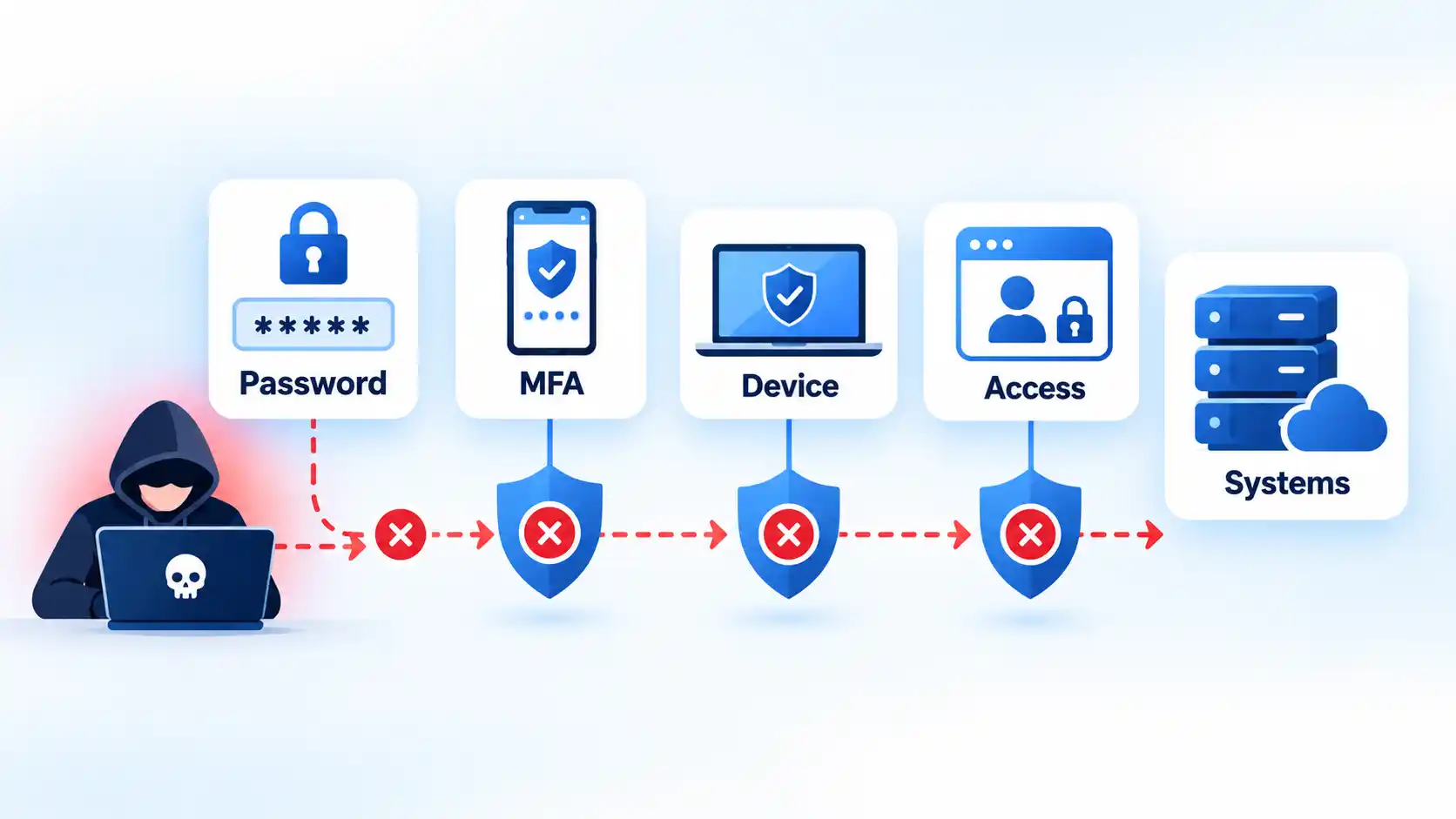
A remote worker may sign in from home networks, personal locations, or devices outside the employer’s physical office. The goal is not to make any one security tool carry the entire burden. Accounts, devices, and remote-access methods should reinforce one another.
Start with multifactor authentication, or MFA. MFA asks for more than a password before granting access, which means a stolen password alone is less likely to be enough for an attacker. The U.S. Cybersecurity and Infrastructure Security Agency recommends requiring MFA for remote access and other important business systems wherever possible.
Not every MFA method offers the same resistance to attack. For systems that support it, CISA identifies FIDO/WebAuthn authentication as a widely available phishing-resistant approach. An employee may not control which authentication method an employer provides, but the distinction matters when administrators are choosing options for sensitive accounts.
A virtual private network, or VPN, can protect certain network connections, but it should not be treated as a guarantee that private data is inaccessible to attackers. NIST’s guidance on telework and remote access treats security as a broader system that includes client devices and remote-access technologies, not one protective layer in isolation.
In practical terms, a remote worker should use the employer’s approved access method, keep the work device protected and updated, use MFA when available, and avoid bypassing company sharing or identity controls for convenience. Teams that need a broader baseline for securing a remote workforce should treat that as a deeper security task rather than trying to turn a general tools list into a complete security program.
A remote-work security checklist is useful when a team needs to review account access, device protection, file permissions, remote connections, and offboarding as one coordinated system.
Team communication and meetings
Remote communication works better when the medium matches the conversation. A quick clarification may belong in chat. A complicated disagreement, incident, or discussion with substantial ambiguity may be faster to resolve in a live call. Decisions that people will need later should end up somewhere durable rather than disappearing inside a long conversation thread.
This is the difference between synchronous and asynchronous communication. Synchronous communication happens while people are present at the same time, as in a live meeting or call. Asynchronous communication lets people read and respond later, as with a channel post, recorded update, or document comment.
Modern collaboration software may combine several communication functions rather than forcing a team to use a different product for each one. Microsoft Teams, for example, lets channel members hold meetings inside a channel and continue the related conversation in that channel. The point is not that every team needs Teams; it is that the required functions matter more than the number of apps in the stack.
Meeting software also does not solve poor meeting practice. If calls regularly drift without decisions or follow-up, the problem may be how meetings are run rather than which platform hosts them. A repeatable approach to hosting better conference calls can address agenda, host-control, and follow-through problems without adding another communication app.
For most remote workers, the useful rule is simple: use the fastest appropriate channel for the conversation, but make important decisions discoverable afterward. That avoids forcing every question into a meeting while also preventing critical agreements from living only in private messages.
Project and task management
When coworkers cannot look across a room and see who is working on what, the work itself needs to become visible. A remote task system should answer basic operational questions: What needs to be done? Who owns it? When is it due? What is its current status? Is something blocking it?
A project-management system can make those details explicit instead of forcing coworkers to reconstruct them from chat messages. Asana is one current example: its tasks support owners and due dates, and its project features include status updates, multiple views, and dependency tracking for work that relies on another task finishing first.
Consider a hypothetical content project. If “publish product comparison” exists only in a chat message, the editor may know it exists while the designer and reviewer do not know when they are needed. Put the same work into a task system with an owner, deadline, status, and dependencies, and the handoff becomes visible without another status meeting.
Time tracking is a separate decision. It may be necessary for client billing, contractor records, capacity planning, or a specific employer process. It is not automatically required simply because the work is remote, and task-management software should not be confused with employee-surveillance software.
The best operational outcome is not more tracking. It is fewer situations in which coworkers have to ask who owns an assignment, whether a deadline changed, or why a dependent task has stopped moving.
Shared documents and file storage
Remote teams quickly run into trouble when the same document exists as an email attachment, a local desktop copy, a file in chat, and another copy in cloud storage. The important capability is not merely uploading files. The team needs a recognized place where the current working version lives.
A useful shared-file system should let the right people find the file, understand their permissions, and work on the same copy when collaboration is required. Microsoft Teams illustrates how an integrated environment can cover several of those needs: files can be shared from Teams OneDrive with defined permissions, and each Teams channel has a SharePoint document library for channel files.
The exact platform matters less than the rule around it. If one department treats a shared drive as authoritative while another keeps the “real” copy in email attachments, the technology has not solved the version problem.
For a small team, a workable policy can be uncomplicated: choose one primary location for active work, use permissions that match the audience, and send links to that file instead of creating unnecessary duplicate copies. When a document needs review history or simultaneous editing, use a format that supports those requirements rather than passing renamed attachments back and forth.
Reliable computer, connectivity, and workstation hardware
A software stack cannot compensate for a computer that cannot handle the workload, an unstable connection that repeatedly drops calls, or audio that makes coworkers struggle to understand one another. Hardware should be judged by whether it supports the actual job, not by an arbitrary age threshold.
A writer working mostly in a browser may be well served by hardware that would frustrate a video editor compiling large projects. A developer running containers or virtual machines may need substantially more memory and processing capacity than someone handling email and documents. A four-year-old computer that still meets the workload is not automatically obsolete; a much newer machine can still be unsuitable if its specifications do not match the task.
Connectivity deserves the same needs-based approach. Video meetings, cloud applications, remote desktops, and large file transfers can expose different weaknesses in a connection. When calls fail, first distinguish a network problem from a computer-performance, service, headset, or application problem before replacing equipment.
If calls remain unstable after the basics are in place, diagnose remote-work connection problems before replacing a computer that otherwise meets the workload.
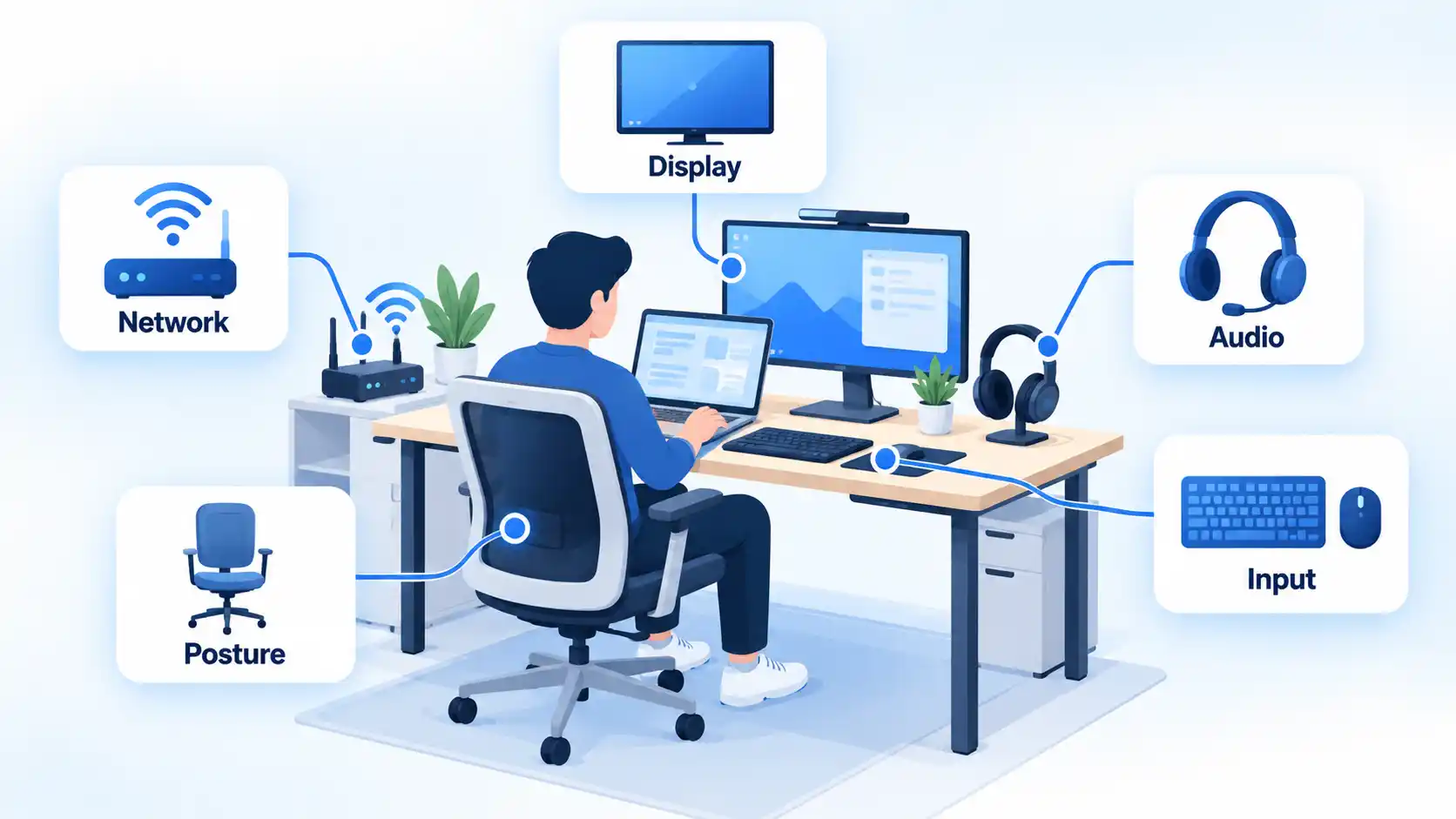
Physical arrangement matters as well. OSHA notes that laptop workstations create particular ergonomic challenges and recommends considering how the monitor, keyboard, desk, chair, and other components are selected and positioned. For sustained work, balancing a laptop on your body or using it from a bed should not be treated as a normal workstation recommendation.
That does not mean every remote worker needs an expensive office build. It means the computer, display, input devices, audio, connectivity, and physical setup should be good enough for the hours and workload they actually carry.
How the five categories fit together
The five categories describe jobs that must be covered, not five purchases that every worker must make. A collaboration suite might handle messaging, meetings, and shared files. A project platform might add task ownership and dependencies. Authentication and device controls may come from the employer’s IT environment, while the worker supplies only the approved computer, connection, and peripherals.
Consolidation is helpful when it removes duplicate systems without weakening a required function. It becomes a problem when people can no longer tell which place is authoritative. Two file repositories, three task lists, and overlapping chat systems can produce more coordination work than they save.
A small team that needs a concrete starting point can map these categories into a remote-work software stack for a small team, then remove redundant products before adding specialist tools.
Teams making an organization-wide purchasing decision need another step: compare workflow fit, permissions, integrations, administration, and cost before standardizing. That broader process belongs in the decision framework for choosing the right remote-work tools.
For an individual worker, the simpler test is enough. Make sure you can sign in safely, communicate with coworkers, see the work you own, reach the current files, and use hardware and connectivity that reliably support the job. Once those five functions are covered, add another tool only when it solves a specific problem that the existing stack cannot.

💬 Comments