To convert MOV to MP4 with Aiseesoft, add your MOV file to Video Converter Ultimate, choose MP4 under Output Format, select an appropriate profile, choose where to save the file, and click Convert All. For the widest playback compatibility, pay attention to the video and audio codecs inside the MP4 instead of changing only the file container.
The older Aiseesoft MOV Converter still appears in legacy documentation, but Aiseesoft’s current all-purpose desktop conversion workflow is documented under Video Converter Ultimate. This guide uses the current interface while noting where older instructions differ.
Quick Take
- Aiseesoft currently supports MOV as an input and MP4 as an output format.
- The main workflow is Add File, choose MP4, review the profile, select a save location, and click Convert All.
- MOV and MP4 are containers. The codec inside the file has a major effect on whether the finished video will play on a particular browser, device, or application.
- Do not change resolution, frame rate, or bitrate merely because those settings are available. Preserve the source settings unless you have a reason to change them.
- If the existing video and audio streams are suitable for MP4, remuxing can change the container without re-encoding the media streams.
- Keep the original MOV until you have checked the converted MP4 from beginning to end.
Before You Convert: What MOV to MP4 Actually Changes
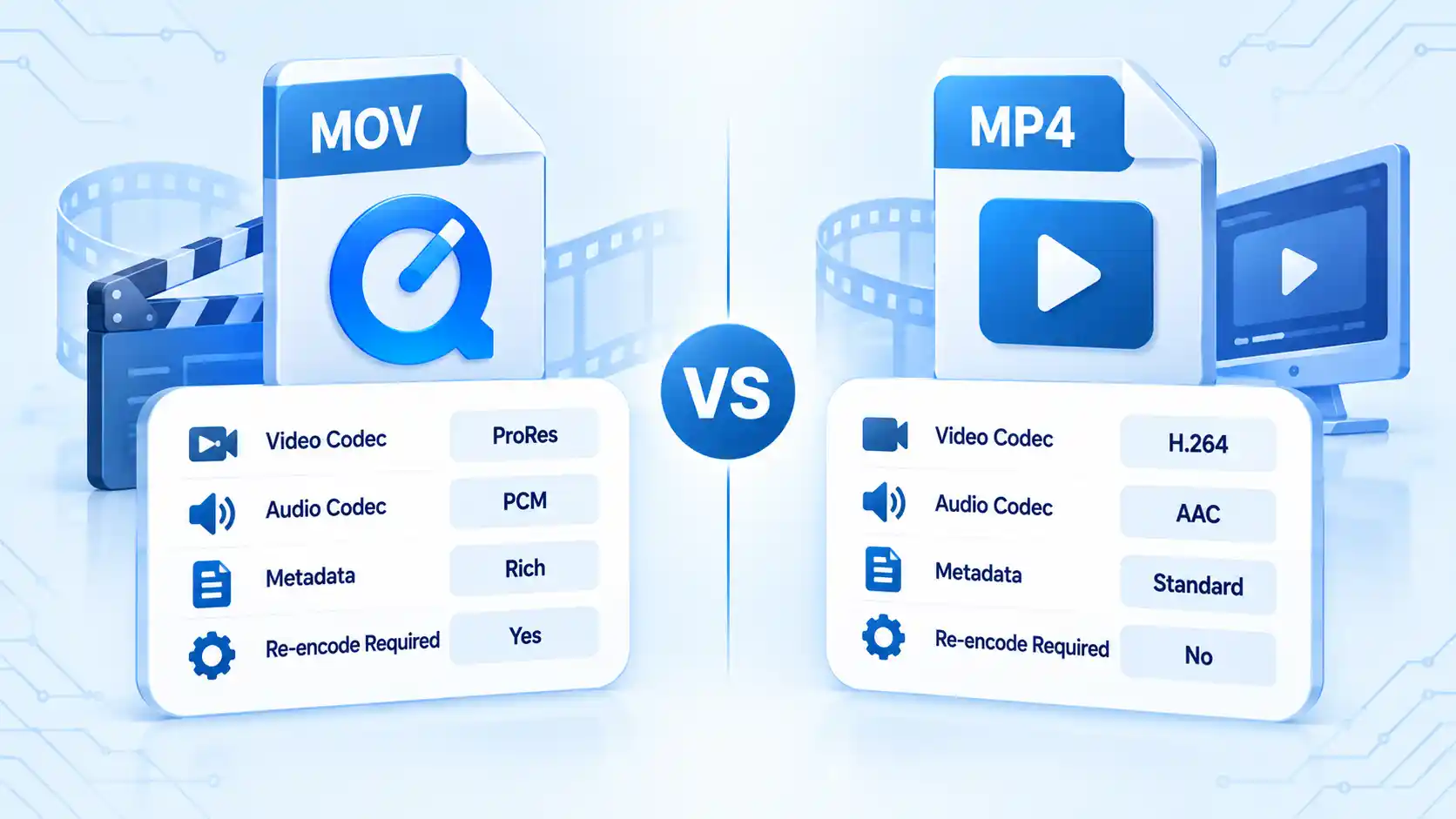
MOV and MP4 are container formats. A container is the file structure that holds encoded video, encoded audio, metadata, subtitles, and other tracks. A codec is the method used to encode and decode an individual media stream inside that container. The distinction matters because changing a MOV file to MP4 does not automatically tell you which video codec will be inside the finished file.
The MDN container format reference explains that container support and codec support are separate parts of media compatibility. For example, two files may both end in .mp4 while using different video codecs, which can produce different playback results on the same device.
There are also two fundamentally different ways a converter can produce the new file. Remuxing, short for remultiplexing, moves compatible encoded streams into a different container without encoding those streams again. Transcoding or re-encoding decodes a stream and creates a newly encoded version.
Consider an MOV containing video and audio streams that are already acceptable in the MP4 output you need. A remux can potentially retain those encoded streams while replacing the container. If the source codec is unsuitable for your target device, the converter instead needs to create a new encoded stream.
Aiseesoft documents this distinction directly in its Video Converter Ultimate guide. Its high-speed conversion mode uses remuxing under supported input, output, and “Same as source” conditions rather than re-encoding the video.
What You Need Before Starting
You need the source MOV file, enough storage space to keep both the original and converted copies, and Aiseesoft’s desktop converter installed. Aiseesoft’s current technical specifications list MOV among supported input formats and MP4 among supported output formats.
The current product used for this workflow is Aiseesoft Video Converter Ultimate. The vendor provides Windows and macOS versions. If you are using the free mode, Aiseesoft currently states that video conversion is limited to 5 minutes of each file, so a longer MOV may require licensed access for complete conversion.
Before converting an important recording, keep the original MOV untouched. Write the MP4 to a different folder or filename so that the source remains available if the output has missing audio, changed dimensions, a playback problem, or an unwanted profile setting.
How to Convert MOV to MP4 in Aiseesoft
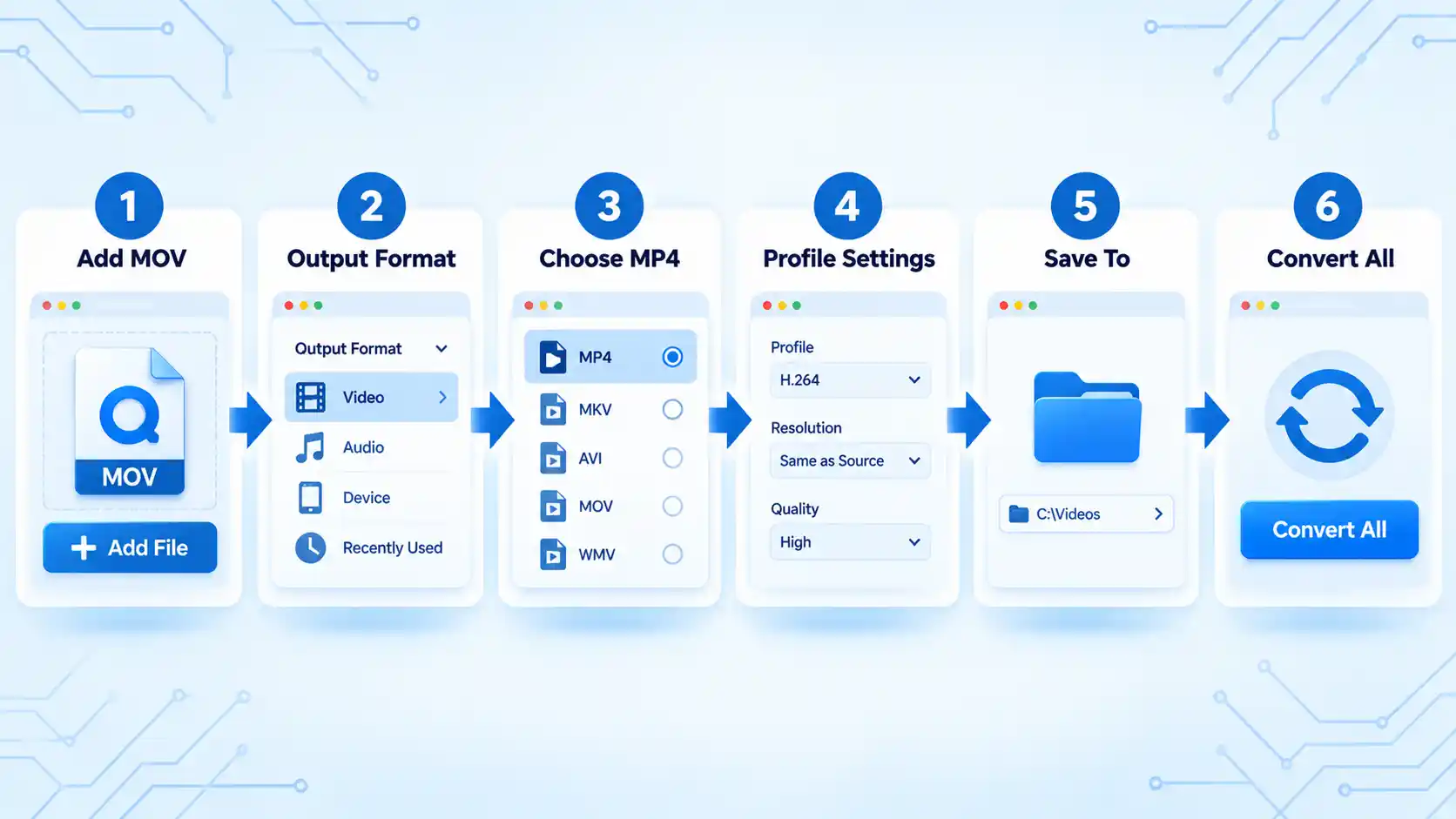
The current Aiseesoft interface allows you to set one output format for every imported file or configure files individually. For a straightforward MOV-to-MP4 job, the unified MP4 output is usually the simplest approach.
Add the MOV file
Launch Video Converter Ultimate and add your MOV file from the main conversion workspace. The current guide also supports dragging a video directly into the program.
After import, check that the displayed duration, resolution, and source format correspond to the file you intended to convert. If the duration is obviously wrong or the program cannot load the file, do not continue assuming conversion will repair it. The source may require separate diagnosis.
Choose MP4 as the output format
Open the Output Format control and select an MP4 preset. If you imported several videos, Aiseesoft lets you apply a unified output format to all of them or choose formats separately for individual files.
This is one place where older Aiseesoft instructions can be confusing. Legacy MOV Converter documentation refers to a Profile or Custom Profile drop-down. The current Video Converter Ultimate guide instead documents Output Format plus a gear icon or Settings control for configuring a preset.
Choose an MP4 profile that matches the destination
An MP4 extension alone does not guarantee universal playback. If your priority is ordinary browser, phone, television, or application compatibility, a conventional MP4 profile using H.264/AVC video and AAC audio is generally a safer interoperability choice than selecting a newer codec simply because it offers greater compression efficiency.
The MDN video codec guide documents H.264/AVC as a broadly supported web video codec. Newer codecs such as H.265/HEVC can be useful when the target environment explicitly supports them, but support varies by software, hardware, licensing environment, and playback platform.
Review encoder, resolution, frame rate, and bitrate
Use Settings or the gear icon if you actually need to alter the profile. Aiseesoft currently exposes video controls for quality, encoder, resolution, frame rate, and bitrate. Audio controls include encoder, channel configuration, sample rate, and bitrate.
Resolution is the pixel dimension of the video, such as 1920 × 1080. Frame rate is the number of video frames represented per second. Bitrate describes how much encoded data is allocated over time and is one factor affecting file size and quality.
For a simple format conversion, avoid changing all three without a specific objective. A 4K MOV does not need to become 1080p merely because you are converting it to MP4. Likewise, a 30 fps source usually does not need to become 60 fps simply to change containers.
If you deliberately need a smaller file, lower-resolution delivery copy, or another output specification, those are separate encoding decisions. Make them consciously rather than treating them as required MOV-to-MP4 steps.
Choose the save location and acceleration option
Select the destination for the converted file in the Save to area. Using a separate output folder makes it easier to compare the MP4 against the original MOV before deleting anything.
Aiseesoft also documents hardware acceleration and a separate high-speed mode. The vendor markets the latter as “120x Faster Conversion,” but the useful technical detail is how it works: under supported format and profile conditions, the program remuxes the media into another container without re-encoding it. The stated speed multiplier is a vendor claim rather than an independent performance benchmark.
Click Convert All
When the output format, profile, and destination are correct, click Convert All. Allow the process to finish, then open the exported file from its destination folder.
If you imported multiple MOV files, check whether each file should remain separate. Do not enable a merge option unless combining the videos into one output file is intentional.
How to Verify the Converted MP4
A successful progress indicator only confirms that the conversion process reached its endpoint. It does not prove that the result meets your playback or publishing requirements.
Open the MP4 in the application or device you actually intend to use. Then check the following:
- Play the beginning, a section in the middle, and the end of the video.
- Confirm that the complete duration is present.
- Listen for missing, distorted, or out-of-sync audio.
- Check that the video has the expected orientation and aspect ratio.
- Verify that resolution is what you intended.
- Check any required subtitle or additional audio tracks.
- Test the file in the target browser, editor, television, phone, or upload service rather than relying on playback in only one desktop player.
An MP4 can open successfully on one computer and fail in another environment if the target does not support a codec or profile used inside it. That is why changing a filename extension or merely seeing .mp4 at the end of a file is not sufficient verification.
Only remove the source MOV after the converted copy passes these checks and you no longer need the original as a master or editing source.
Common MOV-to-MP4 Problems and Fixes
When a conversion produces an unexpected result, first identify whether the problem concerns the container, codec, encoding parameters, source file, or target playback environment. The table below maps common symptoms to the first settings worth checking.
| Problem | Likely cause | What to check | Practical fix |
|---|---|---|---|
| MP4 does not play on the target device | The MP4 contains an unsupported codec or profile. | Video encoder, audio encoder, and target-device requirements. | Re-encode with a more widely supported MP4 profile, such as H.264 video with compatible audio. |
| Converted file is much larger | The output bitrate, resolution, frame rate, or codec differs from the source. | Compare source information with the selected profile. | Use a profile closer to the source or deliberately set a suitable bitrate and resolution. |
| Video quality looks worse | The file was re-encoded with insufficient quality or bitrate, or downscaled. | Resolution, quality setting, encoder, and bitrate. | Use a higher-quality profile or preserve source dimensions where appropriate. |
| Audio is missing | The wrong track was selected or the output audio configuration is unsuitable. | Audio-track selection and audio encoder. | Select the intended source audio track and use a compatible output audio format. |
| Audio is out of sync | The source has timing problems or conversion introduced a timing mismatch. | Check whether the MOV itself is synchronized before conversion. | Correct the source or use Aiseesoft’s audio synchronization controls where appropriate. |
| Resolution changed unexpectedly | A preset selected a different output size. | Output resolution before conversion. | Select the required resolution or a Same as source profile. |
| Conversion is slower than expected | The file requires re-encoding, acceleration is unavailable, or demanding settings were selected. | Codec, resolution, acceleration availability, and whether remux conditions are met. | Use remuxing only when compatible; otherwise allow the necessary encode to complete. |
| Aiseesoft will not import the MOV | The file may use an unsupported stream, have an incomplete header, or be damaged. | Confirm that other software can read the complete source file. | Work from a healthy source or diagnose the MOV before attempting another conversion. |
| Only part of a long file converts in free mode | The current free conversion allowance is limited. | Source duration and account/license status. | Check the current Aiseesoft trial terms before assuming the source file is defective. |
If the source itself will not open correctly, repeated conversions are unlikely to solve the underlying problem.
When to Use Remuxing Instead of Re-encoding
Remuxing is preferable when the existing encoded streams already meet the requirements of the target MP4. Because the video and audio do not have to be decoded and encoded again, remuxing can be much faster and avoids a new lossy video encoding generation.
A simple example is a MOV that already contains streams suitable for your intended MP4 environment. If the converter can place those streams into MP4 unchanged, there is little benefit in recompressing them merely to obtain a different container.
Aiseesoft says its high-speed mode supports MOV among its eligible input containers and MP4 among eligible outputs when the required “Same as source” conditions are satisfied. If those conditions are not met, the program can instead use its ordinary conversion path.
Do not force remuxing when the target needs a different codec, resolution, frame rate, or other encoded property. Those changes require creation of a new encoded stream. The same technical distinction also applies when you convert MKV to MP4: sometimes changing the container is enough, while other jobs require transcoding.
Editing Before You Export
You do not need to edit a MOV simply because you are converting it to MP4. Editing and format conversion solve different problems. If the source is already correct, adding extra processing increases the opportunity for an unintended change.
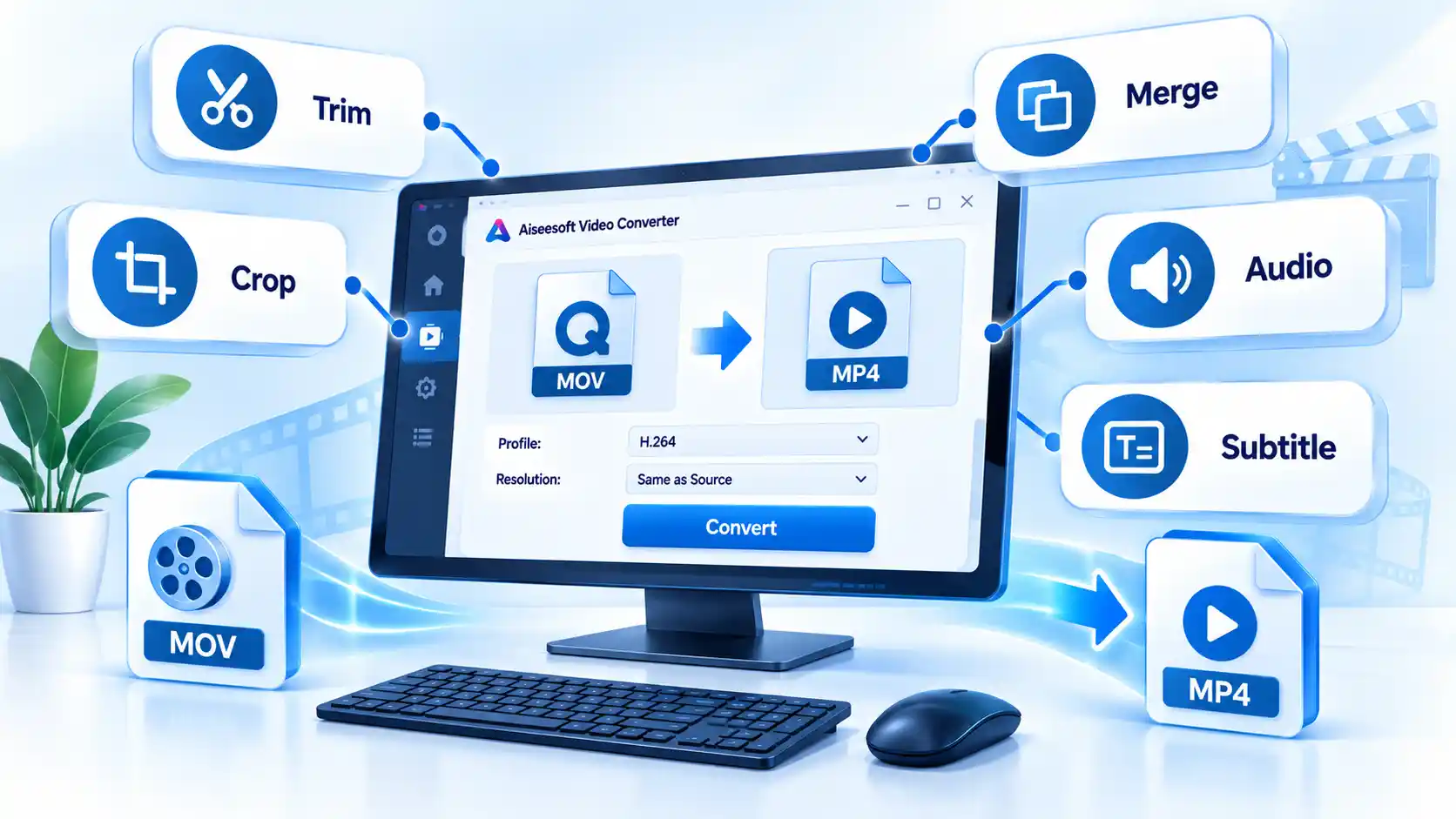
If edits are needed, Aiseesoft’s current converter documentation includes tools for trimming, cropping, rotating, filters, audio-track management, subtitles, compression, and other adjustments. Make these changes before the final conversion so you can inspect one finished output rather than creating several unnecessary generations.
If several clips are supposed to become one video, Aiseesoft also documents ways to merge MOV files. Confirm the clip order and final output settings before starting the combined export.
For readers working with a different source container, We also have a separate guide to convert 4K MKV to MP4 with WinX.
Operational Limits and Edge Cases
Aiseesoft can expose many combinations of container, codec, resolution, and bitrate, but a technically valid MP4 is not necessarily the best MP4 for every destination. A television, browser, messaging platform, editing application, or older phone may impose its own codec, profile, resolution, file-size, or audio restrictions.
High-efficiency codecs also introduce a compatibility trade-off. H.265/HEVC, for example, can be attractive when storage efficiency matters and the target environment supports it. H.264/AVC remains the more conservative choice when broad interoperability is the priority.
Professional camera MOV files require particular care. Some MOV files are editing masters that contain high-bitrate or production-oriented codecs. Converting one to a delivery-oriented MP4 can substantially reduce file size, but the MP4 should not automatically replace the original master if future editing, color work, archival use, or maximum source quality matters.
Batch conversion presents another edge case. Applying one MP4 profile to many MOV files is convenient, but the sources may not all have the same resolution, frame rate, orientation, audio layout, or intended destination. Inspect mixed batches before forcing them through one specification.
Key Takeaways
- The current Aiseesoft workflow uses Video Converter Ultimate, even though older pages and search queries may still refer to Aiseesoft MOV Converter.
- Choose MP4 under Output Format, then review the codec and profile instead of treating the file extension as the only setting that matters.
- Keep source resolution, frame rate, and similar properties unless you have a clear reason to change them.
- Use remuxing when the existing streams already satisfy the target MP4 requirements. Re-encode when you need to change the codec or encoded properties.
- Verify playback, duration, audio, dimensions, and required tracks before deleting the original MOV.
- For important recordings or editing masters, keep the MOV even after creating an MP4 delivery copy.
Frequently Asked Questions
Does converting MOV to MP4 always reduce video quality?
No. If compatible video and audio streams are remuxed into MP4 without re-encoding, the encoded media streams do not undergo another lossy encoding pass. If the video is transcoded, a new encoded stream is created, and the resulting quality depends on the codec and output settings.
Why is my converted MP4 larger than the original MOV?
The output may use a higher bitrate, different codec, larger resolution, different frame rate, or different audio settings. MOV and MP4 file extensions alone do not determine file size. Compare the source properties with the selected Aiseesoft profile before converting again.
Can Aiseesoft convert several MOV files to MP4 at once?
Yes. The current Video Converter Ultimate guide documents adding multiple files and either choosing formats individually or assigning one unified Output Format to the list. Check mixed-resolution or mixed-frame-rate batches before applying one profile to every file.
Should I use H.264 or H.265 for an MP4?
Choose based on the target. H.264/AVC is usually the more conservative option when broad device and browser compatibility matters. H.265/HEVC can provide better compression efficiency in compatible environments, but support is less uniform. Verify the requirements of the device or service that will receive the MP4.
Can I delete the MOV after converting it to MP4?
You can delete it if the MP4 has been fully verified and the MOV has no continuing archival or editing value. For camera originals, client masters, or important personal footage, keeping the source is safer because the converted MP4 may be a delivery copy rather than an equivalent replacement.

💬 Comments