You can stop qualifying unknown WhatsApp calls from ringing by turning on Silence Unknown Callers under WhatsApp’s Privacy settings. The feature silences those calls rather than universally blocking them, so use WhatsApp’s separate Block and Report controls for persistent or suspicious accounts.
What Silence Unknown Callers Actually Does
Silence Unknown Callers is primarily a screening control. WhatsApp allows unknown callers to call you by default, but when this feature is enabled, qualifying unknown calls do not ring normally. They still appear in your Calls list so you can review them later if the caller turns out to be legitimate. Meta’s explanation of Silence Unknown Callers confirms that silenced calls remain visible rather than being discarded.
This is different from blocking. According to WhatsApp’s blocking and reporting documentation, blocking a person stops you from receiving that person’s direct WhatsApp messages, calls, and future status updates. Reporting serves another purpose: it submits information to WhatsApp for review, but reporting someone without blocking them does not itself stop further contact.
Silence Unknown Callers does not create a universal firewall that prevents every unfamiliar account from attempting to call you. It primarily stops qualifying unknown calls from ringing. Block a repeat caller separately when you want that specific account to stop contacting you directly.
There is also a security reason for the feature’s design. Meta says WhatsApp uses a specialized protocol for delivering stripped-down notifications for silenced calls, reducing the amount of attacker-controlled call-setup data processed by the recipient’s device. Meta designed this approach to reduce the attack surface associated with unsolicited calls as well as the nuisance of unwanted ringing.
How to Stop Unknown WhatsApp Calls From Ringing
The main setting is available under WhatsApp’s Privacy controls on Android and iPhone. The important navigation path is Settings > Privacy > Calls > Silence Unknown Callers, although the control used to open Settings can vary slightly between app versions.
- Open WhatsApp Settings. On Android, open WhatsApp, tap the three-dot menu, and choose Settings. On iPhone, open WhatsApp and select Settings.
- Open Privacy. Select Privacy from WhatsApp’s Settings screen.
- Open Calls. In the Privacy settings, select Calls.
- Turn on Silence Unknown Callers. Enable Silence Unknown Callers. Calls that WhatsApp classifies as unknown should no longer ring normally, although you can still review them in the Calls list.
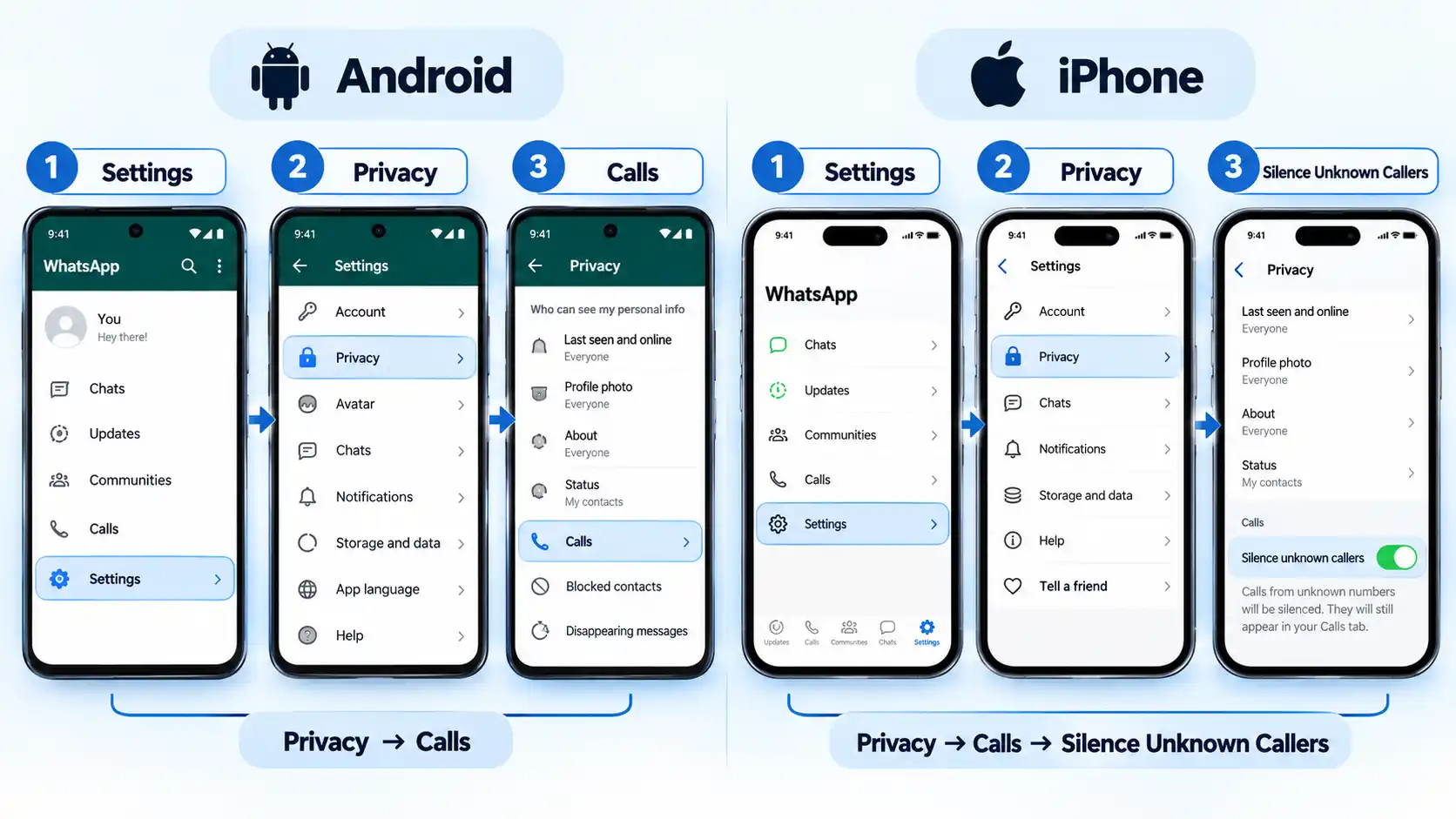
WhatsApp’s current privacy documentation confirms that unknown callers can call users by default and lists silencing unknown callers among its available privacy controls. WhatsApp’s privacy-settings documentation also places the feature alongside other controls for deciding how people can contact you.
Silence, Block, or Report: Which Control Should You Use?
These controls solve different problems. Silencing reduces interruptions from a category of callers, blocking stops direct contact from a particular account, and reporting sends information about problematic activity to WhatsApp for review.
| Action | Effect on calls | Other effect | Useful when |
|---|---|---|---|
| Silence Unknown Callers | Qualifying unknown calls do not ring normally but remain visible in the Calls list. | It does not permanently block a particular account. | You want fewer interruptions while retaining a record of unfamiliar calls. |
| Block | Direct WhatsApp calls from that account stop reaching you. | Direct messages and future status updates from that user also stop reaching you. Shared group conversations remain an exception. | A particular account repeatedly contacts you and you want direct contact to stop. |
| Report | Reporting alone does not stop future calls. | WhatsApp receives information about the reported activity for review. | The account appears to be sending spam, scams, abuse, or other problematic content. |
When you report a user in an individual chat, WhatsApp says it can receive up to five of that user’s most recent messages. If calls took place, WhatsApp may also receive basic information about up to five recent calls with that user, such as who initiated the call and how long it lasted. A report does not guarantee that the account will be banned.
How to Block and Report a Persistent WhatsApp Spam Caller
Use this procedure when the problem is one identifiable account rather than unknown callers in general. Blocking stops direct contact from that account, while reporting is appropriate when its activity appears problematic or abusive.
- Open the caller’s information. Open the chat or call entry associated with the number, then open the person’s contact or account information.
- Block the account. Choose WhatsApp’s Block option when you want to stop receiving direct messages, calls, and future status updates from that user.
- Report the account when appropriate. If the caller appears to be sending spam, attempting fraud, impersonating someone, or otherwise sending problematic content, use WhatsApp’s Report option as well. Reporting without blocking does not itself stop future contact.
Blocking does not delete the existing chat automatically. WhatsApp says you may leave the chat in your chat list, archive it, or delete it separately. A blocked person is not sent a notification telling them that you blocked them. People you block can still see your messages in a WhatsApp group you both participate in, and you can still see theirs.
What to Do if the WhatsApp Caller Looks Like a Scammer
An unfamiliar call is not automatically fraudulent, but become more cautious if the caller pressures you to reveal information, open a link, install software, send money, or provide an account code. WhatsApp’s guidance on suspicious messages and scams identifies requests for personal or financial information, suspicious links or app downloads, impersonation, investments, jobs, loans, and demands for money as warning signs.
- Do not share registration codes or passwords. WhatsApp says you should never give another person your six-digit registration code or two-step verification password.
- Do not give the caller bank information, card details, passwords, or other sensitive information. End the interaction and verify any claimed organization independently.
- Do not install an app or open a suspicious link because the caller tells you to. Open the legitimate service independently if you need to investigate an account warning.
- Verify claimed identities through a separate trusted channel. A familiar-looking name or number is not proof that the caller is who they claim to be.
- Block and report the account when appropriate. Blocking stops direct contact from the account, while reporting sends relevant information to WhatsApp for review.
If a caller claims to represent a company, bank, employer, family member, or another trusted party, end the suspicious interaction and verify the claim using contact information you already trust. The same principle applies when dealing safely with spoofed calls and emails: identity information shown on a screen should not replace independent verification.
Why “For Good” Does Not Mean Every Unknown Call Attempt Disappears
The most important limitation is that Silence Unknown Callers changes how qualifying incoming calls reach your attention. It does not establish that unfamiliar WhatsApp accounts have lost the ability to attempt contact altogether. Meta says silenced calls remain visible in the Calls list so you can review them later.
The practical approach is therefore layered. Turn on Silence Unknown Callers to remove ringing interruptions from qualifying unfamiliar callers, then block individual accounts that repeatedly contact you. Report accounts when their behavior warrants review.
Interaction history can matter too. Current 2026 procedural guidance reports that if you deliberately call or message a previously silenced number, later calls from that number may start ringing normally. WhatsApp’s current general privacy page does not spell it out, so it should be treated as current secondary procedural guidance rather than an explicit first-party rule.
That interaction history is one reason Silence Unknown Callers troubleshooting needs to distinguish an actual settings problem from a number WhatsApp may no longer classify as unknown.
Extra WhatsApp Privacy Settings That Help but Do Not Stop Spam Calls
Several other WhatsApp privacy and account-security features are useful, but they solve different problems. They should not be treated as substitutes for Silence Unknown Callers or blocking.
Privacy Checkup
WhatsApp’s Privacy Checkup brings several privacy controls into one guided process. Meta says selecting Start checkup from Privacy settings walks users through privacy layers covering messages, calls, and personal information.
Protect IP Address in Calls
For calls you actually answer or place, WhatsApp offers a separate privacy setting that can relay calls through WhatsApp servers so the other participant cannot directly see your Internet Protocol address. Meta says this helps prevent the other participant from using that address to infer information such as your general geographical location or internet provider. Meta’s engineering documentation says calls remain end-to-end encrypted when relayed through WhatsApp’s servers.
For calls you actually answer, WhatsApp’s Protect IP Address in Calls setting addresses call-metadata privacy rather than spam filtering.
Account Security and Two-Step Verification
Account-protection controls reduce the risk of somebody taking over your WhatsApp account, but they do not filter incoming spam calls. In August 2026, Meta announced a stronger two-step verification system based on a full password rather than the older six-digit PIN. WhatsApp’s current Help Center also notes that existing PIN users may still need to upgrade their verification method, so the migration can differ by account. WhatsApp’s current registration and two-step verification documentation also warns users never to share their registration code or password.
Meta’s August 2026 security update also says Android can show additional context for callers who are not saved in your contacts, including whether the number is registered in another country and whether you share any groups. Those details can help with evaluation, but they do not establish that a caller is trustworthy.
If your concern goes beyond nuisance calls, securing WhatsApp against account takeover requires controls such as two-step verification, passkeys, careful handling of registration codes, and regular review of account access.
Verify That Silence Unknown Callers Is Working
After changing the setting, verify the result rather than assuming it worked. If practical, use a trusted person whose number is not saved in your contacts and with whom you have not already interacted on WhatsApp. Do not test the feature by contacting an actual suspicious caller.
Verify the result
- Open WhatsApp > Privacy > Calls and confirm that Silence Unknown Callers is enabled.
- If practical, have a trusted person whose number is not saved in your contacts and who has not previously interacted with you on WhatsApp place a test call.
- Confirm that the test call does not produce the normal incoming-call ringing behavior.
- Open WhatsApp’s Calls list and confirm that the silenced call is still visible there.
If the test behaves as expected, the setting is reducing the main interruption while preserving a record of unfamiliar calls. If one particular account keeps contacting you, use WhatsApp’s individual Block control instead of relying only on unknown-caller silencing.

💬 Comments