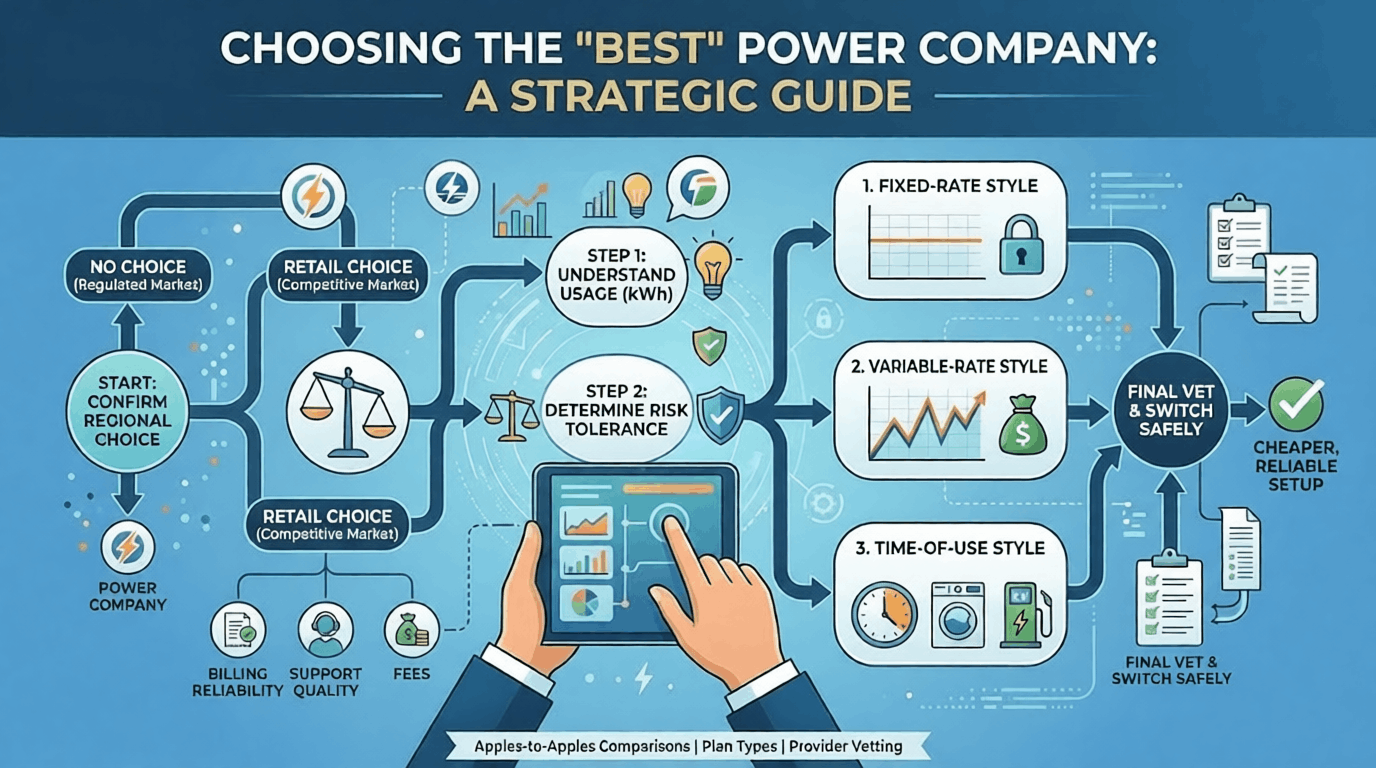
Choosing a “best” power company isn’t a universal answer—it depends on whether you can choose providers in your area, how you use electricity, and how much price risk you’re willing to take.
If you want a cheaper, more reliable setup, start by understanding your usage pattern and the plan structure you’re currently on, then compare power companies’ options using trusted tools for your region.
Quick take: what matters most
- First: Confirm what you can actually switch (provider vs plan vs nothing).
- Next: Use your real usage (kWh) and bill charges to compare offers apples-to-apples.
- Then: Pick a plan type (fixed, variable, time-of-use) that matches your risk tolerance.
- Finally: Vet the provider for billing accuracy, support quality, and fee “gotchas.”
Step 1: Check what “switching” means where you live
In some regions you can choose a retail electricity provider; in others you can’t choose the provider, but you may be able to choose between tariffs, payment options, or add-ons.
If you’re in Texas and your address is in an area open to competition, you can start comparisons through Texas’ Power to Choose plan comparison tool.
If you’re in New Zealand, a consumer-focused starting point is Powerswitch’s FAQs on comparing and switching.
If you’re unsure, search your latest bill for the utility/retailer name and look up your region’s regulator rules (for example, the Public Utility Commission of Texas (PUCT) or the Electricity Authority’s NZ switching guide (PDF)).
Step 2: Understand your current bill before you compare
A lot of “cheap plan” mistakes happen because people compare a headline rate, not the full bill math.
- Find your usage (usually shown in kWh). If you need a refresher on what that unit means, see EIA’s explanation of kWh.
- List fixed charges you pay regardless of usage (daily/monthly fees, metering fees, service charges).
- Write down your current unit rate(s), plus when they apply (any peak/off-peak pricing windows).
- Check whether your rate is fixed, variable, or time-based (and when it can change).
- Note your contract end date and any early-exit or move-out fees.
Practical tip: export 12 months of bills (or at least 3 summer + 3 winter months) so you don’t optimize for one season and lose money the rest of the year.
Step 3: Choose a plan type that matches your risk tolerance
Price isn’t the only variable—plan design changes your exposure to market swings, seasonal demand, and fees.
- Fixed-rate style plans: often easier for budgeting; watch contract length and exit fees.
- Variable-rate style plans: can be fine if you monitor pricing and can switch quickly; risk is bill volatility.
- Time-of-use plans: can be a win if you can shift load (laundry, dishwashers, EV charging) into cheaper hours; can be a loss if your usage is locked into peak windows.
When not to choose an “aggressive” plan: if you’re already stretched financially, a plan that can spike unexpectedly may create late fees, credit issues, or forced moves to worse default rates.
Step 4: Compare offers the right way (apples-to-apples)
Use your actual kWh usage, not a guess, and compare the total estimated monthly cost (unit rate + fixed charges + known add-ons).
- Compare at multiple usage levels (low/medium/high) because some plans look cheap only at one “sweet spot.”
- Check how long any introductory pricing lasts and what happens after it ends.
- Confirm payment method assumptions (autopay discounts, paper-bill fees, card processing fees).
- For NZ readers, Powerswitch’s switching walkthrough is a useful example of how comparison-to-switch flows typically work.
Step 5: Vet the provider (this is where “cheap” often fails)
Two plans with similar total cost can feel very different once billing, support, and problem-resolution are involved.
- Billing reliability: Does the company clearly explain how rates change and what triggers fees?
- Support reality check: Test their support before you sign (call/chat/email) and see if you can reach a human.
- Complaint patterns: Look for repeated issues (misbilling, unclear renewals, surprise fees), not one-off angry reviews.
- Outage expectations: Your retailer usually won’t change how often the local grid fails, but it can change how well billing and communication are handled during disruptions.
- Renewables claims: If “green power” matters to you, look for clear documentation of what “renewable” means in that plan (and what you’re actually paying for).
Step 6: Switch safely (avoid fees and surprises)
Switching is usually straightforward, but rules and timelines vary—so treat switching like a small project: confirm dates, confirm fees, and keep a paper trail.
- Before you enroll: Screenshot or save the plan page, the terms/fact sheet, and the advertised price structure.
- Confirm: start date, contract length, exit fees, and whether prices can change during the term.
- If you rent or may move soon: prioritize plans that won’t punish early exit (or align contract end with your likely move date).
- After you switch: check the first 1–2 bills carefully; most “bad switch” stories are really billing setup issues caught late.
Small business notes (SMBs): what to do differently
SMBs often have higher daytime usage, different cash-flow constraints, and less flexibility to shift load—so the “best plan” is usually the one that reduces downside risk while keeping costs predictable.
- Ask for usage data by hour/day if available; your peak windows may be driving most of the cost.
- Be cautious with teaser rates if you can’t monitor the account monthly.
- For multi-location businesses, standardize contract end dates so you can renegotiate as a batch.
- Build a policy: who approves plan changes, who checks bills, and what triggers a switch.
Decision tree: pick your next move
Do you have retail choice in your area? ├─ No → Optimize your current tariff + reduce usage + ask about billing options └─ Yes ├─ Need stable budgeting? → Prefer fixed-style plan, watch exit fees ├─ Can monitor monthly and switch fast? → Variable-style may be OK └─ Can shift usage to off-peak? → Consider time-of-use (verify windows)
Implementation checklist (copy/paste)
- Download 12 months of bills (or at least 6 spanning seasons).
- Write down: kWh, unit rate(s), fixed charges, and any credits/penalties.
- Decide your priority: lowest average cost vs predictability vs renewables.
- Compare total estimated monthly cost at 2–3 usage levels.
- Read fees: early exit, late pay, paper billing, payment method.
- Save plan documents before enrolling.
- Audit the first two bills after switching.
Troubleshooting (common problems)
- My first bill is higher than expected: Check whether a credit/discount requires autopay, whether fixed charges changed, and whether the plan uses tiered pricing.
- I’m being charged an exit fee: Look for the contract term and move-out clauses; if unclear, request a written explanation tied to the plan document you enrolled under.
- The rate changed unexpectedly: Verify whether you enrolled in a variable plan, whether an introductory rate ended, or whether time-of-use windows were misunderstood.
- I want to switch again immediately: Confirm whether a new switch triggers additional fees and whether you have a cooling-off period in your region.

💬 Comments