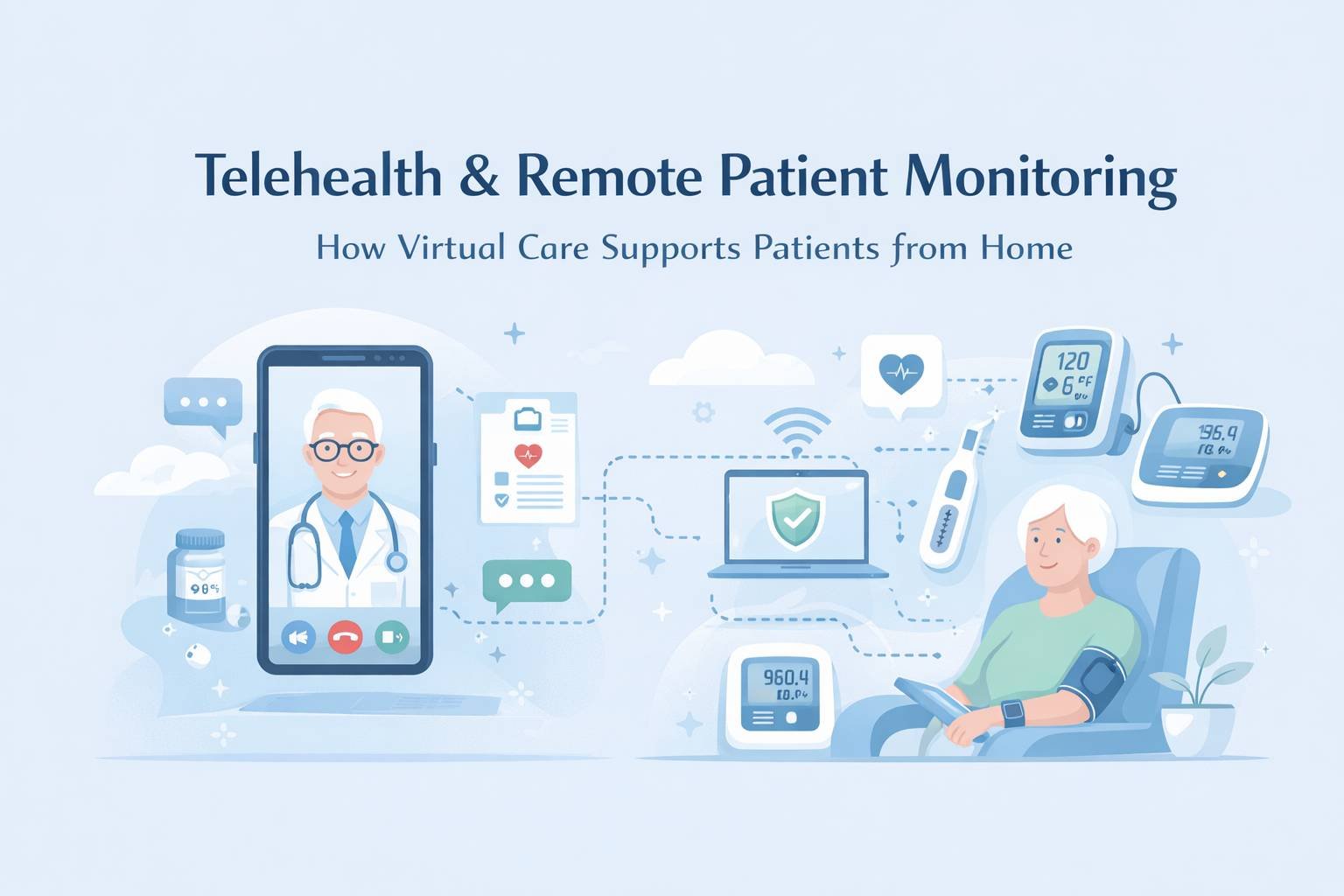
Telehealth and remote patient monitoring are no longer just emergency-era workarounds. They are now part of how many health systems deliver follow-up care, chronic-condition support, and routine check-ins for patients who need access without unnecessary travel.
If you have only seen older articles framed around lockdowns and crisis response, the bigger picture is simpler: telehealth helps people connect with clinicians from a distance through technology like telemedicine, while remote patient monitoring helps clinicians follow certain health data between visits.
Quick Take
- Telehealth is remote care delivered through phone, video, and other telecommunications tools.
- Remote patient monitoring uses connected devices to collect and send health data for review between appointments.
- These tools can be especially useful for older adults, patients with limited mobility, and people who live far from care.
- Remote care improves access, but it also introduces privacy, security, and connectivity considerations.
- The best setup is not “telehealth instead of in-person care.” It is a care model that uses each option where it fits best.
What Telehealth Means Today
According to HRSA’s definition of telehealth, telehealth includes long-distance clinical care, health-related education, health administration, and public health support delivered through telecommunications technologies.
In patient-facing terms, that usually means you can talk to a clinician by phone or video instead of traveling to the office for every interaction. As HHS explains in its telehealth patient guide, this can make it easier to connect with a provider without an in-person office visit.
What Remote Patient Monitoring Is
Remote patient monitoring, often shortened to RPM, is different from a standard virtual visit. Instead of focusing only on a live conversation, RPM uses connected devices to collect physiologic data that can be reviewed as part of ongoing care.
According to CMS guidance on remote patient monitoring, Medicare broadly covers RPM for internet-connected physiologic data in both chronic and acute conditions. That matters because it shows RPM is not limited to one specialty or one diagnosis.
Many care programs also refer to this model as Remote patient monitoring systems that combine connected devices with clinician review workflows.
Telehealth vs. RPM
| Feature | Telehealth | Remote Patient Monitoring |
|---|---|---|
| Primary purpose | Live communication with a clinician | Ongoing review of health data between visits |
| Main format | Phone, video, portal-based consultation | Internet-connected monitoring devices |
| Best fit | Follow-up, discussion, triage, routine care coordination | Conditions that benefit from repeat physiologic tracking |
| Patient role | Join the visit and discuss symptoms, questions, or next steps | Use the assigned device correctly and keep data flowing |
The easiest way to explain the difference is this: telehealth is the conversation, while RPM is the data stream. Many care programs now use both together rather than treating them as competing options.
Who Benefits Most from Remote Care
Remote care is especially valuable when access is the main barrier. The National Institute on Aging’s telehealth guide notes that telehealth may be particularly helpful for older adults with limited mobility and for people living in rural areas.
That same logic extends beyond age. Patients managing long travel times, repeated follow-ups, transportation limits, or frequent check-ins often benefit most when some parts of care can happen from home and only the necessary parts require an office visit.
Remote care can also support patients managing complex or less common illnesses. For example, individuals dealing with a rare cancer, mesothelioma patients sometimes rely on remote consultations to stay connected with specialists when travel to major treatment centers is difficult.
This is also where remote monitoring becomes more practical than many older explainers suggest. If a patient’s care plan depends on trend data rather than a one-time conversation, RPM may add more value than a standard video appointment alone.
Why This Matters in Rural and Underserved Areas
Distance changes what “accessible care” actually means. When specialist care or routine follow-up requires a long drive, time off work, caregiver coordination, or unreliable transport, even a short remote visit can remove more friction than people realize.
HRSA’s telehealth framework explicitly includes long-distance care support, and that is why the topic continues to matter in rural and underserved areas. For these patients, the main value is not novelty; it is keeping care reachable when geography gets in the way.
Privacy and Security Are Part of the Care Model
Remote care is convenient, but it is not risk-free. The HHS OCR privacy guidance for telehealth patients warns that video apps, websites, patient portals, and similar tools can create privacy and security risks for health information.
For patients, the practical takeaways are straightforward: use a private location when possible, avoid casual use of public Wi-Fi for sensitive visits, keep devices updated, and understand which app or portal the provider wants you to use. For providers and platform designers, trust depends on choosing secure systems and helping patients use them correctly.
What a Good Remote-Care Workflow Looks Like
- Confirm whether your provider offers telehealth, RPM, or both.
- Ask what problem the remote setup is meant to solve: routine follow-up, symptom review, chronic-condition tracking, post-discharge monitoring, or something else.
- If RPM is involved, ask which device is used, what data it collects, and how often someone reviews the readings.
- Clarify how you will communicate between appointments, whether through a portal, scheduled calls, or follow-up video visits.
- Review privacy expectations before the first visit, especially if you will be using a personal phone, tablet, or shared home connection.
- Know the escalation path so you understand when a remote interaction should turn into an in-person visit or urgent care evaluation.
Decision Guide
| If your main issue is… | The better fit is usually… | Why |
|---|---|---|
| Travel time and routine follow-up | Telehealth visit | A live remote appointment can remove unnecessary trips. |
| Ongoing physiologic tracking | RPM program | The care team may need repeated device-based data, not just a conversation. |
| Medication review and symptom discussion | Telehealth, with follow-up as needed | These interactions often begin with direct clinician communication. |
| Repeated monitoring between visits | Telehealth plus RPM | The visit explains the plan, and the monitoring supports it over time. |
Where Older Articles Still Go Wrong
Many older telehealth articles are still anchored to peak-pandemic messaging. That framing misses the more useful long-term reality: remote care is now part of mainstream access strategy, especially for patients who need continuity, convenience, or monitoring support rather than a one-time emergency workaround.
Older content also tends to overpromise the technology itself. Not every patient needs connected monitoring, not every condition fits a remote-first workflow, and not every provider runs RPM the same way. The better question is not whether remote care is “the future,” but whether it improves the specific care pathway in front of the patient.
Implementation Checklist
- Ask your provider which remote services they actually offer.
- Confirm whether your visit is phone, video, portal-based, or device-supported.
- Check your internet connection, device battery, camera, and microphone before the visit.
- Use a private space for sensitive conversations.
- Write down questions before the appointment so the visit stays focused.
- If RPM is part of your care plan, make sure you understand how and when readings are captured.
- Keep a backup plan in case the connection fails, such as a direct phone number or portal message option.
FAQ
Is telehealth the same as telemedicine?
Not exactly. Telehealth is the broader term, while telemedicine is often used more narrowly for clinical care delivered at a distance.
Is remote patient monitoring the same thing as a video appointment?
No. A video appointment is a live interaction, while RPM focuses on collecting and reviewing health data between visits.
Who benefits most from telehealth?
Patients with mobility limits, transportation barriers, rural access issues, or frequent follow-up needs often benefit the most.
Do patients need special equipment for RPM?
Sometimes. That depends on the condition being monitored and the device the care team uses.
Does telehealth replace in-person care?
No. It works best as part of a broader care pathway, not as a blanket replacement for every type of visit or test.
Why does privacy matter more in remote care?
Because telehealth relies on apps, networks, portals, and personal devices, all of which can affect how health information is accessed and protected.
Is RPM only for one type of disease?
No. CMS describes RPM broadly enough to include chronic and acute conditions when connected physiologic monitoring is appropriate.
What should patients ask before joining a remote-care program?
Ask what problem it solves, what technology is required, who reviews the data, how often follow-up happens, and when in-person care becomes necessary.
