A condensing steam turbine does not create energy, and its condenser does not save any. The machine converts the pressure energy in steam into shaft work, then hands the leftover low-grade heat to a separate surface condenser that rejects it. The cost saving comes from somewhere less glamorous: the electricity that work produces displaces power you would otherwise buy, and in a combined heat and power (CHP) or waste-heat-to-power setup, recovered heat displaces boiler fuel.
That distinction decides whether a condensing turbine is a good investment for your plant. With continuous steam demand and a use for recovered heat, the system-efficiency case is strong. Without either, the turbine is an expensive way to throw heat away.
Quick Take
Buy a condensing turbine when you already make steam and can consume the electricity on site. The economics live at the system level, in displaced grid power and displaced boiler fuel, and they only hold up when performance is pinned to a named ASME test code. The condenser is where the loss concentrates, so it is the component to instrument first.
What a Condensing Steam Turbine Actually Does
Strip away the marketing and a condensing turbine is a prime mover with one defining trait: it exhausts steam at low pressure into a condenser rather than into a process steam header. The EPA’s CHP technology overview describes a CHP system as a prime mover, generator, heat recovery, and electrical interconnection configured into an integrated whole, with the turbine serving as that prime mover.
The condenser is the part people gloss over. It is a distinct heat exchanger, not an accessory, and it carries its own performance test code. Steam leaves the turbine at low pressure, enters the surface condenser, gives up its latent heat to cooling water, and returns as liquid condensate. That heat leaves the system. The turbine’s job was to extract as much useful work as possible before that happened.
Info
A condensing turbine and a back-pressure turbine solve different problems. A condensing unit maximizes electricity output and rejects heat; a back-pressure unit prioritizes delivering steam to a process. Choosing between them is a heat-to-power ratio decision, not a preference.
Manufacturers build these machines across a wide range of sizes. Triveni Turbines, for example, describes its industrial steam turbine range as reaching up to 100 MWe with impulse and reaction series and API 611/612 compliance, a manufacturer’s self-description of its own product line, useful for understanding what’s on the market rather than as proof of superiority. You can review condensing steam turbines as one reference point when scoping a project.
Where the Energy Saving Actually Comes From
Here is the mechanism in plain terms. Steam enters the turbine at high pressure and expands through the stages, spinning a shaft connected to a generator. The expansion drops the steam to a low pressure, and the condenser finishes the job by condensing it so the cycle can repeat. The work extracted along the way is the product. The heat rejected at the end is the cost of doing business.
The saving shows up when you compare two ways of getting the same electricity and heat. Generating them separately, by buying grid power and firing a boiler, is inefficient at the system level. Generating them together recovers heat that would otherwise be wasted. The EPA’s CHP benefits page puts numbers on that gap.
| Configuration | Efficiency cited by EPA | What it means for the plant |
|---|---|---|
| Average U.S. fossil-fueled power plant | 36% (EPA) | Most of the input energy is discharged as heat |
| Separate heat and grid power | 50–55% fuel-efficient (EPA) | Baseline for comparison at a typical facility |
| CHP systems, typical | 65–80% total system efficiency (EPA) | Recovered heat lifts overall fuel use |
| CHP systems, best cases | Approaching 90% (EPA) | Not a guarantee, depends on technology and design |
| Steam-turbine CHP (prime mover) | 80% (EPA) | EPA’s cited figure for this prime-mover class |
Those figures are aggregate and national. They tell you the direction of the saving, not the size of yours. The broader push toward energy and sustainability initiatives is one reason facilities keep revisiting this calculus, but the engineering case has to stand on your own steam load and heat demand.
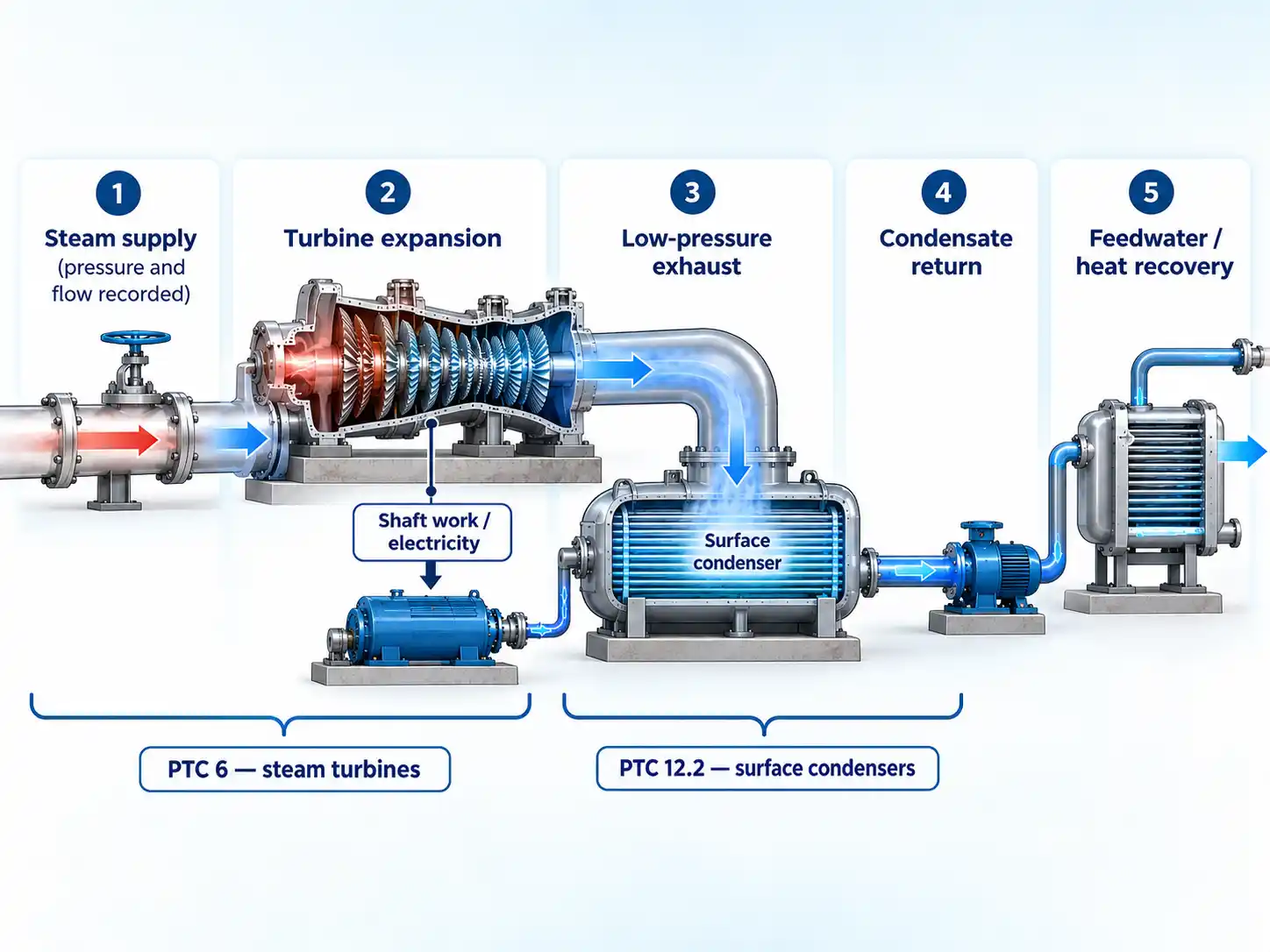
How a condensing turbine moves steam from supply to feedwater
The sequence below is the physical path steam takes through a condensing turbine system. Each step is also a measurement point, and the numbers you collect here are what a performance test evaluates.
- Supply steam to the turbine inlet Steam arrives from a boiler or heat-recovery source at a defined pressure and flow. Record inlet pressure and flow rate, since these are the inputs that define the turbine’s operating point.
- Expand the steam through the turbine stages The steam expands, dropping in pressure and temperature while transferring energy to the rotor. The shaft drives a generator, producing electricity. Shaft work or electrical output is the primary performance endpoint.
- Exhaust at low pressure to the surface condenser Spent steam leaves the turbine at low pressure and enters the condenser, where cooling water absorbs its latent heat and the steam condenses. Condenser performance is measured under its own test code, separate from the turbine test.
- Return condensate to the feedwater system The condensed liquid is collected and pumped back toward the boiler or heat-recovery loop. Condensate quality and return rate affect the whole cycle, not just the turbine.
- Recover heat where the system allows In a CHP or waste-heat-to-power arrangement, heat is captured for a useful thermal load rather than rejected entirely. This is the step that turns a power-only machine into a system-efficiency story.
Inputs, Outputs, and the Heat That Leaves
Every condensing turbine system has a small set of inputs and outputs, and the one people forget is the heat that leaves. Mapping them makes the economics legible.
| Direction | Item | What it represents |
|---|---|---|
| Input | Steam at pressure and flow | The energy carrier entering the turbine |
| Input | Fuel or heat source | What produced the steam upstream |
| Output | Shaft work / electricity | The useful product that displaces purchased power |
| Output | Condenser heat rejection | Low-grade heat transferred to cooling water and lost to the system |
| Output | Condensate | Liquid returned to the feedwater loop |
| Output (conditional) | Recovered useful heat | Present only where the system is designed to capture it |
The heat rejection line is not a defect. It is the physics of a condensing cycle. The question is whether that heat is captured elsewhere for a useful load or simply discharged.
The Standards That Govern the Numbers
Vendor efficiency badges are close to meaningless without a defined test method. This is where the ASME Performance Test Code family earns its place: it gives both the manufacturer and the plant owner a common reference so a performance claim can be checked rather than taken on faith. ASME states that its performance test codes provide a “level playing field” for manufacturers and users, representing the highest accuracy based on current engineering knowledge.
| Code | Scope | When it applies |
|---|---|---|
| PTC 6 | Steam Turbines | Formal performance testing of the turbine itself |
| PTC 6S | Procedures for Routine Performance Test of Steam Turbines | Periodic checks without a full formal test |
| PTC 6.2 | Steam Turbines in Combined Cycles | Where the turbine sits inside a combined-cycle plant |
| PTC 12.2 | Steam Surface Condensers | Testing the condenser as its own component |
| PTC 46 | Overall Plant Performance | Evaluating the whole plant rather than one machine |
| PTC PM | Performance Monitoring Guidelines for Power Plants | Ongoing monitoring between formal tests |
These codes are voluntary performance-test standards. They establish how to measure and compare performance; they do not certify that equipment is safe to operate. Site safety procedures and applicable regulations cover that separately.
Where Performance Claims Break Down
Most disappointing turbine economics trace back to a handful of recurring problems. The PTC 6A guidance on measurement uncertainty exists because measurement itself is a source of error, and the codes weigh accuracy against test cost and the value of the information obtained.
The turbine meets its rated output on paper but underperforms in service
Check whether the original claim was tied to a defined test code and a defined operating point. A performance figure without a test method is not comparable to anything. Re-establish the baseline with a PTC 6 test or a PTC 6S routine test before assuming the machine has degraded.
Electricity output looks fine but the system saving never materializes
Look at the condenser and the heat-recovery path. If condenser performance has drifted, the turbine is working against a worse vacuum than it was designed for. PTC 12.2 gives you the framework to test the condenser as a separate component rather than blaming the turbine.
Two tests of the same machine give different results
This is a measurement-uncertainty problem, not necessarily a hardware problem. PTC 6A addresses how uncertainty is evaluated so that a difference between tests can be judged against the measurement tolerance rather than treated as a real change in performance.
The savings case was built on a single spot measurement
A spot reading is not a performance test. Use PTC PM for ongoing monitoring and reserve formal testing for contractual or acceptance milestones. The value of a precise test has to be weighed against its cost.
Warning
Do not treat a single measurement as proof of performance. ASME’s own guidance recognizes that test accuracy is balanced against test cost and the value of the information, so a cheap test that cannot resolve the difference you care about is not a bargain.
The Trade-offs You Are Actually Trading
Every condensing turbine decision is a trade. The useful skill is knowing which trade you are making and whether the numbers justify it.
| Trade-off | One side | Other side | How to decide |
|---|---|---|---|
| System efficiency vs. heat rejection | Higher total system efficiency through CHP or waste-heat recovery | Condenser still rejects low-grade heat | Confirm a real use for recovered heat before committing |
| Test precision vs. test cost | Formal PTC 6 test gives defensible numbers | Higher cost and disruption | Reserve formal tests for acceptance and contractual milestones |
| Routine checks vs. full tests | PTC 6S routine tests are cheaper and more frequent | Less precision than a full test | Use routine tests to trend, full tests to settle disputes |
| Electricity output vs. process steam | Condensing maximizes power | Back-pressure delivers steam to process | Match the machine to your heat-to-power ratio |
Success
Decision rule: pursue a condensing turbine when you have continuous steam generation, a genuine on-site use for the electricity, and either a use for recovered heat or a clear reason to reject it. Walk away when any of those three is missing.
The Cost Logic, and What It Does Not Promise
The cost case rests on two avoided expenses. First, electricity the turbine generates displaces power you would otherwise purchase from the grid. Second, in a CHP or waste-heat-to-power configuration, recovered heat displaces fuel you would otherwise burn in a boiler.
The EPA’s efficiency comparison is the honest frame: separate heat and grid power sits at 50–55% fuel-efficient, while CHP systems typically reach 65–80% total system efficiency, with some approaching 90%.
What that does not give you is a dollar figure. The published evidence establishes efficiency ranges and the mechanism behind them. It does not establish payback periods, savings per kilowatt-hour, or return on investment for your facility. Those depend on your fuel price, your electricity tariff, your load profile, and your capital cost, all of which are specific to you.
Danger
Treat any “up to X% savings” claim without a defined test code and a defined operating point as unverified. Efficiency percentages describe system performance under stated conditions; they are not a savings guarantee.
Who Owns the Outcome
Responsibility for whether a condensing turbine delivers is split across several parties, and knowing who owns what prevents finger-pointing later.
- Plant owner and operator — owns the operating envelope, the steam load, the heat demand, and the decision to test. Performance governance sits here.
- Original equipment manufacturer — owns the machine specification and the performance it commits to, ideally against a named test code.
- EPC contractor or project management consultant — owns integration of the turbine, condenser, and balance of plant into a working system.
- Service providers — own maintenance, refurbishment, and lifecycle support, which determine whether the original performance holds over time.
- Third-party test engineers — own the measurement under the applicable ASME PTC, and therefore the credibility of any performance claim.
Manufacturers position themselves across these roles differently. Triveni, for instance, describes aftermarket and refurbishment services across the full lifecycle of the steam turbine generator, alongside its new-equipment range, a useful reminder that the machine’s performance story continues long after commissioning.
The Bottom Line
A condensing steam turbine is a sound investment under specific conditions: you already make steam, you can use the electricity on site, and you either recover the rejected heat or have a clear reason not to. Under those conditions, the system-efficiency argument is real and the EPA’s figures give it a defensible shape. Outside them, you are paying for a machine that turns fuel into work and then throws the rest away.
The discipline that separates a good project from a disappointing one is measurement. Insist on a named ASME PTC for any performance commitment, test the condenser as its own component, and treat uncertainty as a number to be managed rather than a nuisance to be ignored. If you are weighing a capital decision, take it to a qualified engineer and a formal PTC-based test, not to an article, including this one.

💬 Comments