Data and technology are changing education by making learning activity easier to measure, expanding access beyond the classroom, shortening some feedback cycles, and giving teachers and students new forms of digital and AI-assisted support. The technology itself does not guarantee better learning; results depend on teaching quality, human judgment, access, privacy, system design, and how the tools are actually used.
The most important shift is therefore not simply from books to screens. It is from isolated digital tools toward connected education systems in which learning activity can produce useful information, that information can inform a decision, and the decision can lead to different teaching, feedback, or support.
The Bigger Shift: From Digital Tools to Data-Informed Education
A digital classroom is not automatically a data-informed classroom. Uploading a worksheet to a learning platform changes the delivery method, but it does not necessarily change how teaching decisions are made. A deeper transformation happens when information produced during learning helps a teacher, student, or education system decide what should happen next.
Educational data can include assessment results, assignment completion, attendance, learning-platform activity, course progress, or other information generated as students interact with school systems. A learning management system, usually shortened to LMS, is software used to distribute materials, collect work, manage courses, and often track learning activity. A student information system, or SIS, usually manages institutional records such as enrollment, grades, attendance, and student details.
Learning analytics is the process of examining learning-related data to understand activity, progress, or potential problems. The useful part is not the dashboard itself. The useful part is the decision that follows from it.
For example, imagine that several students answer the same algebra question incorrectly. A digital assessment may reveal the pattern quickly. The teacher can then examine whether the class misunderstood the underlying concept, whether the wording of the question caused confusion, or whether a smaller group needs additional practice. The data provides a signal, but the teacher still interprets that signal.
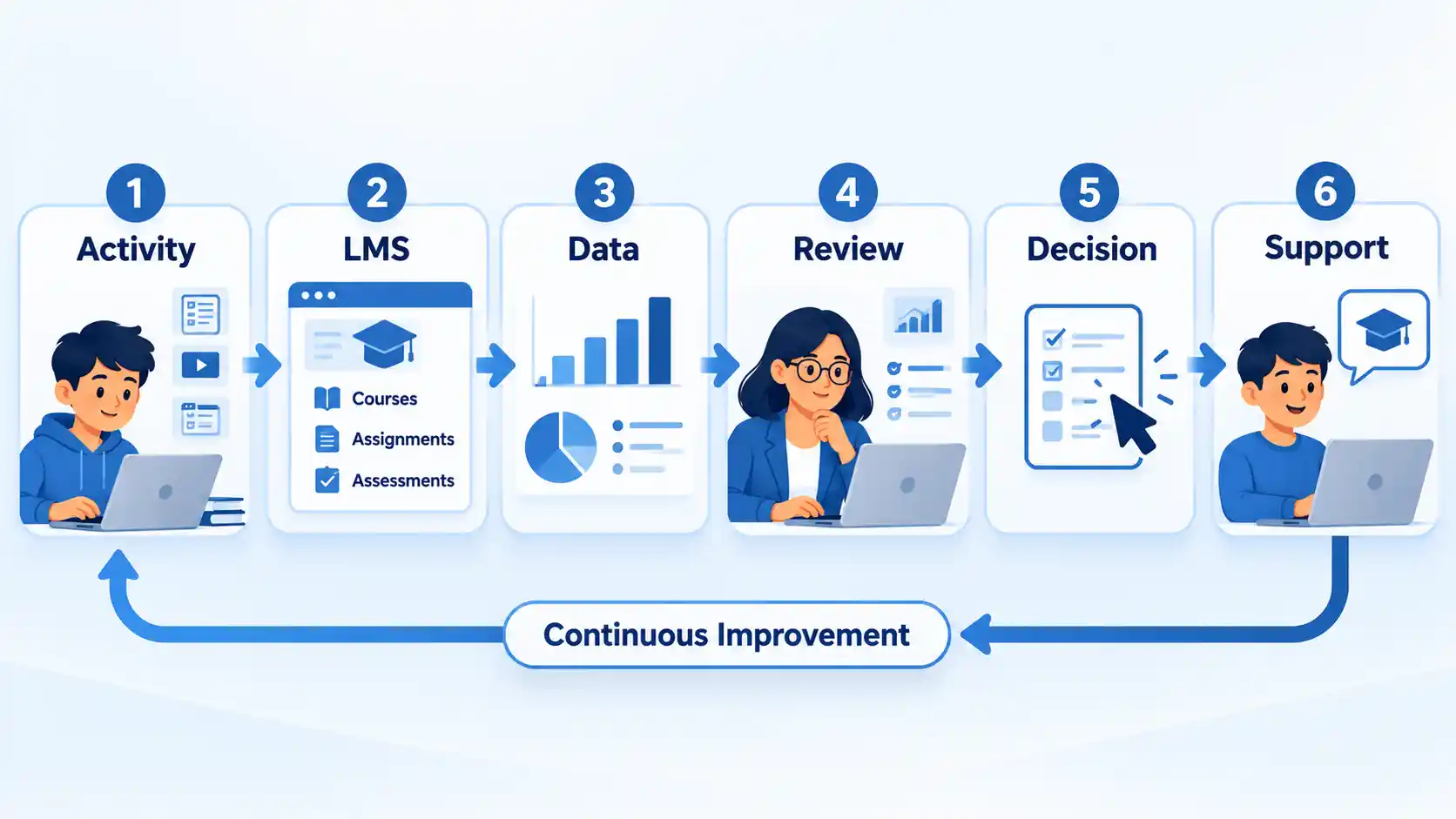
This is why interoperability matters. Interoperability means that different systems can exchange and use information without unnecessary manual re-entry. The OECD’s digital education research describes interoperability as important for linking otherwise disconnected education data and making it more useful for teaching, administration, and decision-making.
More data can also create more work. If teachers must repeatedly export spreadsheets, reconcile inconsistent records, or check several dashboards to answer one question, technology can add administrative friction instead of reducing it. The practical goal is therefore not maximum data collection. It is collecting useful information and making it available to the people who can act on it.
How Technology Is Changing the Learning Experience
Personalization and adaptive support
Technology can make it easier to give different learners different practice, pacing, explanations, or recommendations. Adaptive learning systems are designed to change what a learner sees based on previous responses or performance.
A mathematics platform, for example, might give one student additional fraction practice after repeated errors while moving another student to a more difficult problem set. That is different from giving every learner the same sequence regardless of what they understand.
Personalization should not be confused with guaranteed improvement. A system can personalize the wrong material, respond to incomplete data, or optimize for a metric that does not reflect genuine understanding. Teachers still need to know why a recommendation was made and whether it makes sense in the context of the learner.
It also helps to distinguish adaptive learning from generative AI tutoring because they personalize support in different ways. Adaptive systems often choose among predefined activities or pathways, while generative AI can produce new explanations, examples, questions, and dialogue in response to a student’s request.
Faster feedback and formative assessment
Digital systems can shorten the time between a student’s action and the feedback that follows. This is especially useful for formative assessment, which means assessment used during learning to identify what a learner understands and what still needs attention.
A short online quiz can show a student which answers were incorrect immediately and can show a teacher whether the same misconception appears across the class. That creates an opportunity to adjust the next lesson before the misunderstanding becomes harder to correct.
Speed alone does not make feedback good. Automated feedback may be generic, inaccurate, or focused on surface features while missing the reason a learner made an error. Effective feedback still needs to match the learning objective and give the learner enough information to improve.
Learning beyond one room and one schedule
Technology also changes where learning can happen. Course platforms, recorded lessons, shared documents, discussion tools, digital libraries, and asynchronous activities allow learners to access material without being in the same place at the same time.
This is one reason online learning platforms have become important parts of education and professional development. They can organize lessons, assessments, communication, and progress tracking within one digital environment.
Flexibility does not automatically equal accessibility. A learner still needs an appropriate device, reliable connectivity, usable software, accessible content, and enough digital skill to participate. Technology can remove a geographic barrier while creating a new technical or financial one.
What Generative AI Changes, and What It Does Not
Generative artificial intelligence adds something different to education because it can produce new text, explanations, examples, questions, summaries, code, images, and conversational responses rather than simply retrieving a fixed item from a database.
AI as a tutor, assistant, and teaching aid
A student can ask an AI system to explain a concept in simpler language, generate another practice question, compare two ideas, or provide feedback on a draft. A teacher can use similar technology to brainstorm examples, create first-pass lesson materials, adapt explanations for different reading levels, or reduce some repetitive administrative work.
The educational value depends heavily on how the system is designed and used. A general-purpose chatbot that simply provides an answer creates a different learning experience from a tutoring system designed to ask questions, provide hints, check understanding, and encourage the learner to attempt the problem.
The OECD Digital Education Outlook 2026 reports emerging evidence that general-purpose generative AI can improve performance on a task without necessarily producing corresponding learning gains. It also finds more promising results when AI is used with deliberate pedagogical goals.
Better output is not automatically better learning
Consider a student who asks an AI system to write a strong explanation of photosynthesis and then submits the generated response. The final answer may be accurate and well written, but it tells the teacher very little about whether the student can explain photosynthesis independently.
Now consider a different workflow. The student first writes an explanation, asks the AI to identify unclear reasoning without rewriting the answer, revises the work, and then explains the concept aloud or applies it to a new problem. AI is still involved, but the learner is doing more of the thinking.
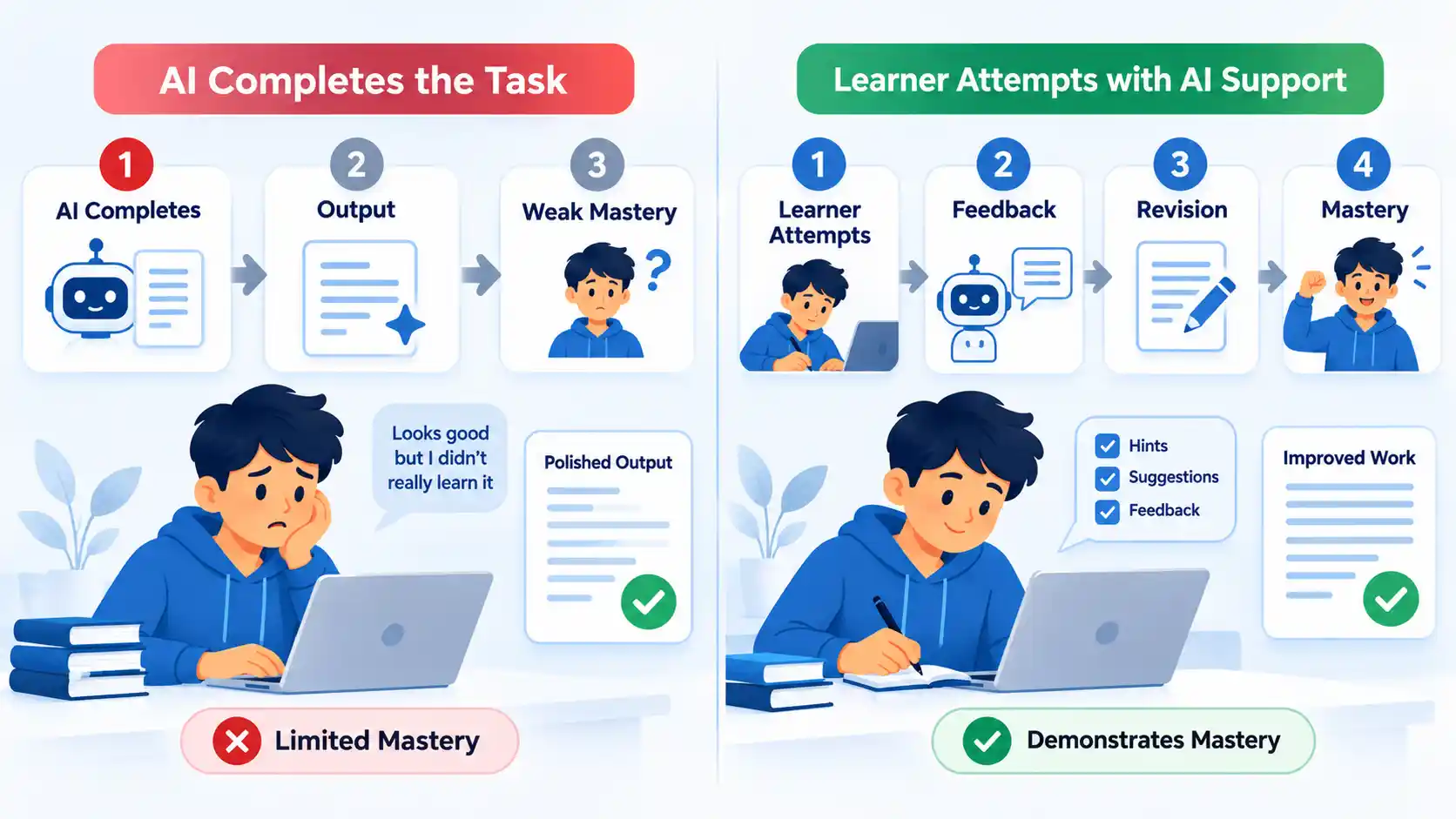
This difference is sometimes described as cognitive offloading: shifting part of the thinking or memory work to an external tool. Offloading is not always harmful. Calculators, search engines, spell-checkers, and reference materials already reduce certain mental tasks. The educational question is whether the tool removes work that is irrelevant to the learning goal or removes the exact thinking the learner is supposed to practise.
Generative AI can also produce inaccurate or unsupported answers. UNESCO’s guidance on generative AI in education stresses the need for human-centered validation, privacy protection, and appropriate pedagogical design. Students and teachers should therefore verify important claims rather than treating fluent language as proof of accuracy.
How the Teacher’s Role Changes
Data and AI can automate parts of education, but they also make teacher judgment important. A system can identify a pattern; it cannot automatically know every reason behind that pattern.
Suppose an analytics tool flags a student as needing support because several assignments are missing. The signal may be useful, but the cause could be poor understanding, illness, connectivity problems, an inaccessible platform, or simply incorrect records. Human review changes what the appropriate response should be.
This is a human-in-the-loop approach: software supports a decision, but a person remains responsible for interpreting the evidence and acting on it.
Teachers also need new competencies. UNESCO’s AI competency framework for teachers identifies 15 competencies across five dimensions: human-centered mindset, ethics of AI, AI foundations and applications, AI pedagogy, and AI for professional learning. Those skills matter because teachers increasingly need to judge when AI is useful, when its output needs verification, and when an activity should be completed without AI assistance.
That makes AI literacy for students and teachers a practical part of using these systems well, not an optional extra.
The Risks That Grow With Data-Driven Education
Privacy and security
The more an educational system knows about learners, the more carefully that information needs to be governed. Depending on the platform, student data can include names, contact details, enrollment records, grades, attendance, uploaded work, activity logs, device information, or patterns of interaction with the service.
A useful privacy review starts with simple questions: What information is being collected? Why is it necessary? Who can access it? Is it shared with another company? How long is it retained? Can unnecessary information be deleted? What happens if an account or system is compromised?
These are operational questions, not abstract concerns. In a U.S. enforcement action involving education technology company Chegg, the Federal Trade Commission required security and data-management changes after alleging that security failures exposed sensitive personal information. The case is a U.S. example rather than a universal legal standard, but it illustrates why education platforms holding sensitive information need meaningful security controls.
A useful procurement process therefore needs a clear way to evaluate student data privacy in EdTech before a platform is adopted.
Bias and high-stakes automated decisions
Not every educational recommendation has the same consequence. Software suggesting another practice exercise is very different from software influencing admissions, placement, evaluation, or access to an educational opportunity.
That distinction matters because errors and bias become more serious as the consequence of the decision increases. In the European Union, official AI Act guidance identifies specified educational AI uses as high-risk, including certain systems used for access or admission and systems used to evaluate learning outcomes. It also identifies educational uses that fall outside those categories or can qualify for exceptions. This is an EU regulatory example, not a statement that every education AI tool is legally high-risk everywhere.
Even when no high-risk legal classification applies, institutions still need to ask whether an automated system is reliable, whether its errors affect some groups more than others, whether people can understand the basis for important outputs, and whether meaningful human review is available.
Equity and accessibility
Technology can widen access. A learner who cannot travel to a campus may be able to join remotely. Captioning, text-to-speech, speech recognition, adjustable text, translation tools, and other assistive features can also make some content usable in ways that fixed-format material cannot.
The same system can create exclusion when it assumes fast broadband, a modern laptop, continuous electricity, a particular language, strong digital literacy, or an interface that does not work properly with assistive technology. The OECD’s 2026 guidance calls for equitable digital infrastructure and support, including devices, connectivity, digital resources, and professional learning opportunities.
The practical test is therefore not whether a resource is online. It is whether the intended learners can actually use it.
Academic integrity and outsourced work
Generative AI has made academic-integrity debates more visible, but outsourcing academic work existed long before AI. The central assessment question is whether submitted work genuinely demonstrates the student’s own knowledge, reasoning, or skill.
Institutions may therefore need policies that address both AI-generated submissions and work obtained through commercial research-paper services. Rules differ between institutions and jurisdictions, so students should follow the academic-integrity requirements that apply to their course rather than assuming that every form of outside assistance is treated the same way.
A useful policy should distinguish legitimate support, such as tutoring, proofreading, accessibility assistance, or permitted AI feedback, from having another person or system perform assessed work that the learner is expected to complete independently.
What the Future of Education Is Likely to Look Like
The future of education is unlikely to be defined by one device or one AI system. A more defensible direction is continued use of digital learning environments, increasingly capable AI-assisted tools, human teaching, and stronger attention to how education data and automated decisions are governed.
Interoperability is likely to remain an important institutional goal because disconnected information systems limit how quickly education data can be combined and used. OECD research on digital education describes interoperability standards as a way for separate systems to exchange and reuse information without requiring every function to be placed inside one platform.
Assessment is also under pressure to evolve. The OECD’s 2026 analysis of generative AI and learning warns against confusing AI-assisted performance with genuine competence. When software can produce a polished final product with little learner effort, the finished product alone provides weaker evidence of what the learner understands.
That gives schools a reason to place more emphasis, where appropriate, on evidence such as drafts, oral explanation, supervised work, application to unfamiliar problems, or the reasoning process behind an answer. The right assessment method still depends on the subject, learner, learning objective, and stakes involved.
A digitally supported lesson might combine teacher explanation, independent student work, adaptive practice, AI-generated hints, a short formative assessment, and teacher review of the resulting evidence. None of those elements needs to replace the others.
UNESCO’s Global Education Monitoring Report on technology in education argues that learners’ interests should remain central and that digital technologies should support education based on human interaction rather than aim to substitute for it. That provides a useful test for adoption: start with the educational need, then ask whether a technology actually helps address it.
What Matters More Than the Technology Itself
Data and technology are changing education most meaningfully when they improve the connection between what learners do, what teachers can understand, and what happens next. Better-designed systems can make feedback faster, extend access, support differentiated learning, reduce some routine work, and provide new ways to practise or explain difficult ideas.
They can also create privacy risks, inaccessible learning environments, biased decisions, misleading analytics, and opportunities to outsource the thinking that education is supposed to develop.
The important question is therefore not how much technology a school, university, teacher, or student uses. It is whether that technology helps people learn, teach, assess, and make decisions better while preserving human judgment, learner agency, privacy, accessibility, and evidence of genuine understanding.
“`

💬 Comments