No agency model wins on principle. A full-service firm and a specialist are both better positioned to protect your budget when you keep practical control of the ad accounts, name the person doing the daily work, and measure cost per qualified lead instead of click counts.
Choosing the model is the easy part. The money is saved in verification: what scope you buy, who holds the platform accounts, what the report actually counts, and how you leave if the work stalls. This article runs both models across the same criteria, then hands you an ordered hiring process that lets you walk away cheaply at any stage.
Quick Take
- Choose full service when you need several channels run together and nobody inside your business can coordinate them.
- Choose a specialist when the need is narrow and someone on your side can integrate the output with the rest of your marketing.
- Before signing either model, get the day-to-day manager named in writing, hold admin control of your ad, analytics, and business-portfolio assets, and negotiate trial and exit terms.
How the Two Models Compare on the Same Criteria
Run both models through the same seven criteria and the decision usually makes itself. Full service wins where coordination is the constraint. A specialist wins where depth inside a narrow scope is the constraint.
| Criterion | Full-service agency | Specialist agency |
|---|---|---|
| Scope | Several channels or workstreams run by one team, such as search, paid social, content, and site conversion work | A narrower slice: one channel, one creative discipline, or one market |
| Coordination load for you | Lower week to week, because one account lead assembles the work | Higher, because you sequence the specialist alongside other vendors |
| Internal capacity needed | Light: someone to approve priorities and budgets | Real: someone to brief, integrate, and own the surrounding channels |
| Speed to first output | Slower start while several workstreams are onboarded | Faster start inside the narrow scope |
| Budget risk | Bundled fees hide scope creep; ask for line-item scope | Fees map more cleanly to a defined deliverable; integration gaps cost you elsewhere |
| Reporting | Consolidated, but easy to blur which channel produced which result | Sharper inside its scope, with blind spots outside it |
| Exit flexibility | More dependencies to unwind at handover | Fewer dependencies and a cleaner handover |
Channel mix keeps widening, which is why a proposal has to state what it will run and how it will be measured. In HubSpot’s 2026 State of Marketing Report, marketers still rank website, blog, and SEO as their top ROI channel, with paid social close behind, and a meaningful share reported decreased search traffic as consumers turn to AI tools (HubSpot marketing statistics). An agency that cannot name the channels it will manage, and the metric it will move in each, has not priced the work yet.
Where the Two Models Really Diverge
Coordination has to live somewhere
Every marketing programme has glue work: aligning a paid search brief with a landing page, deciding which channel gets credit, keeping a content calendar from colliding with a product launch. Full service folds that glue into one retainer. You pay for it whether or not your channels need to talk to each other, and small budgets can spend a lot of money on internal coordination.
If coordination is the bottleneck in your business, a digital marketing agency such as 42connect is one place to start the comparison. Test it against the checklist below and confirm whether its model, current services, team structure, and terms match the full-service criteria before you rely on any of it.
Depth pays only inside its scope
A specialist earns the fee by going deeper in one area: creative craft, a single paid channel, a local market, or a brand system. That depth shows up quickly inside the lane. The integration work sitting outside the lane stays with you, and it is easy to underestimate.
If a narrow gap is the real problem, a Gilbert digital marketing agency such as Creatitive is one starting point for that conversation. Verify the current service scope, who does the day-to-day work, and the contract terms yourself.
Bundled fees make scope creep quiet
Full-service retainers can absorb extra requests without a visible price change, which feels generous until the two channels you care about start slipping. Ask for a scope table that lists every workstream, the hours attached to it, and the rate for work outside it. A specialist has less to bundle, so the fee conversation is usually shorter.
The Budget-Protecting Hiring Checklist
Work these six steps in order. Each one is cheap to abandon and expensive to skip, which is why the sequence matters more than the speed.
- Write the outcome, the ceiling, and the baseline first.Put one sentence on paper describing the business result, a budget ceiling covering fees and media together, and the numbers you will be measured against: leads per month, cost per lead, close rate, and average deal value.
Skip the baseline and every proposal looks impressive. Also check whether a percentage-of-spend fee still makes sense when your media budget is small, because the same percentage behaves very differently at scale.
You are ready when you can state the 90-day success condition in one line with today’s number beside it.
- Decide the model, then shortlist three agencies.Choose full service or specialist before you look at a single pitch deck. Shortlisting first is how buyers end up comparing a specialist’s craft against a full-service bundle and paying for neither properly.
Ask each shortlisted agency for two references from comparable clients, and ask which model those clients bought.
You are ready when all three can describe a comparable client without prompting.
- Run one discovery call against a fixed question set.Use the same six questions with every agency and record the answers side by side: client retention over a stated period with a stated denominator, reporting frequency, scope-change fees, account access, named delivery staff, and reference contacts.
Ask them in these words so the answers stay comparable:
“How many clients did you have at the start of the period you measure retention over, and how many are still with you today?” “Can you send a sample report from a comparable client that shows lead-quality numbers, not just spend and clicks?” “What exactly triggers an out-of-scope fee, and what hourly rate applies?” “Who will be named as my day-to-day account manager, and how many other accounts do they carry?” “Who holds admin access on my ad, analytics, and business-portfolio assets, and how do I remove it?” “Which two clients can I call who worked with this exact team recently?”
Vague answers are information. “We keep most clients” is not a retention figure. “We report on a regular schedule, and here is a recent sample” is.
You are ready when every shortlisted agency has answered all six in writing.
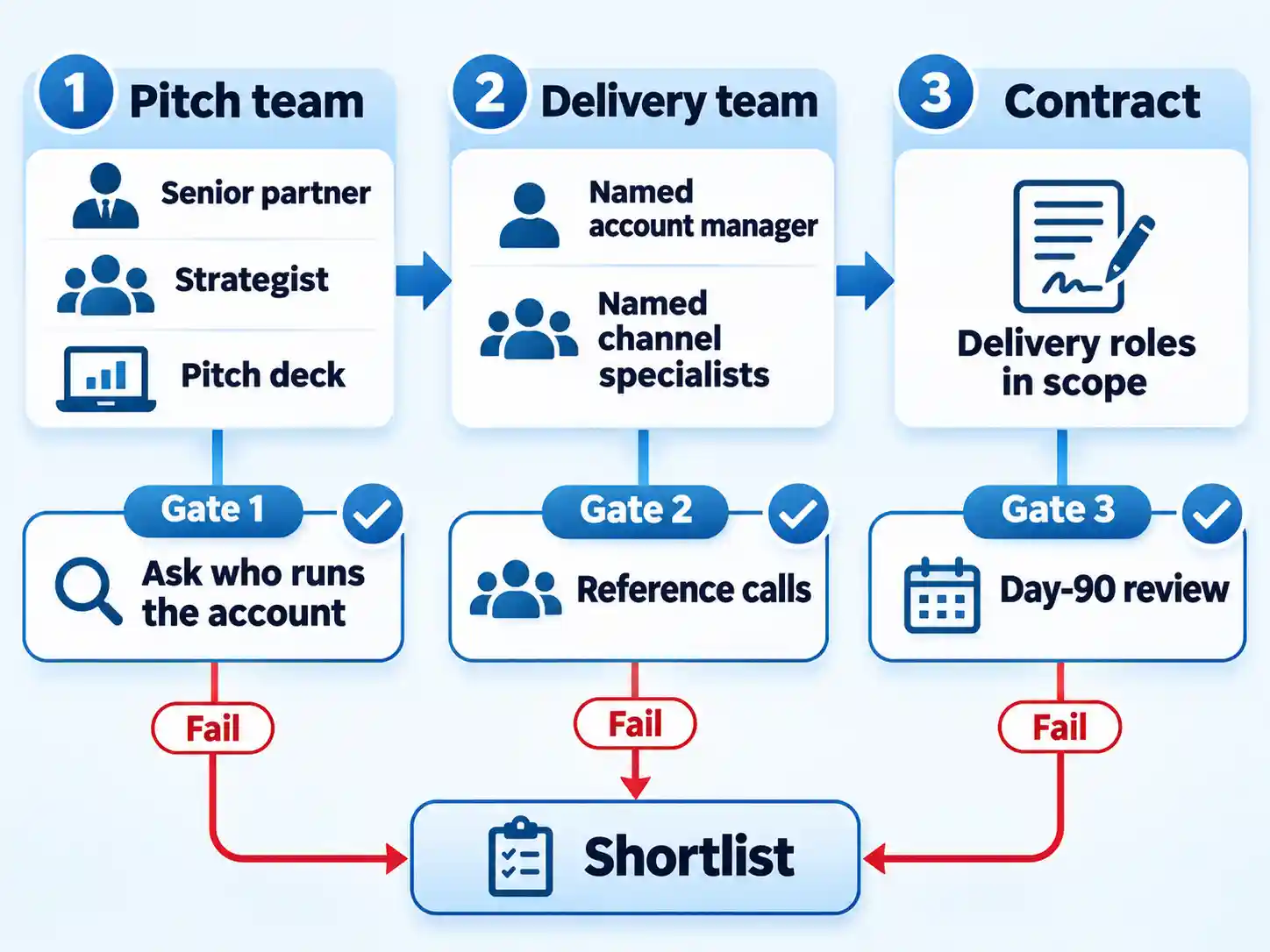
- Meet the day-to-day account manager before signing.Ask for the name, title, and current account load of the person who will run your account each week, then put that person on a call.
The pitch team sold the work and the delivery team performs it. If the named manager cannot attend the call, you have learned something useful about the working relationship you are buying.
You are ready when delivery roles appear in the scope of work, not just in the meeting notes.
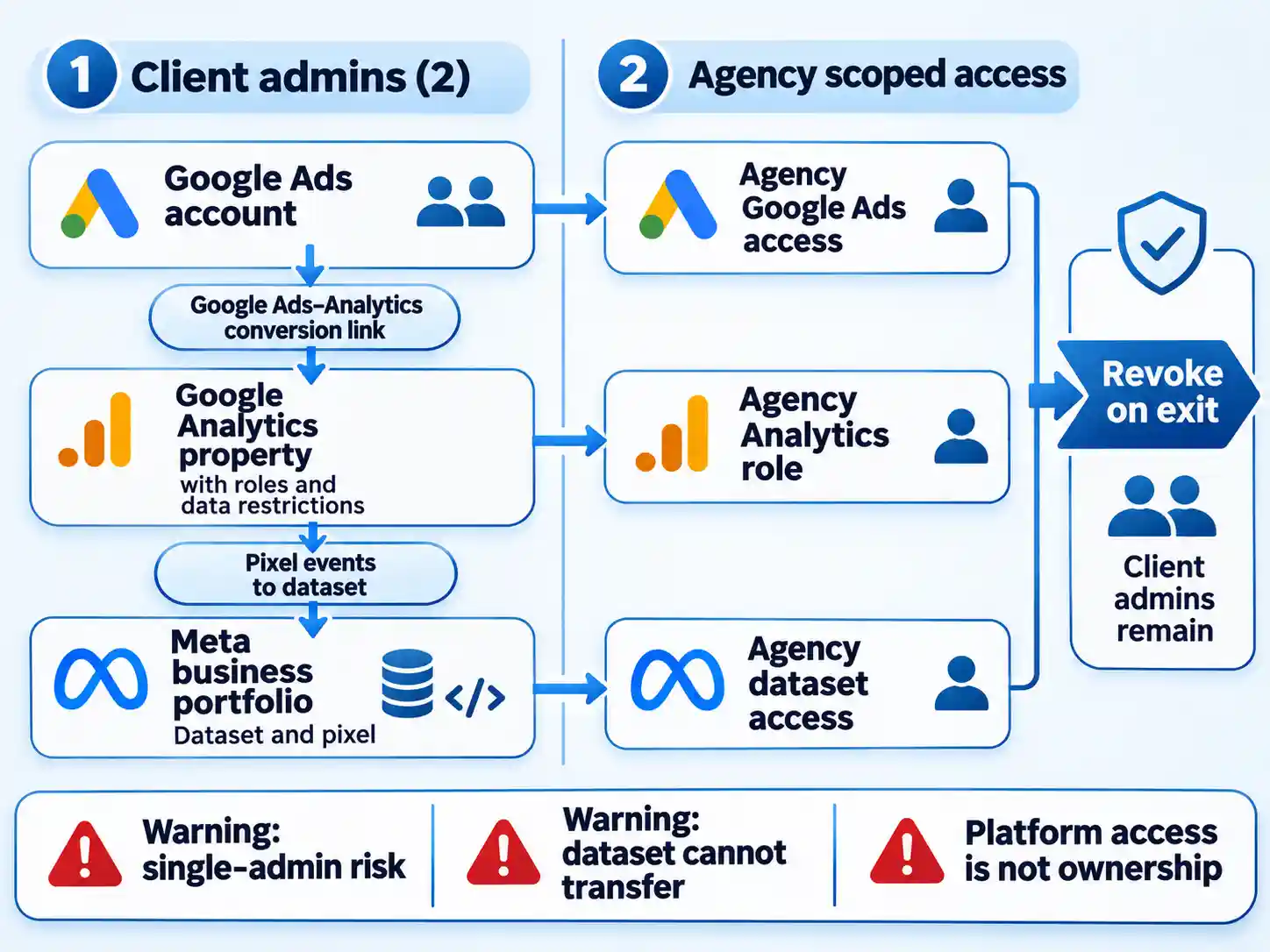
- Audit account access and a sample report.Build an access map: who creates the Google Ads account, who holds admin, who is the second admin, what access level the agency receives, which Analytics roles and data restrictions apply, and which business portfolio owns the Meta dataset.
Use the platform documentation as your reference point, because it describes what each control actually permits. A sample report is the other half of this step: check whether it leads with spend and impressions or with cost per qualified lead.
You are ready when you can log in, see the agency’s access level, and remove it without asking anyone for permission.
- Negotiate trial, notice, and scope-change terms, then sign.Put four things on the table before signature: a trial period, a notice period, a rate card for scope changes, and a handover list.
Handover matters more than exit. Name the deliverables explicitly, including account access, creative files, tracking documentation, and reporting history.
You are ready when the contract states what happens on the last day and a qualified local lawyer has read it against the law that applies to you.
Pitch Team vs. Delivery Team
The person who closed the deal may not be the person who runs your account. That gap is a process failure you can design around, and it starts with refusing to sign until you have met the manager who will be in your account every week.
Three checks close most of the gap. Meet the named day-to-day manager on a call. Compare the roles listed in the pitch against the roles written into the scope of work. Then call references for that specific team, not for the agency’s best-known client.
Use direct questions and write the answers down: who will be in my account weekly, what happens when that person leaves, how many accounts does the manager hold, and which clients has this exact team served in the past year. Ask whether senior people stay involved throughout; the check separates accounts that do from accounts that only say they do.
Who Should Hold the Ad, Analytics, and Business-Portfolio Accounts
Practical control beats a promise in a contract. You want to remove agency access on a Friday without losing campaign history, pixels, or conversion data. Three platform areas decide whether you can.
Google Ads. Access levels control what a user can do inside the account. Users with admin access to a manager account that has ownership can edit user access, managers, and product links, so ask whether the agency holds ownership or a scoped user role. Google’s help documentation also warns that an account with only one administrator may lose access to its tags if that user becomes unavailable, and notes that adding at least one additional administrator may help ensure uninterrupted tag management (Google Ads access levels). Standard and Admin access can help create conversions from Analytics events, so decide who needs that power.
Google Analytics. Roles and data restrictions are assigned at the account or property level, and an administrator can change both. The two restrictions hide cost metrics or revenue metrics from a user, which suits a contractor who needs campaign performance without margin data. Google Ads users are automatically granted Analytics roles when the accounts are linked, and those assignments persist until the link is deleted (Analytics access management). Administrators can review and edit linked-user access.
Meta business portfolio. Adding a pixel to a business portfolio means creating or adding it to a dataset, and that requires full control of the portfolio. Datasets cannot be deleted or transferred to another business portfolio; you can add people, partners, and ad accounts instead. A portfolio can hold up to 100 datasets (Meta dataset documentation). Decide who owns the portfolio before the first pixel ships.
Platform access is a set of permissions, not a legal ownership opinion. Put the ownership question into the contract and have qualified local counsel review the wording that applies in your jurisdiction.
Account control is one half of vetting a partner. For the brand-side checks that sit alongside it, see five things to ensure when hiring a marketing agency for your brand.
Switching Costs and Migration Traps
Switching is cheap when the accounts are yours and expensive when they are not. Campaign history, conversion tracking, and audience definitions live inside the platform account, so whoever controls the account controls your continuity.
Two traps catch buyers late. First, the Analytics link: Google Ads users keep their Analytics roles until the link is deleted, so an agency that keeps the link keeps a doorway. Second, the Meta dataset: because a dataset cannot move between business portfolios, tracking built inside an agency portfolio usually has to be rebuilt, not transferred.
Keep a written transition list from day one: platform account IDs, admin lists, tracking documentation, change history exports, and the reporting source of truth. That list is what makes an exit boring.
Reporting That Protects the Budget
Impressions, reach, and click-through rate explain why a campaign moved. They cannot be the scoreboard. Split reporting into layers and give each layer a named owner, so nobody argues about a number whose definition nobody agreed.
| Layer | Typical metrics | Who defines it |
|---|---|---|
| Delivery | Impressions, reach, clicks, click-through rate, frequency, spend pacing | Agency, reported weekly for diagnosis |
| Response | Form fills, calls, booked demos, cost per lead | Shared, with tracking ownership written down |
| Qualification | Qualified lead rate, cost per qualified lead, cost per acquisition | Sales and marketing agree the definition in writing |
| Business outcome | Pipeline value, closed revenue, payback period | Client, with the CRM as the source of truth |
Attribution is directional, so scope it once and stop re-litigating it. Platform dashboards over-claim credit, and last-click reporting flatters branded search. Pick one source of truth for pipeline, state the attribution model in the contract, and review it quarterly.
Set the cadence too. A weekly delivery check on pacing and blockers, a monthly review on cost per qualified lead, and a quarterly review on pipeline keeps reporting useful without turning it into a reporting industry.
Trial Periods, Notice, and Exit Terms
A 60-day or 90-day trial and a 30-day notice period are targets to negotiate, not market standards or legal entitlements. Ask for them, expect a counter, and treat the answer as a signal about how the agency thinks about risk.
Four clauses do most of the work. A scope-change rate card stops small requests from becoming unbilled resentments. A notice period gives you a cheap exit if the work stalls. A handover list names what you receive on the last day. Termination-fee wording tells you what leaving costs.
Long lock-ins need a specific reason, such as a build phase that takes months. If the reason is “our process”, ask for milestones tied to payments instead of one long commitment.
Contract law varies by jurisdiction and this is not legal advice. Have a qualified local lawyer read the agreement before you sign, and keep the negotiation commercial rather than adversarial.
If Access Is Already Wrong
The agency holds the only admin. Check the account’s user list first to see who can grant access. If a linked manager account holds ownership, its admins may control user access, managers, and product links. Put a written request on record for the access change you need, including removal of the link if that is the cleanest exit, and set a deadline.
You are the single administrator. Add a second administrator on the client side now. A Google Ads account with only one administrator can lose access to its tags if that user becomes unavailable, and a second administrator is the cheapest continuity fix available (Google Ads access levels).
Analytics access will not go away. A Google Analytics administrator can review linked-user access and change roles and data restrictions. If the Google Ads link stays, Google Ads users keep their Analytics roles, so decide whether the link should survive the contract.
The Meta dataset sits in the agency portfolio. Because a dataset cannot be deleted or transferred to another business portfolio, plan to rebuild tracking inside your own portfolio rather than assume a handover is possible. Ask to be added as a person or partner on the existing dataset in the meantime so you keep measurement while you migrate.
Which Model Fits Your Situation
No in-house marketer, several channels to run
An in-house team with one weak channel
A focused brand, creative, or local-market problem
No measurement in place yet
Walk away when the day-to-day manager cannot be named before signature, when the agency will not let you hold admin access to the primary accounts, when reference calls must go through a sales contact rather than the delivery team, when the sample report has no lead-quality definitions, or when scope-change fees stay undisclosed until the contract.
What to Do Before You Sign
Run the six steps, then test the answers against the model you chose. Request an access map in writing, book two reference calls with the team that will actually run the account, and ask for one sample report built on your own metric hierarchy.
Finally, negotiate the trial and exit terms while you still have leverage, then have a local lawyer read the agreement. If the answers change which model fits, change the model; that is the cheapest possible moment to discover it.
New to the process entirely? Start with this broader guide to hiring a digital marketing agency, then come back and run the checklist above before any contract goes to signature.

💬 Comments