Humbot is best understood as a combined AI-checking and rewriting toolkit, not as a system that can prove who wrote a piece of text. External benchmarking shows that its humanizer can reduce AI-detection signals in some conditions, but neither those results nor Humbot’s detector features support a guarantee that text is human-written or universally undetectable.
Humbot Review Verdict
Our Verdict
Humbot is most useful as a multi-purpose writing toolkit for people who want rewriting tools and several AI-detection signals in one place. Its humanizer has produced meaningful detector-bypass results in independent testing, but performance varies by detector, writing type, and test cycle. Its AI checker can help you compare detection signals, but those signals should not be treated as proof of authorship. Humbot therefore makes more sense for editing and risk-checking than for anyone who needs a guaranteed detector verdict or guaranteed evasion.
The distinction matters because Humbot is really serving two different jobs. Its checker tries to tell you how text is likely to be assessed by AI-detection systems, while its humanizer rewrites text to make it read more naturally and reduce detectable AI patterns. The first job is limited by the accuracy of AI detectors themselves. The second is limited by whether the rewrite remains accurate, readable, faithful to the original meaning, and effective against the particular detector that matters to you.
For that reason, this review does not treat a low AI score as proof that a document was written by a human. A false positive occurs when human-written text is incorrectly labeled as AI-generated, while a false negative occurs when AI-generated text is classified as human. Both failure modes matter when judging Humbot or any competing detector.
How This Review Was Evaluated
The main independent humanizer evidence comes from HumanizerBench’s August 2026 Humbot results. HumanizerBench publishes its methodology, test outputs, detector verdicts, and scoring rules, which makes the benchmark more auditable than a review based on one or two example paragraphs.
There is an important conflict to disclose. HumanizerBench is operated by WriteHuman, which sells a competing humanizer. The benchmark says WriteHuman is subjected to the same published methodology and that raw data is available for inspection, but its commercial relationship still matters when weighing the conclusions. Its results are useful evidence, not unquestionable ground truth.
Humbot was also checked against current Turnitin guidance on AI-writing reports and academic research on detector limitations. Those sources help answer a separate question that humanizer benchmarks cannot settle: how much confidence anyone should place in an AI-detection score in the first place.
What Humbot Actually Does in 2026
Humbot has expanded beyond a single-purpose humanizer. Its current feature list includes an AI humanizer, AI checker, plagiarism checker, grammar checker, summarizer, translator, citation generator, document-reading tools, quiz generation, and other study or writing utilities. The breadth is useful context, but it does not mean every tool has the same accuracy or evidentiary value.
AI checker
Humbot combines its rewriting functions with an AI checker. On its separate AI-checker page, Humbot says the service can present results associated with multiple detection systems, including GPTZero, Originality.ai, ZeroGPT, and Copyleaks, rather than forcing the user to check each service separately. Its pricing page also lists a Humbot 1.0 checking model alongside access to advanced AI-check models.
That setup can be convenient if you want several signals in one workflow. It should not be confused with independent verification that all of those detector results are correct, however. Humbot’s statement that its displayed results match the corresponding detector systems is a vendor claim, and this review did not reproduce that claim through direct testing.
AI humanizer
The current humanizer accepts text for rewriting and offers controls intended to make AI-generated drafts read more naturally. Humbot says the service can preserve meaning, citations, voice, and key facts while restructuring phrasing. It also advertises reduced detection signals across systems such as GPTZero, Originality.ai, Turnitin, ZeroGPT, and Copyleaks.
Those are performance claims from Humbot itself. They are not guarantees established by the vendor page alone. The more useful question is what happened when an outside benchmark submitted Humbot outputs to several detectors under a repeatable methodology.
Other bundled tools
Humbot’s paid-plan documentation shows that word credits can be used across multiple tools, so buyers are paying for a broader platform rather than only an AI humanizer. That may be valuable if you also need grammar checking, summarization, document reading, translation, or citations. Someone who needs only one specialist function may care more about that function’s accuracy than the size of the bundle.
Is Humbot a Good AI Detector?
Humbot can be useful for checking how text is likely to be classified by several detector systems, but that is different from reliably determining authorship. AI detectors estimate patterns associated with generated text. They do not inspect a document and discover a definitive record proving whether a human or a model wrote each sentence.
Turnitin makes this limitation unusually explicit. Its current guidance states that false positives are possible, and its system no longer displays a numerical percentage for results between 1% and 19% because that range is less reliable and can be misinterpreted. Turnitin has also said its AI-writing assessment should not be the sole basis for adverse action against a student.
Older peer-reviewed research provides another reason for caution. A 2023 Stanford-led study published in Patterns found that the detectors it evaluated frequently misclassified writing by non-native English writers as AI-generated. That research does not measure Humbot’s current checker, and detector technology has changed since 2023, but it remains evidence that detector error can affect different writers unevenly.
For a deeper explanation of the trade-offs, AI detector accuracy depends on the model, threshold, language, text length, and the kind of writing being assessed.
Determining whether content was written by AI therefore requires more context than a single percentage. Draft history, factual accuracy, citations, source material, writing process, and human review can all matter depending on why the question is being asked.
If genuinely human writing is flagged, the right response is to verify the text and context rather than repeatedly rewriting it solely to lower a score; handling a false AI flag should preserve drafts, sources, and other available authorship evidence.
So, is Humbot a good AI detector? It is better understood as a convenient place to gather detection signals than as an authority on who wrote a document. That distinction is especially important in education, employment, publishing, or other settings where an incorrect accusation can have consequences.
Is Humbot a Good AI Humanizer?
The independent evidence is more informative here because Humbot has actually been included in a multi-detector benchmark. The results show that it can substantially change how AI-generated text is classified, but they also show why “undetectable” is too strong a description.
What the August 2026 benchmark found
In HumanizerBench’s August 2026 cycle, Humbot ranked #5 with an overall score of 66.95 out of 100 and a reported 71.7% detector-bypass rate. The benchmark tested 33 prompts, and the published output data reports average meaning preservation of 93.9%. Only 10 of the 33 runs passed at least four of the five detectors used in the benchmark.
Those numbers describe different things. HumanizerBench calculates its bypass metric from detector scores across GPTZero, Originality.ai, Copyleaks, Winston AI, and ZeroGPT, while its overall score also considers meaning preservation, readability, consistency, and penalties. A 71.7% bypass score therefore does not mean that 71.7% of documents are guaranteed to fool every detector.
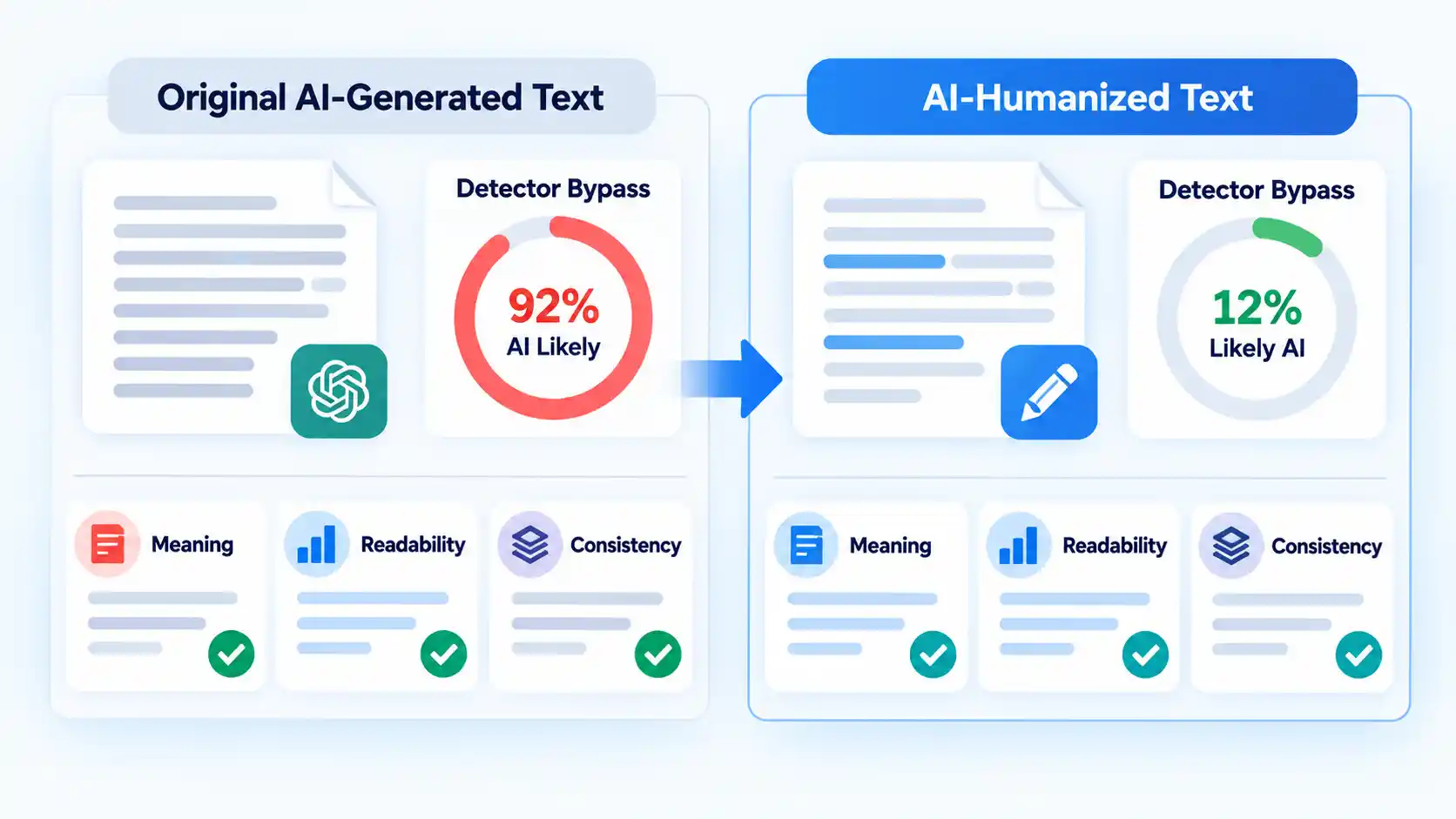
The benchmark’s published run-level evidence illustrates the variability. For its first August landing-page test, for example, four of five detectors classified the humanized output as passing while GPTZero did not. That kind of disagreement is exactly why a tool can perform well overall without being reliable against every detector on every document.
Why the September 2026 result needs separate treatment
Humbot does not have a completed score in HumanizerBench’s September 2026 ranking. According to the benchmark’s September results report, its first eight tests completed slowly and then the service stopped returning outputs. HumanizerBench says it skipped the remaining tests and treated Humbot as unavailable rather than scoring those missing runs as failures.
That means the August result remains the latest completed HumanizerBench score available for Humbot in this review. The September interruption is operational evidence from that benchmark session, not proof that Humbot is generally unreliable or permanently unavailable.
A separate 2025 Techpoint Africa hands-on review also reported one humanization attempt that stalled before working after a refresh. That observation comes from a single review session and should not be generalized into a measured failure rate, but it provides another example of why availability and output behavior can vary in practice.
What a bypass result cannot prove
A successful detector result only tells you what that particular detector concluded about that particular output under those conditions. It does not prove the text was written by a human, guarantee the same outcome after a detector update, or establish that the rewrite is factually accurate.
The distinction matters when comparing Humbot vs GPTZero because a multi-tool humanizer and a dedicated detector solve different problems.
The Bigger Problem With “Undetectable AI” Claims
AI humanization is an adversarial problem. In this context, adversarial modification means changing generated text specifically so that a detector is less likely to recognize the signals it uses. When humanizers change those patterns, detector developers can respond with new models or detection features, and the cycle continues.
A 2025 research paper titled DAMAGE: Detecting Adversarially Modified AI Generated Text studied 19 humanizer and paraphrasing tools and reported that many existing AI detectors failed on humanized AI text. The researchers also developed a detector intended to be more resistant to that kind of modification. The paper is a preprint, so its findings should be weighed accordingly, but it demonstrates why bypass performance is a moving target rather than a permanent product property.
There is also a quality trade-off. A rewrite could reduce a detector’s confidence by substantially changing wording, shortening a passage, padding it, or drifting away from the original meaning. That is not necessarily an improvement. A humanizer is more useful when it changes enough to improve flow or reduce unwanted patterns while still preserving facts, quotations, citations, tone, and the author’s actual point.
This is why “100% human” or “undetectable” should not be read literally. Humbot makes strong claims about natural output and detector performance on its own pages, but independent benchmark results show variation among detectors, while detector vendors themselves acknowledge uncertainty.
Plans, Word Limits, and What You Are Actually Paying For
Humbot’s current pricing page lists multiple paid configurations with different allocations of Basic and Advanced words. The visible plan data includes configurations with 3,000 Basic words plus 1,000 Advanced words, 30,000 Basic words plus 5,000 Advanced words, and an unlimited-Basic configuration with 10,000 Advanced words.
The plans also differ in per-request limits. The current page lists humanizer input limits of 500 words, 1,200 words, or unlimited words depending on the configuration. For the AI checker, the listed input limits are 500 words, 1,200 words, or up to 150,000 words. Humbot also states that credits can be used across its tools.
Those limits matter more than the headline word allowance if you work with long documents. A plan can provide a large monthly allowance but still constrain how much text you can process in one request.
This review does not quote a current subscription price because Humbot’s monetary amounts were not reliably exposed in the public page data available during verification on September 13, 2026. Publishing an inferred or third-party price would create unnecessary risk of showing a stale figure. Check the live pricing page before purchasing and compare the price against the exact word pool and per-request limit you need.
Who Humbot Makes Sense For, and Who Should Be Cautious
The best fit depends on whether you need writing assistance, detection signals, or proof. Humbot is much better suited to the first two jobs than the third.
Which option should you choose?
Use Humbot as a rewriting and checking aid
Avoid this if: you need a tool that can prove authorship or guarantee that every detector will classify a document as human-written.
Main trade-off: convenience and measurable detector-bypass performance come with uncertainty about how any individual detector will react and whether a rewrite preserves every important detail.
Use detector results only as supporting evidence
Avoid this if: an AI score would become the sole basis for accusing a student, employee, contractor, or author of misconduct.
Main trade-off: automated detection is fast, but false positives and false negatives make human judgment necessary when the consequences matter.
For writers and content teams, Humbot can therefore make sense as an editing aid. A draft can be rewritten, checked, and then manually reviewed for factual accuracy, tone, citations, and meaning. That last step is essential. A detector-friendly rewrite that changes a product specification, research finding, legal statement, financial figure, or quotation is still a bad edit.
Students should also distinguish legitimate editing from attempts to conceal prohibited assistance. Humbot’s own humanizer page tells students to follow their institution’s AI policies and disclose use where required. No detector-bypass result overrides a school, publisher, employer, or client’s rules.
Humbot Pros and Cons
Pros
- Combines AI rewriting, checking, plagiarism, grammar, summarization, translation, and other writing utilities in one platform.
- Can surface several AI-detection signals without requiring a separate manual check on every detector site.
- Independent August 2026 benchmarking found meaningful detector-bypass performance while reporting high average meaning preservation.
- HumanizerBench publishes prompt-level outputs and detector verdicts, so its Humbot results can be inspected rather than accepted as a black-box ranking.
Cons
- Neither Humbot nor any AI detector can provide definitive proof of human authorship from a score alone.
- Independent results vary by detector and writing sample, so universal “undetectable” claims are not supported.
- Humbot did not complete HumanizerBench’s September 2026 cycle after the service stopped returning outputs during that benchmark session.
- HumanizerBench is operated by a competing humanizer vendor, which creates a commercial conflict even though its methodology and raw data are published.
- Rewritten text still requires manual review for factual accuracy, citations, tone, and meaning.
Final Verdict
Humbot is a legitimate multi-function writing platform, but whether it is “good” depends on the job you expect it to perform. Its AI humanizer has credible independent evidence showing that it can reduce detector signals across multiple systems, yet the August 2026 benchmark also shows that results are far from universal. The September benchmark could not produce a complete score because Humbot stopped returning outputs partway through that test cycle.
As an AI checker, Humbot is best used to gather signals rather than determine authorship. Detector vendors acknowledge false positives, academic research has documented fairness problems, and humanized text can further complicate classification. The safest interpretation is therefore practical rather than absolute: use Humbot to assist rewriting and comparison, then verify the final text yourself and follow any applicable AI-use rules.

💬 Comments