NFT marketing can still make sense when a token gives customers something useful, such as verifiable ownership, transferable access, a collectible, or a benefit connected to a blockchain-based service, game, or virtual environment. If the same campaign would work just as well with an ordinary account, coupon, membership database, or digital download, adding an NFT may create more complexity than value.
Quick Take
Start with the customer benefit, not the blockchain. An NFT is easiest to justify when its ownership record, transferability, access tied to token ownership, or connection to a blockchain-based product materially improves the campaign. Scarcity alone does not create demand, and issuing a token does not automatically produce loyalty, sales, copyright rights, or useful marketing analytics.
What NFT Marketing Means for a Brand
NFT marketing for a brand means using non-fungible tokens as part of a campaign, loyalty program, access system, collectible, or other customer experience. That is different from marketing an NFT collection whose main objective is to attract buyers to a mint or marketplace listing.
An NFT is a token that represents something individually identifiable on a blockchain. On Ethereum, for example, ERC-721 provides a standard for unique tokens and includes functions for identifying owners and transferring tokens between accounts.
For a marketer, the technical standard matters less than what the token changes for the customer. A brand might use an NFT as a membership pass, a record of ownership for a digital collectible, access to a limited experience, or an item that can move through a compatible blockchain ecosystem.
The important distinction is that the NFT is infrastructure, not the marketing idea itself. Customers still need a reason to care about the benefit attached to it.
Where NFTs Can Add Marketing Value
The strongest use cases are those where unique ownership or controlled access is part of the experience rather than an extra technical layer added for attention. A 2025 study using field data from 450 brand NFT campaigns found that several factors, including added utility, Web3 partnerships, sales through a company-owned campaign site, brand equity, and some measures of brand fit, were associated with NFT sales revenue. The researchers described the fit result as less robust than several other factors, so it should not be treated as a simple formula for success. The same research also found experimental evidence of negative spillovers to attitudes toward the parent brand, especially after failed NFT campaigns.
The table separates common uses from the simpler tools that may solve the same problem. The useful question is not merely whether an NFT can perform the job, but whether turning the benefit or asset into a blockchain token adds something the alternative lacks.
| Use case | What the NFT can add | Simpler alternative | Main limitation |
|---|---|---|---|
| Loyalty or membership | A transferable or publicly verifiable token that represents access or status | Customer account, loyalty database, membership card | Customers may need wallet onboarding, and the token adds little if portability or ownership is irrelevant |
| Gated access or experiences | A token can act as proof that a wallet qualifies for a benefit, event, community, or digital area | Login, ticket, promo code, email-based membership | The business still has to provide and maintain the promised benefit |
| Digital collectibles | Each collectible can have a distinct blockchain ownership record and may be transferable | Account-bound digital badge, downloadable item, conventional collectible database | Scarcity and ownership do not create demand by themselves |
| Games and virtual environments | Compatible blockchain assets may be held separately from a single game account and traded or transferred where supported | Game-controlled inventory or account item | Other games and platforms do not automatically recognize the asset |
| Product-linked digital benefits | A token can represent a digital companion item, claim, membership status, or proof of participation connected to a physical product | QR code, account entitlement, serial-number database | The token is unnecessary when the benefit never needs independent ownership or transfer |
Virtual environments are one place where the ownership model can make a practical difference. A blockchain can record which address holds a token separately from a platform’s private account database, although blockchain-linked virtual assets still depend on the software and rules of the platforms that support them.
Gaming provides another concrete example. An NFT can identify a specific sword, skin, character, or other unique object, while the game determines what that object actually does. The distinction becomes clearer when looking at NFT-based in-game items and the systems needed to connect blockchain ownership with game software.
A token-gated reward also needs a benefit worth keeping after the initial launch. That is why NFT loyalty programs depend on reward design, redemption rules, customer access, and ongoing fulfilment rather than the token alone.
What an NFT Marketing Campaign Actually Needs
Issuing the token is only one part of an NFT campaign. A workable campaign still needs a clear objective, a defined audience, a customer benefit, the digital asset itself, a way for people to receive or buy it, communication around the offer, fulfilment of any promised benefits, and a way to measure the result.
Start with the business goal. A campaign designed to reward existing customers needs different distribution and measurement from one designed to sell a collectible or unlock an event. The same principle applies outside blockchain campaigns: campaign goals and measurement should be connected so the team can judge whether the activity produced the intended result.
Next comes the customer experience. A crypto wallet is software or hardware that manages blockchain accounts and lets a user authorize transactions. If participants need one, decide whether the intended audience is likely to have a wallet already and how much extra setup the campaign can tolerate. A technically sophisticated token is not useful marketing if most intended customers cannot comfortably claim or use it.
The production layer may include artwork, metadata, a blockchain network, and a smart contract, which is a program on a blockchain that carries out defined rules such as creating or transferring tokens. For a generative art collection, the image-generation stage can be handled with a no-code NFT generator, but asset production is only one part of the campaign; the audience, utility, rights, distribution, and measurement still need separate planning.
Measurement should follow the campaign objective rather than relying on the existence of blockchain data. Depending on the goal, useful signals might include successful claims, benefit redemptions, qualified website visits, participation by existing customers, event access, or continued use of the promised utility. An NFT does not automatically measure ad exposure, customer satisfaction, or whether a campaign caused a sale.
What NFTs Do Not Automatically Give You
The easiest way to overestimate NFT marketing is to treat the token as a bundle of benefits it does not actually provide. A blockchain record can answer who currently holds a token, but ownership of that token does not settle questions about copyright, demand, platform support, or revenue.
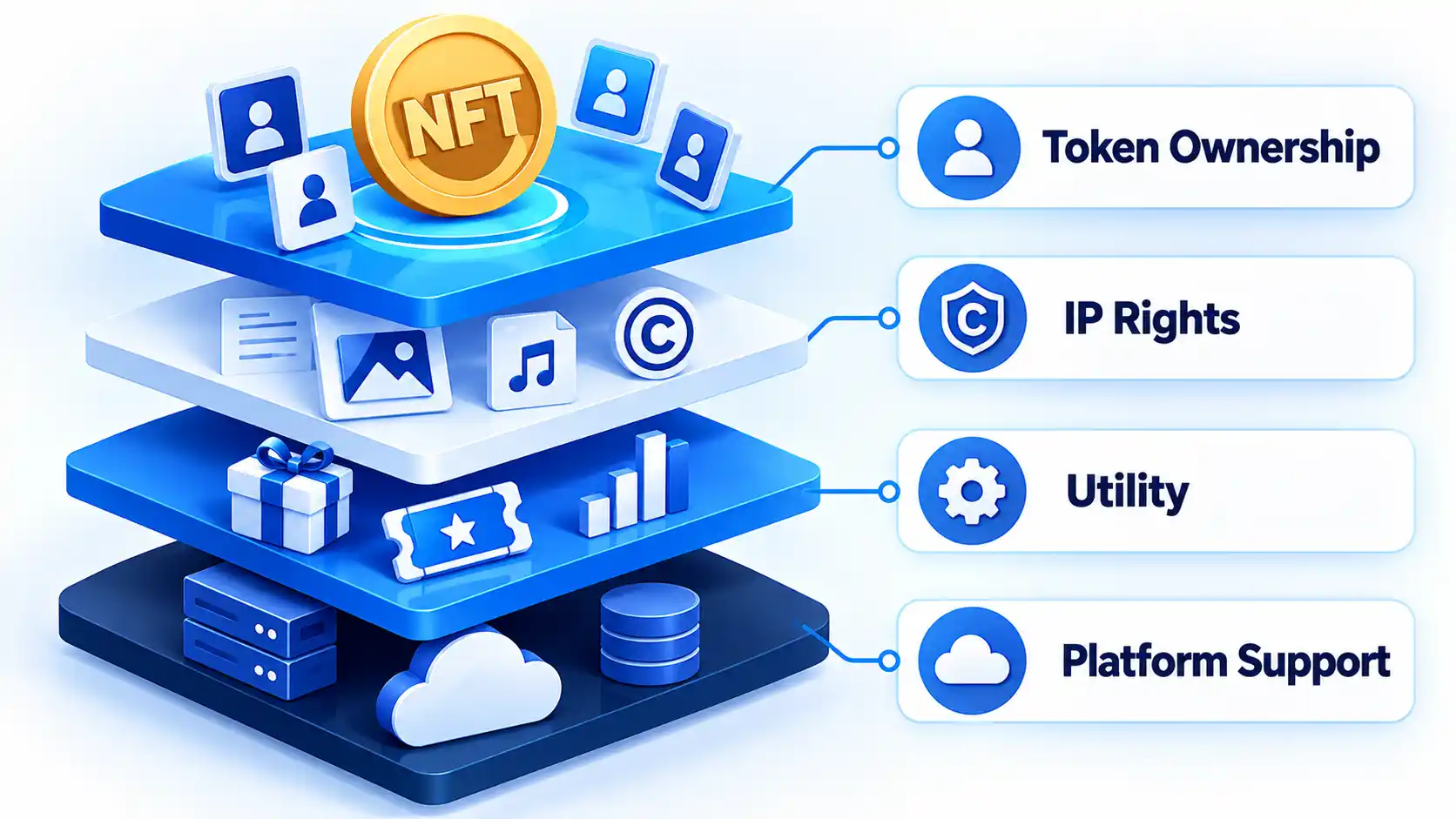
Ownership of the NFT does not automatically mean ownership of the copyright. A joint U.S. Copyright Office and U.S. Patent and Trademark Office study identified widespread concern about which intellectual-property rights are involved in NFT transactions. The rights a buyer receives can depend on the agreement or license attached to the transaction.
That distinction matters to brands using artwork, music, characters, logos, or customer-created material. If commercial-use rights are part of the offer, those rights should be established separately rather than assumed from token ownership. NFT ownership and copyright answer different legal questions even when they relate to the same digital work.
Blockchain ownership also does not guarantee cross-platform usefulness. Another game, virtual world, or app still needs to recognize the token and know what to do with its associated asset. A transferable ownership record is not the same thing as universal interoperability.
Scarcity does not guarantee demand. A brand can limit a collection to a fixed number of tokens, but customers still need a reason to value the item or benefit. Reducing supply does not create relevance, loyalty, or purchase intent by itself.
Tokenization does not guarantee revenue or profit. The brand-NFT research found that sales revenue varied with multiple brand and campaign factors rather than with the mere existence of an NFT. Revenue should therefore be treated as an outcome to test, not an automatic feature of tokenization.
Risks and Compliance Checks Before Launch
An NFT campaign can move into higher-risk territory when its marketing makes claims about investment returns, resale profits, ownership rights, or benefits the brand may not be able to maintain.
Investment-style language deserves particular care. In a 2023 enforcement action involving Impact Theory, the U.S. Securities and Exchange Commission found that the company encouraged buyers to view its Founder’s Keys NFTs as an investment and promoted the prospect of profits if the business succeeded. The SEC concluded that the NFTs in that offering were investment contracts.
The Impact Theory order addressed that specific offering and marketing conduct; it did not classify every NFT as a security. In 2025 remarks expressly presented as her own views rather than those of the Commission, SEC Commissioner Hester Peirce said that many NFTs are not securities. For a brand, the safer lesson is not to rely on a universal label. The token’s structure, the rights it represents, promises made to buyers, and the way it is marketed can affect the analysis.
Intellectual-property rights need a similar check. The brand should know whether it has permission to use the artwork, trademarks, music, characters, and other protected material involved, and the customer-facing terms should not promise rights that the token itself does not provide.
For endorsements aimed at or reasonably likely to affect U.S. consumers, a material relationship between a promoter and a brand should be made clear. Federal Trade Commission guidance says social-media endorsements should make a material connection with the brand obvious, including financial, employment, personal, family, and certain free-product relationships.
Operational risk matters too. A campaign may depend on wallets, blockchain fees, marketplaces, metadata hosting, smart contracts, and third-party services. The brand also has to keep any promised access, discounts, events, or membership benefits working for as long as customers were led to expect them.
When NFT Marketing Is—and Isn’t—a Good Fit
NFT marketing is easier to justify when the customer benefit depends on a property that tokenization genuinely provides. That may include independently verifiable ownership, transferability, access tied to token ownership, a collectible identity, or integration with an existing blockchain-based game, community, or virtual environment.
It is harder to justify when the token merely replaces a database entry without changing the customer experience. A discount can usually be delivered with a coupon. Membership can usually be managed with an account. Loyalty points can usually stay in a conventional rewards system. A digital image does not need to be an NFT simply because it is limited in number.
The audience also matters. Asking customers to create or connect a wallet introduces extra setup and security responsibilities. For an audience already comfortable with blockchain-based products, that may be normal. For a mainstream customer base that only wants a straightforward discount or membership benefit, the extra setup can work against the campaign.
When the main business problem is loyalty rather than blockchain ownership, NFT and traditional loyalty programs can solve some of the same goals with very different infrastructure and customer requirements.
A useful final test is to remove the blockchain from the idea on paper. If the campaign loses an important customer benefit, tokenization may have a legitimate role. If almost nothing changes, the simpler system is usually easier to explain, operate, and maintain.
Bottom Line
Do not begin an NFT marketing campaign by asking how to mint a token. Begin by asking what the customer should be able to own, access, transfer, collect, or do that would be difficult to provide as effectively with a conventional marketing system.
If tokenized ownership materially improves that benefit, an NFT can be a reasonable part of the campaign. If removing the NFT changes nothing meaningful for the customer, the blockchain is probably solving a technical problem the campaign does not have.

💬 Comments