Sustainable soy technology is a stack of precision, monitoring, and data tools layered on top of sound agronomy. GPS-guided application, soil and moisture sensors, drone crop scouting, and digital traceability platforms all make farming decisions more precise and more measurable. None of them makes a farm sustainable on its own.
Quick Take
The tools that matter most for soy sharpen a specific input decision (where fertilizer, water, or pesticide goes and how much) and the data systems that let buyers verify what happened in the field. Expect real gains in efficiency and accountability. Expect the transition to take years, not a single season.
What “Sustainable Soy Technology” Actually Means
The phrase gets used loosely, so it helps to split it into three distinct categories that do different jobs:
- Precision application tools control how much of an input lands where (fertilizer, water, pesticide) using GPS guidance and variable-rate equipment.
- Monitoring tools collect field data: soil moisture and nutrient sensors, weather feeds, and drone imagery that flags crop stress before it spreads.
- Traceability and data platforms record what happened on the farm and pass that record up the supply chain to buyers and markets.
These categories are not interchangeable, and conflating them is where most loose talk about “smart farming” goes wrong. A yield-analytics dashboard is not a traceability system. A traceability platform is not a certification. And precision equipment, on its own, is not a sustainability outcome.
The American Soybean Association frames it this way: on many farms, technology “plays an integral role in every aspect of the operation,” allowing farmers to grow more food on less land and apply fertilizer, water, and pesticides with pinpoint accuracy. The same source is careful to note that hands-on practices (crop rotation, reduced tillage, cover crops, and soil and water management) are what establish a sustainable production system in the first place. Technology sits on top of that foundation. The ASA’s sustainability commitment page lays out both halves of that equation.
How the Main Tools Work
Strip away the marketing and each tool answers a narrow question. Precision application answers “how much and where.” Sensors answer “what is the field doing right now.” Drones answer “what is happening in the parts of the field I can’t walk.”
| Tool | What it does | Soy relevance |
|---|---|---|
| GPS-guided application | Steers equipment and controls variable-rate delivery of fertilizer, water, and pesticides with pinpoint accuracy | Reduces overlap and off-target input use across variable soybean fields |
| Soil and moisture sensors | Detect moisture levels, nutrient content, and pH balance in real time | Informs fertilizer and irrigation timing instead of guesswork |
| Automated irrigation | Delivers precise water amounts based on live soil conditions | Cuts water waste during sensitive growth stages |
| Drone crop monitoring | Multispectral cameras analyze crop health and detect disease before it spreads | Catches stress in large or hard-to-reach fields early |
| Data platforms | Consolidate fragmented farm records into one system for planning and reporting | Connects field decisions to sustainability reporting and market access |
Precision application is the best-established of these mechanisms. Pinpoint accuracy in applying fertilizer, water, and pesticides describes what the equipment can do when it is calibrated and used well. The same is true of the monitoring layer: soil sensors read moisture, nutrient content, and pH in real time, automated irrigation systems deliver water based on live soil conditions, and multispectral drone cameras flag crop stress before it spreads across a field. The precision-agriculture overview behind those descriptions explains the underlying technology in more detail.
Traceability and the Data-to-Market Chain
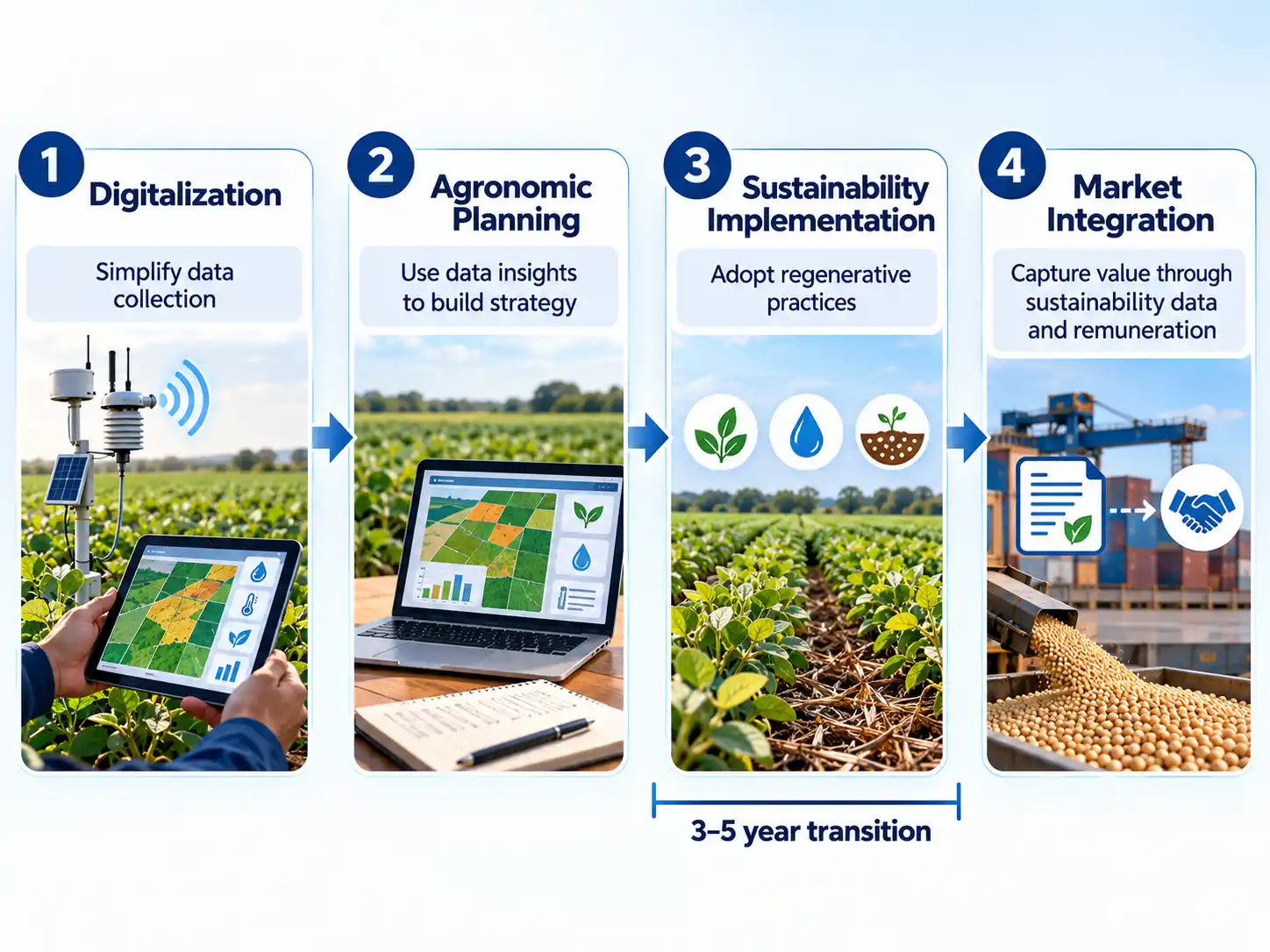
Traceability is where technology stops being a field tool and becomes a commercial one. At the 2024 International Conference of the Round Table on Responsible Soy, xFarm Technologies’ Matteo Cunial described a four-step approach his company uses to move farms from scattered records to a market-ready sustainability story. The conference session laid out the sequence:
- Digitalization. Simplify data collection and management so records stop living in scattered notebooks and spreadsheets.
- Agronomic planning. Turn that data into a farming strategy: what to plant, where to cut rates, when to act.
- Sustainability implementation. Guide farmers in adopting regenerative practices on the ground.
- Market integration. Let farmers capture value through their sustainability data, with remuneration for verified practice.
The session also highlighted AI-driven traceability as an emerging part of the soy supply chain’s toolkit.
That last step is the one to watch closely. Market integration means a farmer’s sustainability data can translate into remuneration, but it depends on buyers actually paying for verified practice and on systems that can prove the data is real. Traceability records what happened. It does not, by itself, certify that what happened meets a standard. Those are separate layers, and readers assessing a sustainability claim should ask which layer they’re looking at.
For U.S. soy specifically, the industry’s market-facing mechanism is the U.S. Soy Sustainability Assurance Protocol (SSAP), which the U.S. Soybean Export Council uses to inform global markets of the sector’s sustainability commitment. Programs like this are where field-level data and buyer expectations meet. Readers who want the export-market context can explore U.S. Soy’s market programs.
Why It Matters
Three practical stakes sit behind all this equipment and software:
- Efficiency under resource pressure. Precision application and smart irrigation target the inputs that cost the most and carry the most environmental weight: fertilizer, water, and pesticide. Getting the rate and placement right is where the measurable gains live.
- Market access. Buyers increasingly want documentation, not assurances. A farm that can produce credible sustainability data has a different conversation with a purchaser than one that cannot.
- Accountability. Digital records make it harder to overstate a claim, which cuts both ways: it protects legitimate operations and exposes weak ones.
The ASA’s policy work adds a supporting layer: the association advocates for mandatory farm bill funding for voluntary conservation programs including the Conservation Stewardship Program, the Environmental Quality Incentives Program, and the Regional Conservation Partnership Program. Grower associations push for that funding because voluntary conservation programs are how many of the practices underneath the technology (cover cropping, reduced tillage, nutrient management) get paid for on working farms.
Common Misconceptions
Misconception: If a farm uses precision technology, its soy is sustainable.
Correction: Precision tools improve how inputs are applied. Sustainability also depends on crop rotation, reduced tillage, cover crops, and soil and water management: practices the ASA explicitly names as the foundation of a sustainable production system. Technology without those practices is efficiency without a direction.
Misconception: Traceability equals certification.
Correction: A traceability platform records and transmits data. Certification requires verification against a defined standard. The two are complementary, not identical, and a dashboard that shows field history is not a certificate.
Misconception: Genetically modified soy is a proven sustainability win.
Correction: GM soybean cultivars, including glyphosate-resistant varieties developed for weed management, are a real agronomic tool. Herbicide-tolerant cultivars change which chemicals a farm uses and how it manages weeds; they do not eliminate chemical inputs. Treat GM as a contested trade-off, not a settled sustainability benefit. Background on GM soy innovation covers the cultivar side of that trade-off.
Where the Promise Meets Its Limits
The most useful limit to understand is time. At the RTRS conference, Cunial was direct: farmers need three to five years to transition to regenerative agriculture. That is a soil and management change measured in growing seasons, and any expectation of a single-season transformation is misjudged. The conference session records the assessment in full.
The second limit is dependency on practice. Technology amplifies what a farm is already doing. Precision application on a farm with poor rotation and no cover cropping produces cleaner input records, not a healthier field. The ASA’s framing (technology as one integral part alongside hands-on practices) is the honest one.
The third limit is measurement. Sensor and drone data tell you what a field looks like; they don’t automatically tell you whether the whole operation is sustainable in any broader sense. The general precision-agriculture descriptions available are mechanism-level, not outcome-level, and soy-specific proof of universal benefit is thin. That gap is where vendor claims tend to outrun the evidence.
How to Evaluate a Tool Before You Buy
The fastest way to sort a real tool from a marketing one is to run it through a short audit. Work through these questions in order, and stop at the first one that fails.
- Name the decision. Which specific choice does this tool change: fertilizer rate on a low-yield zone, irrigation timing, pesticide placement, or the record a buyer receives? If you cannot name the decision, the tool is not yet earning its place.
- Confirm the measurement. Can the tool show you the before-and-after on that decision: rate applied, water delivered, zone flagged? A dashboard that aggregates data without changing a number on the ground fails here.
- Check the calibration path. Precision equipment only delivers pinpoint accuracy when it is calibrated and maintained. Ask who calibrates it, how often, and what happens when a sensor drifts.
- Trace the data to a buyer. If the tool produces sustainability data, ask which buyer, program, or platform will accept it, and whether that acceptance comes with payment or only with a report. Traceability records what happened; certification verifies it against a standard. Know which layer you are buying.
- Budget the transition. Plan on a multi-year shift before regenerative practice shows up in soil and management, and treat any single-season promise as a red flag. The RTRS conference session records the transition timeline in full.
Here is how the audit plays out on a real choice. A variable-rate fertilizer system that lets you cut rates on low-yield zones, document the change, and hand the record to a buyer passes all five questions. A dashboard that aggregates field data but never changes a decision, and never reaches a buyer, fails at question two: at least for now.
Info
The decision rule: Judge a soy technology by whether it improves a specific, measurable input decision (rate, placement, timing, or water delivery) or produces verifiable data a buyer will accept. A sustainability label on the box is not the test. The decision it sharpens is.
Bottom Line
That test also explains why the transition takes years. Soil and management change on a seasonal clock, and no software compresses it. What technology can do is make each season’s decisions visible and provable, so the multi-year shift is measurable rather than assumed. Buyers who want documentation and farmers who want credit for good practice both depend on that record being real.
Key Takeaways
- Sustainable soy technology splits into precision application, field monitoring, and traceability: three categories with different jobs and different evidence strength.
- Precision application is the best-established mechanism; traceability and market integration are newer and depend on buyers paying for verified data.
- Technology works alongside crop rotation, reduced tillage, cover crops, and soil and water management: not instead of them.
- Plan for a multi-year transition to regenerative practice, and treat GM herbicide resistance as a contested trade-off rather than a sustainability claim.

💬 Comments