The blockchain platforms worth knowing in 2026 are not all trying to solve the same problem. Ethereum, Solana, and similar public networks provide shared execution environments, while Hyperledger Fabric and Corda are designed around controlled participation, and Besu can operate in both public Ethereum and private-network settings.
That difference matters more than a simple ranking. The right platform depends on who must participate, what data can be public, where application logic runs, which development environment your team can support, and whether you want to use an existing network or operate infrastructure yourselves.
Quick Take
There is no universal number-one blockchain platform. Ethereum and Solana are broad public application platforms; Avalanche adds application-specific network options; Fabric and Corda focus on permissioned multi-organization workflows; Besu brings Ethereum compatibility into public or private deployments; and Stellar, Cardano, Tezos, and XRP Ledger offer distinct models for assets, applications, governance, and payments.
What counts as a blockchain platform?
A blockchain platform is infrastructure on which applications or multi-party systems can record state and coordinate transactions using a distributed ledger. The phrase is broad enough to cover several architectures that should not be treated as interchangeable.
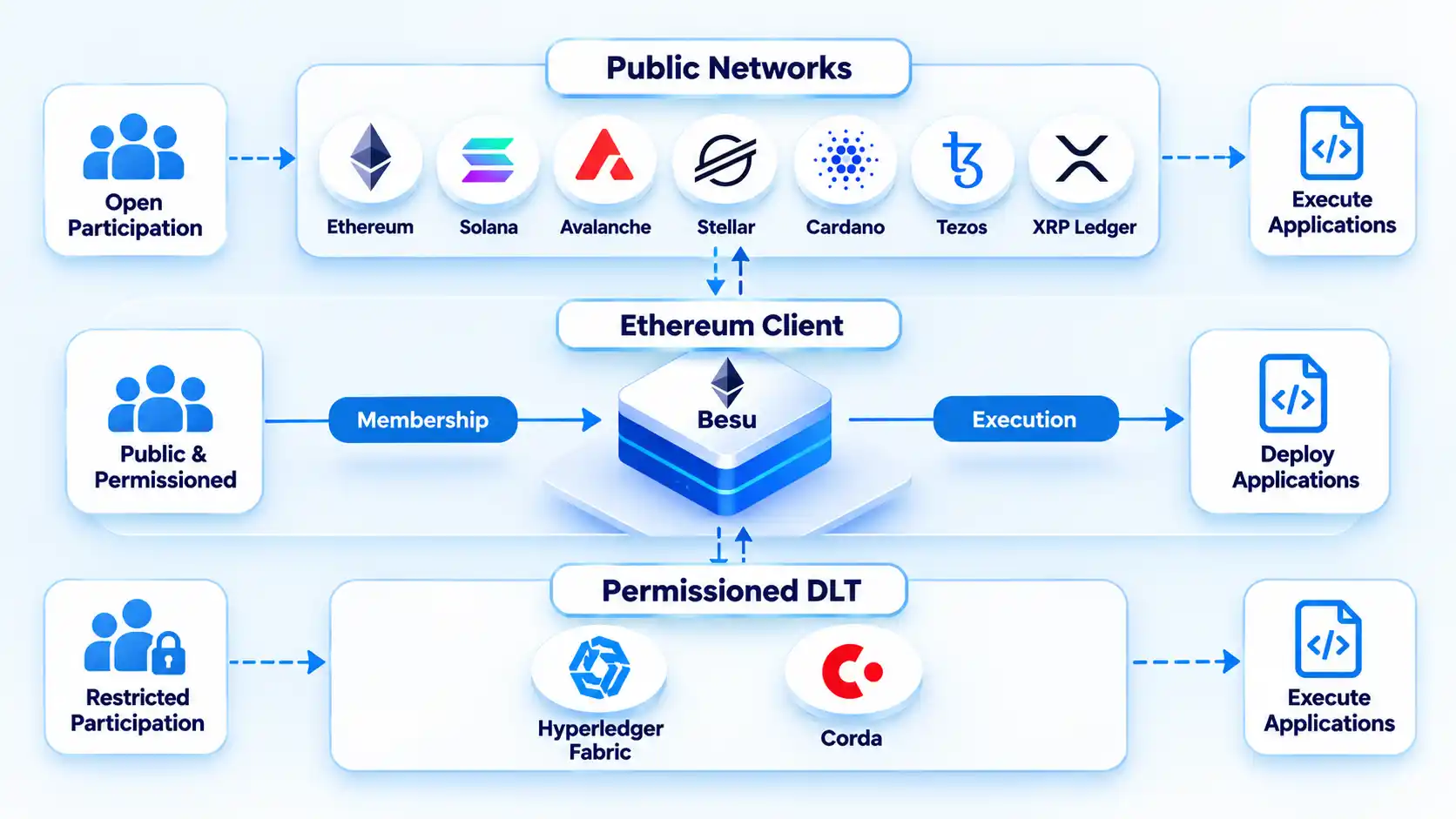
On a public programmable network such as Ethereum, developers deploy application logic to an existing network that anyone can access. Ethereum describes smart contracts as programs deployed at addresses on the blockchain, and its public deployment model allows anyone with the required resources to submit transactions or deploy contracts. Smart contracts run as programs on Ethereum, rather than inside a network controlled by one participating company.
Permissioned distributed ledger technology, or DLT, starts from a different assumption: participating organizations have identifiable roles and access rules. Hyperledger Fabric is built around known identities and channel-level policies, while Corda describes its application networks as private, permissioned groups whose members are admitted under rules set by a network operator. Fabric ties identities and access controls to organizations and channels, and Corda gates participation through application-network membership.
Besu illustrates a third category. It is an Ethereum execution client rather than a separate public Layer 1 network. It can participate in public Ethereum and can also be used in private permissioned deployments. That makes “blockchain platform” a useful umbrella term, but not a reason to compare every technology by the same metric.
How to compare blockchain platforms in 2026
The most useful comparison starts with architecture rather than headline transaction-per-second claims. Ask who may participate, how application logic is executed, whether transaction data needs selective confidentiality, what development environment the team must maintain, and whether the project requires its own network.
| Platform | Network model | Development / execution model | Strong fit | Main constraint |
|---|---|---|---|---|
| Ethereum | Public, permissionless network | EVM smart contracts, commonly Solidity or Vyper | General-purpose public applications and EVM ecosystems | Public execution and transaction fees may not fit confidential or tightly controlled workflows |
| Solana | Public network | Programs plus separate state accounts, using the Solana execution model | Applications designed around Solana’s account and program architecture | Development patterns differ substantially from EVM application architecture |
| Avalanche | Public Primary Network plus sovereign Avalanche L1s | EVM-compatible C-Chain or configurable application-specific L1s | Projects that need EVM compatibility or greater control over their own network | Choosing between the shared C-Chain and operating an L1 adds an architectural decision |
| Hyperledger Fabric | Permissioned consortium network | Chaincode, channels, endorsement policies, and private data collections | Multi-organization systems requiring controlled membership and selective data sharing | Participants must design and operate governance, identities, policies, and infrastructure |
| Besu | Public Ethereum or private permissioned network | Ethereum client with EVM compatibility and permissioning options | Organizations that want Ethereum tooling across public or consortium deployments | Besu is infrastructure for an Ethereum-compatible network, not a separate public application ecosystem |
| Corda | Private, permissioned application networks | CorDapps and point-to-point flows between relevant participants | Business workflows where transactions should be shared only with involved parties | Its transaction and communication model differs from conventional globally broadcast blockchains |
| Stellar | Public network | Native asset operations plus Soroban smart contracts written in Rust and compiled to Wasm | Asset, payment, and smart-contract applications built around the Stellar ecosystem | Soroban has its own resource model and restricted Rust environment |
| Cardano | Public proof-of-stake network | Plutus and Cardano-specific ledger/application tooling | Teams comfortable with Cardano’s functional-programming-oriented development model | The programming and ledger model requires different design assumptions from EVM chains |
| Tezos | Public network | Michelson smart contracts, commonly authored through Michelson or higher-level languages | Applications that value Tezos’s protocol-governance and contract model | Its development stack and governance process are ecosystem-specific |
| XRP Ledger | Public shared ledger | Ledger-native transaction types and APIs with validator-based consensus | Payments, assets, and transaction workflows built around XRPL’s ledger model | Native XRPL is not an EVM smart-contract environment; EVM compatibility is provided through a separate sidechain |
The table is a filter, not a ranking. A consortium that needs known members and selective disclosure may eliminate several public networks immediately, while a team building a public composable application may decide that operating a permissioned network would add responsibilities it does not need.
Ethereum
Ethereum remains the clearest baseline for a general-purpose public smart-contract platform. Developers deploy code to the Ethereum Virtual Machine (EVM), and applications can interact with other deployed contracts. That composability is useful when an application needs to participate in an existing ecosystem of tokens, protocols, wallets, and other on-chain services.
One major legacy claim needs correcting: Ethereum no longer uses proof of work. The network switched to proof of stake in 2022. Validators now stake ETH and participate in validating and proposing blocks rather than relying on proof-of-work mining.
The trade-off is that Ethereum’s base layer is public infrastructure. Data submitted on-chain should be treated as public unless the application adds a separate privacy design, and transaction costs depend on network conditions and the work a transaction requires. Many applications therefore use Ethereum alongside Layer 2 networks, off-chain services, or other supporting infrastructure rather than placing every operation directly on the base layer.
For teams weighing public smart-contract ecosystems, Ethereum and Solana differ materially in their execution and state models, so language familiarity alone should not determine the architecture.
A team without in-house Solidity and smart-contract engineering may also use an Ethereum development company for implementation, although that resourcing decision is separate from deciding whether Ethereum is the right underlying network.
Solana
Solana separates executable programs from the mutable data they operate on. Its smart contracts, called programs, are stored as executable accounts, while application state lives in other accounts supplied to program instructions. Solana programs operate on data stored in separate accounts.
That design is not simply an Ethereum-style smart-contract environment with different branding. A Solana application must be structured around accounts, instructions, transactions, program-derived addresses, compute limits, and the network’s own tooling. For practitioners, those differences affect state layout, account access, testing, and transaction construction.
Proof of History (PoH) provides a cryptographic record of ordering and elapsed time, so it should not be described as a one-word substitute for Solana’s complete consensus design. That distinction is particularly important in 2026 because Solana is transitioning toward Alpenglow. Mainnet prerequisites such as BLS public-key registration and the Validator Admission Ticket are already active, but those prerequisites do not activate Alpenglow itself. The mainnet explorer still lists the Alpenglow consensus feature as upcoming, while Solana’s upgrade material says the new consensus path changes validator agreement without replacing the program execution model.
For application developers, the durable comparison is therefore the execution architecture: programs and accounts remain central to how applications are built even as the network’s consensus layer evolves.
Avalanche
Avalanche offers two related choices that should not be collapsed into one. Applications can use the EVM-compatible C-Chain on Avalanche’s Primary Network, or a project can deploy an Avalanche L1 with its own network rules.
An Avalanche L1 can use its own validator requirements and network configuration. The documentation also describes application-specific EVM deployments through Subnet-EVM, allowing teams to preserve familiar Ethereum-style execution while operating a more customized network.
That flexibility is the reason Avalanche belongs in this list, but it is also the main design burden. “Build on Avalanche” is not a complete architecture decision. A team still has to decide whether the shared C-Chain is sufficient or whether the operational control of a dedicated L1 justifies running additional infrastructure and governance.
Hyperledger Fabric
Hyperledger Fabric is designed for environments where participating organizations are known rather than anonymous. Network identities are tied to organizations through membership infrastructure, while policies determine who may endorse, submit, or validate operations.
Privacy is more granular than simply calling the whole network “private.” Fabric can isolate ledgers through channels, and organizations on the same channel can use private data collections when only a subset should receive particular transaction data. Private data collections distribute the private values only to authorized organizations while recording hashes on the channel ledger.
Application logic is implemented as chaincode. Transactions move through proposal, endorsement, ordering, validation, and commitment rather than following the execution model of a typical public smart-contract chain. That makes Fabric a strong architectural match when several organizations need a shared record but still require explicit membership and data-governance boundaries.
The cost of that control is operational responsibility. Participants must maintain identity and membership infrastructure, peers, ordering services, policies, channels, upgrades, monitoring, and governance processes. Fabric is most useful when those responsibilities solve a real organizational problem rather than merely recreating a database across more machines.
Besu
Besu is best understood as Ethereum infrastructure rather than another Ethereum competitor. LF Decentralized Trust describes it as an Ethereum client for public and private permissioned network use cases, with an EVM implementation and permissioning features suited to consortium environments.
That makes Besu relevant to organizations that want Ethereum compatibility while retaining more control over network membership or consensus configuration. Developers can work with the Ethereum application stack while infrastructure teams operate the client in a topology suited to the project.
For enterprise architectures, Fabric, Corda, and Besu solve different governance and data-sharing problems. Fabric starts from permissioned organizational identities and channels, Corda emphasizes need-to-know business interactions, while Besu keeps Ethereum compatibility at the center of the deployment.
The distinction prevents a common comparison error. Besu itself is not a separate public Layer 1 with an independent ecosystem that should be ranked beside Ethereum on token economics or public network activity. The meaningful question is whether an Ethereum-compatible client and network configuration fit the system you need to operate.
Corda
Corda approaches distributed applications from the perspective of business participants that need to agree on shared facts without broadcasting every interaction to every member. Its application networks are private and permissioned, with network operators controlling membership according to the rules of the deployment.
Communication is deliberately selective. Corda uses flows to coordinate ledger interactions between participants instead of relying on a globally broadcast application state. A flow defines the interactions needed to complete business operations such as obtaining signatures or recording an agreed update.
Developers build CorDapps using Corda’s application APIs and JVM-compatible tooling. Production application networks also need membership infrastructure so participating identities can be admitted and managed under the network’s rules.
This architecture makes Corda difficult to compare with Ethereum by simple throughput or token metrics. Its more relevant question is whether a workflow involves identified parties that need coordinated state, controlled membership, and limited information sharing. If every participant should see the same public application state, another architecture may be simpler.
Stellar
Stellar has long centered on assets and value transfer, but its current development model also includes Soroban smart contracts. Soroban is integrated into the Stellar network rather than operating as a separate blockchain.
Contracts are written in Rust and compiled to WebAssembly. The Soroban environment provides its own software development kit, resource accounting, storage model, testing environment, and host functions. Developers should therefore treat “Rust support” as the start of the learning curve, not proof that ordinary Rust applications can move on-chain unchanged.
Stellar is most distinctive when an application combines ledger-native assets or payment-oriented workflows with programmable contract logic. The relationship between Stellar accounts, assets, and Soroban can reduce the need to recreate every asset behavior inside a standalone contract.
The practical limitation is ecosystem specificity. Teams need to understand Stellar’s asset model and Soroban execution rules rather than assuming patterns from an EVM chain will transfer directly.
Cardano
Cardano is a public proof-of-stake blockchain built around the Ouroboros consensus family. Its current documentation describes Ouroboros as Cardano’s proof-of-stake consensus protocol, with stake pools participating in the protocol.
For application developers, the larger distinction is the programming and ledger model. Plutus is Cardano’s native smart-contract language and is based on Haskell, while Cardano’s extended unspent transaction output model, usually shortened to EUTXO, determines how scripts and transaction state interact. Plutus code is compiled into Plutus Core for on-chain execution, and Cardano’s current developer documentation also lists other smart-contract tooling such as Aiken.
That model can appeal to teams that value functional programming, predictable transaction validation, or Cardano-specific ledger design, but it is not an EVM-compatible development experience. Existing Solidity contracts and Ethereum deployment assumptions cannot simply be treated as native Cardano applications.
The older claim that Cardano’s proof-of-stake design makes it categorically faster than Ethereum is also no longer a valid comparison. Ethereum has used proof of stake since 2022, so current evaluations need to compare the actual execution, scaling, development, and application requirements of each network.
Tezos
Tezos is differentiated less by a generic claim about speed and more by how protocol upgrades are governed. Its on-chain process can propose, vote on, test, and activate protocol amendments. The self-amendment process can activate approved protocol changes without a traditional hard fork.
Smart contracts ultimately execute as Michelson, Tezos’s stack-based domain-specific language. Developers do not necessarily need to write low-level Michelson directly because higher-level languages can compile to it. Michelson remains the underlying smart-contract language.
This makes Tezos particularly relevant when protocol governance and upgrade mechanics matter to the project’s long-term assumptions. It does not mean applications themselves become automatically upgradeable or safe. Contract design, access control, key management, audits, and operational governance remain separate responsibilities.
XRP Ledger
XRP Ledger, usually shortened to XRPL, is the platform name. Ripple is a separate company, so using “Ripple” as the blockchain name creates unnecessary confusion.
XRPL reaches agreement through its own validator-based consensus process rather than proof-of-work mining. Servers choose validator sets they trust, exchange transaction proposals, and work toward agreement on the transactions that form the next validated ledger version. The XRP Ledger Consensus Protocol coordinates agreement on validated ledger states.
The ledger is especially oriented toward accounts, balances, assets, offers, and payment-related transaction workflows. That makes it relevant for systems built around transferring or issuing value without requiring every application to resemble an EVM smart-contract project.
Native XRPL should not be confused with its adjacent programmability options. XRPL documentation treats EVM compatibility as a separate sidechain architecture; a sidechain has its own consensus, rules, nodes, and validator set even when assets can move between it and the XRP Ledger mainchain.
That distinction matters when comparing XRPL with a general-purpose smart-contract network. Start with the application’s transaction model and required programmability, then decide whether the main ledger’s native features, a sidechain, or a different platform is the better architectural fit.
Which type of blockchain platform fits your project?
Start with the coordination problem. Before choosing any blockchain, confirm that multiple parties genuinely need a shared state that no single participant should control alone. A conventional database may be simpler when one organization already has the authority, availability, and trust required to maintain the system.
For a public application that needs open participation and composability with an existing smart-contract ecosystem, Ethereum is the clearest reference point, while Solana, Cardano, Tezos, Stellar, and Avalanche offer different execution, governance, asset, or network models. The choice should follow the application’s architecture rather than a generic “fastest chain” label.
If the participants are known organizations and transaction visibility must be controlled, Hyperledger Fabric or Corda may be closer to the actual problem. Fabric gives administrators channels, policies, organizational identities, and private data collections. Corda organizes interactions around permissioned application networks and selective flows between participants.
Besu fits a different enterprise requirement: retaining Ethereum compatibility while operating Ethereum client infrastructure in a public or permissioned environment. Avalanche L1s can also be relevant when a project needs greater control over validator membership, execution, fees, privacy, or network economics than a shared public chain provides.
A separate design task is turning application requirements into blockchain-platform criteria. Useful criteria include who may join, who must see each transaction, what language and runtime the team can maintain, whether applications need existing ecosystem composability, and who will operate and upgrade the network.
- Use public smart-contract infrastructure when open participation, public state, and ecosystem composability are part of the application rather than problems to work around.
- Use a permissioned DLT framework when known organizations require shared state, explicit governance, controlled membership, or selective data visibility.
- Consider an application-specific network when the project genuinely needs control over validators, execution rules, economics, privacy, or infrastructure beyond what a shared chain provides.
- Prefer a conventional database when one trusted operator can already provide the required source of truth and distributing governance would add complexity without solving a real coordination problem.
Conclusion
The most useful blockchain-platform comparison in 2026 is not a race to find one universal winner. Ethereum, Solana, Avalanche, Hyperledger Fabric, Besu, Corda, Stellar, Cardano, Tezos, and XRP Ledger represent different answers to questions about participation, execution, privacy, governance, assets, and operational control.
Choose the architecture first, then compare technologies inside that architectural family. That approach removes several misleading comparisons, makes platform limitations easier to see, and gives development teams a more defensible starting point than rankings based on broad claims about speed, scalability, or popularity.

💬 Comments