Smart technology can make public spaces safer by helping people detect hazards, control access, communicate warnings, and coordinate emergency responses. Cameras, connected lighting, emergency call points, and environmental sensors serve different purposes, but they become more useful when the people responsible for safety can act on the information they provide.
These systems can support safety in parks, shopping centres, transport stations, public buildings, and busy streets. However, installing more technology does not automatically prevent crime or accidents. The right equipment depends on the risks in each location, how reliably it works, and what happens when it raises an alert.
The following 11 technologies show how public safety systems work, where they are useful, and what their limitations mean in practice.
Smart Video Surveillance Systems
Security cameras can help staff monitor entrances, walkways, parking areas, and other locations where visibility is important. Instead of relying entirely on guards patrolling an area, a control room can receive footage from cameras positioned throughout a facility.
Modern video surveillance systems may include high-resolution cameras, night-vision capabilities, remote viewing, and recording equipment. Depending on the installation, staff can view live footage, examine past incidents, or use recordings to help establish what happened.
For example, a shopping centre’s security team might use several cameras to check different entrances when someone reports a missing child. The cameras could help staff review relevant areas, but their usefulness would depend on where they are installed, the quality of the footage, and whether someone is available to examine it.
Some installations also use automatic licence plate recognition, which reads vehicle registration plates from camera images and compares them with stored records. Cities can use licence plate readers to support vehicle-related investigations, including efforts to identify stolen vehicles.
Video recording alone does not guarantee that an incident will be noticed or prevented. Blind spots, poor lighting, damaged equipment, and delays in reviewing footage can reduce its value. Recorded images can help an investigation after an incident, but preventing harm also requires monitoring and an appropriate response.
AI Video Analytics and Automated Alerts
Watching several camera feeds continuously can be difficult for security staff. Artificial intelligence (AI) video analytics can help by examining footage and generating alerts when software detects a defined event or pattern.
Depending on the system, analytics may identify movement in a restricted area, flag a potentially unattended object, or highlight activity for review. Rather than requiring someone to examine every moment of footage, the software can direct attention to events that may need closer inspection.
At a restricted service entrance in a railway station, a camera might detect movement after the area has closed. The system could alert an operator, who would then need to determine whether the movement involves an authorised worker, an intruder, or an incorrect detection.
Facial recognition is a more sensitive application. It compares facial images to estimate whether they represent the same person. A possible match is not proof of identity. The National Institute of Standards and Technology has documented differences in facial recognition error rates associated with algorithms and demographic characteristics. Image quality and the circumstances in which a system operates also affect its reliability.
An automated alert should therefore be treated as information requiring assessment, not an automatic judgment about a person’s intentions or identity. Operators need to understand what the software can detect, how errors are handled, and which decisions require human confirmation.
Smart Lighting Systems
A poorly lit path or parking area can make it harder for pedestrians to see obstacles and for staff to observe what is happening. Smart lighting addresses visibility by adjusting illumination through sensors, schedules, or a connected control system.
Some lights become brighter when motion is detected. Others can be monitored remotely so maintenance teams can identify equipment faults or adjust lighting levels in particular areas.
In a public park, for instance, connected lights might follow an evening schedule while increasing brightness near a path when movement is detected. The aim is to maintain useful visibility without keeping every fitting at its highest output continuously.
Better outdoor lighting has been associated with reduced crime in some settings. A randomised street-lighting experiment in New York City found reductions in nighttime outdoor crime following additional lighting in the studied areas.
The study examined a specific intervention, not smart lighting systems generally. Its findings cannot be used to predict the effects of motion-activated lighting in every park or street.
Good lighting design also matters. Excessive glare can affect visibility, while uneven illumination may leave important areas difficult to see. Before adding connected controls, operators need lighting that suits the layout, activities, and people using the space.
Gunshot Detection Sensors
Gunshot detection systems use microphones and software to identify sounds that may come from gunfire. When several sensors detect a possible gunshot, the system can analyse the sound information to estimate where it occurred.
The resulting alert may be sent to a monitoring centre or an authorised emergency response team. It can provide a possible incident location even when no one has yet made a telephone report.
This technology is mainly relevant to places where gun violence presents a documented risk. Its role is to help responders become aware of possible incidents and identify where further investigation may be needed.
Identifying a sound is not the same as confirming a shooting. Other sharp noises can sometimes be mistaken for gunfire, while buildings and environmental conditions can affect location estimates. Alerts need a defined procedure for assessment and response.
Even when a detection system works as intended, that does not establish that installing it reduces gun violence. The U.S. Government Accountability Office found that measuring the effectiveness of gunshot detection and other smart city technologies can be difficult, partly because several measures may operate together and outcomes cannot easily be attributed to one system.
Evaluations should consider how useful the alerts are, the resources needed to respond, and whether the technology produces meaningful benefits for the community. A faster notification is valuable only when it leads to an appropriate response.
Turnstile and Access Control Systems
Not every part of a public building is meant to be open to everyone. Transport facilities, offices, stadiums, and shopping centres may contain staff rooms, service corridors, or paid-entry areas that require controlled access.
Access control systems manage entry using authorised credentials such as cards, tickets, or mobile passes. Some turnstiles connect to a central security system, allowing staff to monitor entry activity or investigate access problems.
A stadium, for example, can use ticket-reading turnstiles to manage admission and collect entry counts. A separate controlled door can restrict access to equipment rooms or staff-only areas.
These functions are part of a broader approach to physical access control and security, which combines entry restrictions with other measures for protecting buildings and their occupants.
Access control must suit the location. A restricted equipment room has different requirements from an open public square, and entry barriers must not create dangerous crowd pressure or obstruct safe evacuation.
Credential systems may also become unavailable because of power failures, damaged readers, or lost access permissions. Operators need suitable procedures for emergency entry, evacuation, and safely handling system failures.
Emergency Notification Systems
When a dangerous situation develops, people need to know what is happening and what protective action they should take. Emergency notification systems distribute warnings through channels such as mobile alerts, text messages, email, and connected displays.
If flooding threatens access roads near a transport facility, for example, an authorised alerting system could send information about affected routes and areas to avoid.
A useful warning identifies the danger, the relevant location, and the action recipients should take. An alarm that merely signals that something is wrong may leave people uncertain about how to protect themselves.
Emergency alerts also need to account for how people receive and understand messages. Research from the National Institute of Standards and Technology examines how short messages and outdoor warning systems communicate imminent threats.
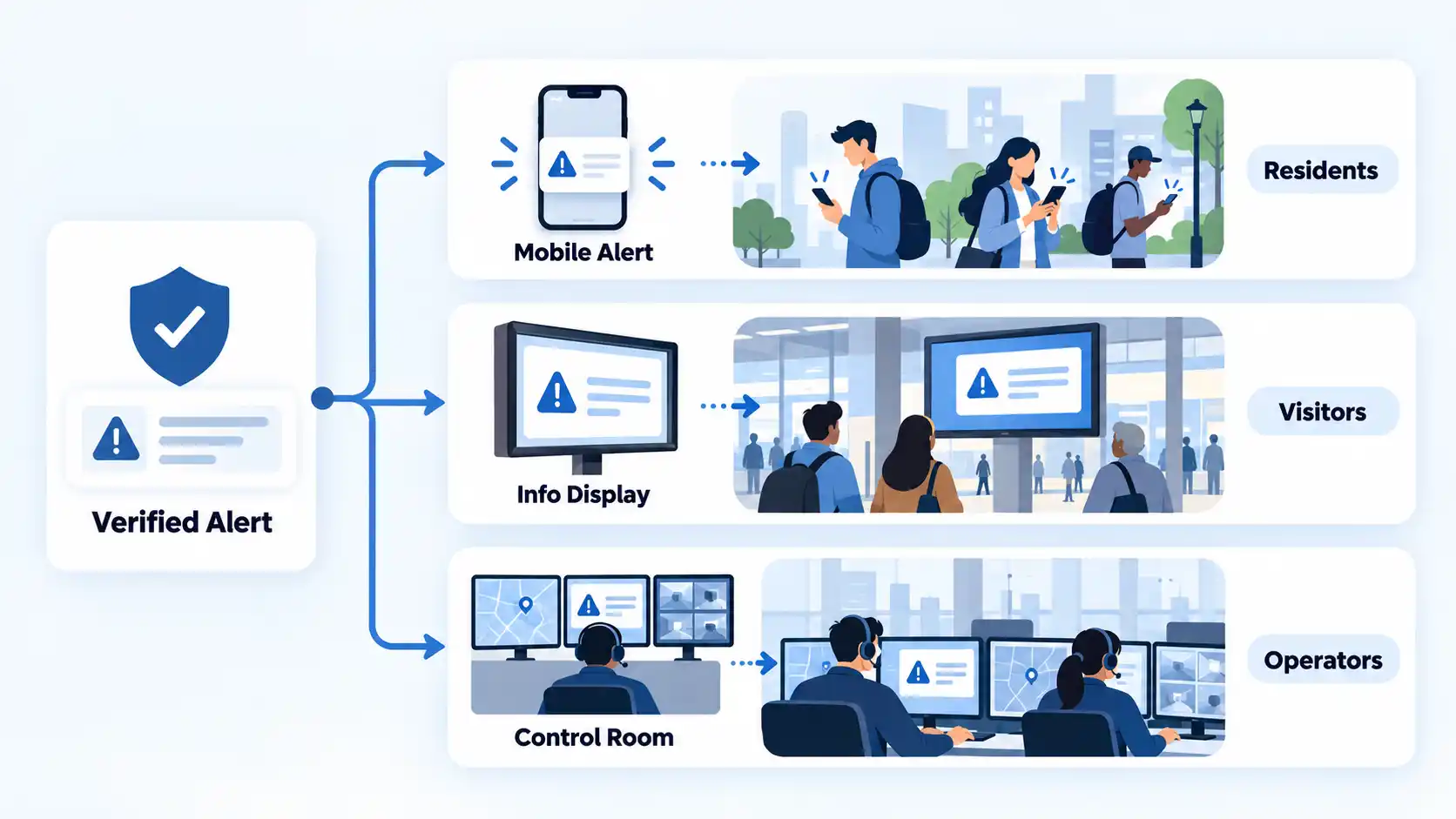
Using several communication channels can help reach people in different circumstances, but each has limits. Some people may not receive a mobile message, understand its language, hear an audible alert, or see a display.
Emergency communication planning therefore needs accessible messages, clear responsibility for issuing warnings, and suitable alternatives when one delivery method is unavailable. Different channels must also communicate consistent instructions so recipients are not told to take conflicting actions.
Public Address and Digital Signage Systems
A mobile warning may not reach everyone already inside a busy venue. Public address systems and digital signs can provide instructions directly to people in the affected area.
Public address equipment uses speakers to broadcast spoken messages. Digital signage uses screens to display information such as route changes, temporary closures, or emergency instructions.
At a transport station, an authorised operator might announce that a particular entrance is closed while digital signs direct passengers towards another available route. The two channels can reinforce the same instruction for people who may struggle to hear or see one of them.
These systems are particularly useful when instructions change as an incident develops. Messages can be updated to reflect new conditions, provided the operator has reliable information and the authority to issue them.
However, instructions must be understandable in their surroundings. Background noise, unclear wording, poor speaker placement, and screens outside people’s view can interfere with communication.
Recorded announcements can help deliver consistent wording, but they cannot account for every situation. Trained staff must be able to issue appropriate instructions when conditions change, especially when a planned route or gathering point becomes unsafe.
Emergency Call Points and Panic Buttons
Not every emergency is detected by a camera or sensor. Sometimes the first person to recognise danger is a visitor, employee, or member of the public who needs a direct way to request help.
Emergency call points and panic buttons provide a way to notify an authorised responder. They may take the form of a fixed help-point unit, a wall-mounted alarm button, or an approved mobile application used by on-site personnel.
A staffed car park may provide a clearly marked help point that connects a visitor with a control room. When someone activates it, the system may identify the call point’s location and allow staff to assess the situation.
What happens after activation depends on the equipment. Some call points allow two-way voice communication, while simpler systems transmit only an alarm signal. Users should not assume a device contacts public emergency services when it actually notifies only local staff.
A call point has limited value when alerts go to an unattended console or an unavailable operator. Public installations therefore need an established receiving point, clear operating responsibility, accessible placement, and regular maintenance.
In areas with unreliable mobile coverage, a dedicated and appropriately connected help point may provide an alternative way to request assistance. Its communication link and backup arrangements should be considered alongside the needs of the people expected to use it.
Environmental Hazard Monitoring Sensors
Public safety involves more than crime prevention. Flooding, smoke, extreme heat, and other environmental hazards can make roads, buildings, and shared outdoor areas dangerous.
Environmental sensors collect measurements about specific conditions. Depending on the installation, these may include water levels, temperature, air quality, or other indicators associated with a known local risk.
Water-level monitoring provides a useful example. The U.S. Geological Survey makes measurements from monitoring locations available to the public, helping people examine water conditions and changes over time.
At a flood-prone pedestrian route, an appropriately installed sensor could send water-level readings to a local monitoring system. When the reading reaches a threshold defined by the responsible authority, staff could assess whether to inspect the route, restrict access, or issue a warning.
The sensor does not make the route safe by itself. It supplies measurements that may support a decision, while an established response procedure determines what happens next.
Measurements also depend on sensor positioning, maintenance, calibration, and communication reliability. A reading from the wrong location or a malfunctioning device can give an inaccurate picture of conditions.
Crowd Monitoring and Occupancy Sensors
A venue can become unsafe when too many people gather in a narrow entrance, corridor, or standing area. Crowd monitoring helps organisers estimate attendance and identify where congestion is building.
Depending on the location, monitoring may involve ticket scans, entry counters, cameras, or dedicated people-counting sensors. These systems provide different kinds of information: some estimate how many people have entered, while others help staff observe movement or crowd concentration in a particular area.
At a stadium entrance, for example, monitoring may reveal that people are arriving faster than they can safely enter. Supervisors can use that information alongside observations from staff to decide whether queue arrangements or other established crowd-management measures need attention.
The UK’s Health and Safety Executive identifies entrances, exits, queues, stairs, and other potential bottlenecks as areas that deserve monitoring. Its guidance also distinguishes the total number of visitors from the way people are distributed across a venue.
That difference matters because a site may remain below its overall capacity while one entrance or standing area becomes overcrowded. In open spaces, counting is also harder because people can arrive and leave through several routes.
Technology should support staff rather than replace their judgment. People working within a crowd may notice distress, pressure, or movement problems that an overall occupancy figure does not reveal.
Connected Traffic and Emergency Vehicle Priority Systems
Traffic management can affect public safety when emergency vehicles need to travel through busy intersections or reach locations near large public events.
Connected traffic systems collect information about road conditions and can support changes to traffic signal timing. Some intersections also support emergency vehicle signal preemption, a system that temporarily changes a normal signal sequence to give an authorised emergency vehicle priority.
For example, a suitably equipped junction may respond to an approaching fire engine by changing its signal operation under an approved traffic-control design. Other road users must still receive appropriate indications, and the system must account for vehicles and pedestrians already using the intersection.
The Federal Highway Administration explains emergency vehicle signal preemption and traffic signal control, including how priority operations interact with normal intersection timing.
Changing one junction can affect traffic nearby, so priority systems require careful design and coordination. Their usefulness also depends on the route, traffic conditions, equipment coverage, and maintenance.
These systems can support emergency movement, but they do not guarantee faster arrival for every incident. An improvement needs to be measured against local operating conditions rather than assumed from the technology’s presence.
How Connected Safety Systems Work Together
Individual devices become more useful when their information reaches the people who can make decisions. A camera may show an obstruction, a sensor may detect rising water, and a call point may report an injured visitor. Each event needs an appropriate type of response.
Integration means connecting relevant systems so they can exchange information and support coordinated action. It does not mean every device should automatically control the others or that software should make all emergency decisions.
Consider a hypothetical flood warning at a public transport facility. The following sequence illustrates how connected systems could help staff manage the situation:
- Detection: A water-level sensor sends a reading suggesting that a monitored area may be approaching an unsafe condition.
- Assessment: An authorised operator checks the available information and follows the facility’s established emergency procedures.
- Communication: When a warning or closure is authorised, notification systems, speakers, and digital signs deliver appropriate instructions.
- Response: Responsible personnel secure or inspect the affected area where safe, assist people who need help, and coordinate with emergency services when necessary.
- Follow-up: Staff monitor changing conditions and update instructions before the area returns to normal use under the applicable procedures.
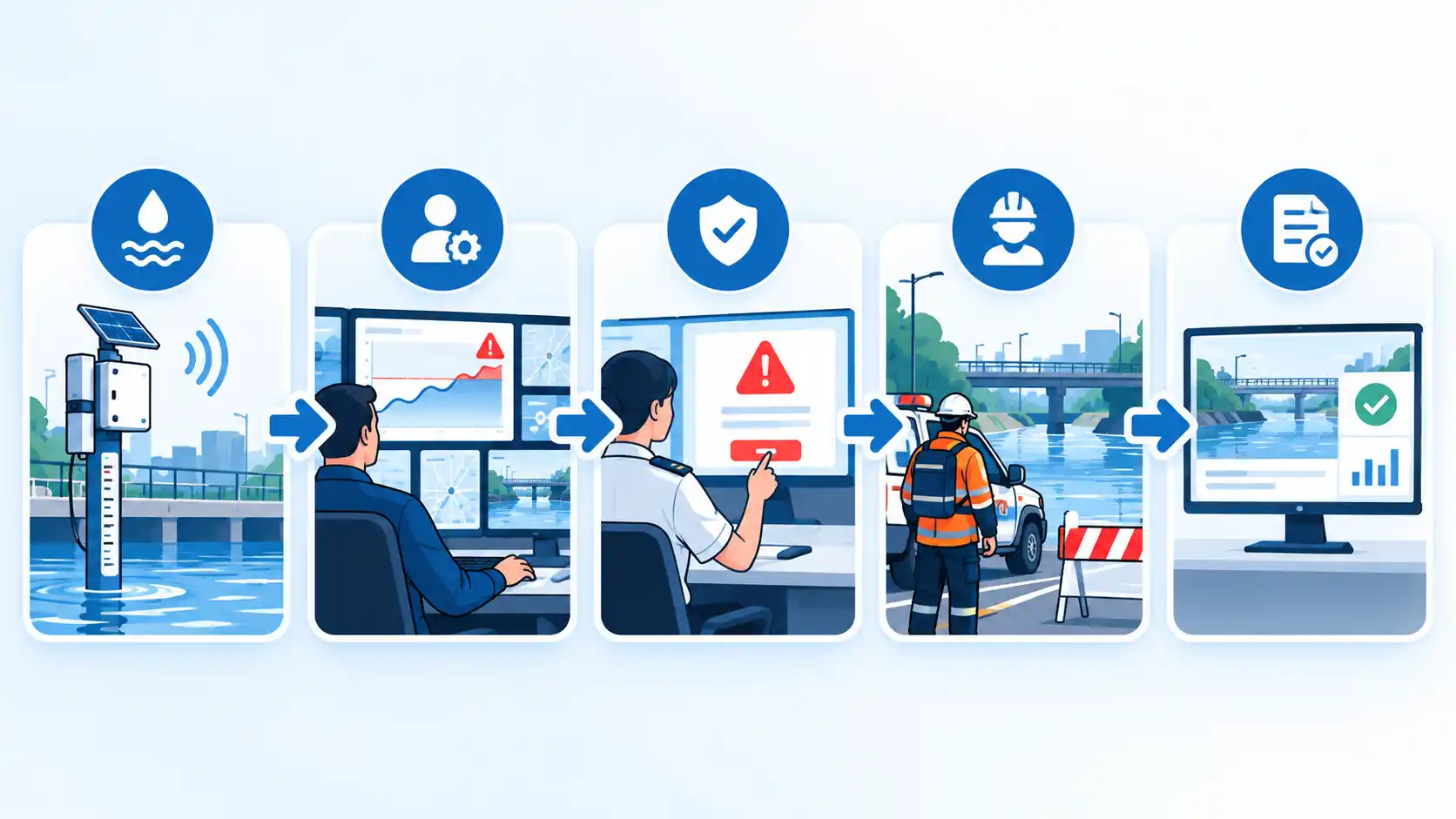
For this arrangement to work, alerts must reach the correct people, and staff must understand which events require immediate attention. Buildings and emergency responders may also need agreed ways to share relevant information. NIST has examined the technical challenges of connecting buildings to public safety networks.
Interoperability means different systems can exchange and use information appropriately. This can matter when a facility uses cameras, alarms, and other equipment from several manufacturers. Before purchase, operators should verify compatibility for the specific functions they need rather than assuming all connected products will work together.
Connection also introduces shared risks. A network failure may interrupt multiple alerts, repeated false alarms can distract operators, and weak security controls can expose sensitive footage or location data.
Facilities need clear rules for who can access information, how long it is retained, and which actions require human confirmation. They should also have suitable backup arrangements and staff procedures for dealing with power, communication, or system failures.
What Makes Public Safety Technology Worth Using?
Start with the hazard that needs attention, rather than the number of devices a supplier can install. A poorly lit park path, a crowded stadium entrance, and a road that regularly floods do not need identical solutions.
The proposed system should have a clear purpose: what it will detect or control, who receives its information, what action follows, and how the organisation will judge whether it has helped.
Cost, privacy, and maintenance deserve attention alongside performance. A U.S. Government Accountability Office assessment of smart city technologies identifies difficulties in measuring benefits and raises concerns about transparency and the handling of collected information.
A smaller installation with reliable monitoring and trained staff may be more valuable than a larger network that produces alerts nobody handles. Public-space operators should also consider accessibility, data protection, backup arrangements, and the resources needed to maintain the system.
When reviewing an existing installation, begin with its weakest operational point. If warnings regularly reach an unattended console, improve the alert-handling process before expanding sensor coverage. If visitors cannot understand emergency instructions, address communication before purchasing additional detection equipment.
Invest first where a known safety risk, a reliable technical function, and an accountable human response meet. Expand only when there is a reasonable way to evaluate whether the system improves the conditions it was installed to address.

💬 Comments