
Last year, Huawei demonstrated its commitment to mobile photography by launching the P20 Pro and, a few months later, the Mate 20 Pro, both featuring triple cameras co-developed with Leica, which have been praised numerous times. This year, Huawei has reaffirmed its commitment to photography with the Huawei P30 Pro, which builds upon the main improvements of the P20 Pro and Mate 20 Pro. We must look for them precisely on the camera, as we will see later.
Don’t miss reading the Apple iPhone 11 Pro Review.
Huawei P30 Pro Review
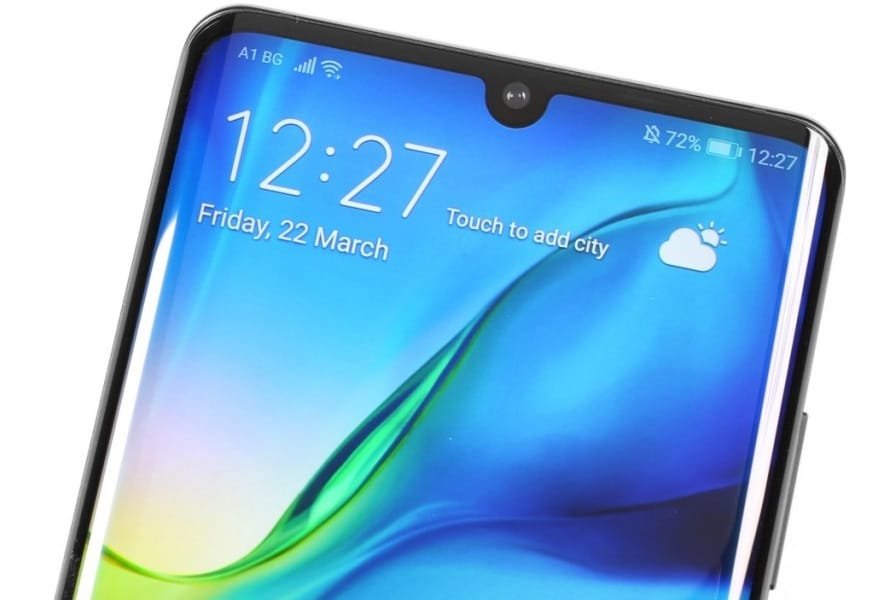
The Huawei P30 Pro maintains a design similar to that of its predecessor, with a large 6.5 ″ screen curved to the sides and occupying almost the entire front.
The screen is surrounded by a frame that is quite narrow and widens at the bottom, resulting in a more pronounced chin than other high-end smartphones.
According to Huawei, it is a design decision to favour grip and gestures, although I would have preferred an even narrower frame.
The glass back covers, also curved on the sides, are available in three finishes with striking gradient colours – Nacre, Aurora, and Amber – in addition to a serious and traditional Black colour. The model tastes pretty attractive, although fingerprints tend to be marked.
Huawei has decided to dispense with the 3D facial recognition present in the Mate 20 Pro, allowing it to considerably reduce the size of the notch, which now has the shape of a water drop. Instead, Huawei has opted for an integrated fingerprint reader on the screen, following this year’s trend, although it also offers simple facial recognition.
The fingerprint reader works well, although the unlocking process is somewhat slower than a conventional reader. The area where you must place your finger is small, and even with the Always-On screen active, it is not marked until you place your finger, making it difficult to hit the first one.
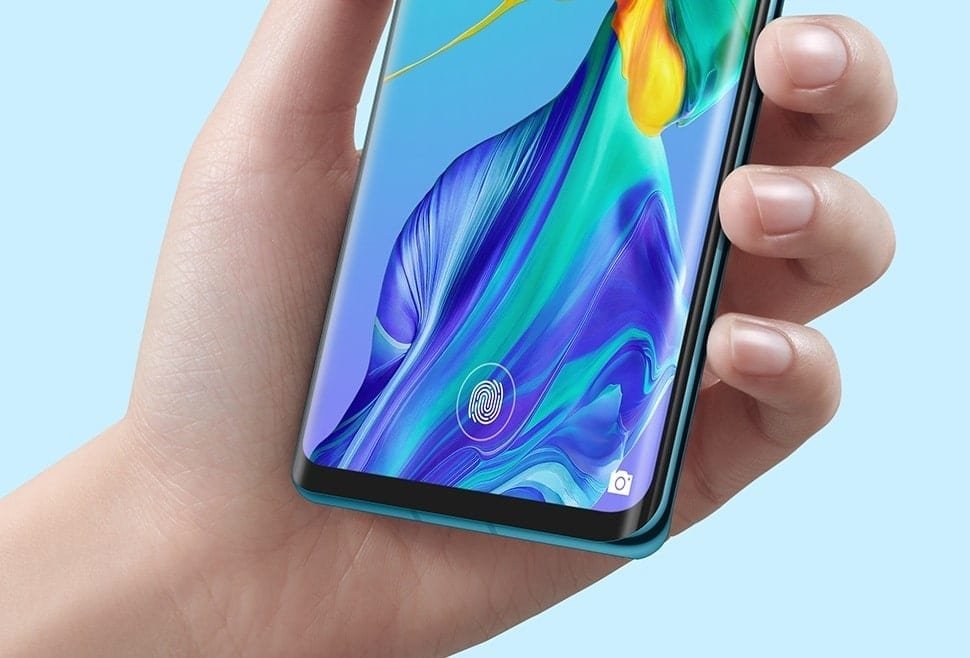
Another design innovation of the Huawei P30 Pro is its lack of an earpiece on the top. Huawei has equipped the P30 Pro with a screen that, when vibrating, brings the sound to your ear when you have your ear resting on the front. In practice, it works well.
Huawei has incorporated an OLED panel with Full HD+ + resolution, so you might wonder if it looks as sharp as Quad HD+ + panels. In my opinion, a density of 398 dpi is more than enough, even for an OLED panel with a Pentile matrix. Other smartphones with higher resolution panels typically operate in Full HD+ to consume less energy.
The P30 Pro screen is capable of displaying a wide range of colours. It not only covers the sRGB colour space but also the wider P3 Display space, commonly used in the film industry, and is compatible with HDR content.
In normal colour mode, the screen offers spectacular colour accuracy and pure white colour, without any colour tone. If we opt for the vivid colour mode, the colour accuracy worsens because, as the name itself indicates, the colours are oversaturated (although many people prefer unreal colours…).
The maximum brightness of the screen is around 592 nits (measured with the screen fully lit in white), indicating a high level of brightness, although slightly below that of some other high-end smartphones. Since it has an OLED panel, the black colour is pure and the contrast is very high (theoretically infinite).
The screen offers Always On Display mode that permanently displays the time and other data of interest, such as battery level and notification icons. It is possible to wake up the screen with a double-tap on it and have it turn on automatically when a notification arrives.
Processor
The Huawei P30 Pro features a Kirin 980 processor manufactured using a 7 nm process, which means it consumes less energy and is more powerful than processors from previous generations.
This processor has eight cores: two powerful Cortex-A76 high-performance 2.6 GHz cores, two high-efficiency Cortex-A76 cores at 1.9 GHz, and four Cortex-A55 cores with extreme efficiency at 1.8 GHz. Also, it has a dual NPU, which accelerates operations related to artificial intelligence.
The Huawei P30 Pro is accompanied by 8GB of RAM, which is more than enough to avoid problems when multitasking. In my experience, apps remain in memory, and unexpected closures do not occur.
In CPU benchmarks, the Huawei P30 Pro has obtained high scores, along with other high-end smartphones from last year, but below what the Snapdragon 855 or the Exynos 9820 offer today.
The 3D graphics performance is good, but it falls below other high-end smartphones in the benchmarks.
However, three demanding 3D games have been tried: Asphalt 9, Dead Effect 2, and PUBG. In all of them, very high average refresh rates have been measured, close to 30 or 60 FPS, depending on the limitations of the title.
Therefore, today, if you are fond of games, you will have no problem enjoying the most demanding 3D titles.
The Huawei P30 Pro is available with 128, 256, or 512 GB of storage, so there is a model that suits your needs. Huawei has added the possibility of expanding storage, but instead of using a micro-SD card, it has opted for a proprietary format called NM Card that offers an expansion of up to 256 GB.
In terms of connectivity, the Huawei P30 Pro is well-equipped with WiFi 802.11 b / g / n / ac (Wave 2), Bluetooth 5 (compatible with aptX, aptX HD, LDAC, and HWA), 4.5G / LTE, an infrared transmitter, and NFC.
Battery
The Huawei P30 Pro has a large 4,200 mAh battery that has obtained good autonomy compared to other high-end smartphones.
Also, it has the SuperCharge 40W fast charge that allows you to fully recharge your phone in less than 1 hour, along with wireless charging at 15W. Interestingly, the Huawei P30 Pro is also capable of wirelessly charging other smartphones, although it makes the process quite slow.
In the multimedia aspect, it should be noted that Huawei has incorporated Dolby Atmos-compatible sound when using headphones, but the smartphone lacks a 3.5 mm jack. and therefore does not offer FM radio either. We did not find stereo speakers, but the only speaker present is the one next to the USB-C connector.
Focusing on the phone software, Huawei incorporates its customisation layer, EMUI 9.1, on Android 9 Pie, which benefits from the optimisations Huawei made compared to previous versions.
EMUI adds a large number of features that complement Android, such as a carousel of wallpapers, additional energy-saving modes, additional application permissions, one-handed operation, twin application, private space, application lock, file safe, and the ability to project in desktop mode wirelessly or back up.
In my opinion, the aspect where EMUI fails is in its aesthetics, which looks somewhat dated compared to other layers of customisation. However, the company is making progress, and some icons have been redesigned for the better.
Camera
Focusing on the star section of photography, Huawei has incorporated a quad rear camera developed in collaboration with Leica.
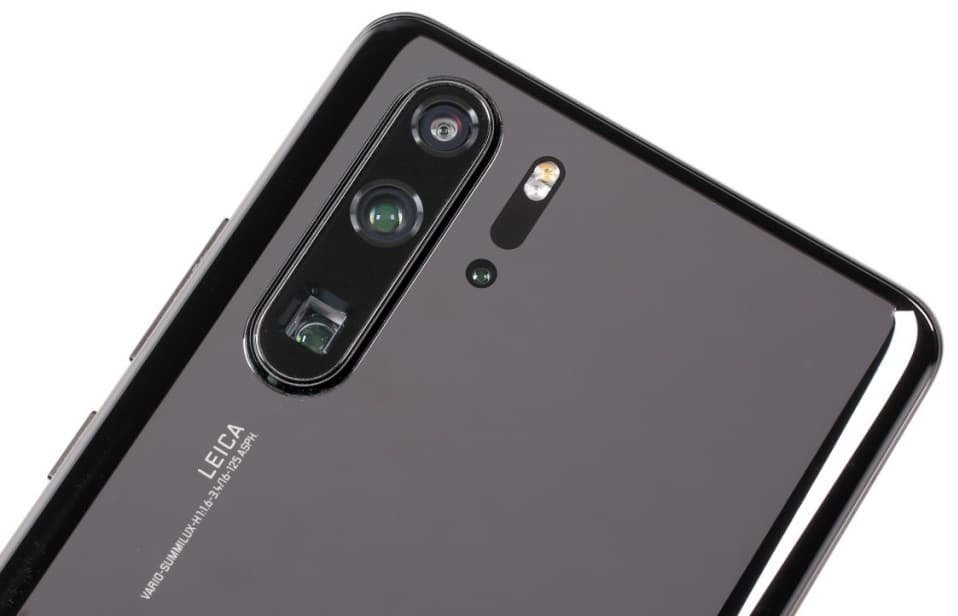
The quad-camera is made up of a 40 MP main camera (f/1.6) with optical stabilisation and a new SuperSpectrum sensor capable of capturing more light, an ultra-wide 20MP camera (f/2.2), and an 8 MP telephoto camera with 5X optical zoom (f/3.4) and optical stabilisation. Also, Huawei has added a fourth ToF camera to measure distances.
Starting with the main chamber, its performance in sufficient light conditions is good, although on certain occasions, the processing plays a trick, resulting in photographs with unnatural colours (usually orange) or an unnatural appearance. However, these occasions are the least.
When light is scarce, the new sensor demonstrates its capabilities, as the photographs have a lower level of noise compared to other rivals and maintain a wide dynamic range. The Night mode has also been improved and is capable of taking long-exposure photographs without a tripod, once again surpassing other high-end smartphones.
The presence of an ultra-wide-angle camera brings great versatility, especially when capturing monuments and buildings or taking group photographs without having to get too far away. In travel, it becomes a perfect ally.
Another star feature of the camera is the periscopic lens, which offers 5X optical zoom, 10X hybrid zoom, and 50X digital zoom. Thanks to this camera, we can capture details that we could not have imagined capturing with a mobile until now.
The only drawback of such a high optical zoom is that any zoom level lower than 5X is achieved by expanding the image captured by the main camera through software. Therefore, if you only need to zoom in to 2X or 3X, the quality is lower.
The last camera is the ToF depth camera that will help achieve a more natural blur effect on portraits when activated via an OTA update. In tests, the portraits look quite natural and, although certain areas of the hair remain a challenge, the result is very satisfactory even without the ToF camera running.
When recording video, the Huawei P30 Pro offers 4K recording at 30 fps and 1080p at 30/60 fps, but, for the moment, there is no trace of 4K recording at 60fps. The recording has good quality and the stabilisation is excellent.
Huawei has included some curious modes that squeeze the AI capabilities to the fullest, such as the Colour AI mode, which leaves the entire scene black and white but keeps people in colour, and the Blurred Background mode, which applies the bokeh effect to video recordings.
The front camera has a resolution of 32MP and captures selfies with good quality as long as we are in good light conditions. It allows you to take selfies in Portrait mode and, of course, apply a beauty effect.
Price
The Huawei P30 Pro is on sale for an official price of $685.00 (128GB), $733.99 (256GB), and $947.99 (512GB) and can be purchased online.
Here, you can find my Huawei P30 Pro in-depth Review, Price and Opinion. Don’t hesitate to read it.
If you liked the analysis, share the article on your social networks.

💬 Comments