You cannot hear a spec sheet on a train. A 300-ohm open-back that turns a quiet desk into a small concert hall falls apart on a bus: it leaks your music to the row behind, lets the engine in, and asks for more voltage than a phone can supply. Put a sealed, easy-to-drive pair in the same bag and the same tracks finally land.
That one comparison explains most disappointing purchases. The two costliest mistakes look like opposites. One listener carries a studio reference home for relaxed evening listening and finds every compressed master exposed. Another buys a bass-forward sealed model for orchestral recordings and wonders why cellos sound thick and the hall has vanished. Both bought a headphone that matched a reputation instead of a room.
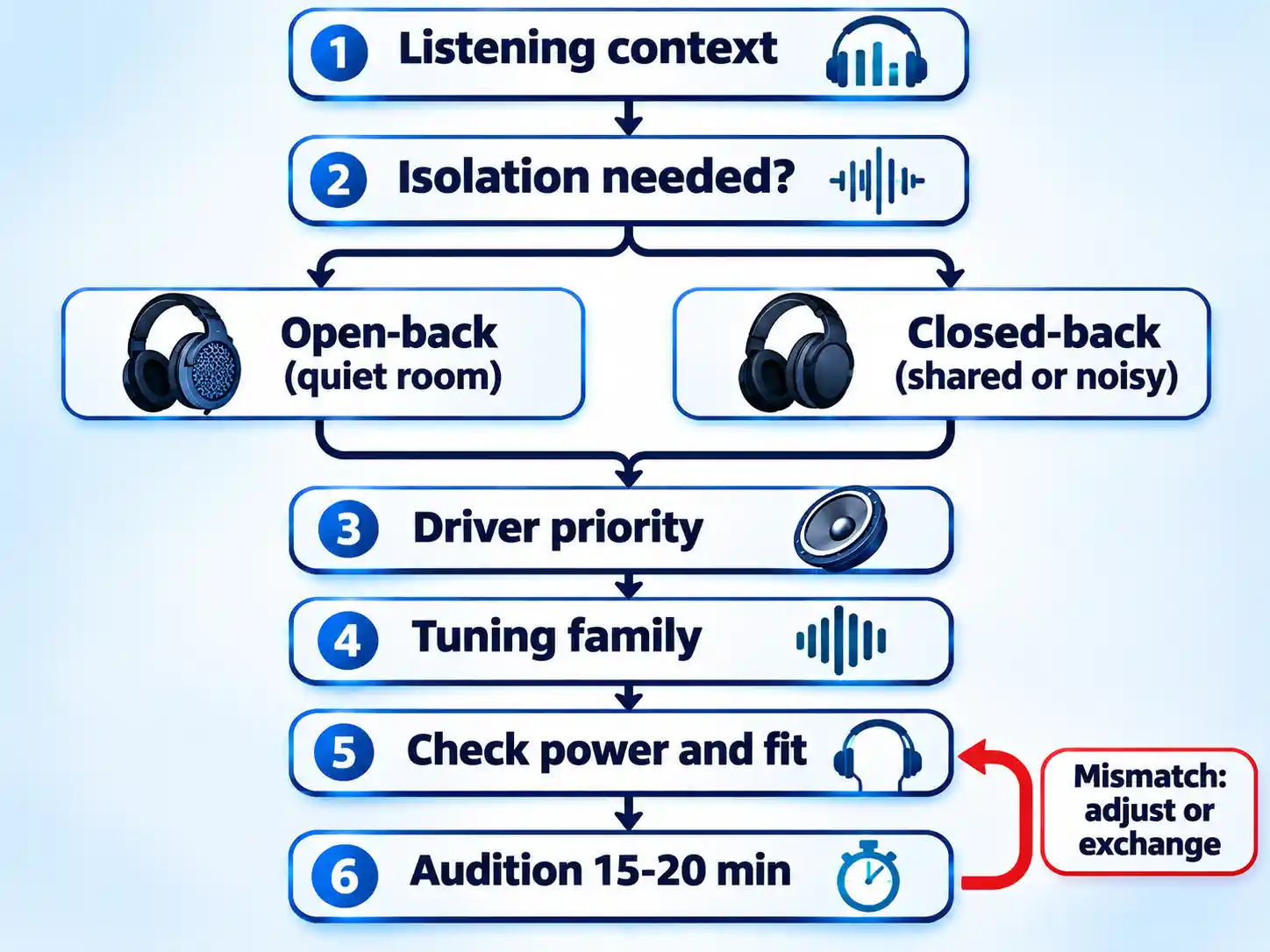
Work the filters in order: enclosure for where you listen, driver for the strengths your music rewards, tuning for your library. Then verify power and fit before money changes hands.
Quick Take
- Quiet room, acoustic, classical, jazz: open-back with neutral-to-balanced tuning, wired, and amp headroom if the load is high.
- Commute, hip-hop, EDM: closed-back with bass extension or a V-shaped tuning, plus either active noise cancellation or a strong passive seal.
- Rock, metal, dense mixes: balanced tuning with clear mids and controlled treble; your room settles the enclosure and the genre only refines the tuning.
- Multi-hour sessions: weight, clamp force, headband design, and pad material outrank a small tuning difference you may never notice after hour two.
What You Need Before You Start
Prerequisites
- A written answer to “where will these live?” — room noise, other people within earshot, and how many hours a day you wear them.
- The exact source you will plug into: phone, laptop jack, USB dongle, desktop amp, or a wireless codec you can live with.
- Five or six familiar test tracks across genres, including at least one recording you know is thin or bright.
- A budget ceiling that includes a possible amp or replacement pads, not just the headphone.
- A confirmed return or exchange window with the retailer, because fit problems show up late.
Build a Headphone Shortlist in Seven Ordered Steps
Each step removes candidates that cannot work for you, so the list gets shorter and more specific as you go.
- Describe your listening context in writing. Note the room’s noise level, whether music leaking out will bother anyone, whether incoming noise ruins the listen, your daily wear time, and the device that will drive them. If a train, shared office, or open-plan desk appears anywhere on that list, treat isolation as a hard requirement from here on.
- Lock the enclosure before you read a single review. Choose open-back when the room is quiet, you want width and natural decay, and you accept that sound travels both ways. Choose closed-back when isolation, privacy, and bass reinforcement matter more than stage width. You should be able to name your enclosure and the reason in one sentence.
- Decide what you want the driver to do. Dynamic designs typically bring punch, low weight, and easy drive; planar designs typically bring speed, even bass, and low distortion at the cost of weight and current draw. Write down which of those you would actually pay for.
- Name one tuning family you like and one you can live with. Pick a primary and a fallback from the signature glossary below, then only compare models that sit inside those two families. This single step kills most impulse buys.
- Build a shortlist of three archetypes. Use the archetype table to pick three candidates that each pass your enclosure, tuning, and power filters. If a candidate fails any one of the three, drop it and take the next archetype. Three different acoustic approaches teach you more than three variations on the same idea.
- Check the numbers that decide driveability and comfort. Look up impedance, sensitivity, weight, and pad material. High impedance paired with low sensitivity usually needs dedicated amplification, and a source whose output impedance sits high relative to the headphone’s load can bend the frequency response. Headband construction carries as much load as the figure on the scale: a suspension strap spreads pressure across a wide band and keeps the crown of your head clear, while a single padded strap concentrates it in one spot. A heavy pair deserves a long try-on before you commit.
Open-Back vs Closed-Back: Pick the Room First
Open-back designs vent the rear of the driver to the air. That venting is why the stage widens and decay sounds natural: the cup is not trapping pressure, so instruments seem to sit around your head instead of inside it. The cost is total. Isolation is close to zero, music leaks outward, and room noise walks straight in. Long sessions benefit because pressure never builds inside the cup, which is one reason open models stay comfortable through extended sessions for many listeners.
Closed-back designs seal the chamber. You get real passive isolation, a more contained image, and low frequencies that feel pressurized and physical. The sealed air also traps heat and can color the sound with cup resonance. If you listen within earshot of other people, a sealed pair becomes the honest choice, however good the open one sounds in a showroom.
| Design | Stage and decay | Isolation and leakage | Bass character | Long-session comfort | Fits these situations |
|---|---|---|---|---|---|
| Open-back | Wider, out-of-head presentation with longer, more natural decay | Near-zero isolation; your music leaks out and room noise leaks in | Less reinforced; can sound leaner than a sealed equivalent | Air moves through the cup, so pressure and heat build slowly | Quiet rooms, critical listening, acoustic, classical, jazz, mixing |
| Closed-back | Narrower stage with a more in-head image | Meaningful passive isolation; keeps music in and noise out | Sealed air reinforces sub-bass, so electronic and hip-hop feel more physical | Warmer ears and faster heat buildup; clamp force matters more | Commutes, shared offices, noisy rooms, tracking, bass-led genres |
Dynamic vs Planar Magnetic: What the Driver Actually Changes
A dynamic driver attaches a voice coil to a diaphragm and moves it from the center. That geometry is cheap to build, efficient, and light, and it tends to produce bass with punch and warmth. Above the midrange, the diaphragm can break up in ways that show as response irregularities, which is part of why tuning decisions matter so much.
A planar magnetic driver suspends a flat diaphragm with embedded conductors between magnet arrays, so the whole surface moves together. The result is typically low distortion, fast transients, and bass that starts and stops with unusual grip. The trade-offs are physical: planar models often weigh more, and some present a load that punishes a weak source. Some planar designs also measure flatter low-frequency response than a typical dynamic counterpart, which is a useful tendency to know and a poor guarantee to shop by.
Info
Driver type sets a starting point, and implementation decides the rest. A good dynamic and a good planar in the same price class simply sound different, so judge the measured response and your own listening impression rather than the word on the box. A planar can be tuned dark and a dynamic can be tuned bright.
| Driver | How it moves | Likely strengths | Likely trade-offs | Source demand | Best fit |
|---|---|---|---|---|---|
| Dynamic | Voice coil attached to a diaphragm moving in a magnetic field | Punch and warmth, efficient, light, inexpensive to build | Diaphragm breakup can roughen the top end; bass can thicken | Usually comfortable from a phone or laptop jack | Portable listening, first serious pair, rock, pop, hip-hop |
| Planar magnetic | Flat conductor-laden diaphragm driven uniformly between opposing magnet arrays | Fast transients, low distortion, even and controlled bass | Often heavier, sometimes current-hungry, less tolerant of weak sources | Verify sensitivity and amp headroom before buying | Quiet-room detail listening, jazz, classical, electronic with tight bass |
Match the Tuning to Your Library
A sound signature describes how a headphone balances bass, midrange, and treble. Those categories overlap and no universal threshold separates them, so use them as shorthand with a seller or a review and let your ears settle the argument. Enclosure and pads change the outcome too: a sealed cup reinforces low frequencies, an open cup releases them, and swapping velour pads for leather can shift the tonal balance before you touch a single setting.
Manufacturers increasingly tune toward published preference targets, and the best known is the Harman target curve, which grew out of Sean Olive’s listener research at Harman International. In practice that curve reads as a gentle bass shelf below 200 Hz, a flat midrange, and a controlled treble peak near 3 kHz. Treat a target-tuned model as its own family sitting between strict neutrality and consumer-friendly color, and shop on the measured response plus a listening session. A marketing page tells you less than the curve and your own library.
| Signature | What you hear | Suits | Watch for |
|---|---|---|---|
| Neutral / flat | Even balance from bass to treble with nothing pushed forward | Mixing, reference listening, classical, acoustic | Unforgiving of thin or compressed masters; can feel plain for casual fun |
| Balanced | Broadly even with small lifts where music needs them | Mixed libraries, one-pair buyers, pop and rock | Less character than a dedicated tuning; still varies model to model |
| Warm | Fuller low end with a smoother, softer top | Long sessions, jazz, acoustic, bright or older recordings | Can blunt attack and fine detail |
| Bright | Forward upper mids and treble with plenty of sparkle | Detail fans, string instruments, some electronic music | Sibilance and fatigue over long listens |
| Bass-heavy | Sub-bass and mid-bass pushed well forward | Hip-hop, EDM, gym sessions, commuting | Mids can sound recessed or muddy |
| V-shaped | Bass and treble lifted, midrange set back | Rock, pop, electronic, lively casual listening | Vocals and guitars lose prominence |
| U-shaped | Lifted ends with a shallower mid dip than V-shaped | Listeners who want energy and vocals together | Can drift toward boom and sizzle if badly executed |
| Analytical | Detail and separation prioritized, often with a bright lean | Producers, reviewers, critical listening | Tiring, and it exposes poor recordings |
| Dark | Treble rolled off for a relaxed top end | Treble-sensitive listeners, long sessions, warm rooms | Loses air and cymbal detail |
Headphone Archetypes by Environment and Music
Once the filters are set, the shortlist writes itself from a handful of archetypes. A bedroom producer mixing in a quiet room wants an open-back with neutral tuning and enough amp headroom for the load — the Sennheiser HD 560S and HD 600 are the familiar reference examples, and the HD 600’s 300-ohm load needs a better source than a laptop jack, while an easier load such as the HD 599 runs from modest hardware. A commuter listening to hip-hop wants a sealed dynamic pair such as the Audio-Technica ATH-M50x, where the closed cup adds weight to the low end and the outside world stays outside.
Someone chasing separation in dense jazz or orchestral recordings can justify a planar open-back such as the HiFiMAN HE400se or Sundara class, provided the source can deliver current and the extra weight is acceptable for a long sitting. These models illustrate each archetype; check current specifications before you buy, and treat any single review as one data point.
| Archetype | Where it works | Music priority | Typical listener | Budget tier | Watch for |
|---|---|---|---|---|---|
| Open-back dynamic, neutral | Quiet room, desk or sofa | Classical, jazz, acoustic, reference listening | Bedroom producer mixing, critical listener | Value to mid | Needs amplification as impedance climbs; no isolation at all |
| Open-back planar | Quiet room, dedicated listening chair | Instrument separation, fast bass in jazz and electronic | Detail-focused audiophile | Mid to premium | Weight and current draw; confirm your source before ordering |
| Closed-back dynamic, isolating | Commute, shared office, tracking desk | Hip-hop, EDM, rock, bass-led listening | Commuter, everyday listener, recording musician | Value to mid | Heat and clamp over long sessions; pad swaps change the tuning |
| Closed-back wireless with ANC | Travel, open-plan office, walking | Streaming pop, podcasts, bass-heavy playlists | Traveler, hybrid worker | Mid to premium | DSP tuning and codec support vary; wired mode may sound different |
| Balanced all-rounder, open or closed | One pair for everything | Mixed library, gaming, calls | First serious buyer with a broad library | Value to mid | Trades peak strength for flexibility; plan to use EQ |
Budget tiers here are relative planning bands rather than fixed figures, since pricing shifts with generation and region. Compare current listings in your own market before you set a ceiling.
Verify the Match Before You Commit
Run these checks as soon as the pair is on your head. A failure at this stage means handing the pair back.
Verify the result
- Isolation holds: on a closed-back pair at normal volume, a person nearby hears nothing intelligible. If they can follow the lyrics, the seal or the design is wrong for a shared space.
- Leakage is acceptable: on an open-back pair, whoever shares the room can hear your music and you have decided that is fine.
- Loudness headroom exists: your phone or laptop reaches a satisfying level well below maximum volume, leaving room for quiet recordings and dynamic peaks.
- The comfort clock survives its first trial with no hotspot on the crown, no pressure in front of the ears, and no heat spike.
- Glasses, earrings, and hair sit clear of the pad seal without breaking isolation.
- Bass notes start and stop cleanly, and vocals sit where you expect them on tracks you know by heart.
- The return or exchange window is confirmed in writing before the packaging goes in the bin.
Warning
Open-back headphones provide near-zero isolation and leak in both directions, so they are the wrong purchase for a commute, a shared office, or a room where someone else is trying to concentrate. Separately, a high-impedance or low-sensitivity model plugged into a phone jack will sound thin and quiet; treat that as a power problem to solve before you blame the headphone.
Troubleshooting Common Mismatches
The bass vanishes at low volume
Check the seal first: glasses, hair, and a loose pad can bleed away low frequencies on a closed-back pair. If the fit is sound, suspect source power, especially with a planar or a high-impedance model. Try a stronger source or a portable amp before blaming the tuning, and exchange the pair only if bass stays weak at healthy volume on a known-good chain.
Everyone nearby can hear my playlist
That is the open-back design working as intended. If the room is shared, no pad swap or accessory fixes it. Move to a closed-back model, ideally one with active noise cancellation if the environment is loud in both directions.
Cymbals and “s” sounds turn harsh after a while
You are probably on a bright or analytical tuning. Try a warm or dark alternative, a slightly warmer pad if the model supports swaps, or gentle EQ in the upper midrange if your source offers it. If nothing settles, exchange the pair rather than training yourself to tolerate it.
Plenty of volume, but everything sounds flat and thin
This is the classic underpowered load. Confirm the impedance and sensitivity, then check whether your source can deliver enough voltage and current. A competent amp for a difficult load costs less than a second headphone, and an easier load may suit your existing gear better.
Hot ears and a headache during longer sessions
Work through geometry before sound. Flex the headband to ease clamp, extend the cups so the pads sit around the ears instead of on them, and check the headband type: a suspension strap spreads weight over a wider area and takes pressure off the crown, while a single padded band puts it all in one place. Consider breathable velour pads if the model allows swaps. When adjustment fails, exchange for a lighter closed-back with lower clamp force. If pain persists after those changes, stop wearing the pair and speak to a qualified professional rather than pushing through it.
The stage feels narrow and crowded
Sealed cups trade width for isolation, so a closed-back will always image more inside your head than an open pair at the same price. If width matters most and the room is quiet, an open-back is the correct fix. If the room is not quiet, accept the trade and look for a closed model with clean separation instead.
What to Ignore
- Driver diameter as a quality signal. Larger diaphragms move more air, yet tuning and material quality decide the result. A bigger number on a box rarely predicts a better listen.
- Burn-in as a purchase step. Do not budget time or money for it, and treat a claim that a headphone “opens up after a long break-in” as a reason to keep shopping.
- Upgraded cables and plated connectors. Put that money toward a competent amp or a better-fitting model instead.
- “Planar is always better.” A good dynamic and a good planar differ in character. Implementation decides the outcome.
- Studio as a badge of quality. A reference tuning is designed to expose flaws. That is valuable for mixing and tiring for relaxed listening.
- Fashion-first models with no tuning information. If the maker will not tell you how it sounds, you are guessing with your money.
Music Analysis Resources
Before you compare candidates, build a test set of recordings whose production you already know. thegreatestsong.com looks at individual songs and the choices behind them, which makes it easier to notice how a specific mix behaves on a specific pair. Ted S., a tech expert from The Greatest Song blog, writes about the people and gear around those recordings, and that context helps when you want reference tracks that stress a system in useful ways.
The Bottom Line
If you are stuck between two models, let your worst listening environment break the tie. The pair that survives a noisy commute or a shared desk is the pair you will actually use; the one that only works in silence belongs to a different buyer. Judge candidates inside your chosen enclosure, then let tuning settle the remaining choice.
Key Takeaways
- The room has veto power: any headphone that fails your isolation requirement is disqualified regardless of how it measures.
- Impedance and sensitivity belong in the purchase decision, because the source is part of the system you are buying into.
- Fit is a specification: weight, clamp, headband design, and pad material decide whether a good-sounding pair ever gets worn through extended sessions.
Your first proper listen with the pair on your head settles more than a stack of reviews. Buy where returns are easy, keep the packaging until the seal and the clamp have both proven themselves, and you will spend your money once.

💬 Comments