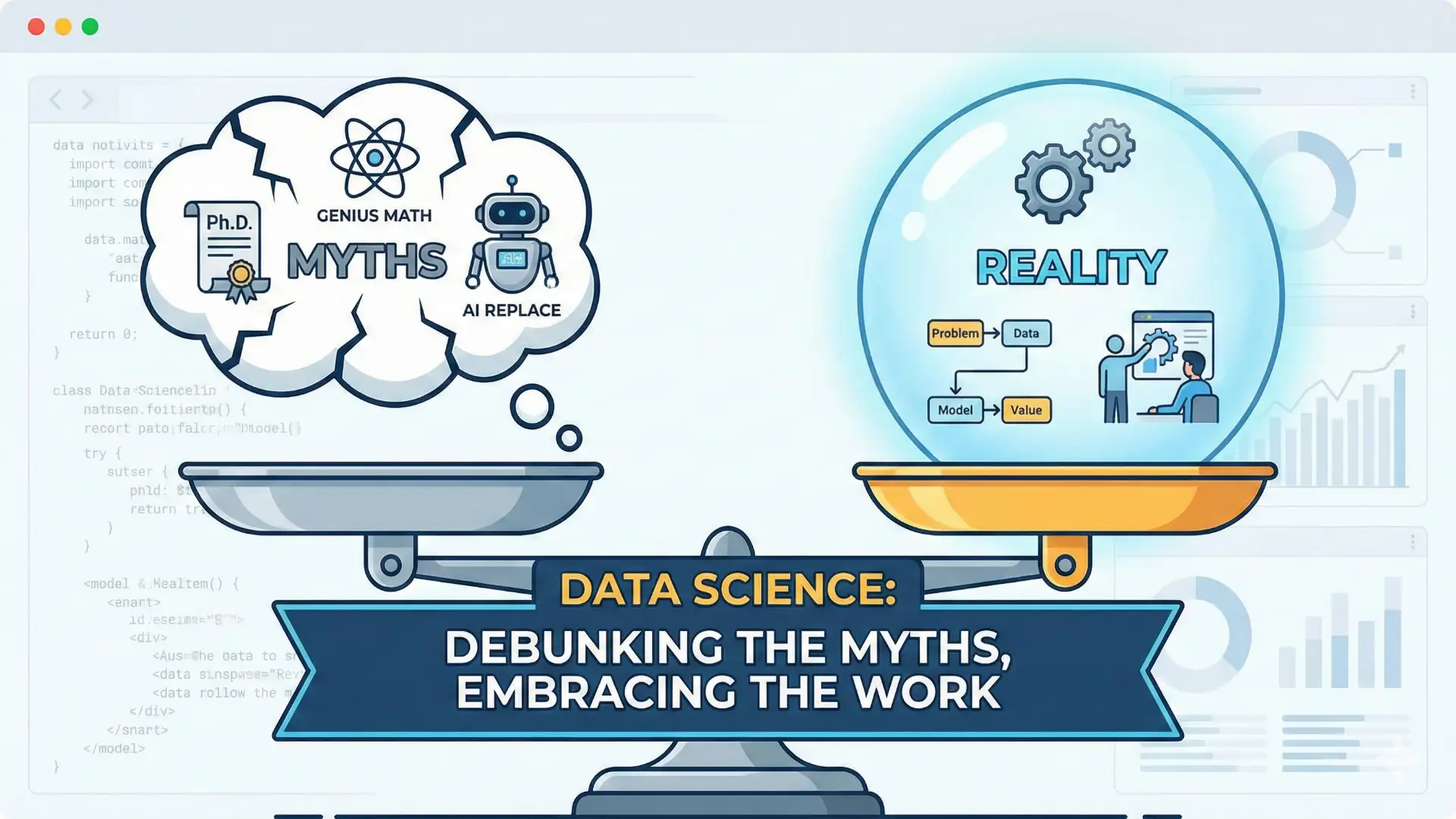
Data science looks intimidating from the outside, so myths spread fast—especially around degrees, tools, and “genius-level” math.
This update replaces vague claims with practical guidance, and it gives you a simple way to verify what’s true for the kind of data role you actually want.
Quick take (read this first)
- Data science is a learnable craft: you build skill through projects, feedback, and repetition—not “innate talent.”
- Many roles don’t require a Ph.D., but requirements vary by employer and job family.
- Tools and models matter, but the workflow (problem framing → data work → evaluation → deployment) is what makes work valuable.
- SMEs can benefit from analytics; you don’t need enterprise scale to make better decisions.
- AI is changing the work, not deleting the need for people who can define problems, validate outputs, and manage risk.
1) “Data science requires an innate ability.”
Why people believe it: Early results can look like magic (especially when someone demos a polished model).
What’s true: Most progress in data work comes from learnable habits: cleaning messy data, asking better questions, and validating results.
Do this instead: Start with one repeatable workflow and use it on 3–5 small projects; if you need a starter roadmap, build it around a beginner-friendly data science learning plan.
How to verify (fast): Pick any real dataset and time-box 60 minutes: can you define a question, check data quality, and produce a chart + explanation? If yes, you’re already doing “data science” in the practical sense.
2) “You need a Ph.D. to become a data scientist.”
Why people believe it: Some teams hire for research-heavy roles, and those often prefer advanced degrees.
What’s true: Degree expectations vary, but one credible baseline is the U.S. Bureau of Labor Statistics’ Occupational Outlook Handbook entry for data scientists, which describes typical entry education while noting some employers may prefer or require graduate study.
Do this instead: Decide which lane you want before you over-invest: analytics-focused roles usually reward strong SQL, clear communication, and business impact; research-heavy roles can reward deeper theory and publications.
How to verify (fast): Pull 20 job postings for your target title in your region and count how often “Ph.D.” is truly required vs “preferred.”
3) “If you don’t have a CS/math/statistics background, you can’t do data science.”
Why people believe it: The loudest content online often focuses on machine learning and advanced math.
What’s true: You can transition from many backgrounds, but you still have to learn the fundamentals—just in the order that supports your role.
Do this instead: Learn “minimum viable math” for your lane (probability basics, linear regression intuition, evaluation metrics), then go deeper only when your projects force the need; a good next step is a focused statistics guide for practical data work.
When not to use this approach: If you’re targeting research scientist roles, you’ll likely need deeper theory earlier.
4) “Data science is all about tools.”
Why people believe it: Tool tutorials are easy to market, and tool lists feel like progress.
What’s true: Tools are replaceable; your ability to frame problems, inspect data quality, and explain outcomes transfers across stacks.
Do this instead: Pick one stack and stick to it long enough to ship: SQL + one scripting language + one notebook environment is usually enough to start; if you need a sane default, use a starter tool stack guide and stop switching every week.
How to verify (fast): Look at job ads: they often list tools, but the responsibilities describe outcomes (dashboards, experiments, forecasting, stakeholder decisions).
5) “Data science is all about models.”
Why people believe it: Models are the flashy part, and demos rarely show data prep or stakeholder negotiation.
What’s true: In real projects, modeling is one phase inside a larger lifecycle—problem definition, data understanding, preparation, evaluation, and deployment all matter.
Do this instead: Use a simple process model to keep your work grounded; even an older but still useful reference like CRISP-DM’s six-phase project framework can stop you from “training models at random” without a business goal.
Failure scenario to watch: If you can’t explain what decision your model changes, you’re probably doing model-building as a hobby, not a solution.
6) “Data science is only for large businesses.”
Why people believe it: Big companies have bigger datasets, bigger budgets, and louder case studies.
What’s true: Smaller firms can use data analytics to understand operations, customers, and markets—often without building anything fancy.
Do this instead: Start with “boring wins”: reduce churn, improve inventory accuracy, shorten support response time, tighten marketing attribution; for a policy-level overview on why analytics matters for smaller firms, see the OECD’s report on data analytics in SMEs.
How to verify (fast): If you can measure a before/after outcome with decent data definitions, your company is “data-ready” enough to benefit.
7) “AI will replace data scientists.”
Why people believe it: Generative AI can write code, summarize data, and draft reports—so it feels like the whole job is automated.
What’s true: AI can accelerate tasks, but teams still need humans to define objectives, manage risk, validate outputs, and decide what should happen next.
Do this instead: Treat AI as an assistant inside a governed workflow: document assumptions, test outputs, and create review points; the NIST AI Risk Management Framework (AI RMF 1.0) is a practical reference for thinking about risk, oversight, and trustworthiness across the lifecycle.
How to verify (fast): Track AI-generated work like you would a junior analyst: spot-check with known truth data, unit tests, and peer review before it hits production.
Implementation checklist (beginner-friendly)
- Pick one problem with a measurable outcome (time saved, revenue protected, errors reduced).
- Write the decision you want to improve in one sentence.
- Audit data quality early (missing values, duplicates, time windows, leakage risk).
- Start with a baseline (simple rules or simple regression) before “big” ML.
- Validate in a way that matches reality (holdout by time, not random, when data is time-based).
- Ship something usable: a short report, a dashboard, or a lightweight script with clear inputs/outputs.
- Document assumptions and limitations so someone else can safely reuse your work.
Decision tree: what should you learn next?
Do you want a job where you answer business questions weekly?
  Yes → Learn SQL + dashboarding + experimentation basics → Build 3 stakeholder-style case studies.
  No  → Do you want to build predictive systems?
          Yes → Learn data prep + evaluation + deployment basics → Build 2 end-to-end projects.
          No  → Do you want research roles?
                  Yes → Go deeper on statistics/ML theory + papers + rigorous evaluation.
                  No  → Consider analytics engineering / BI / data ops tracks first.
Troubleshooting (common beginner stalls)
- “I’m bad at math.” You may be skipping intuition: learn metrics (precision/recall, RMSE) and what failure looks like before diving into proofs.
- “I don’t know what project to build.” Copy a real business workflow (support tickets, sales funnel, inventory) and improve one step with data.
- “I keep switching tools.” Freeze your stack for 30 days and focus on shipping; tool variety comes after outcomes.
- “My model looks great, but it fails in the real world.” Check leakage, time-split validation, and whether the deployment data matches training data.
- “Stakeholders ignore my work.” Lead with the decision and the trade-off, not the algorithm.
Key takeaways
- Data science is learnable—and most of the work is clarity, not cleverness.
- Degrees can help, but skills + proof of work + judgment move the needle across most roles.
- Tools and models are means; a repeatable lifecycle and good decisions are the goal.
- Small businesses can benefit by measuring and improving operations, not by chasing “AI.”
- AI speeds up tasks, but increases the need for validation, risk awareness, and accountability.
FAQ
What’s the difference between data science and data analytics?
Analytics is usually decision support (reporting, dashboards, experiments), while data science often includes building predictive or automated decision systems; in practice, teams overlap heavily.
Should I learn Python or SQL first?
If your goal is entry-level analytics work, start with SQL so you can pull and shape data; then add Python for automation, modeling, and reproducible analysis.
Do I need to master deep learning to get hired?
Not for most beginner roles; many jobs value clean data work, clear metrics, and stakeholder communication over advanced architectures.
How many projects should I put in my portfolio?
Aim for 2–4 projects that read like real work: clear goal, messy data, sensible baseline, validation, and a short “what I’d do next.”
What’s a “good” first model?
A baseline you can explain: logistic regression for classification, linear regression for forecasting (with simple feature engineering), or even rules if that’s enough to improve a decision.
How do I keep up with AI changes without burning out?
Anchor on fundamentals (problem framing, data quality, evaluation, communication) and treat new tools as optional accelerators—not prerequisites.
Where should I go next?
If you want a guided path, use a data science portfolio project template and build one project end-to-end before starting the next course.
For a broader view of how work and skills are changing, the World Economic Forum’s Future of Jobs Report 2025 page is a useful starting point.

💬 Comments