Twenty-idea lists are easy to write and hard to use. What you need going into 2027 is a short list you can actually test before money changes hands.
The five models below are worth testing. Treat 2027 as a planning frame, and treat every market figure as a category signal rather than a forecast for your business.
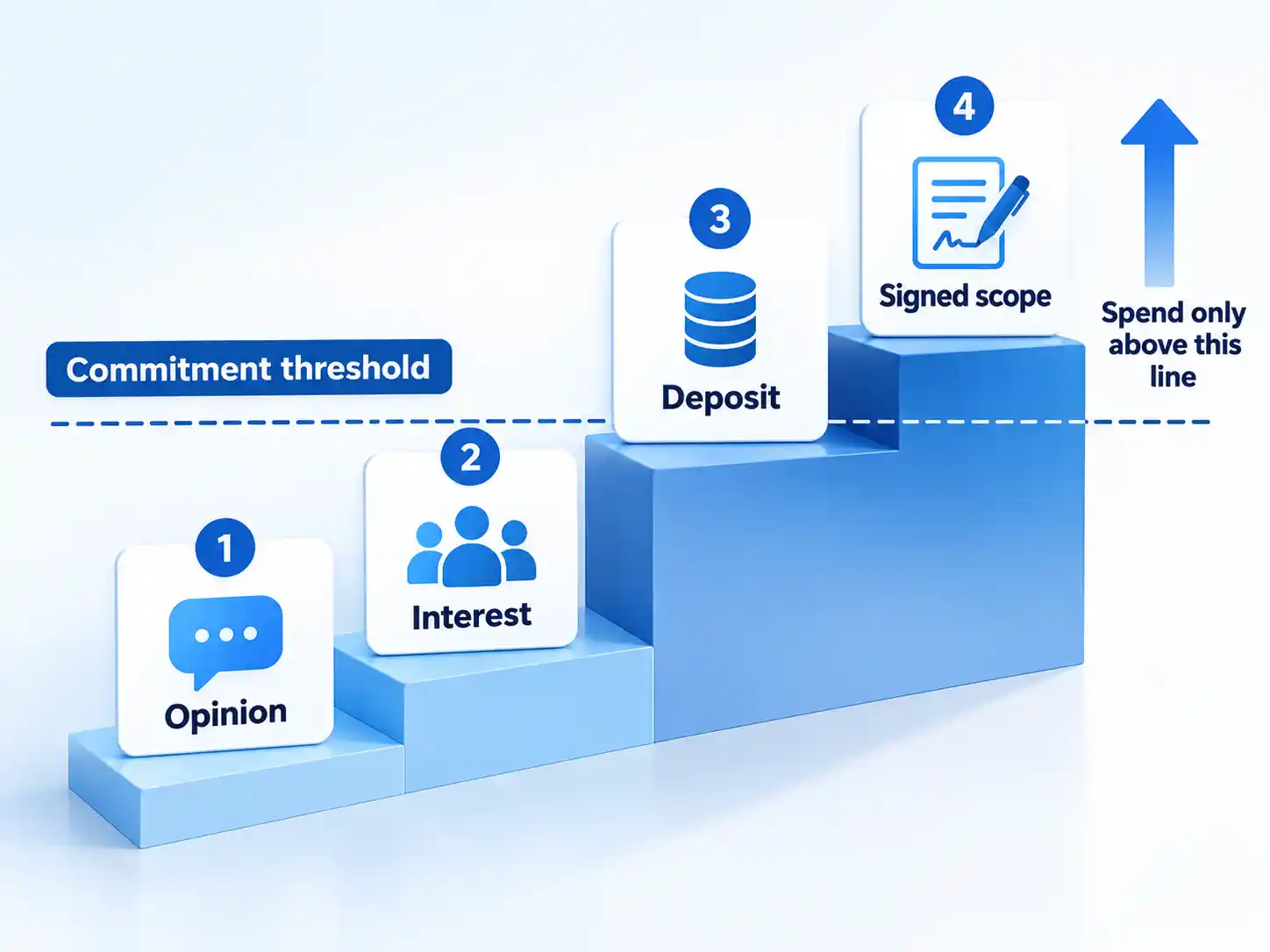
The rule running through all five: interest is cheap, commitment is evidence. A friend’s encouragement, a survey answer, or a stranger’s “that sounds cool” costs the person nothing. A deposit, a paid pilot, or a signed fixed-fee scope costs them something, and that cost is the signal worth reading.
Quick Take
Five models worth testing: a niche ecommerce product brand, an ecommerce product-research service, a small-business workflow automation service, marketing and revenue-operations automation support, and a launch-planning and market-research service. Each needs a specific buyer and a recurring problem. Pick the model that matches a skill you already have, write your pass line before you start, and walk away from any idea that produces encouragement instead of a payment.
Five home-business opportunities, defined
A home business here means a business model you can sell and deliver remotely, without premises or a storefront. That definition splits the five into two families, and the split matters more than the topic list.
One is an operator model: you build something and sell it repeatedly. Four are service models: you sell expertise and deliver it to a client. Operator models carry inventory and fulfillment risk. Service models carry client-acquisition and scope risk. Neither risk profile is easier; they fail differently.
The two automation ideas are also separate businesses. A workflow automation service fixes operations: intake, scheduling, invoicing, support routing. Marketing and revenue-operations automation support fixes campaigns, CRM hygiene, lead routing, and reporting. Different buyers, different access requirements, different measures of success.
| Opportunity | Target buyer | Recurring problem | Category signal | Delivery model | First test |
|---|---|---|---|---|---|
| Niche ecommerce product brand | A narrow community with a specific buying habit | The version they want is missing, compromised, or overpriced | Online buying keeps expanding | Small-batch or preorder storefront run from home | Preorder campaign requiring real deposits |
| Ecommerce product-research service | Sellers about to commit to a product category | Product selection is guesswork with an expensive reversal cost | Product-market fit is a common failure point | Fixed-scope research report plus a working call | Low-fee paid research sprint for two sellers |
| Small-business workflow automation service | Small firms drowning in repetitive admin | The same manual steps repeat every week across disconnected tools | Business automation is now mainstream | Audit, build, train, then maintain | Paid workflow audit with a written scope |
| Marketing and RevOps automation support | Marketing and revenue-operations teams | Campaign setup, CRM hygiene, and reporting repeat monthly | RevOps teams already rely on automation | One workflow on fixed fee, then a retainer | Single paid pilot workflow, invoiced up front |
| Launch-planning and market-research service | Pre-launch founders and solo operators | They need demand evidence and a competitive picture, not a template | Official guidance emphasizes market research | Fixed-fee research package plus a working session | Fixed fee for three founders, delivered in a week |
1. Niche ecommerce product brand
Target buyer and recurring problem
You choose one community with a narrow buying habit: a hobby, a trade, a gear obsession, a dietary constraint. Then you sell a product that community buys more than once. The recurring problem is usually a gap. The item they want exists only in a compromised version, so they substitute, modify, or overpay for the nearest thing.
Narrow is the point. Confirming demand inside a niche market before you invest in development is a smaller, more answerable question than whether ecommerce as a whole is growing.
Demand signal
Online buying keeps expanding, but that is a category signal. The narrower signal is a community already spending money on the problem and visibly settling for compromised options. Look for repeat purchases, workarounds, and complaints about the nearest available product. Those patterns justify a preorder test; they do not justify a bulk order.
How it works, constraints, and trade-offs
You source or make a small batch, sell through your own storefront, and let preorders pull inventory rather than guessing at demand and pushing stock. The work fits a home setup until volume forces a fulfillment partner.
Margin is where this model bites. Packaging, advertising, and payment processing all come out of the headline markup. A product that looks profitable at list price can be thin once those costs land.
- Cash sits in inventory before a single customer pays you.
- Returns and customer service are yours, including the awkward ones.
- Fulfillment either eats your evenings or eats your margin.
- Differentiation decays the moment a competitor copies a good idea.
The trade-off is optionality. You are buying a real asset with real downside, and changing your mind after the container ships is expensive.
Lean validation test
Run a preorder campaign before you place a bulk order. Build one product page for one niche, set a fixed price and a deposit amount, and give the offer a deadline. Your pass line: enough paid deposits to cover the minimum production run you can afford, plus at least one customer asking about a second product or restock. Your fail line: survey interest, social likes, or “I’d buy that” replies with no deposits. If the campaign misses, revise the product or the niche before you spend on inventory.
2. Ecommerce product-research service
Target buyer and recurring problem
Your buyer is someone about to open a store, or an existing small seller adding a category, who lacks a repeatable way to compare product categories. Product selection is a guess with a long and expensive tail. The failure pattern that makes the first idea risky is the reason this service exists. Sellers keep discovering the fit problem after they have paid for stock.
Demand signal
Sellers know they might choose wrong. A second opinion before committing capital is a plausible buying motive. It is not proof that your research offer will sell.
How it works, constraints, and trade-offs
You sell a fixed-scope deliverable: a shortlist of two to four categories, the demand evidence behind each, competitor pricing, a margin sketch, and one working call to walk through the findings. Delivery is remote and repeatable.
- You cannot promise a winning product, and saying so out loud will lose you some buyers.
- Free research tools make the low end of this market hard to charge for.
- Scope creeps into general business consulting unless the deliverable is written down.
- Client acquisition is the bottleneck, not the research itself.
You trade inventory risk for credibility risk. Every report is a public test of your judgment.
Lean validation test
Offer a fixed-fee research sprint to two sellers at a deliberately low price and a fixed turnaround. Your pass line: two of ten qualified conversations convert to paid, and at least one client asks for a follow-on. Your fail line: prospects ask for a free sample of the shortlist, or want the answer in a fifteen-minute call. Free-sample requests mean the offer is not specific enough to be worth money yet.
3. Small-business workflow automation service
Target buyer and recurring problem
Your buyer runs a small business where the same manual steps repeat every week: form submissions copied into a spreadsheet, invoices typed twice, appointments rescheduled by hand, support tickets routed by whoever notices first. The recurring problem is disconnected tools and no one with time to connect them.
Demand signal
The category-level signal is that small firms already buy automation and understand the category. That is useful for opening conversations, not proof of demand. The test is whether a specific business will pay for a written audit before you build anything.
How it works, constraints, and trade-offs
The delivery shape is an audit, a build, a training session, and an optional maintenance retainer. All of it runs remotely, and the audit is a natural first invoice.
- You need access to client systems, which means security and privacy conversations before you touch anything.
- Integrations break when a vendor changes an API or a client changes a process.
- Staff who were not consulted can quietly route around the automation.
- Scope grows unless you document what is in the build and what is not.
You trade product risk for client risk. Revenue depends on someone else’s willingness to change how their team works.
Lean validation test
Sell a paid workflow audit at a fixed fee with a written deliverable: a process map, two automations scoped, and an estimate of hours removed. Pass line: one business pays for the audit and asks for a build quote within a month. Fail line: three free audits and no invoice. Free audits feel like progress and teach you little about willingness to pay.
4. Marketing and RevOps automation support
Target buyer and recurring problem
Your buyer sits in marketing or revenue operations at a small-to-mid company. The recurring problem is monthly repetition: campaign builds, lead routing rules, CRM cleanup, and reporting pulls that consume a week every cycle and break whenever a form or field changes.
Demand signal
The category-level signal is that marketing and revenue-operations teams already rely on automation for campaign setup, lead routing, CRM hygiene, and reporting. The signal is familiarity with the category, not a queue of buyers. Your test is whether one team will pay for a single scoped workflow before work begins.
How it works, constraints, and trade-offs
Start with a single workflow on a fixed fee, then move to a monthly retainer for maintenance and new builds. Delivery is remote and the work is documented in the client’s own systems, which makes handover clean.
- You depend on platform features and pricing you do not control.
- Attribution and reporting requests can turn into arguments about numbers you did not generate.
- Access to ad accounts and CRM records triggers security review, which slows every sale.
- Results depend on the quality of the client’s data, which is often the real problem.
You trade build risk for measurement risk. Clients judge you on outcomes that other people’s data partly determines.
Lean validation test
Offer one pilot workflow, invoiced before the build starts. Pass line: money received before work begins, and the client can name the hours or steps the workflow removed. Fail line: requests for a quick free version first. A marketing team that will not pay for one scoped workflow is unlikely to pay a retainer either.
5. Launch-planning and market-research service
Target buyer and recurring problem
Your buyer is a pre-launch founder, often someone still employed and planning a first business. They need demand evidence, a competitive picture, and a plan they can act on. Their search history is full of templates that answer none of it.
Demand signal
Official planning guidance frames market research as the way to confirm and improve a business idea, understand the customer base, and reduce risk. It lists demand, market size, economic indicators, location, market saturation, and pricing as the questions to answer. Its competitive analysis covers strengths and weaknesses, the window to enter, barriers, and indirect competitors. Lean startup plans summarize only key elements, can run to one page, and can take as little as an hour to draft.
Founders can also get free business counseling through a government resource partner network. A generic paid plan competes directly with free help. Your paid offer has to be faster, more specific, or more hands-on than what a founder can get at no cost.
How it works, constraints, and trade-offs
The package is fixed-fee: a competitive snapshot, written answers to the demand questions that matter for that founder, a one-page lean plan, and a working session to pressure-test assumptions. Delivery is remote and can be completed in a week.
- You must articulate why you beat free counseling for this specific founder.
- Scope expands because founders want someone to agree with them.
- Some buyers want permission, and analysis disappoints them.
- You do not control whether the business launches or works.
You trade certainty for speed. Your value is compressing months of confused research into a short, specific, usable document.
Lean validation test
Sell the package at a fixed fee to three founders and deliver within a week. Pass line: at least two pay in full before the working session. Fail line: requests to “just glance at the plan quickly” or to discount on the promise of a testimonial. A free glance hands the sale to the free-counseling alternative.
How to run a lean validation test
Run one test at a time on one idea. The goal is a decision you can defend with evidence.
Prerequisites
- One chosen idea, not a shortlist of five
- A one-sentence description of the buyer you are targeting
- A spending cap for the test, in money and hours
- A deadline by which you will judge the result
- Write the buyer and the problem in one sentence. Name a person in a specific situation. A demographic label is too broad. If the sentence needs a second sentence to make sense, the target is still too broad and the test will attract the wrong people.
- Pick one behavioral commitment as your evidence. Choose a deposit, a paid pilot, or a signed fixed-fee scope. Free actions count only as conversations.
- Set the pass and fail lines before you start. Write a number, a timeframe, and a spend cap on the same page. Decide in advance what result would make you continue, revise the offer, or stop entirely. Do not negotiate the interpretation after the numbers arrive.
- Run the smallest version that can produce that evidence. One product, one fixed-fee offer, one workflow, one campaign. Track every conversation and every payment in a single ledger as it happens. Do not reconstruct it later.
- Review against the line and decide. Compare the result to the number you wrote down. A result below the line means change the offer or the idea. A result above the line justifies a larger test before a larger purchase.
Verify the result
- Your pass and fail numbers were written down before the test started.
- At least one person took a costly action: a deposit, a paid pilot, or a signed scope.
- You can name the total money and hours spent on the test.
- Your ledger separates paid commitments from free conversations.
Everyone likes the idea, but nobody pays
This usually means the offer is too vague to price. Narrow the buyer, name one deliverable, and attach a specific fee and deadline. If the narrowed version still produces no payment, the problem sits with the buyer or the problem, and the right move is a different idea rather than a lower price.
One prospect says yes but wants the work before paying
Treat this as a fail unless the scope is a free sample you planned in advance. A paid pilot that starts unpaid gives you no evidence that the buyer will pay. Restate the fixed scope and fee once. If the answer is still no, close the conversation.
The test cost more than the cap you set
Stop and record the overspend before running anything else. Oversized tests hide the answer because you cannot tell whether the result came from the offer or the extra spend. Halve the scope, keep the pass line, and rerun with the smaller budget.
Common misconceptions and limitations
Warning
None of these five models produces income on autopilot, and nothing here is a projection of what you will earn. Every figure is a category-level signal about a market, not about your business. Treat any offer that promises passive income or guaranteed returns as a reason to close the tab.
A big market is not your market. Total ecommerce sales can grow while your specific product line stays flat. The product-market-fit failure rate exists because sellers read category growth as personal validation.
Adoption is not buying intent. Automation is now widely adopted across businesses and near-universal among RevOps teams. Those numbers describe a normal tool category. They do not create a queue of buyers. Whether a specific business has budget, authority, and urgency this quarter is a separate question, and it is the one your test is asking.
Free help is a real competitor. The counseling network is not a technicality to wave away in a sales call. A paid planning service has to be visibly faster, more specialized, or more hands-on than free advice, or the buyer is behaving rationally by walking away.
Automation carries obligations. Access to client systems, personal data, and revenue records creates privacy, security, and change-management work that is part of the job. Builders who skip client training tend to watch their automations get bypassed.
Inventory is a commitment. A product brand ties up cash in stock, absorbs returns, and pays for fulfillment before the first reorder. That risk is manageable, but it is not refundable.
Which idea fits you?
| If this describes you | Start with | Why it fits |
|---|---|---|
| You enjoy product, sourcing, and merchandising, and can absorb inventory risk | Niche ecommerce product brand | Your edge is taste and supply, and a preorder campaign tests it before stock exists |
| You like digging through market data and writing clear findings | Ecommerce product-research service | The deliverable is analysis, and your buyers are already worried about choosing wrong |
| You are comfortable with integrations and training people | Small-business workflow automation service | Clients pay to remove manual work, and a scoped audit is an easy first invoice |
| You have CRM, campaign, or revenue-reporting experience | Marketing and RevOps automation support | Buyer teams already run automation and need cleanup and governance, not convincing |
| You write well and like structuring ambiguous problems | Launch-planning and market-research service | You compete on speed and specificity against free counseling |
| You cannot absorb inventory risk or sell to clients yet | None of the five; test a smaller paid service first | Both families require a paying customer, and a smaller offer gets you there with less exposure |
What to do once the test returns a number
Five options remain a menu until you attach a test and a number to one of them. Choose the idea that matches skills you already have. Headline appeal is a weak reason to start.
If the result clears your line, the next move is a larger test: more buyers, a higher price, a second product. Do not make a larger purchase. If it misses, change the offer before you change the idea. Narrow the buyer, name one deliverable, attach a specific fee, and set a deadline. Only when the narrowed offer also misses does the idea itself become the suspect.
Buying inventory, another tool subscription, or one more course is an expensive way to avoid that conclusion.
If you want more capital-light options before you commit, browse our low-cost small-business ideas and keep the same pass/fail discipline.

💬 Comments