Most brands already know young people use TikTok. What they need is an agency that can show how a specific audience moves across six or seven surfaces, produce content fast enough to matter on each, and prove the disclosure is visible on every paid creator post. That is the work a specialist Gen Z agency sells: a research and production function with a legal workflow attached to it.
Quick Take
- What specialists do: audience segmentation, platform-native creative, creator and user-generated content programmes, community channels, social-search and social-commerce work, measurement, and creator disclosure review.
- Why the category exists: youth spending is growing and the channels that carry it are fragmented enough to need dedicated staff.
- What is overrated: buying influencers by follower count, polished one-way campaigns, trend-chasing without a point of view, and finished AI-generated ads.
- What to verify before signing: the segmentation data behind the pitch, the disclosure workflow written into creator contracts, and pilot metrics that survive a weak month.
- What nobody can promise: virality, a fixed sales lift, or cultural credibility with a cohort that can spot an advert at fifty paces.
What counts as a Gen Z marketing agency
No certifying body accredits a Gen Z marketing agency. The phrase describes a service specialism: a shop that earns its fees by understanding a young audience well enough to plan, produce, and measure work aimed at it. There is no standard curriculum and no exam. When an agency says it specialises in Gen Z, it is describing its client roster, its staff, and its process — read the claim that way.
Gen Z itself is an age cohort with fuzzy edges. Pew Research Center treats 1996 as the last Millennial birth year and anyone born from 1997 onward as Gen Z. Pew describes generational cutoff points as analytical tools drawn for research convenience, with approximate boundaries. Commercial definitions drift from there: Refuel Agency’s youth division uses 1997 to 2012 as a workable span for teen and young-adult media planning.
Info
End dates vary by source. An agency that presents one as settled fact is simplifying for convenience. Ask which definition it plans against and why it suits your product.
The practical difference between a specialist and a general digital agency shows up in staffing. A general agency can run a campaign for any audience. A specialist carries researchers who study youth segments, producers who shoot vertical-first, creator managers with live rosters, community staff who work inside DMs and Discord, and a compliance workflow built for creator disclosure. An influencer network sells access to creators. An in-house creator team makes content. The specialist agency is usually the layer coordinating all of it against one brief.
| Dimension | General digital agency | Gen Z-specialist agency |
|---|---|---|
| Audience research | Broad segments, often syndicated data | Youth segmentation tied to platform behaviour and subculture |
| Creative production | Campaign assets adapted per channel | Platform-native, creator-style content built for speed |
| Talent model | In-house creative and media teams | Creator roster plus community managers |
| Channel mix | Paid-led, reach-oriented | Social search, DMs, Discord, Reddit, WhatsApp, social commerce |
| Measurement | Impressions, reach, brand lift studies | Creator-level results, replies, saves, community signals |
| Legal review | Standard advertising review | Creator disclosure workflow built into the campaign plan |
Why brands are paying attention
| Signal | What it means for planning | How to use it |
|---|---|---|
| Cohort scale | Gen Z is a large global cohort, and many brands now treat it as a primary audience rather than a future one. | Plan for a multi-market audience from the start. |
| Spending shift | Spending power is moving toward younger consumers and toward emerging markets, so a single Western media plan can miss much of the audience. | Treat global reach and local behavior as separate planning questions. |
| Geographic spread | Gen Z spending is not concentrated only in North America and the EU. | Ask which markets the agency can actually research and staff. |
| Current spending power | Young consumers already control meaningful discretionary spend, which is why budget owners pay attention. | Do not assume the audience is only a future customer. |
| Workforce share | Gen Z is entering the workforce in growing numbers, which affects both consumer messaging and employee-facing communications. | Check whether the agency understands the difference between consumer and workplace audiences. |
That context explains why the budget meetings happen. The operational reason the category exists is fragmentation. A single campaign has to land across channels that behave differently, and youth audiences split into interest-based pockets that each need their own content, creator relationships, and community management.
The operating model: research, creators, community, search, and measurement
Competent specialist shops usually cover the same seven workstreams, assembled from what practitioners and agencies describe rather than from any published industry standard. Treat the list as a checklist for interrogating a pitch; the order can vary by brief.
- Research and segmentation. Age is the first filter; the plan comes from region, income, values, platform behaviour, and the specific subculture. Ask for the segmentation document with its sample, date, and geography.
- Channel fit from platform data. Which platforms carry the audience, which carry ad receptivity, and where discovery starts for this category. Kantar reports that just over 31% of people globally say social media ads capture their attention, down from 43% the year before, a figure that should temper any plan leaning on reach alone.
- Platform-native creative. Content built to look like it belongs in the feed, produced at the speed of the feed. The Forbes Communications Council panel describes highly polished, interruptive advertising as losing ground, and creator-led short-form as the format younger audiences reward.
- Creator and user-generated content collaboration. Creators briefed on the message and the product truth, then given room to make the content. One contributor to that panel puts it bluntly: a small creator whose audience replies can beat a far larger creator whose audience scrolls past.
- Community and one-to-few channels. Broadcast lists, DMs, Discord, Reddit, and WhatsApp, where a brand answers people individually at scale. One panel contributor reports reply rates there beating an email list by a wide margin; treat that as practitioner experience rather than a published benchmark.
- Social search and commerce. The Forbes Communications Council panel reports that discovery increasingly starts on social search and AI answer engines, and NielsenIQ describes this cohort as the most omnichannel generation, moving between in-store, social commerce, direct-to-consumer apps, and loyalty apps.
- Measurement and disclosure. Metrics agreed before launch, creator-level reporting, and a placement check on every disclosure. Disclosure belongs inside the campaign design from the first creator contract, with legal review built into the schedule before launch.
What the work looks like in practice
Published campaign write-ups are useful for seeing the shape of the work. They are also marketing for the agencies that publish them, so read each one for method and ignore the implied causation.
| Reported example | What it illustrates | What it does not prove |
|---|---|---|
| Ryanair’s comedy-driven TikTok content, reported at over 1.4 million followers | A consistent comic voice that fits the platform’s native humour | That the follower count caused bookings, or that the tone transfers to another category |
| A McDonald’s TikTok post with over 2.4 million likes, and a three-word brand comment that drew more than 304,000 likes (as of April 2023) | The comment section as a real distribution surface where a brand can join existing conversation | Any sales effect; likes measure reaction, not purchase |
| Spotify Wrapped 2023 personalised summaries | Personalised, shareable artefacts that give users a reason to post on the brand’s behalf | That a similar mechanic will travel to a category without natural personal data |
| Glossier’s use of everyday customers as ambassadors | Peer voices carrying more weight than studio-polished imagery | That ambassador programmes scale without curation and disclosure discipline |
| Heinz’s “Absolutely Heinz” phrase-led campaign | A simple, repeatable line doing the work that a media budget often has to buy | That a catchphrase is a repeatable formula |
The pattern across these examples is attention earned through participation: a comment, a share, a remix, a joke the audience finishes themselves. None of them demonstrates what a sales lift looked like, and the publishers did not present that data.
Where the common advice goes wrong
| Assumption | What the evidence suggests |
|---|---|
| “TikTok is the only channel that matters.” | Kantar found Gen Z’s top three preferred advertising platforms include established players such as Facebook and Google, while TikTok and Snapchat advertising was preferred by older generations. Liking a platform’s content and accepting its ads are separate measurements. |
| “Buy the biggest influencer you can afford.” | A Forbes Communications Council contributor describes a 5,000-follower creator whose audience replies beating a 500,000-follower creator whose audience scrolls past. Treat that as a practitioner illustration of engaged-audience logic, not a performance guarantee. |
| “AI makes youth creative cheap and fast.” | NielsenIQ’s neuroscience research found that consumers easily identified AI-generated ads and described them as “annoying,” “boring,” and “confusing,” with weak memory response; the pattern was consistent across ages and demographics. The same research credits AI with value in idea generation and storyboarding. |
| “Gen Z is one audience.” | Pew Research Center cautions that generational cutoff points are analytical tools rather than an exact science, and NielsenIQ describes this cohort as the least Western generation, with emerging markets carrying a disproportionate share of spending. |
| “Celebrity endorsements still open doors.” | NielsenIQ reports a preference for advice from social influencers and customer reviews over traditional Hollywood celebrities, and the Forbes panel flags celebrity endorsements without an authentic product relationship as losing impact. |
| “Values messaging is a free win.” | NielsenIQ’s research on pro-social messaging finds audiences are sensitive to negativity and drawn to positive, solution-led framing carried by personal stories. A campaign built on division tends to be avoided. |
| Sources: Kantar, NielsenIQ, Forbes Communications Council, and Pew Research Center. | |
How to vet a specialist Gen Z agency
Specialist help pays off when the bottleneck is execution capacity and channel knowledge. It pays off badly when the brief is really “make us relevant,” which no external team can deliver on its own. If this is a first specialist hire, the same questions apply as in our tips on hiring a digital marketing agency.
Run these checks in order. Each one produces an answer you can compare across shortlisted shops.
Prerequisites
- A written audience brief: age band, regions, the specific interest group or subculture, and the business outcome you need.
- An approved budget range for a pilot, separate from any annual retainer.
- A named legal or compliance reviewer who can clear creator contracts and claims.
- A measurement owner on your side who controls the analytics and can check the reporting.
- Send the audience brief before the pitch meeting. Include the age band, regions, the interest group you are targeting, and the outcome you need. A shop that replies with questions about the subculture is engaged; one that replies with a deck and no questions is running a template.
- Ask for the segmentation evidence behind the strategy. Request the data source, sample size, fielding date, and geography. Personas assembled from secondary roundups tend to collapse the moment they meet a real media plan.
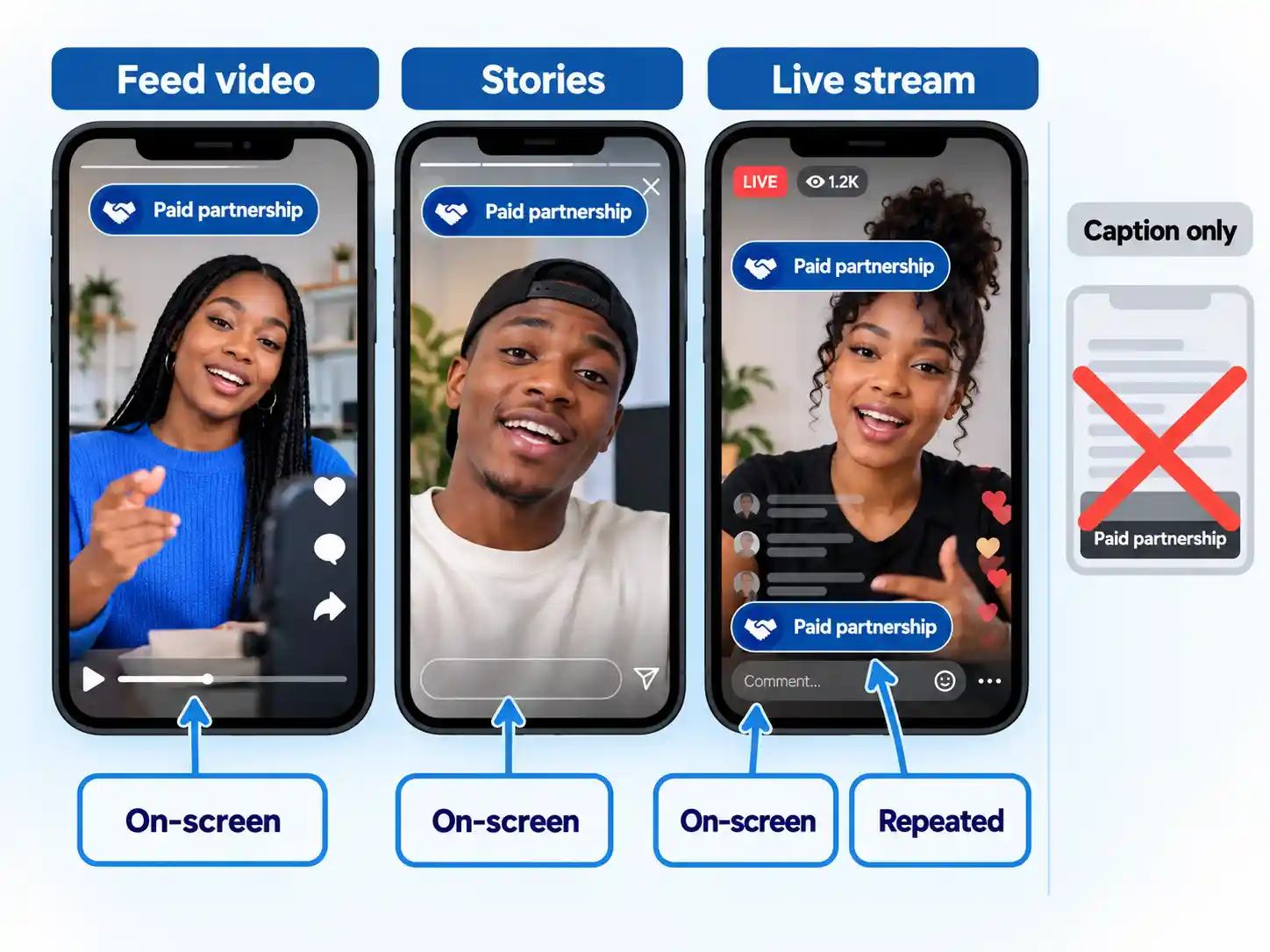
- Audit the creator and disclosure workflow. Ask how creators are briefed, how product claims are checked, where the disclosure sits for feed video, Stories, and live streams, and who signs off before publishing.
- Agree two or three pilot metrics and their baselines. Community reply rate, creator-level engagement with a defined threshold, social-search traffic, or social-commerce sales are all workable. Ask what the baseline is and how it will be measured.
- Write the kill criteria into the contract. Decide in advance what result would end the pilot, who reviews it, and on what date. A pilot with no stopping rule can become a retainer by default.
- Review against the brief, then scale, fix, or stop. Compare the pilot to the outcome you named in step one. Judge it on whether the model reached the right people and produced a measurable response, and resist benchmarking against a viral post from another brand.
Verify the result
- You have seen segmentation data with a sample, a fielding date, and a stated geography.
- Creator contracts include a written disclosure requirement and a claim-check step.
- Disclosure placement is described specifically for video, Stories, and live streams, with named examples.
- The pilot has a named owner on both sides, a review date, and written kill criteria.
- Reporting separates creator-level results from paid reach so you can see which part produced the response.
The agency promises guaranteed virality or a fixed sales lift
Pause the process. Nobody can underwrite audience response to that precision. Ask for the pilot design and the assumptions behind the number, and treat a refusal to show them as the answer.
Reporting arrives as impressions only
Ask for creator-level and community-level metrics alongside the reach figure, plus the baseline each is measured against. Without a baseline, the numbers cannot tell you whether the pilot worked.
Creator posts are live with no visible disclosure
Stop the campaign until placement is corrected and the requirement is written into the creator agreement. Retroactive captions do not fix a disclosure that viewers already missed.
Warning
U.S. Federal Trade Commission guidance requires endorsers to disclose material connections — payment, free or discounted products, employment, personal or family relationships — in a way that is hard to miss and placed with the endorsement itself. A profile-page note, a tag at the end of a caption, or a disclosure hidden behind a “more” click does not meet that bar. Video needs the disclosure inside the video, live streams need it repeated, and vague tags such as “sp,” “spon,” or “collab” are discouraged. Creators cannot describe products they have not tried or make claims the brand cannot support. This is U.S. guidance and does not substitute for advice on other jurisdictions.
Shortlisting goes faster once the brief and the disclosure workflow are written down. A specialist Gen Z marketing agency can tell you in one conversation whether your audience sits inside its remit, which is a cheaper test than a three-month discovery phase.
Limitations and bottom line
The useful question is whether the shop’s operating model matches the bottleneck you actually have. If you already know that a real teen or young-adult audience buys from you and your team cannot cover research, creators, community, and disclosure at the speed the channels demand, a specialist can add capacity and judgment. If your audience is a broad 18-to-34 segment, or the purchase runs through parents and institutions, a general team or an in-house crew may be the better economic fit.
That judgment has limits. Commercial pages describe an agency’s own services rather than independent proof of results, and campaign write-ups often illustrate method without publishing the sales data that would settle cause and effect. What you can verify is process: whether the research has a sample and a date, whether creators are managed and disclosed, whether community channels are staffed, and whether reporting separates creator-level response from paid reach.
Buy the operating model, then test it small. A team that can show its segmentation, run a clean pilot, and report honestly on a modest result is a better bet than a deck promising to decode a generation. The audience already knows what feels native; the practical task is to build a team that can keep up.
💬 Comments