Baccarat is a fixed-rules casino card game where participants wager on whether a designated “Player” hand or “Banker” hand will achieve a terminal point total closest to 9 under modulo 10 arithmetic, or whether the two hands will finish in a tie. Because all dealing and third-card drawing decisions follow an unalterable mathematical tableau known as the drawing rules, players make zero strategic decisions after placing their opening wager, facing a low baseline house edge of 1.06% on the Banker bet and 1.24% on the Player bet.
Quick Take: Core Baccarat Specifications
- Terminal Objective: Back the hand total closest to 9 using standard card valuations where 10s and face cards count as 0, Aces equal 1, and totals drop the tens digit (sum mod 10).
- Agency & Execution: Bettors do not manage cards or choose hit/stand options; dealers execute a strictly deterministic protocol.
- Mathematical Optimal Bet: Betting on the Banker yields an expected value (EV) loss of just -1.06% even after settling the standard 5% casino commission.
- Fatal Bet to Avoid: The Tie bet carries an excessive house edge of 14.36% on standard 8:1 payouts and should never be wagered.
Core Mechanics and Table Architecture
To understand baccarat operations, a participant must first dismantle the primary misconception that causes friction for casino novices: the semantic confusion surrounding the terms “Player” and “Banker.”
Decoupling the Bettor from the Table Positions
In blackjack or poker, the cards dealt to your seat represent your personal holding, and you make active tactical decisions against the house or other opponents. In baccarat, however, the terms Player (historically referred to as Punto) and Banker (Banco) represent two abstract, competing hand propositions dealt on the casino felt. The participant seated at the table is merely a spectator who wagers on the outcome of these two hands. A player can sit at seat position four and wager exclusively on the Banker for an entire three-hour shoe without ever touching a card or violating game protocol. The casino finances both outcomes; the Banker is not the dealer, and the Player is not you.
Card Valuations and Modulo 10 Arithmetic
Baccarat utilizes standard 52-card decks, typically dealt from a continuous shuffling machine or a pre-shuffled dealing shoe containing 6 or 8 complete decks. Every card carries a rigid point value that never fluctuates during play:
- Aces: Fixed value of 1 point.
- Cards 2 through 9: Retain their natural face value (2 = 2, 7 = 7, etc.).
- 10s, Jacks, Queens, and Kings: Valued at 0 points.
Hand totals cannot exceed 9. When the pip value of the cards in a two-card or three-card hand produces a two-digit total, the tens digit is completely discarded. In technical terms, the game applies modulo 10 arithmetic (Hand Total = Sum of Card Values mod 10).
For example, if the Player hand is dealt an 8 and a 7, the raw arithmetic sum is 15. By stripping the tens digit, the actual baccarat valuation is 5 (15 mod 10 = 5). Similarly, a hand comprising a 9, a 4, and an 8 totals 21, which yields a definitive hand valuation of 1. A hand consisting of a King and a Queen totals 0, an outcome colloquially designated as baccara—the Italian and French term for “zero” from which the game takes its historic name.
The Initial Deal and Natural Hand Resolutions
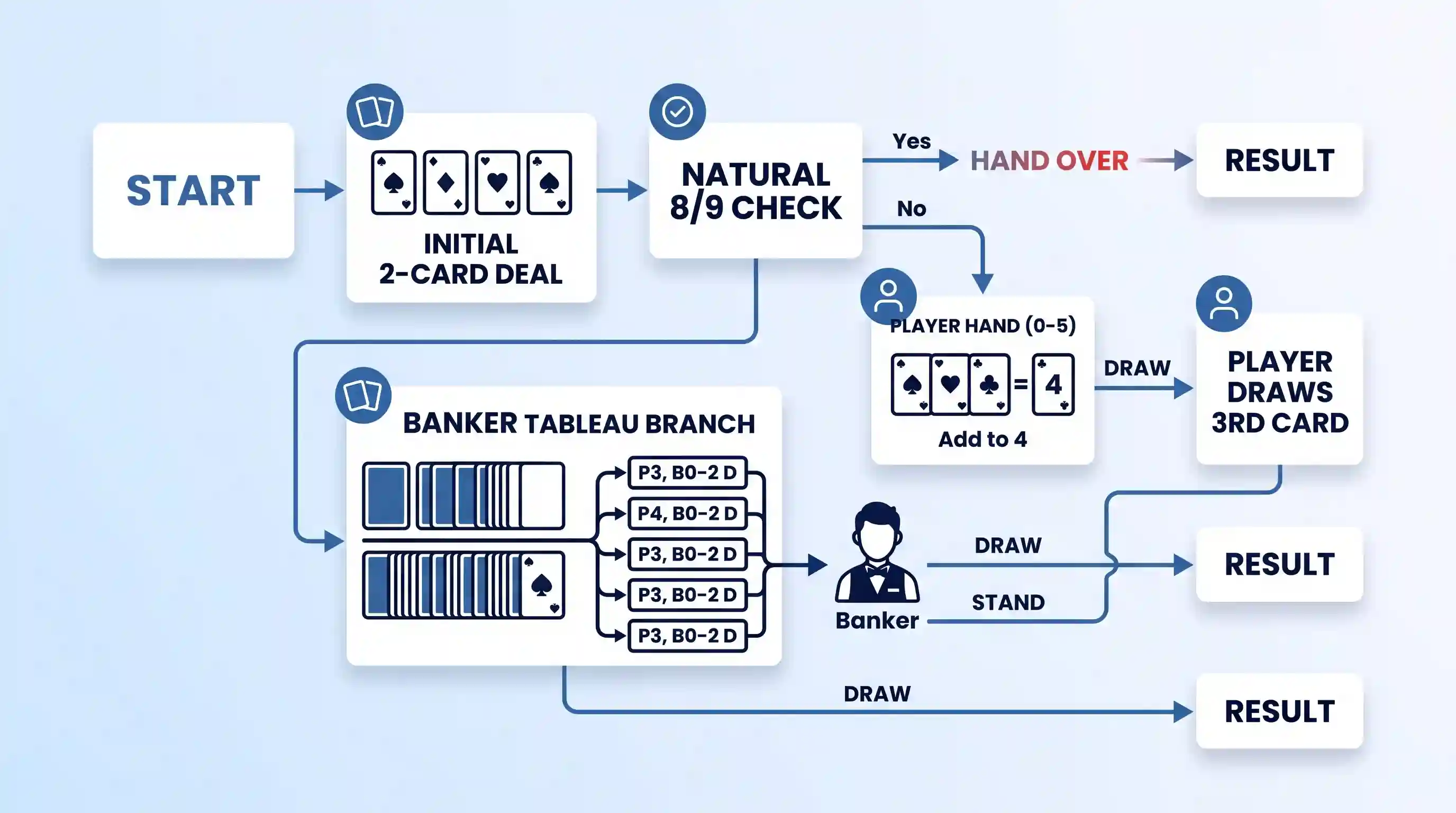
Each coup (the French term for a single round of play) begins with four cards dealt from the shoe. Two cards are slid face down to the Player box, and two cards are delivered to the Banker box. Once these four cards are exposed and tallied, the dealer checks for an immediate terminal condition known as a Natural.
If either the Player or the Banker achieves a two-card total of 8 or 9, the round terminates instantly. No further cards are dealt to either side. The hand closest to 9 wins, or if both hands share an identical value of 8 or 9, the round settles as a Tie. Only when neither hand forms an 8 or 9 does the game transition into its automated drawing procedure, known in professional gaming operations as the tableau.

The Third-Card Drawing Rules (The Tableau Decoded)
The rules governing whether a hand must draw a third card are absolute, mechanical, and enforced by the dealer under strict Nevada Gaming Control Board technical standards. Neither the casino dealer nor the bettor has any discretion over hitting or standing.
Player Hand Rule: The Fixed Threshold
The resolution sequence always evaluates the Player hand first. The Player drawing logic is completely binary and does not depend on the Banker’s holding:
- If the Player’s two-card total is 0, 1, 2, 3, 4, or 5, the Player must draw exactly one additional card.
- If the Player’s two-card total is 6 or 7, the Player must stand pat.
The Player hand will never receive more than three cards under any circumstances.
Banker Hand Rule: The Conditional Positional Advantage
The Banker drawing logic is more sophisticated. If the Player stood pat with a total of 6 or 7 (meaning the Player drew zero cards), the Banker behaves identically to the Player: drawing a third card on totals of 0 through 5, and standing on 6 or 7.
However, if the Player was compelled to draw a third card, the Banker’s subsequent action is dictated by a compound condition: the Banker’s current two-card count evaluated against the specific face value of the single card drawn by the Player. This structural mechanic grants the Banker a permanent informational and positional advantage identical to acting last in financial market positions.
The Third-Card Reference Matrix
The complete conditional decision logic for the Banker is detailed in the reference matrix below:
| Banker Two-Card Total | Banker Draws When Player Third Card Is: | Banker Stands When Player Third Card Is: |
|---|---|---|
| 0, 1, or 2 | Always draws a card (any value) | Never stands |
| 3 | 0, 1, 2, 3, 4, 5, 6, 7, or 9 | 8 |
| 4 | 2, 3, 4, 5, 6, or 7 | 0, 1, 8, or 9 |
| 5 | 4, 5, 6, or 7 | 0, 1, 2, 3, 8, or 9 |
| 6 | 6 or 7 | 0, 1, 2, 3, 4, 5, 8, or 9 |
| 7 | Never draws (Stands pat) | Always stands (0 through 9) |
| 8 or 9 | Natural (Hand closed on deal) | Natural (Hand closed on deal) |
Notice the mathematical nuance on a Banker total of 3: if the Player draws an 8, the Banker does not hit. Drawing against a Player hand that just absorbed an 8 would mean the Player either improved their hand significantly or landed on a total that makes hitting an unnecessary risk. This fine-tuned conditional mechanism is what tilts the natural win frequency directly toward the Banker.
Mathematical Breakdown: Probabilities, Payouts, and House Edge
Because every hand outcome is locked into a deterministic drawing sequence, the game can be fully solved using combinatorial probability. In an 8-deck shoe containing 416 cards, there are exactly 4,998,398,275,500 possible unique opening four-card combinations. According to foundational combinatorial calculations compiled in the Wizard of Odds baccarat baseline analysis, the outcome probabilities across all resolved hands settle as follows:
- Banker Win: 45.86% of all hands
- Player Win: 44.62% of all hands
- Tie: 9.52% of all hands
When computing expected value and standard house advantages, industry analysts evaluate both all-hands distributions and non-tie rounds. When Ties are removed from the denominator (since ordinary Player and Banker wagers push on a tie), the Banker wins 50.68% of decisive hands, while the Player wins 49.32%.
The Banker Wager: The Mathematical Baseline
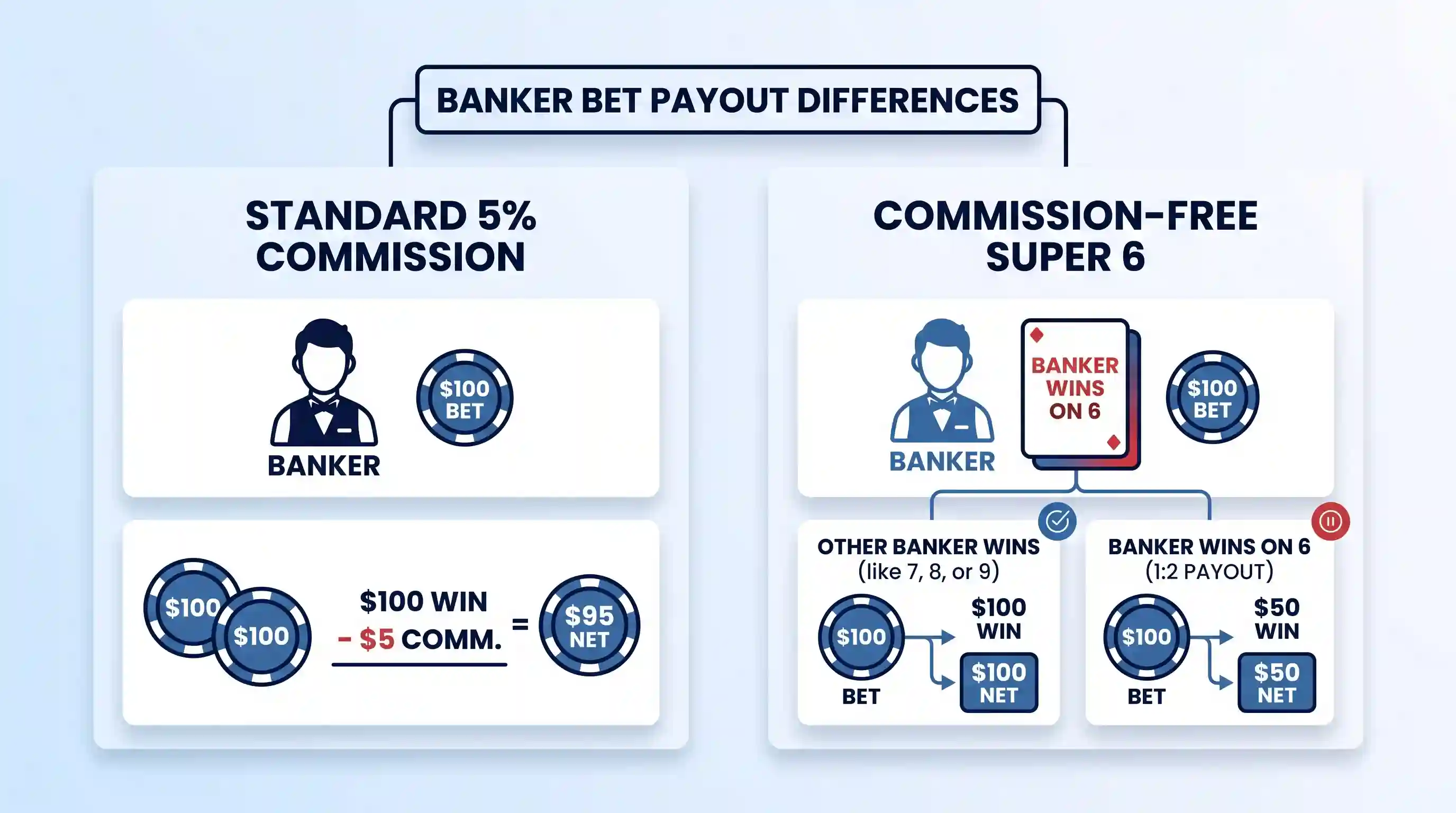
Because the Banker wins more often than it loses, an unpenalized even-money (1:1) payout on the Banker would give bettors a positive mathematical expectation against the casino. To protect the house advantage, casinos levy a mandatory 5% commission on all winning Banker wagers. When you win a $100 bet on the Banker, the house returns your original $100 stake plus a net profit of $95.
Using the discrete expected value formula for a $1 unit bet, where the payoff on a Banker win is +0.95, a loss is -1.00, and a Tie returns +0.00:
EVBanker = (+0.95 × P(Banker)) + (−1.00 × P(Player)) + (0.00 × P(Tie))
EVBanker = (+0.95 × 0.458597) − (1.00 × 0.446247) + 0 = −0.010579
This translates to a baseline casino house edge of exactly 1.06%. Even after forfeiting 5% of your earnings on every winning coup, the Banker remains one of the single most advantageous wagers in the commercial casino ecosystem, closely rivaling the best odds found when comparing blackjack odds to baccarat.
The Player Wager: Pure Even-Money Performance
The Player wager requires no commission calculations. A winning wager pays true even money (1:1). If you wager $100 on the Player and win, you receive your $100 stake back along with $100 in profit.
The expected value calculation reflects the structural absence of the last-action drawing rule:
EVPlayer = (+1.00 × P(Player)) + (−1.00 × P(Banker)) + (0.00 × P(Tie))
EVPlayer = (+1.00 × 0.446247) − (1.00 × 0.458597) + 0 = −0.012351
The resulting house edge on the Player proposition is 1.24%. While slightly inferior to the Banker wager over hundreds of thousands of simulated trials, it carries the operational benefit of avoiding commission tracking at land-based tables.
The Tie Wager: The Casino Profit Center
The Tie wager is a proposition bet that pays 8:1 at the vast majority of physical and online gaming establishments. Superficially, an 8:1 multiple appeals to recreational players seeking high payout multipliers. Mathematically, it represents one of the most predatory offerings on the casino floor.
With a raw occurrence probability of 9.5156%, the expected value formula on an 8:1 payout structure is calculated as follows:
EVTie = (+8.00 × P(Tie)) − (1.00 × [P(Banker) + P(Player)])
EVTie = (+8.00 × 0.095156) − (1.00 × 0.904844) = 0.761248 − 0.904844 = −0.143596
This yields a staggering house edge of 14.36%. For every $100 wagered on the Tie proposition across an extended shoe, the mathematical theoretical hold for the casino is $14.36—nearly fourteen times higher than the cost of betting on the Banker. Extensive institutional data published in the UNLV Gaming Law Journal research proves that casino table holds fluctuate wildly based on the percentage of handle diverted into these proposition bets. Some rare gaming salons offer a 9:1 payout on Ties, which compresses the house edge to 4.84%, but even this altered payout remains quadruply worse than backing either the Banker or the Player.
Popular Side Bets: Dragon Bonus, Pairs, and Panda 8
Modern gaming pit managers routinely supplement the traditional felt layout with side bets designed to extract higher margins. The three most prevalent options include:
- Banker / Player Pair (11:1 Payout): Wagers that the first two cards dealt to the chosen side form a numeric pair (e.g., 7♥-7♠). In an 8-deck shoe, the probability is 7.47%, producing an oppressive house edge of 10.36%. In a 6-deck shoe, the house edge expands to 11.25%.
- Dragon Bonus: Pays out if your selected hand wins with a natural or by an arithmetic margin of at least 4 points. While a 9-point non-natural win pays 30:1, the blended house edge is 2.65% on the Player side and jumps to 9.37% on the Banker side, as cataloged in the Wizard of Odds side bet distribution tables.
- EZ Baccarat Proposition Bets (Dragon 7 & Panda 8): In EZ Baccarat, where commission is eliminated, the casino pays 40:1 on a “Dragon 7” (a winning 3-card Banker total of 7), saddling the bettor with a 7.61% edge. The complementary “Panda 8” (a winning 3-card Player total of 8) pays 25:1 against a 10.19% house advantage.
Table Variations and Operational Formats
Baccarat manifests across casino floors and digital card rooms in three primary operational frameworks, each altering dealing speeds, minimum bet thresholds, and player etiquette.
Punto Banco vs. Mini-Baccarat vs. Chemin de Fer
Chemin de Fer is the classic European variant popularized in French casinos and Ian Fleming novels. In this format, players sit around a large oval table and actively take turns banking the game against fellow bettors, passing the shoe counter-clockwise. Furthermore, players retain limited agency: on a total of 5, the Player can elect whether to hit or stand.
Punto Banco (North American Baccarat) transferred all financial liability to the house and eliminated player discretion, implementing the strict tableau seen today. In its traditional high-roller incarnation (“Big Table Baccarat”), up to 14 players sit in a roped-off velvet lounge with three dealing staff. Players are permitted to physically touch, bend, and slowly squeeze the cards face up before handing them back to the dealer.
Mini-Baccarat emerged as casinos sought to democratize the game for the main floor. The table is sized like a standard blackjack layout, accommodating six or seven seated players. The dealer handles every single card, entirely eliminating player contact. Dealing speeds in Mini-Baccarat accelerate dramatically, often reaching 150 to 200 hands per hour compared to 40 hands per hour at a leisurely Big Table layout. Because the house edge manifests per hand played, this quadrupled velocity rapidly accelerates a player’s hourly expected theoretical loss.
The “Commission-Free” Paradox (Super 6 / Punto 2000)
Tracking, logging, and collecting 5% commissions requires dealer labor and physical plastic commission markers kept in the dealer’s tray, slowing the pace of the game. To resolve this friction, operators introduced No Commission Baccarat (also marketed as Super 6 or Punto 2000).
In this format, all winning Banker hands pay an uninhibited even money (1:1)—with one critical catch: if the Banker wins with a point total of exactly 6, the payout is reduced to 1:2 (fifty cents on the dollar, paying $50 on a $100 wager). While recreational bettors celebrate the elimination of the 5% tax, the rigorous mathematical mechanics of commission-free baccarat prove that winning on a 6 occurs frequently enough (5.39% of all hands) that the clawback raises the overall Banker house edge from 1.06% up to 1.46%. Consequently, in any casino offering both variants, playing commission-free baccarat is mathematically irrational.
Digital vs. Live Dealer Online Baccarat
When playing via digital casino interfaces, bettors encounter two structural delivery architectures:
- RNG Virtual Baccarat: The game executes via a software engine using a pseudorandom number generator governed by a cryptographic seed. The digital shoe is shuffled instantaneously before every single hand, rendering shoe-penetration mechanics irrelevant. Reputable online operators utilize software that has passed rigorous audits by testing agencies such as eCOGRA, guaranteeing strict compliance with an authentic, fair certified random number generator.
- Live Dealer Video Feeds: Specialized software studios broadcast real human dealers running physical cards over embedded optical scanners. In top-tier provider architectures, such as those analyzed across professional Playtech live dealer table rooms and modern Microgaming digital table mechanics, dealing shoes integrate internal infrared readers that scan each card’s pip and suit as it exits the shoe collar, displaying the card valuation on the player’s heads-up digital interface milliseconds before the dealer places it on the felt. This operational standard prevents manual dealer miscalculations and protects against card manipulation across international mobile casino platform architectures.
Strategic Realities: Dispelling Casino Myths
Because baccarat features elegant rituals and rapid table action, it has accumulated a dense cluster of gaming fallacies that drain beginner bankrolls.
Why Card Counting Fails in Baccarat
Card counting in blackjack functions because low cards (2 through 6) disproportionately favor the dealer by preventing dealer busts, while high cards (10 through Ace) favor the player by triggering 3:2 natural payouts and double-down opportunities. When cards leave the blackjack shoe, the distribution skew changes the expected value dramatically enough to flip the edge to the player.
In baccarat, this dynamic is fundamentally neutralized. Modulo 10 arithmetic means removing high cards degrades both the Player and the Banker equally. Removing low cards affects both hands symmetrically. While exhaustive computer simulations by mathematician Edward O. Thorp proved that an extraordinarily complex card-counting system can yield a theoretical edge, that edge occurs in less than three out of every thousand hands near the very end of an eight-deck shoe. Furthermore, casinos insert a plastic “cut card” approximately 16 cards from the end of the shoe (as mandated by Nevada gaming standards), systematically retiring the deck long before this infinitesimally tiny edge can ever materialize. Card counting in baccarat is mathematically futile.
Scoreboards and “Roads”: The Gambler’s Fallacy
Every commercial baccarat table features an electronic LED display depicting historical patterns. These graphical scoreboards—categorized as the Bead Plate, Big Road, Big Eye Boy, Small Road, and Cockroach Pig—use alternating red and blue rings to display streaks, chops, and perceived structural trends in the shoe.
Bettors frequently stare at these displays to identify “dragon tails” (long consecutive streaks of one outcome) and adjust their bets accordingly. This behavior is a textbook execution of the Gambler’s Fallacy. Each baccarat coup is an independent trial governed by combinatorial card draws. The card shoe possesses no memory; whether the Banker has won seven consecutive times or zero times, the probability of the Banker winning the next coup remains unchanged at 50.68% (excluding ties). Roads are visually engaging casino tools designed to encourage aggressive wagering, not predictive instruments.
Pragmatic Bankroll and Volatility Management
Because no betting system can overcome a negative expected value (EV < 0), strategies like the Martingale (doubling your bet after every loss) represent operational suicide. A table minimum of $25 coupled with a $2,500 table maximum will bankrupt a Martingale user on an eight-step losing streak—an event that occurs routinely across standard casino shoe samples. To preserve capital, apply disciplined bankroll management principles:
- Establish a rigid stop-loss threshold capped at 20% of your dedicated trip bankroll per session.
- Select table minimums where your average base bet represents no more than 1% to 2% of your total table bankroll (e.g., $10 units on a $1,000 stake).
- Accept that because the Banker house edge sits at 1.06%, short-term variance will dictate individual session outcomes, while long-term play always regresses to theoretical loss.
Comparative Matrix: Baccarat Bet Types & Mathematical Odds
The comparative matrix below outlines the exact mathematical expectations, standard payout multiples, and theoretical house advantages across all core baccarat wagers in an 8-deck shoe:
| Wager Proposition | Standard Payout | Winning Probability | House Advantage | Analytical Verdict |
|---|---|---|---|---|
| Banker (Standard 5% Commission) | 0.95:1 | 45.86% (50.68% dec.) | 1.06% | Optimal wager. Lowest systemic casino hold on the gaming floor. |
| Player (Standard) | 1:1 | 44.62% (49.32% dec.) | 1.24% | Highly viable. Eliminates commission calculations with negligible penalty. |
| Banker (No Commission / Super 6) | 1:1 (except 1:2 on 6) | 45.86% | 1.46% | Sub-optimal. The 6 clawback increases player cost by nearly 38%. |
| Tie Wager (8:1 Payout) | 8:1 | 9.52% | 14.36% | Mathematically unplayable. Severe capital erosion. |
| Tie Wager (9:1 Payout) | 9:1 | 9.52% | 4.84% | Rare variant. Dramatically improved, but still 4x worse than Banker. |
| Player / Banker Pair | 11:1 | 7.47% | 10.36% | High-variance trap. Avoid unless part of promotion incentives. |
Key Takeaways
- Role Decoupling: You are not the Player, and the casino is not the Banker. Both positions are simply betting propositions open to anyone at the table.
- Modulo Arithmetic: Hand totals are calculated by summing card values and dropping the tens digit. Face cards and tens are worth zero, while Aces equal one.
- Deterministic Play: The entire third-card drawing process is strictly automated by the tableau; player agency ceases the moment bets are placed.
- The Core Strategy: Mathematically, the optimal action on every coup is to wager on the Banker, which delivers a minuscule 1.06% house edge.
- The Illusion of Free Commission: “No Commission” tables compensate by paying 50% on Banker wins of 6, expanding the house edge to 1.46%.
- Scoreboards are Entertainment: Electronic road maps like the Bead Plate and Big Road do not predict future outcomes; each coup remains mathematically independent.
Frequently Asked Questions
What happens to my Player or Banker bet when a round results in a Tie?
If the final hand totals of the Player and Banker are identical, the coup is declared a Tie. All wagers placed directly on the Player or Banker are deemed “pushes”—the casino takes no money, and you are free to retrieve your chips or let them ride for the next round. Only bettors who explicitly wagered on the Tie proposition are paid out.
How does the dealer physically track and collect the 5% Banker commission?
In standard land-based baccarat, the dealer does not break small change on every winning coup. Instead, the dealer pays you true even money immediately and places a laminated tracking button (representing your debt) into a numbered grid on the table that corresponds to your seat. When you leave the table, or when the 8-deck shoe concludes, the dealer tallies your accumulated commission markers, and you settle the balance before cashing out.
Why does the shoe size (6 decks vs. 8 decks) alter the baccarat house edge?
Altering the number of decks modifies the combinatorial probability of drawing specific values without replacement. In a 6-deck shoe, the house edge on the Banker bet nudges upward slightly from 1.0579% to 1.0558% (favoring the player fractionally), while the Player house edge shifts from 1.2351% to 1.2426%. However, these changes occur at the hundredths of a percent level and do not justify seeking out one deck configuration over another in recreational play.
Can a player choose to decline a third card if their initial hand total is 5?
No. In modern casino baccarat (Punto Banco and Mini-Baccarat), neither the participants nor the dealer possess any authority to modify the tableau. If the Player hand totals 5, the rules mandate that a third card must be dealt. The only historic variant allowing tactical choice was Chemin de Fer, which has been almost completely replaced by automated Punto Banco across modern regulated gaming jurisdictions.

💬 Comments