The International is Dota 2’s annual world championship, produced across tournament reporting of the most recognizable events in global esports.The 2026 edition, the 15th, ran in Shanghai from Aug. 13 to 23. The money is what trips people up: the event opened with a 1.6 million dollars base prize pool and closed with a reported total of roughly 3.9 million dollars, a small fraction of the record published in post-event tracking.
Quick Take
- When and where: Aug. 13–23, 2026, in Shanghai.
- Field size: 16 teams, built from seven direct invitations and nine qualifier slots.
- Format: Swiss group stage over five best-of-three rounds, then an eight-team double-elimination playoff with a best-of-five final.
- Money: a 1.6 million dollars base pool before crowdfunding, with a later reported total of roughly 3.9 million dollars.
- Result: Team Spirit won, their third TI title.
What The International 2026 Was
This is the event every other tournament on the Dota calendar gets measured against. Valve has staged it every year since 2011, when the first edition ran at Gamescom in Germany, and the field has settled at 16 teams in the current era: down from 18 between 2017 and 2021, and 20 in 2022 and 2023.
The 2026 edition was the 15th, and it returned to Shanghai, a city that last hosted in 2019, with matches staged at the Oriental Sports Center. Tournament reporting indicates that Team Spirit finished on top, beating TEAM VISION in the grand final for their third TI title. Tournament records likewise list Team Spirit as the most recent champion.
Worth separating from the result: Team Falcons entered the tournament as defending champions, having won TI 2025. Their title defence and Team Spirit’s victory are two different storylines, and pre-event coverage of the Falcons should not be read as a 2026 result.
How the 2026 Format Worked
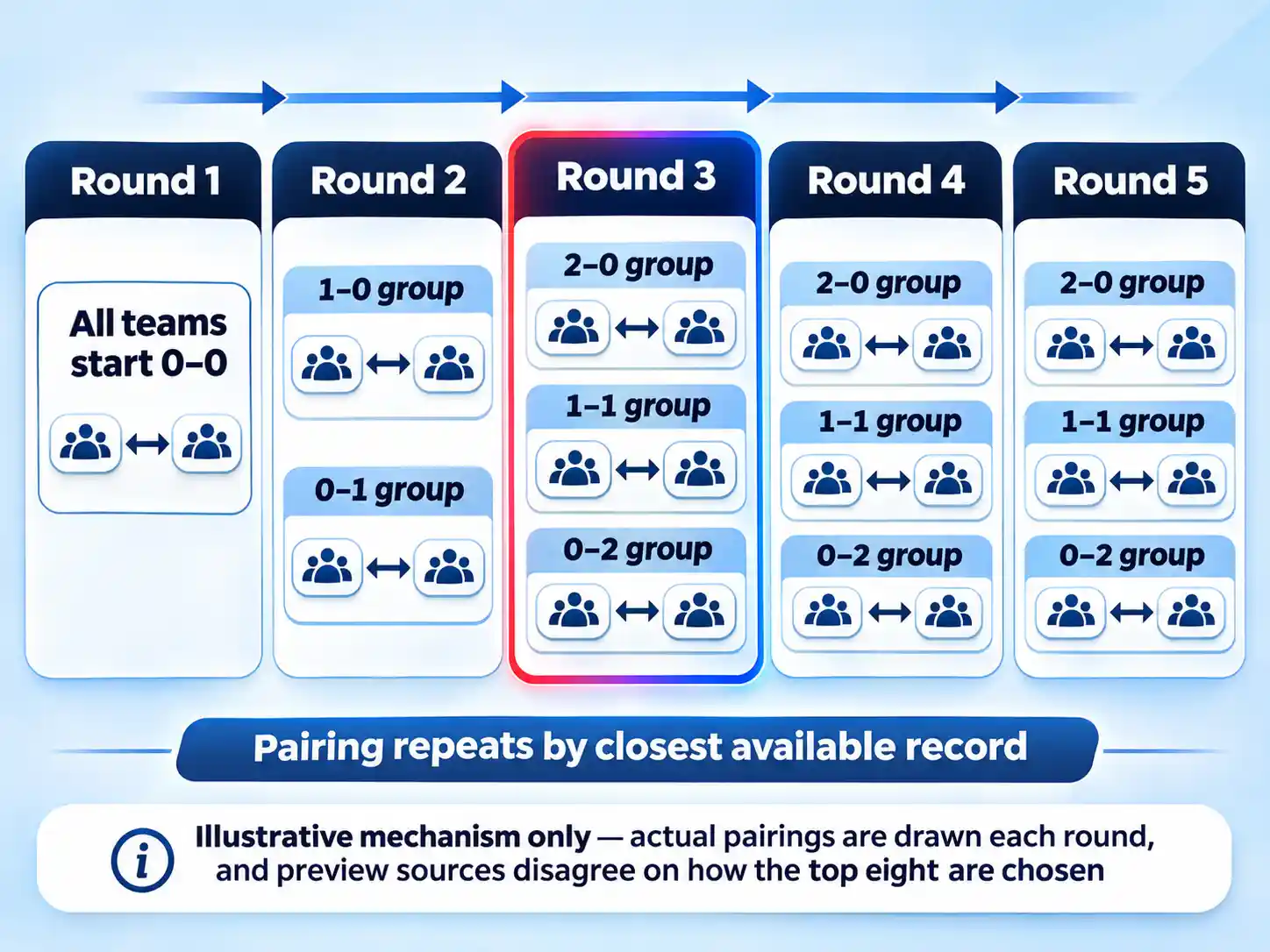
The group stage used the Swiss system: every team starts level, and each new round pairs teams against opponents with a similar win-loss record, so no bracket exists in advance. All 16 teams played five rounds, every series was best-of-three, and the standings after round five decided who stayed in Shanghai.
Eight teams moved on. The playoffs then ran as a double-elimination bracket, best-of-three throughout, with a best-of-five grand final to decide the champion. Double elimination means a single loss drops a team to the lower bracket rather than out of the tournament, which is why the playoff stage can produce a long lower-bracket run from a team that stumbled early: that second life is built into the format, not a reprieve granted after the fact.
Warning
Pre-event coverage agrees that 16 teams played a Swiss group and that eight reached the playoffs, but it splits on how those eight were chosen. One preview describes the top three seeds going straight into the bracket with 4th through 13th playing a separate elimination round; another describes a straightforward top-eight cut after five rounds. Because the descriptions conflict, treat any single diagram of that step with caution.
| Phase | Field | Match format |
|---|---|---|
| Swiss group stage | 16 teams, five rounds | Best-of-three |
| Playoff stage | Eight teams | Double elimination, best-of-three |
| Grand final | Two teams | Best-of-five |
Schedule at a Glance
The event compressed into two tight blocks with a three-day gap between them: four straight days of Swiss rounds, then the surviving eight returned for a four-day playoff sprint. Both blocks ran Thursday to Sunday, so the whole tournament could be followed across two long weekends.
| Phase | Dates | What happened |
|---|---|---|
| Event window | Aug. 13–23, 2026 | Overall tournament dates in Shanghai |
| Group stage | Aug. 13–16 | Five Swiss rounds, best-of-three, cutting 16 teams to eight |
| Playoff stage | Aug. 20–23 | Double-elimination bracket, best-of-three, ending with the best-of-five grand final |
| Sources: Strafe, Izvestia, and PandaScore. | ||
Teams and Qualification
Valve fills the field two ways: direct invitations earned across the season, and regional qualifiers. For TI 2026, Izvestia reported seven direct invitations and nine qualifier slots, and described the qualifier map as four regions (Europe, China, Southeast Asia, and the Americas) with South America and North America each holding one slot inside that single Americas grouping.
- Europe: four qualifier slots.
- China: two qualifier slots.
- Southeast Asia: one qualifier slot.
- Americas: two qualifier slots, one for South America and one for North America.
The pre-event lineup put seven teams outside the qualifier route: Team Falcons, listed as defending champion, plus Aurora Gaming, BoomBoys, Iron Wing, Team Liquid, Team Yandex and Xtreme Gaming, which Strafe labeled direct invites. The nine qualifier entries were Team Spirit, TEAM VISION, Nigma Galaxy, HULIGANI, Team Resilience, Vici Gaming, OG, GamerLegion and LGD Gaming. That is the full 16, and it is worth noting that Team Spirit won the whole thing after entering through the European qualifier rather than a direct invite.
Prize Pool: Base vs. Final
Two figures circulate for TI 2026, and they answer different questions. The base prize pool was 1.6 million dollars, reported in pre-event coverage across tournament reporting. At the time Izvestia published its preview, that base had not yet been topped up by crowdfunding through in-game sales: the mechanism that historically pushed TI pools far beyond their starting figure.
The later reported total was roughly 3.9 million dollars, published in post-event tracking-event reported figure rather than a Valve-confirmed ledger, so it belongs in a different category from the base pool: one is an announced guarantee, the other a tally assembled after the final.
| Edition and scope | Figure | What it represents | Reported by |
|---|---|---|---|
| TI 2021: final pool | 40,018,195 USD | Record prize pool, largest in Dota 2 history | Dota2News |
| TI 2022: final pool | 18,930,775 USD | Final prize pool, well below the 2021 peak | Dota2News |
| TI 2026: base pool | 1,600,000 USD | Starting figure before crowdfunding additions | PandaScore; Izvestia |
| TI 2026: reported final | 3,906,263 USD | Post-event total, secondary reporting | Dota2News |
| Sources: Dota2News, PandaScore, and Izvestia. | |||
Why the Prize Pool Numbers Matter
The gap between those four figures explains most of the confusion around TI money. The tournament’s prize pool has been crowdfunded through in-game transactions since 2013, with a quarter of the relevant revenue routed into the pot, which is how a competition with a modest guarantee once built the largest prize pool in Dota 2 history.
That mechanism produced over 40 million dollars at TI 2021 in Bucharest. It held up well enough the following year to reach nearly 19 million dollars. Recent editions have landed far below both, which is why the 2026 total reads as a collapse to anyone who remembers the peak and as an ordinary number to anyone who has followed the last few years.
If you want to see how a smaller-pool TI was staged, the Dota 2 International 2023 event page is one place to start.
None of this makes the 2026 numbers small in context. TI remains the event every Dota 2 team builds its season around, and a reported pool worth several million dollars is still a serious payout against the rest of the Dota 2 calendar.
How to Read the Numbers
Prize figures get repeated without their scope, and the scope is the whole point. A base pool is a guarantee announced before the event. A reported final total is a post-event number, usually built from third-party tracking. A historical peak is a record, and it is not a forecast.
Success
Before you compare two TI prize numbers, label each one: base pool, reported final total, or historical peak. Figures from different categories measure different things, and mixing them is how a reported total can get described as a record peak.
Here is the check in practice. A headline can say TI’s prize pool fell sharply from its peak. Run the arithmetic yourself: roughly 3.9 million dollars against over 40 million dollars is a reported-final-against-historical-peak comparison. That comparison is true, but it says nothing about how the 2026 pool was funded during the event. Then compare 2026 against itself: 1.6 million dollars in the pre-event previews and that same reported total at the end, a seven-figure gap between the starting guarantee and the reported finish. Same tournament, two different stories about money, and only one of them answers the question a reader probably asked.
Where The International Stands Now
The 2026 edition shows a tournament settled into a tighter shape than the one that produced the 40 million dollars headlines. Sixteen teams, five Swiss rounds, an eight-team double-elimination bracket, a best-of-five final: a structure compact enough to follow in full, with a three-day gap between the last Swiss round and the first playoff match. Whatever changes next year, that skeleton is now the modern standard, and it makes TI easier to watch end to end than it was in the twenty-team era.
The money tells a quieter story. Crowdfunding through in-game sales used to turn a modest guarantee into a much larger pot; in 2026 the guarantee was the number that anchored expectations and the reported finish stayed far below the 2021 peak. That is less a decline than a different funding model landing on a smaller figure, and it shifts attention back to the base pool as the figure that actually sets what a deep run is worth.
So the label on the number is the whole trick with TI money. A starting guarantee, a reported finish and a peak from another era each answer a different question, and knowing which one you are reading is what separates a real comparison from a dramatic-sounding one.

💬 Comments