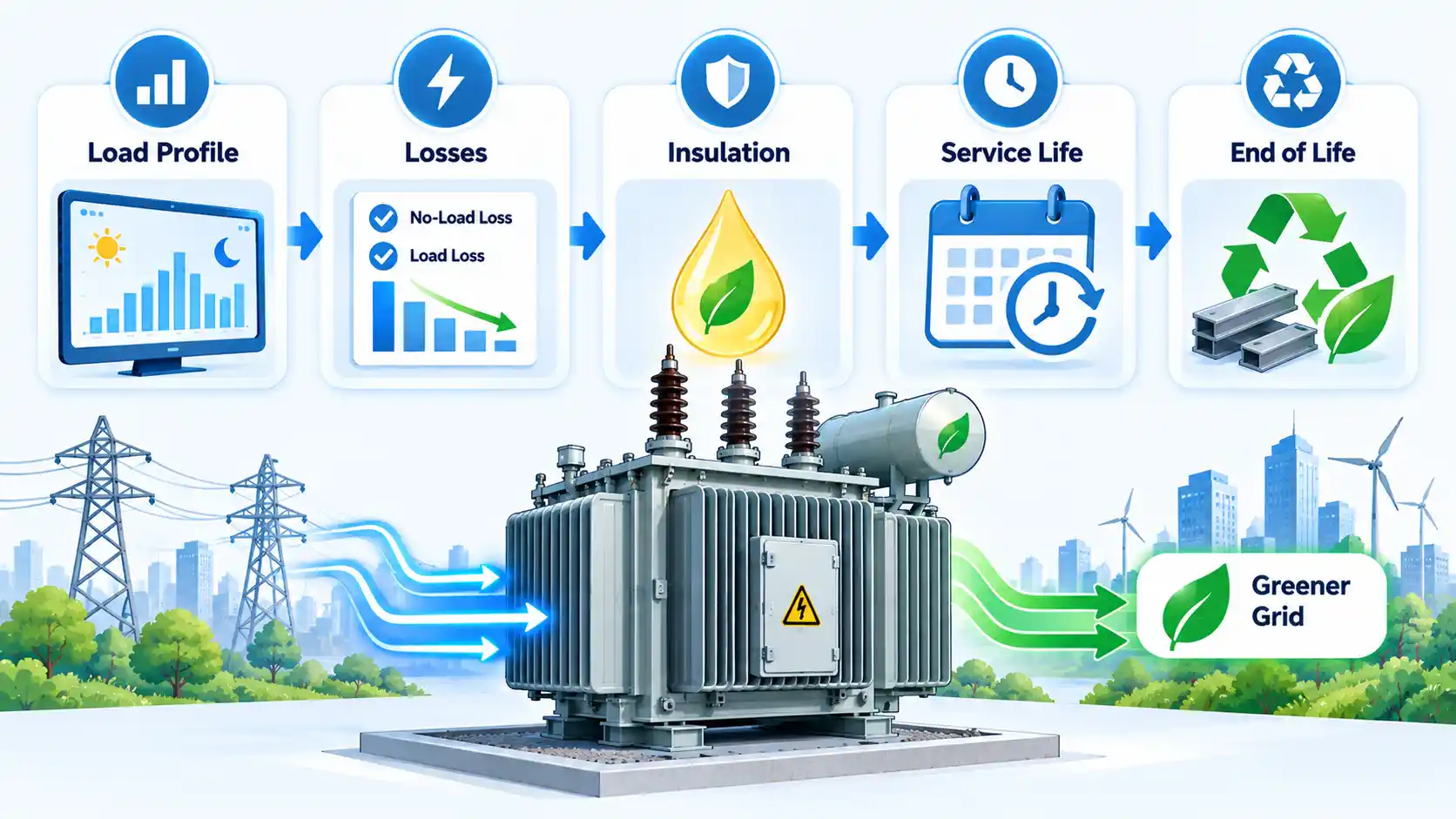
Today’s electrical transformers are becoming greener mainly by wasting less electricity over their service lives, using lower-impact insulating fluids and materials where technically appropriate, and staying in service longer through better maintenance and refurbishment. The important point is that no single feature makes a transformer “green”; environmental performance depends on the complete operating and lifecycle context.
A transformer changes electrical voltage so power can be transmitted, distributed, and used safely and efficiently. Because part of the electricity passing through a transformer is converted into heat, even small improvements in electrical losses can matter when equipment operates continuously for decades.
Quick Take: What Makes a Transformer Greener?
In practical engineering terms, a lower-impact transformer combines efficient electrical design with sensible material, maintenance, and end-of-life decisions. The main factors are:
- Lower no-load losses while the transformer remains energized.
- Lower load losses as current passes through its windings.
- Correct sizing for the expected operating profile.
- Insulating fluids selected for both environmental and technical suitability.
- Maintenance and condition assessment that can prevent premature replacement.
- Repair, refurbishment, and recovery of usable materials where appropriate.
- Compliance with applicable minimum-efficiency regulations.
This broader lifecycle view matters because a transformer that has excellent efficiency on its datasheet can still be a poor choice if it is badly sized, unsuitable for the installation environment, difficult to maintain, or replaced before the end of its technically useful life.
Where Transformer Energy Losses Actually Come From
A transformer does not transfer every unit of incoming electrical energy to the load. Some energy is lost, principally through the magnetic core and the windings. These losses appear mainly as heat.
No-load losses
No-load loss, sometimes called core loss, occurs whenever an alternating-voltage transformer is energized, even if it supplies little or no useful load. Magnetizing the steel core produces hysteresis and eddy-current losses, so a transformer that remains energized around the clock continues consuming some energy even during quiet periods.
This makes no-load performance especially important for equipment that spends much of its life lightly loaded. For example, an oversized transformer serving a facility with modest overnight demand can continue accumulating core losses even when relatively little useful power is being delivered.
Load losses
Load loss is associated mainly with current flowing through the windings. The windings have electrical resistance, so some power is converted into heat. These losses rise strongly as current increases, which makes the expected load profile important when selecting a transformer.
Other losses can arise from magnetic flux interacting with tanks, structural parts, leads, and other conductive components. Engineers therefore look at the complete loss design rather than treating transformer efficiency as a single material choice.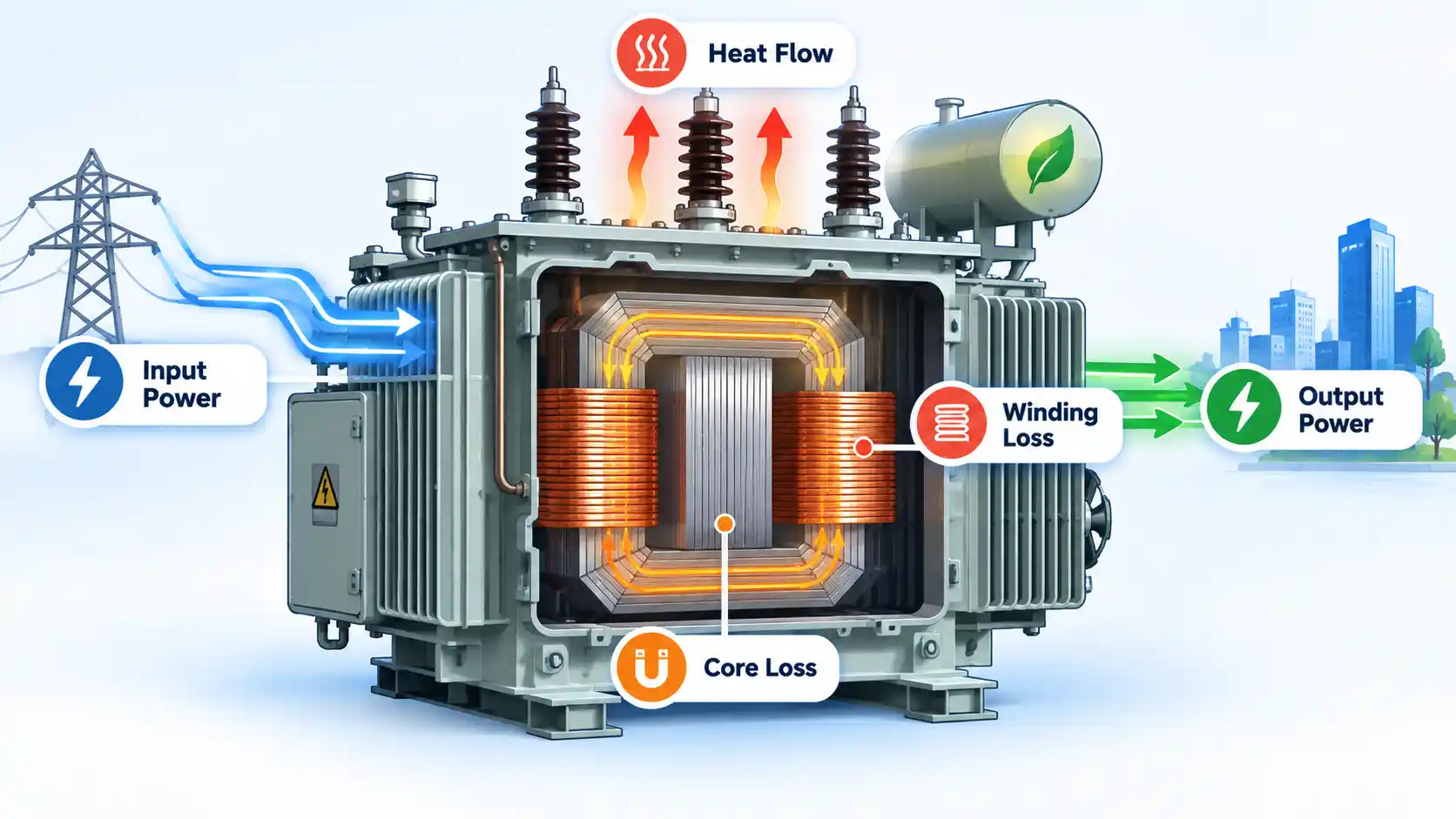
Efficiency Regulation Has Pushed Transformer Design Forward
Minimum-efficiency regulation has been one of the clearest forces pushing manufacturers toward lower-loss transformer designs. The exact rules depend on jurisdiction, transformer category, rating, and installation circumstances.
The EU’s current ecodesign rules
In the European Union, transformer efficiency requirements are governed by Regulation (EU) No 548/2014 as amended by Regulation (EU) 2019/1783. The rules apply mainly to small, medium, and large power transformers of at least 1 kVA used in 50 Hz electricity networks or industrial applications, subject to defined exemptions. Tier 2 requirements have applied since July 1, 2021. The regulation sets maximum loss levels or minimum efficiency requirements depending on transformer class. The EU transformer regulation also recognizes limited replacement situations in which meeting Tier 2 can be technically infeasible or impose disproportionate installation costs.
The European Commission subsequently reviewed whether the regulation should be tightened further. Its transformer ecodesign review, completed in 2024, says it was proposed not to proceed with a further revision and to leave the current legal text unchanged. Among the reasons given were limited added value from the proposed changes and concerns that a third efficiency tier could create excessive costs or security-of-supply problems.
The Commission also estimates that its transformer ecodesign measures can produce approximately 16 TWh of annual electricity savings after 2020, corresponding to about 3.7 million tonnes of avoided CO2 emissions per year. These figures should be understood as modeled policy estimates rather than measurements of a specific transformer fleet in 2026. They are reported on the Commission’s power transformers overview.
The United States is on a different timeline
U.S. requirements should not be treated as interchangeable with EU rules. The U.S. Department of Energy adopted amended efficiency standards for distribution transformers in 2024. The rule became effective on July 8, 2024, but compliance with the amended standards is required on and after April 23, 2029, according to the DOE’s distribution transformer standards page.
For practitioners, regulatory compliance is the floor rather than automatically the economically optimum design. A transformer with lower losses than the minimum requirement may make sense at a continuously energized site with high electricity costs, while a more expensive ultra-low-loss design can be harder to justify in an unusual operating profile or constrained replacement location.
How Greener Transformer Designs Reduce Lifecycle Impact
Reducing losses is usually the largest operational focus, but modern sustainability decisions also include the magnetic core, conductors, insulating fluid, cooling arrangement, maintenance strategy, and eventual recovery or disposal of materials.
Lower-loss magnetic cores and windings
Core losses can be reduced through careful magnetic design, suitable electrical steel or alternative core materials, thinner laminations, and manufacturing methods that limit unnecessary magnetic losses. Winding losses can be reduced through conductor selection, cross-sectional area, winding arrangement, and control of stray electromagnetic effects.
These changes involve trade-offs. More conductor material can lower resistance but increase purchase cost, mass, and embodied material use. A different core material can reduce no-load losses while affecting manufacturing processes, dimensions, acoustic behavior, or cost. That is why lifecycle evaluation is more useful than simply asking which transformer contains the least material.
Natural ester and alternative insulating fluids
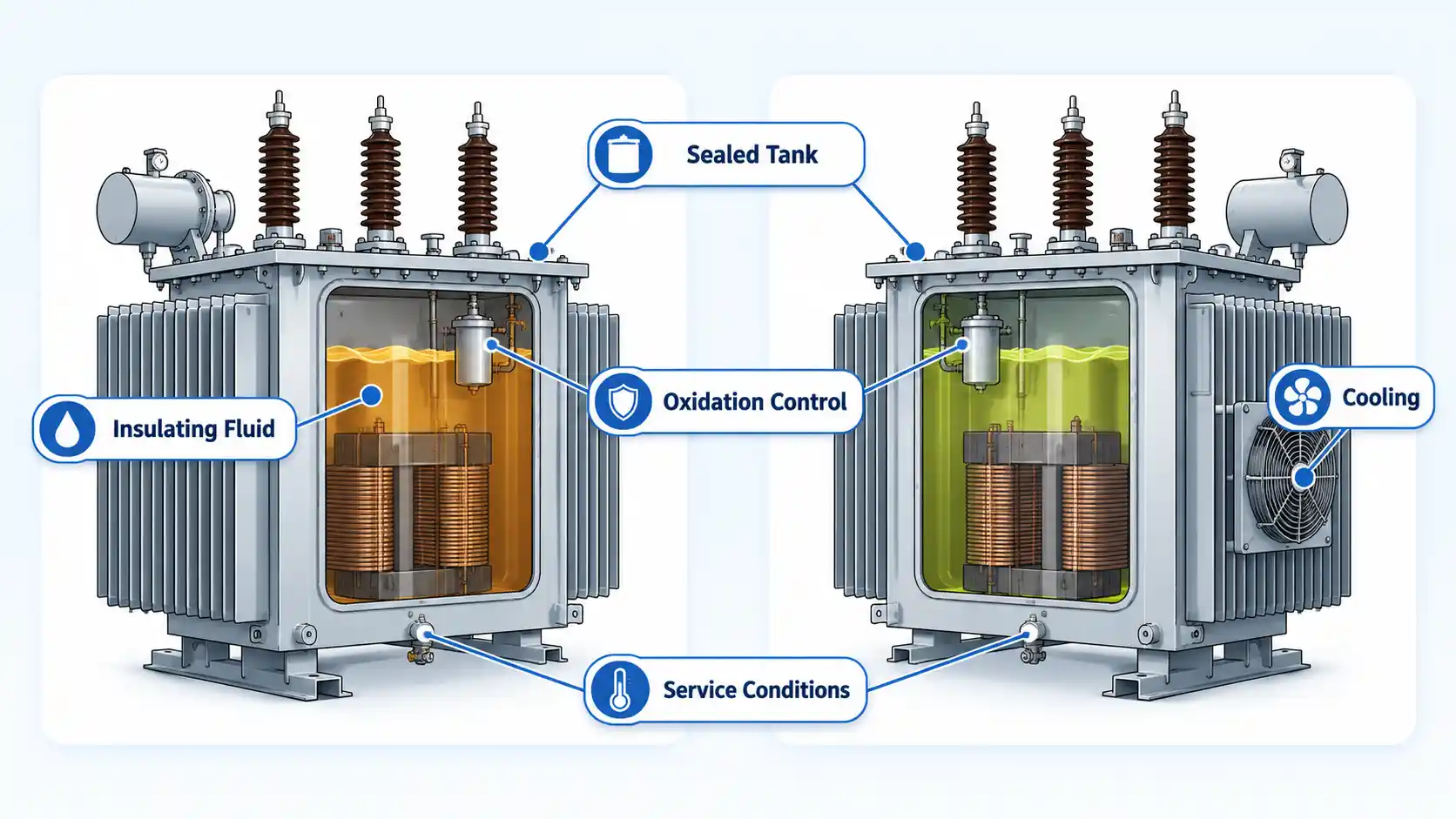
Liquid-filled transformers need a dielectric fluid that electrically insulates internal components while also moving heat away from the windings and core. Mineral oil has historically performed that role, but natural ester fluids derived from biological feedstocks are increasingly considered where their properties suit the application.
IEC 62770:2024 specifies requirements and test methods for unused natural esters used as insulating and heat-transfer media in transformers and similar equipment. Importantly, the standard notes that exposure to air deteriorates natural ester fluid and restricts its use to sealed units or conservator systems protected from atmospheric contact by a membrane or another suitable system.
That requirement illustrates an important principle: a fluid can offer environmental advantages without being a universal drop-in replacement. A peer-reviewed review of natural ester transformer fluids identifies issues including viscosity, pour-point behavior, oxidation stability, and ionization performance. These factors can affect cooling, cold-weather operation, insulation behavior, and transformer design.
Material efficiency and end-of-life design
Transformers contain valuable and energy-intensive materials, including electrical steel, copper or aluminium conductors, structural steel, insulation, and dielectric fluid. A lifecycle approach considers not only the resources needed to manufacture the transformer but also whether major materials can be recovered, reused, recycled, or safely managed when the unit leaves service.
There is an important trade-off here. Using additional conductor or core material may increase manufacturing impact but reduce electrical losses for decades. In a heavily utilized transformer, the operating-energy savings can be more important than minimizing initial material mass. The correct balance depends on loading, service life, electricity generation mix, manufacturing impacts, and end-of-life practices.
Longer Transformer Life Can Also Be a Sustainability Strategy
Replacing an old transformer is not automatically the environmentally preferable decision. If the active components remain serviceable, maintenance, repair, or refurbishment can sometimes extend useful life and avoid the immediate manufacturing and material impacts of replacement.
CIGRE’s 2025 transformer maintenance guidance treats maintenance as part of the full operating lifecycle and notes that repair, refurbishment, or replacement decisions should consider safety, environmental performance, system reliability, and cost. It also notes that transformers are commonly expected to remain in service for several decades.
That does not mean old equipment should be kept indefinitely. Age alone does not determine transformer condition, but insulation deterioration, moisture, overheating history, fault damage, bushing condition, cooling problems, tank corrosion, and changing system requirements can make continued operation unacceptable.
Transformer condition monitoring helps operators distinguish equipment that can remain safely in service from assets that require repair, refurbishment, or replacement.
How Green Transformer Choices Compare
The table below shows why transformer sustainability cannot be reduced to a single efficiency percentage. Each option can lower environmental impact in one area while introducing a cost, design, or operating constraint elsewhere.
| Design or operational choice | Main potential benefit | Main engineering consideration |
|---|---|---|
| Lower core loss | Reduces continuous energy loss while energized | Core material, size, cost, manufacturing, and acoustic trade-offs |
| Lower winding loss | Reduces energy lost as current and load increase | May require more conductor material, space, or higher initial cost |
| Natural ester fluid | Can reduce dependence on petroleum-based insulating fluid and improve selected environmental characteristics | Oxidation, viscosity, low-temperature behavior, cooling, and equipment design must be assessed |
| Longer useful life | Delays replacement and associated manufacturing impacts | Only appropriate when safety, reliability, and condition remain acceptable |
| Repair or refurbishment | Preserves usable equipment and materials | Not economical or technically suitable for every damaged or obsolete unit |
| End-of-life material recovery | Recovers metals and reduces uncontrolled waste | Benefits depend on local dismantling, recycling, and fluid-management practices |
The practical conclusion is that the lowest-loss transformer is not automatically the lowest-impact transformer in every situation. Selection should consider the full operating profile, physical installation, expected service period, maintenance strategy, and disposal pathway.
What Buyers and Facility Engineers Should Evaluate
A useful transformer specification starts with the application rather than a generic efficiency label. Important questions include:
- What is the expected normal and peak load?
- How many hours per year will the transformer remain energized?
- What are the specified no-load and load losses?
- Is the transformer likely to spend long periods lightly loaded?
- What ambient temperatures and ventilation conditions apply?
- Is a liquid-filled or dry-type design more appropriate for the site?
- Are there fire, spill, environmental, or indoor-installation constraints?
- Is there enough room for a physically larger lower-loss design?
- Can the unit be inspected, maintained, and repaired without excessive disruption?
- Which local efficiency regulations apply?
- How will the fluid, metals, and other materials be handled at end of life?
For a commercial product-category example, see electrical transformers (sponsored link). Regardless of supplier, compare the required rating, installation type, no-load losses, load losses, cooling arrangement, service conditions, and maintenance requirements rather than judging a transformer from purchase price alone.
Load profile deserves particular attention. A transformer designed for high efficiency near one operating point may spend much of its actual life at another. For a lightly loaded building transformer, continuous core losses can be significant in the lifecycle calculation. For a heavily loaded industrial or network transformer, winding and stray losses become increasingly important.
Limits of Calling a Transformer “Green”
“Green transformer” is an informal description rather than one universal engineering classification. Two products marketed with the same sustainability language can differ substantially in losses, materials, fluid type, loading suitability, maintenance requirements, and end-of-life arrangements.
Operational emissions are also location-dependent. Saving 1 kWh of electricity does not avoid the same amount of greenhouse-gas emissions on every electricity system because generation mixes differ. Carbon claims therefore need more context than electrical efficiency figures alone.
There can also be tension between manufacturing impact and use-phase savings. A transformer may require additional steel or conductor material to achieve lower lifetime electrical losses. That can still be environmentally sensible when the operating savings over decades outweigh the additional manufacturing burden, but the answer depends on the application.
The same caution applies to insulating fluids. A renewable or biodegradable fluid does not remove the need to check dielectric performance, cooling behavior, oxidation control, temperature limits, compatibility, fire requirements, and maintenance procedures.
Key Takeaways
- Modern transformers become greener primarily by reducing lifetime electrical losses, not simply by carrying an environmental label.
- No-load and load losses behave differently, so the actual load profile matters when choosing a transformer.
- EU Tier 2 ecodesign requirements have applied since July 1, 2021, and the Commission has proposed leaving the current rules unchanged after its latest review.
- New U.S. DOE distribution-transformer efficiency levels were adopted in 2024 but become mandatory from April 23, 2029.
- Natural ester fluids can offer environmental advantages but introduce engineering requirements involving oxidation, cooling, viscosity, and temperature behavior.
- Maintenance, refurbishment, and longer useful life can reduce lifecycle impact when the transformer remains safe and reliable.
- The best environmental choice depends on operating conditions, efficiency, materials, maintenance, installation constraints, and end-of-life handling together.
Frequently Asked Questions
Do transformers use electricity when almost nothing is connected to them?
Yes. An energized alternating-current transformer normally has no-load or core losses even when the connected load is very small. These losses arise primarily from repeatedly magnetizing the core, which is why no-load performance matters for equipment that remains energized continuously.
Can an oversized transformer waste more energy?
It can. Oversizing does not automatically make a transformer inefficient, but a substantially oversized unit may spend much of its life lightly loaded while still incurring continuous core losses. The correct size depends on expected load, growth allowance, reliability requirements, overload capability, and loss economics.
Are natural ester transformer fluids suitable for every climate?
Not automatically. Natural ester properties such as viscosity and pour point can affect low-temperature fluid circulation and cooling. The transformer design, ester formulation, minimum ambient temperature, starting conditions, and manufacturer requirements all need to be considered.
Is refurbishing an old transformer always greener than buying a new one?
No. Refurbishment can avoid premature replacement when the main transformer remains technically sound, but it is not appropriate when insulation condition, damage, reliability risk, safety requirements, losses, or system changes justify replacement. A condition-based engineering assessment is more reliable than making the decision from age alone.
Does transformer efficiency change with load?
Yes. Core losses are comparatively fixed while the transformer is energized, whereas winding losses rise as current increases. As a result, overall efficiency varies with load. Comparing transformers at only one load point can therefore hide meaningful differences in annual energy use.
