A live dealer game show combines a real-time studio broadcast with an online betting interface. Players submit wagers during a defined betting window, the game produces an outcome through a physical mechanism, software randomness, or both, and the system settles accepted wagers against the recorded result.
The television-style presentation can make these games look more complicated than they are. Underneath the host, cameras, animations, wheels, balls, bonus rounds, and multipliers is a structured sequence: accept wagers, close betting, generate or determine the outcome, record the result, apply any bonus rules, and settle the round.
What Is a Live Dealer Game Show?
A live dealer game show is an online casino game presented more like a television game show than a traditional blackjack or roulette table. A live host or presenter appears in a studio, players watch through a browser or app, and betting controls appear alongside the video stream.
The category covers more than spinning wheels. Evolution’s live game-show catalogue includes wheel games, numbered-ball formats, board-game adaptations, and other studio-hosted games. Individual titles can use physical events, software-generated values, or a combination of both.
The game provider and casino operator can also be separate entities. Evolution, for example, states that it supplies live games and game shows to online casinos. In that arrangement, the provider supplies the game while the operator presents it through the player’s casino account. The precise technical and commercial responsibilities vary between platforms.
Current examples show how broad the category is. Pragmatic Play’s Mega Wheel uses a 54-segment physical wheel, Evolution’s Mega Ball uses numbered balls drawn from a machine, and MONOPOLY Live combines physical studio events with a virtual bonus environment.
How One Live Game-Show Round Works
Although individual rules differ, most live game-show rounds can be understood as a sequence of separate but connected events. The video presentation, the player’s wager, the random event, and settlement are not the same thing.
- The round opens. The game makes the available betting selections visible for a new round.
- The betting window begins. Players choose one or more permitted outcomes and submit their wagers.
- The wager must be accepted before betting closes. A selection made on the player’s screen still has to reach the gambling system in time to become part of the round.
- Betting closes. Ordinary wagers are no longer accepted for that round once the cutoff is reached.
- The outcome mechanism runs. A host may spin a wheel, balls may be drawn, physical dice may be rolled, software may generate a random value, or the title may combine several mechanisms.
- The result is recorded. The game identifies the outcome that applies to the accepted wagers.
- Bonus rules run when required. A qualifying outcome may lead to another physical event, a software-generated value, a virtual sequence, or further player input.
- The round is settled. Accepted wagers are compared with the result and the game’s payout rules are applied.
- The next round opens. The interface moves on to another betting period.
Evolution’s Crazy Time rules provide a concrete example. Betting lasts for 15 seconds, players can choose numbered or bonus positions, and the main physical wheel determines whether a number or bonus segment is reached.
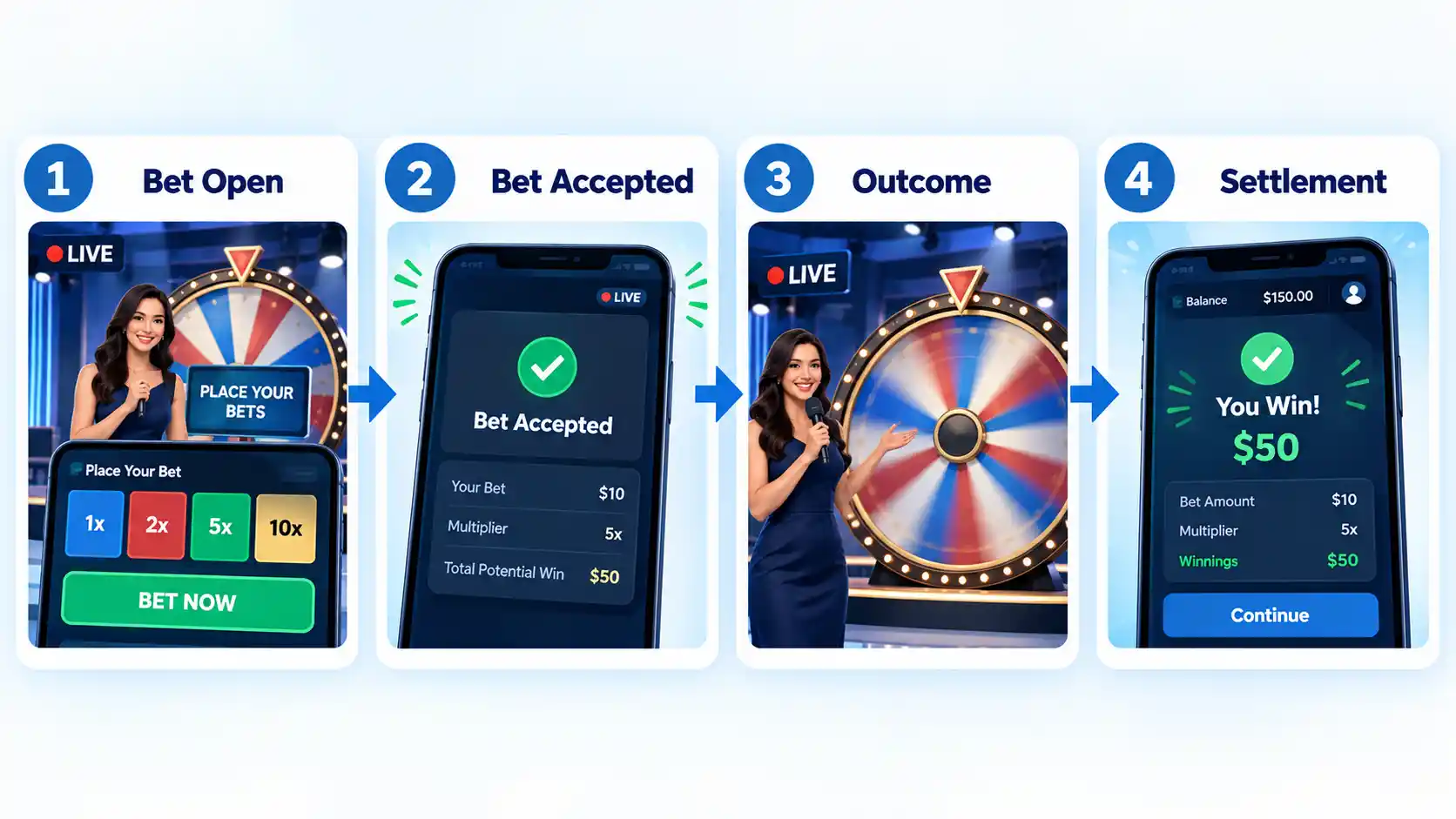
This separation matters when something goes wrong. The video feed is how the player observes the studio, while wager acceptance and the recorded game result determine how an interrupted round is treated.
What Actually Determines the Outcome?
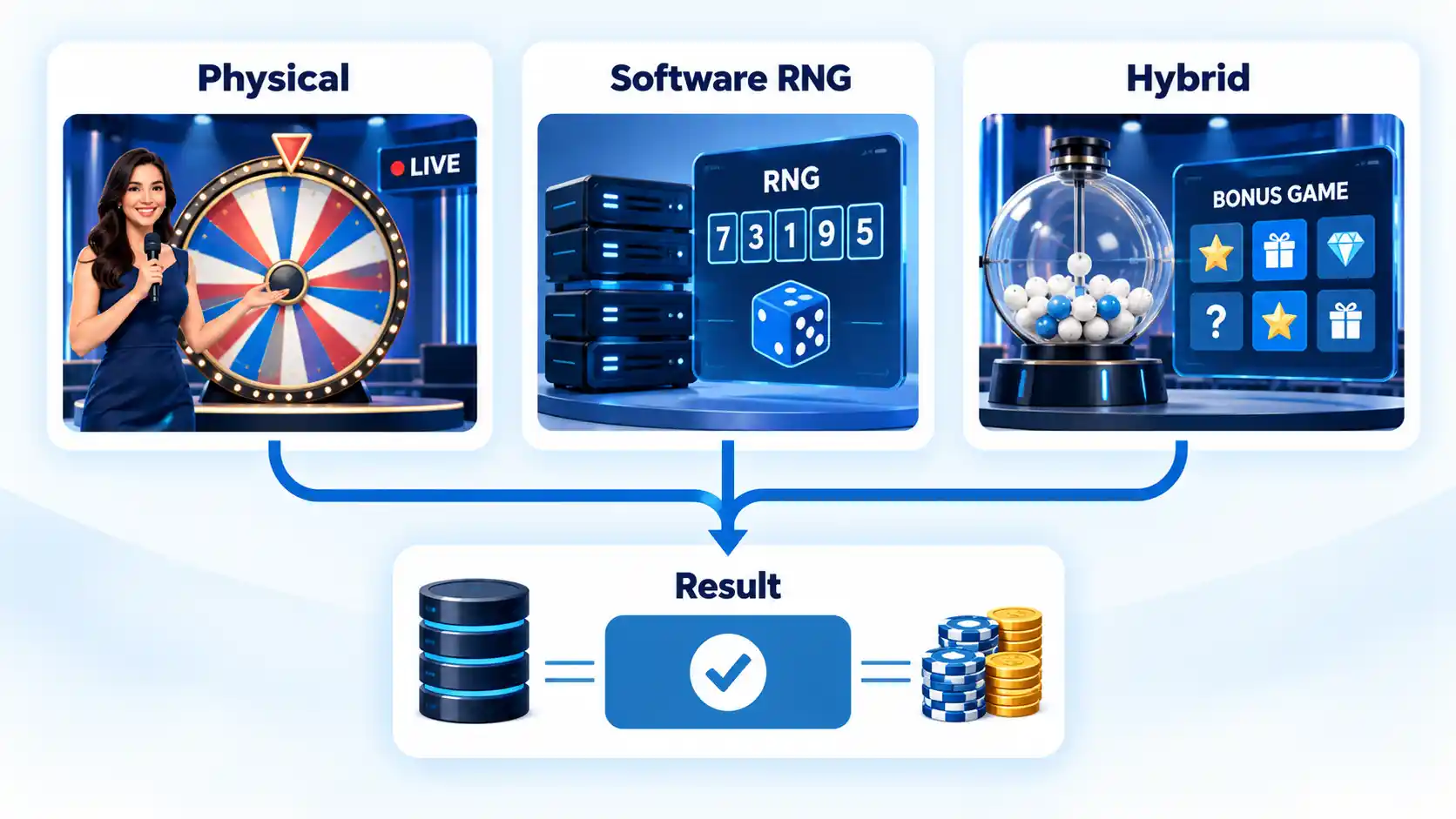
The word live describes the real-time presentation. It does not mean that every random component must be physical. A live game show can use a physical mechanism, a software random number generator, or both.
Physical outcomes
A physical random mechanism creates an outcome through an object or device in the studio. Examples include a spinning wheel, a ball-drawing machine, or physical dice.
The UK Gambling Commission’s RTS 7 random-outcome standard explicitly addresses both software random number generation and games that use the laws of physics to generate an outcome. For games within its scope, outcomes must be acceptably random, and adaptive changes to outcome probabilities during play are not permitted.
Software-generated outcomes
A random number generator, usually shortened to RNG, is software that produces unpredictable values according to the game’s rules. Depending on the title, software randomness can determine a multiplier, bonus value, hidden position, or another game element.
A graphical animation is not automatically an RNG. An animation can simply display the consequence of a result generated elsewhere, while another title may use software itself to determine part of the result. The individual game’s published rules are needed to tell the difference.
Hybrid games
Hybrid titles combine physical and digital elements within the same round. In MONOPOLY Live, for example, a physical wheel can trigger a bonus game, physical dice are rolled in the live studio, and a three-dimensional virtual MONOPOLY board moves according to the dice result.
This distinction is useful when comparing live dealer games and RNG casino games. A live title can contain software-generated random elements without making the entire game an RNG-only product.
How the Studio, Stream and Betting Interface Stay Connected
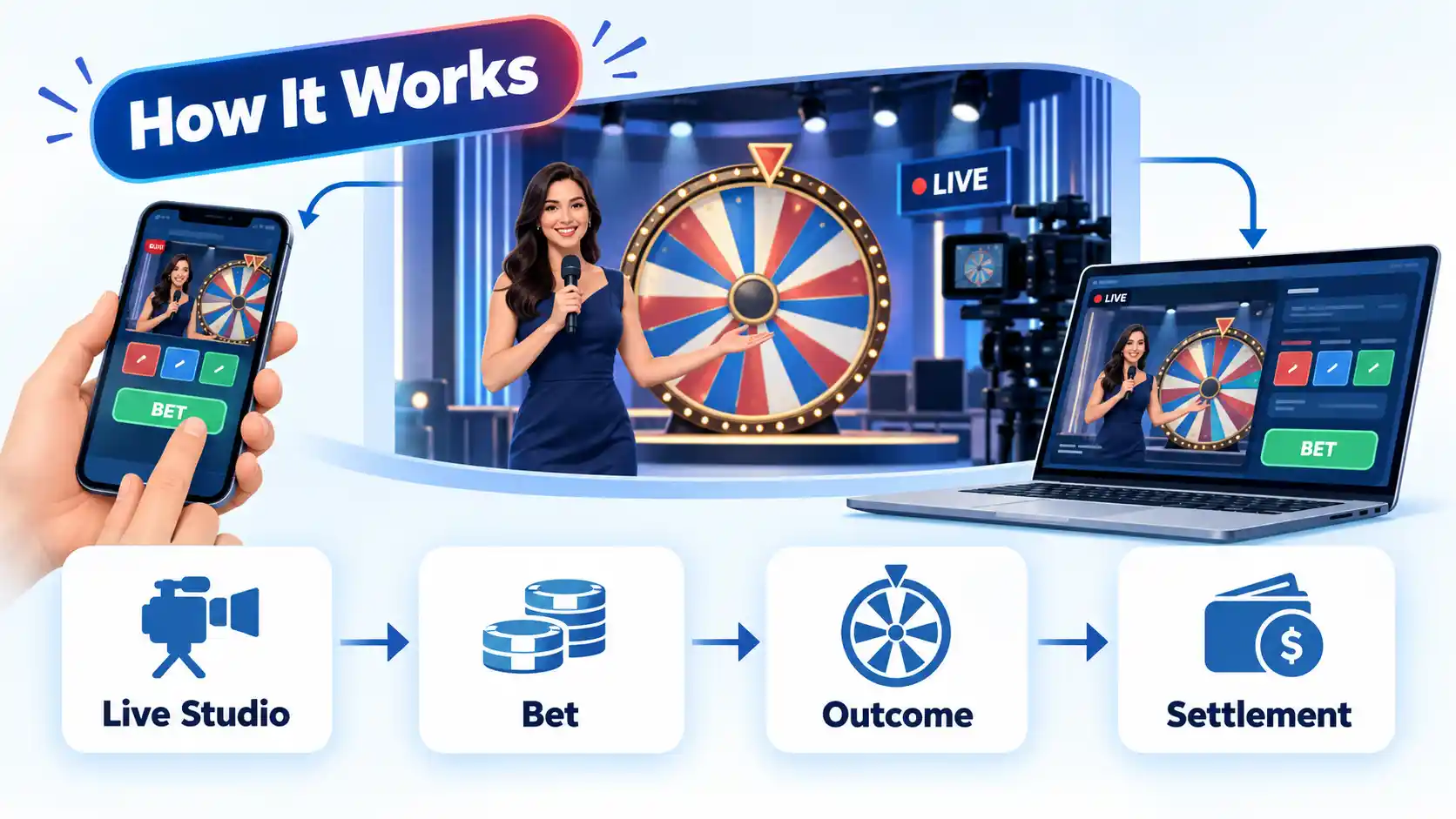
A live game-show platform has to coordinate what the player sees with the wager and result recorded by the gambling system. Those functions are connected, but they are not interchangeable.
The presentation layer is what the player sees and hears: the presenter, studio, cameras, sound, graphics, and live video. The betting layer handles the player’s selections and whether a wager becomes part of the round. The outcome layer produces or records the result according to the game rules. The settlement layer applies that result to accepted wagers.
These labels describe functions rather than one mandatory technical design. Providers do not necessarily use identical cameras, sensors, networking, software architecture, or internal databases, so those implementation details should not be assumed without provider-specific documentation.
What appears on screen can also differ from what generated the result. A virtual board or animated bonus sequence may visualize the consequence of a physical event rather than replace it.
Live game providers also sit inside a broader platform of identity, payments, security, compliance, testing, and account management, so modern online casino technology extends well beyond the video stream. A closer look at live casino technology can separate those functional layers without assuming that every provider uses the same architecture.
Are the Host and the Video Feed Determining Your Result?
The presenter conducts the live game, but the presenter does not have unrestricted discretion to decide which wagers win. The game’s documented rules define how the result is generated and how accepted wagers are evaluated.
For live-dealer studios regulated in Great Britain, the UK Gambling Commission’s live-dealer studio standard requires operations to be fair and independently auditable. Its guidance covers commercial-quality equipment, dealer training, supervision, video surveillance, access controls, game logs, and statistical monitoring.
Those requirements are specific to the regulatory framework in Great Britain and should not be presented as universal rules for every gambling site worldwide. They do show why a regulated live studio involves operational controls behind the visible host and cameras.
What RTP, House Edge and Multipliers Mean in Game Shows
Live game shows often display large multipliers prominently, but a multiplier alone does not tell you how likely a wager is to win or what its theoretical long-run return is. Several terms need to be kept separate.
| Term | What it means | What it does not mean |
|---|---|---|
| RTP | Return to player is the theoretical long-run share of wagered money returned under the stated game rules. | It is not a guaranteed return for one player, one session, or a small number of rounds. |
| House edge | The house edge is the mathematical advantage built into a wager or game rule. | It does not mean the operator must win every individual round. |
| Multiplier | A multiplier scales the payout of a qualifying result. | A larger multiplier does not automatically mean a higher probability of winning. |
| Hit probability | The chance that a specified result occurs under the game’s rules. | It does not make recent outcomes a reliable prediction of the next independent result. |
| Volatility | Volatility describes how returns can be distributed, such as a pattern with more frequent smaller outcomes versus less frequent larger outcomes. | It is not a promise of profit or a forecast of a short session. |
A single title can contain wager types with different theoretical returns. Evolution currently publishes a theoretical RTP range of 94.41% to 96.08% for Crazy Time depending on the relevant betting option and mechanics, rather than treating every selection as mathematically identical.
For games regulated in Great Britain, the UK Gambling Commission’s rules on game descriptions and the likelihood of winning require information that enables customers to understand how the game works, how winners and prizes are determined, and an applicable house edge, RTP, or probability measure before they commit to gamble.
Can Recent Results Predict the Next Spin?
For independent random rounds, recent results do not make a different result “due.” A sequence can look unusual and still be consistent with randomness.
Evolution states in its Crazy Time statistics information that each spin is independent and that past statistics do not predict future outcomes.
For example, several appearances of one segment in succession do not by themselves make another segment more likely on the next independent spin. Historical data describes previous rounds; it does not become a forecasting system unless the documented mechanics create a dependency between rounds.
What Happens If the Stream Freezes or Your Connection Drops?
A frozen video feed does not automatically mean a round has been cancelled. The important questions are whether the wager was accepted, whether the player still had any permitted influence over the outcome, and whether a valid outcome had already been generated.
Great Britain’s interrupted-gambling rules provide a useful regulatory example. Under the UK Gambling Commission’s RTS 10 requirements for interrupted gambling, a result should stand when an interruption occurs after the operator has received the customer’s gamble and the customer can no longer influence the outcome. For a single-participant, single-stage event interrupted before an outcome has been generated, the guidance says a deducted stake should be returned.
Latency can matter as well. The Commission’s time-critical events standard requires operators within its scope to assess risks where response speed materially affects a customer’s chance of winning and to inform customers when technical factors such as network or device performance may create a disadvantage.
In practice, a connection problem can therefore lead to several different situations:
- The wager was not accepted before betting closed, so it is not part of the round.
- The wager was accepted and the player had no further influence over the outcome, so the recorded result can still determine settlement.
- An eligible event was interrupted before a valid outcome was generated, so the applicable interruption rules matter.
- The player’s video feed was delayed or lost even though the game state continued normally.
This is why what happens when a live casino game disconnects mid-round depends on the recorded state of the game rather than only on whether the player could still see the studio.
How Fairness Is Checked in Regulated Live Studios
Fairness in a live game show depends on more than whether the presenter appears trustworthy on camera. A regulated system needs documented game rules, controls around the studio, records of game events, and procedures that can be audited.
In Great Britain, the Gambling Commission requires live-dealer operations to be fair and independently auditable. Its guidance calls for appropriate equipment, staff training, supervision, surveillance, access controls, game logs, and statistical monitoring. Separate randomness requirements address both software RNGs and physical mechanisms that use the laws of physics to produce outcomes.
Those standards are a jurisdiction-specific example, not proof that every live game show available globally operates under identical controls. The relevant operator, regulator, game rules, and complaint procedures still need to be identified for the jurisdiction in which the gambling takes place.
Where licence status matters, verifying an online casino licence is more useful than relying on a logo, game brand, presenter, or polished studio design alone.
Common Live Game-Show Formats and How They Differ
Game shows can share the same live-studio presentation while using very different mechanics. The examples below illustrate different ways of connecting a betting interface to a physical or digital random event.
Dream Catcher: Evolution describes Dream Catcher as a game of chance built around a large vertical money wheel divided into numbered and multiplier segments.
Crazy Time: The main wheel includes numbered and bonus-game segments. A Top Slot feature can assign multipliers, while qualifying wheel results lead into bonus games such as Coin Flip, Cash Hunt, Pachinko, and Crazy Time.
MONOPOLY Live: A physical wheel can trigger the bonus game, physical dice are rolled in the live studio, and a virtual three-dimensional board moves according to those dice.
Mega Ball: Evolution describes this as a bingo-style format. After betting closes, 20 of 51 numbered balls are drawn from a ball-drawing machine and matching numbers are marked automatically on purchased cards, followed by one or two Mega Ball bonus draws.
Cash or Crash: A ball-drawing machine selects coloured balls while the game progresses through a 20-step ladder-style paytable. After qualifying green-ball draws, players can be offered choices to take all, take half, or continue, making it an example where player decisions can occur after the initial wager.
Mega Wheel: Pragmatic Play’s Mega Wheel uses a 54-segment physical wheel. Players select numbered positions before the spin, while the game can also apply a randomly selected Mega Lucky Number and Mega Multiplier.
None of these formats is automatically better because it has more bonus features, a larger possible multiplier, or a more elaborate studio. Those differences affect presentation and payout structure. The more useful questions are how the result is generated, what each wager means, what probability or RTP information applies, and how the system handles settlement and interrupted play.
What to Check Before Treating a Game as Transparent
A transparent live game show should make its mechanics understandable before you commit money. At minimum, check whether the game clearly explains:
- which outcomes you can bet on;
- when betting opens and closes;
- how the main outcome is generated;
- how any bonus round or multiplier is determined;
- the relevant RTP, house edge, or probability information;
- what happens if the game or connection is interrupted;
- which operator and game provider are involved; and
- which regulator and legal-age rules apply where you are located.
In most cases, the minimum legal age for online gambling in Great Britain is 18, according to the UK Gambling Commission. Other jurisdictions can apply different age limits, permitted products, and eligibility rules, so those requirements should be checked locally rather than inferred from the location of the game provider or studio.
The simplest way to understand live dealer game shows is to separate the television-style presentation from the gambling system underneath it. The presenter and graphics make the round visible and interactive, while the accepted wager, defined outcome mechanism, recorded result, and payout rules determine what happens to the bet.

💬 Comments