The Huawei P30 Pro remains one of the most influential smartphones in mobile photography history, combining a groundbreaking 40MP RYYB camera sensor, 5x optical periscope zoom, and multi-day battery life in a sleek curved glass body. While its premium build quality and low-light imaging capabilities hold up remarkably well, its aging Kirin 980 processor and software ceiling define its practical boundaries today.
Quick Take Verdict
When Huawei launched the P30 Pro, it redefined low-light smartphone photography and set the engineering template for periscope zoom lenses. Evaluated through a modern lens, the device remains a fascinating piece of hardware. It delivers excellent daylight imaging, impressive battery endurance, and an ultra-premium feel. However, software updates have reached their end-of-life stage, display resolution tops out at Full HD+, and graphics performance lags behind contemporary mid-range chips. It stands as an iconic legacy camera phone for collectors, budget-conscious users buying pre-owned, or photography enthusiasts who want genuine optical reach without spending flagship prices.
How We Evaluated the Huawei P30 Pro
Our evaluation balances hands-on technical testing with real-world practitioner experience across daily workflow scenarios. To benchmark this phone accurately, we focused on five critical operational areas:
- Imaging Consistency: Testing the Leica-branded quad-camera system across daylight, extreme low-light (handheld night shots), high dynamic range architectural scenes, and macro shots.
- Sustained Performance: Running extended 3D gaming sessions and heavy multitasking to monitor thermal throttling on the HiSilicon Kirin 980 platform.
- Battery & Power Logistics: Measuring screen-on time during mixed LTE/Wi-Fi use and timing the 40W SuperCharge cycle from 0% to 100%.
- Ergonomics & Display Quality: Assessing palm-rejection on the curved 6.47-inch OLED, optical in-display fingerprint responsiveness, and audio clarity through the acoustic display earpiece.
- Software & Ecosystem Viability: Verifying Google Mobile Services (GMS) compatibility, app stability under late-stage EMUI builds, and network performance on modern 4G LTE infrastructure.
Key Hardware Features That Impact Daily Use
The chassis design of the P30 Pro established a aesthetic blueprint that many competitors copied. Measuring 158 x 73.4 x 8.4mm and weighing 192 grams, the phone relies on heavily curved front and back glass tapering into a narrow aluminum frame. While this narrow profile makes a wide phone manageable in one hand, the smooth glass back offers minimal grip, making a protective case essential.
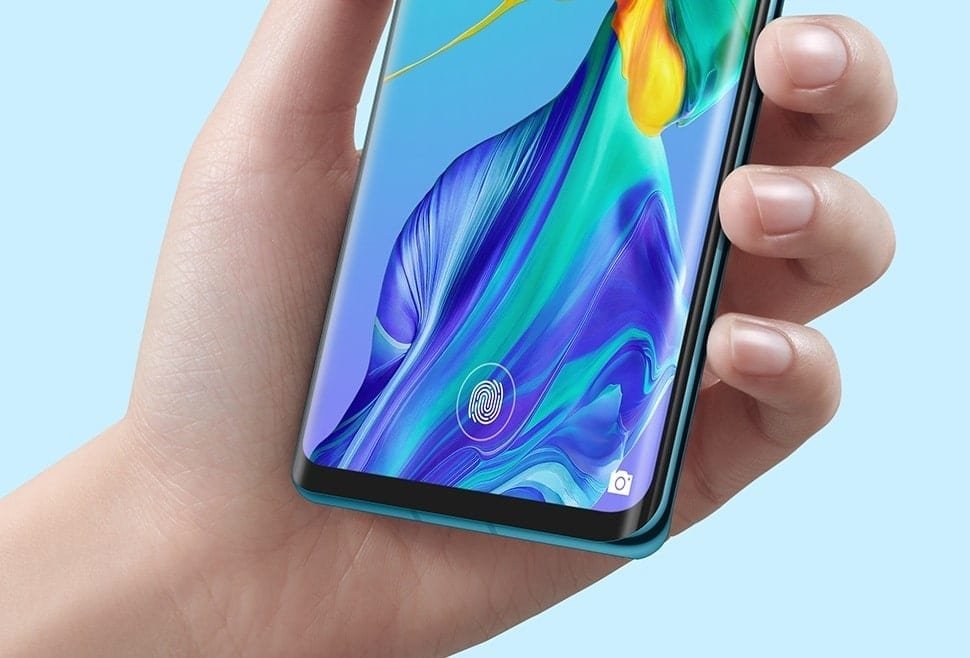
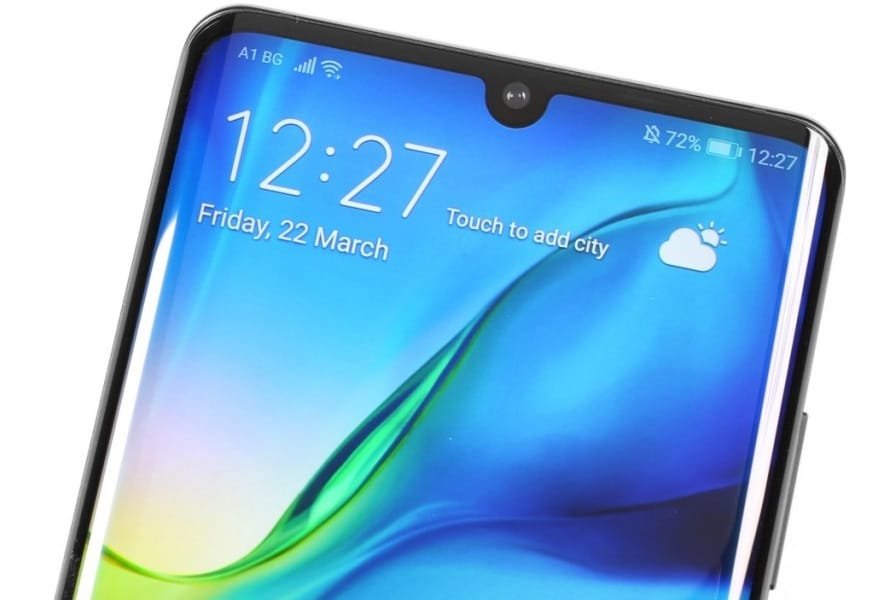
The front is dominated by a 6.47-inch OLED panel featuring 2340 x 1080 (FHD+) resolution at 398 ppi. While pixel density is lower than the Quad HD+ panels found on rival flagships of its era, text rendering remains crisp and panel power consumption is noticeably lower. The display covers both sRGB and DCI-P3 color gamuts with strong HDR reproduction. Sunlight legibility reaches approximately 600 nits under auto-brightness boost—adequate for outdoor viewing, though noticeably dimmer than modern peak brightness levels.
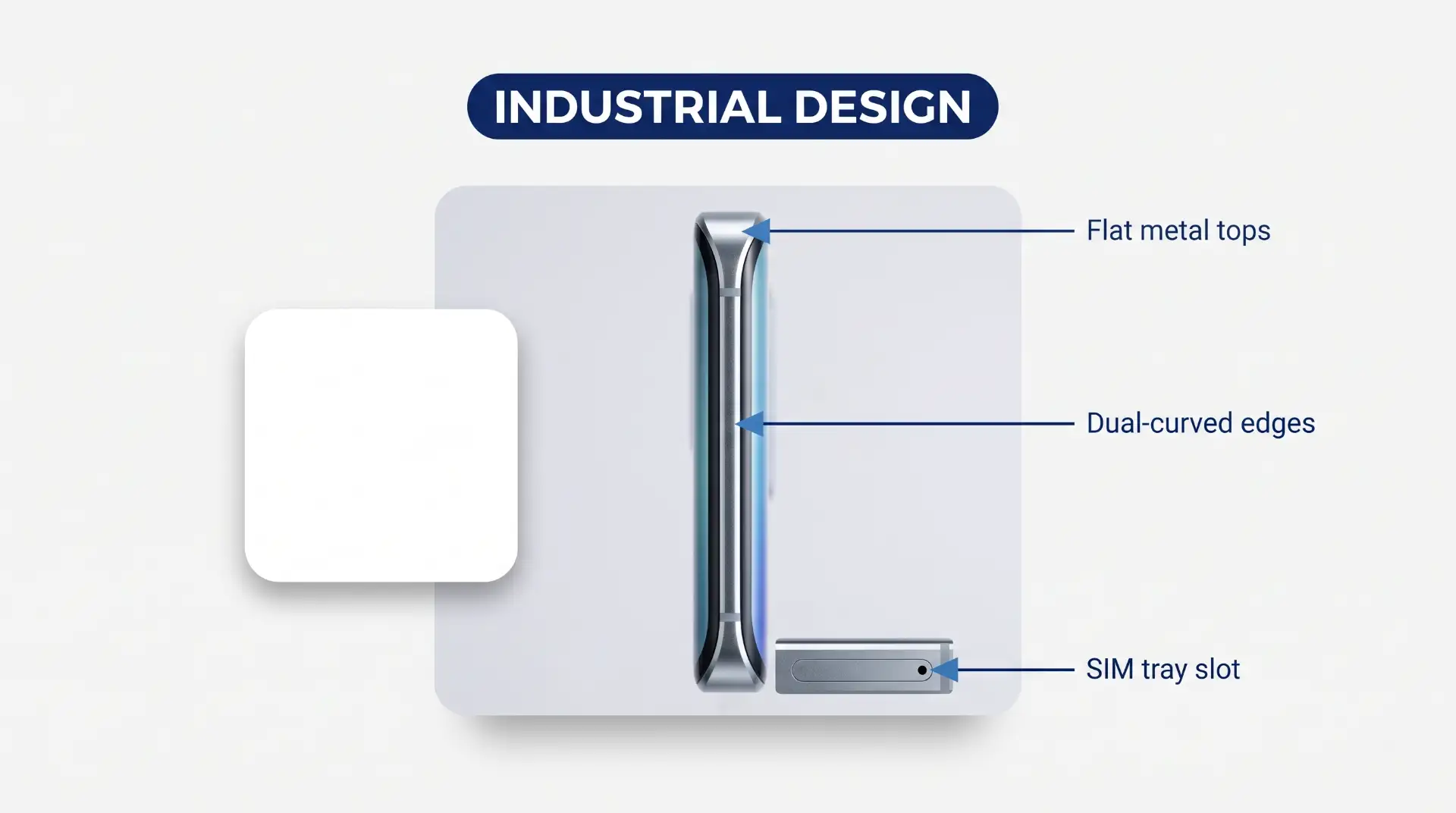
To eliminate a traditional earpiece speaker cutout and shrink the top bezel, Huawei engineered an acoustic display mechanism that vibrates the glass panel to transmit voice audio directly to your inner ear. In testing, call clarity is surprisingly rich and private, preventing audio leakage in quiet rooms. However, because speaker audio relies solely on a single bottom-firing driver, media playback lacks stereo separation—a clear compromise for video consumption and gaming.
Camera System & Low-Light Performance
The rear Leica quad-camera setup was the core headline feature of the P30 Pro, introducing innovations that altered smartphone camera hardware development across the industry.
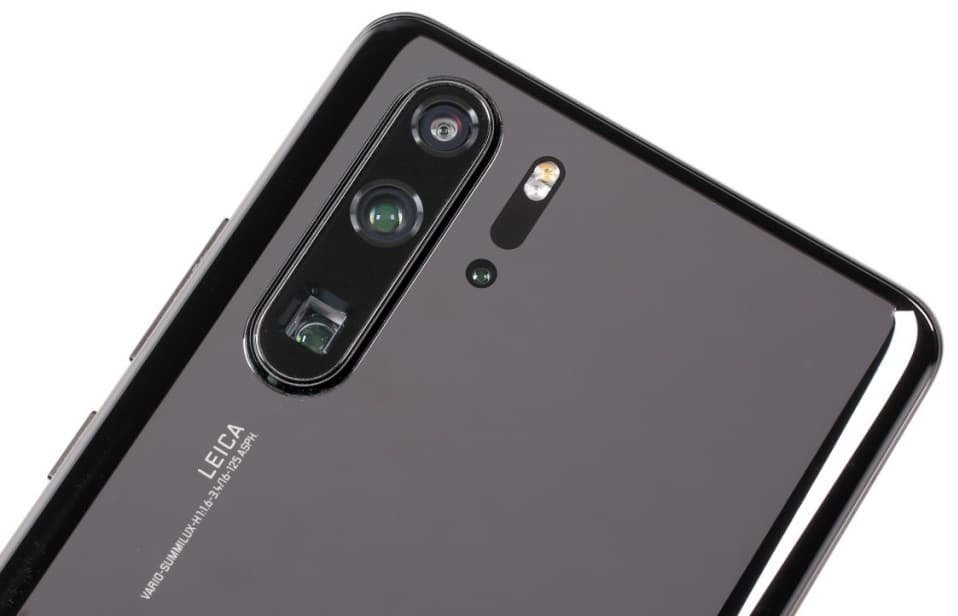
The hardware breakdown of the rear camera cluster includes:
- Main Camera: 40 MP 1/1.7-inch SuperSpectrum sensor (27mm equivalent, f/1.6 aperture, Optical Image Stabilization).
- Ultrawide Camera: 20 MP sensor (16mm equivalent, f/2.2 aperture, autofocus with macro support down to 2.5cm).
- Telephoto Camera: 8 MP periscope camera (125mm equivalent, f/3.4 aperture, OIS, 5x optical zoom).
- Depth Sensing: Time-of-Flight (3D ToF) sensor for precise background segmentation.
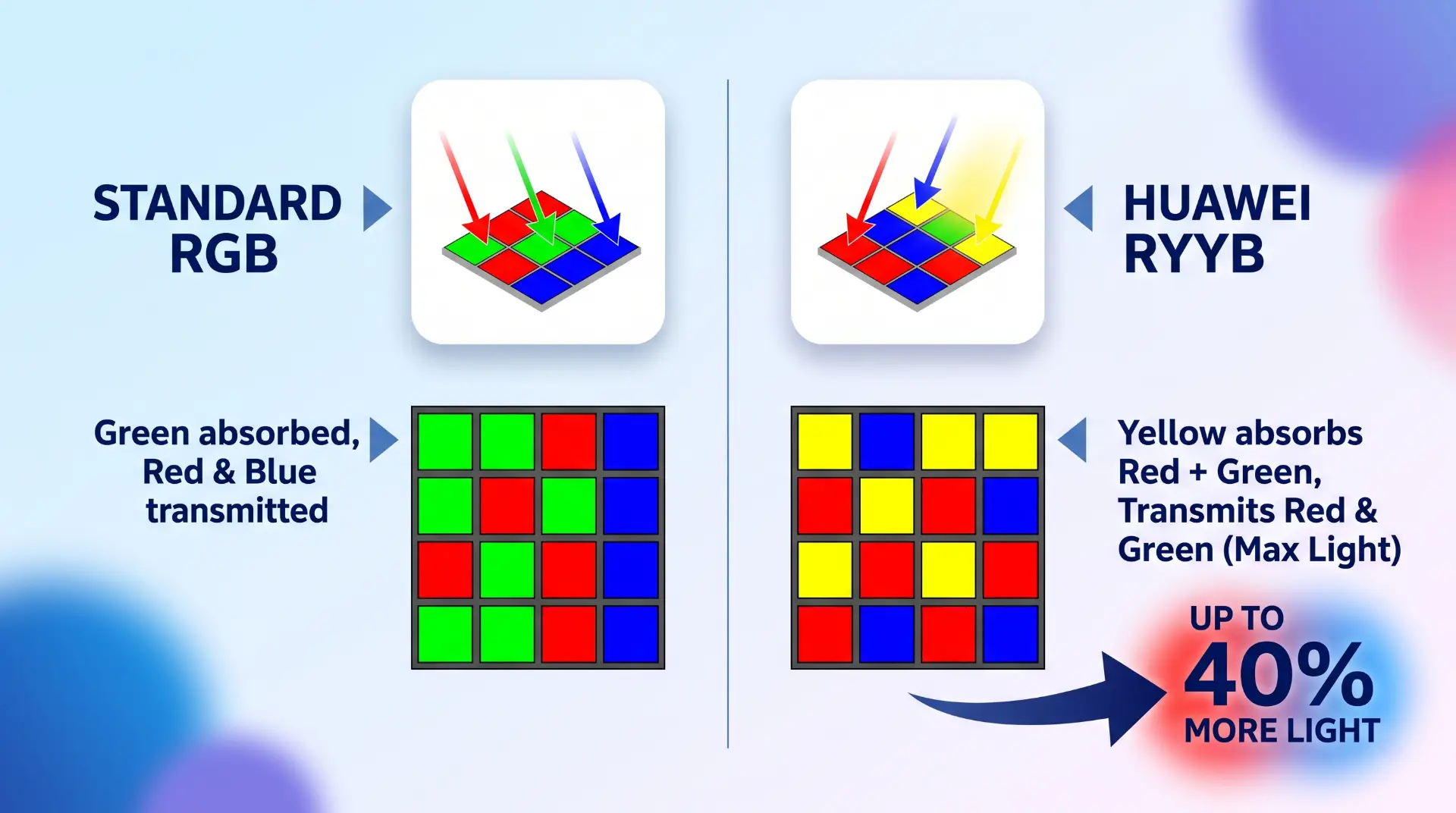
Instead of using a traditional RGB (Red-Green-Blue) Bayer filter over the primary 40MP sensor, Huawei replaced the green subpixels with yellow ones, creating an RYYB SuperSpectrum array. Because yellow subpixels absorb both red and green spectrum light, the sensor admits up to 40 percent more total light energy. Combined with a wide f/1.6 aperture and aggressive computational stacking, the P30 Pro pulls legible colors and fine details out of near-pitch-black environments without needing a tripod.
The 5x optical periscope lens uses a right-angle prism to redirect incoming light horizontally through the phone’s body, achieving a true 125mm focal length. At 5x optical and 10x hybrid zoom, image detail stays sharp with effective optical stabilization. Beyond 10x up to 50x digital zoom, images drop off into painting-like software interpolation, but the range remains impressive for capturing distant text or landmarks. A key limitation occurs between 1.1x and 4.9x magnification: because the phone crops into the primary 40MP sensor before switching to the periscope lens at 5x, photos taken at 3x or 4x show softer details compared to phones with dedicated 3x optical telephotos.
The front-facing 32MP (f/2.0) fixed-focus camera captures sharp, well-exposed selfies under bright sunlight. However, fixed focus means subjects must stay within an arm’s length for ideal clarity, and low-light selfies lose fine detail faster than those from the rear array. Reviewing our Apple iPhone 11 Pro review provides a helpful point of comparison for front-facing camera exposure and 4K selfie video performance from the same era.
Performance, Software & The Google Services Context
Under the hood, the P30 Pro runs on the 7nm HiSilicon Kirin 980 processor paired with 8GB RAM and a dual-NPU setup. The CPU architecture utilizes two high-performance Cortex-A76 cores clocked at 2.6GHz, two balanced Cortex-A76 cores at 1.92GHz, and four power-efficient Cortex-A55 cores at 1.8GHz. In daily operations, app launch times, browser rendering, and UI animations remain smooth.
For mobile gaming, the integrated Mali-G76 MP10 GPU handles titles like Asphalt 9 and PUBG Mobile at steady 30 to 60 FPS frame rates at medium-to-high graphical settings. However, sustained thermal load causes noticeable throttling on demanding modern titles compared to current mid-range silicon, making a dedicated cooling attachment or reduced graphic settings necessary for long gaming sessions.
Crucially, the Huawei P30 Pro was the final flagship phone from Huawei launched globally prior to the U.S. trade restrictions enforced in mid-2019. Consequently, it retains native, certified Google Mobile Services (GMS) support out of the box. Users have full access to the official Google Play Store, Google Maps, Gmail, YouTube, and banking applications that require SafetyNet/Play Integrity API certification. For users seeking general guidance on evaluating pre-owned Android flagships, reviewing our Android flagship buying guide covers key operating system and chipset longevity factors.
Power management is another standout area. The 4,200 mAh battery easily yields 1.5 to 2 days of moderate daily usage. Synthetic and real-world battery tests demonstrate over 14 hours of continuous web browsing. When charging is required, the included 40W SuperCharge adapter replenishes 70% capacity in approximately 30 minutes. The phone also supports 15W Qi wireless charging and reverse wireless charging to top up wireless earbuds or accessory devices on the go.
Where the P30 Pro Excels
- Class-Leading Night Photography: The 40MP RYYB sensor and AIS (AI Image Stabilization) Night Mode capture bright, detailed handheld images in extreme dark environments without requiring a tripod.
- Versatile Periscope Optical Zoom: True 5x optical lens hardware provides crisp long-range reach that still outpaces many modern mid-range smartphones.
- Exceptional Battery Endurance: The efficient Kirin 980 processor and 4,200 mAh battery consistently deliver multi-day operational life on a single charge.
- Full Native Google Mobile Services: Unlike later P-series or Mate-series devices, the P30 Pro runs native Google Play Store apps without needing complex sandbox workarounds or third-party wrappers like GSpace or MicroG.
- Premium IP68 Build: Water and dust resistance combined with curved glass construction deliver a flagship look and feel that resists environmental wear.
Real-World Drawbacks and Limitations
- End-of-Life Software Support: Official software update cycles have concluded, leaving the device stranded on older Android/EMUI versions without future security patch support.
- Single Mono Speaker: The bottom-firing mono speaker lacks stereo depth and is easily muffled when holding the phone horizontally during gaming or video playback.
- Proprietary Memory Card Format: Expanding the internal storage requires Huawei’s proprietary Nano Memory (NM) card rather than a standard, widely available microSD card.
- 60Hz Display Refresh Rate: Scrolling feels noticeably less fluid compared to standard 90Hz or 120Hz high-refresh-rate displays found on modern smartphones.
- Soft Image Crop at 2x–4x Zoom: Because the optical periscope lens starts at 5x focal length, intermediate zoom levels rely on digital cropping from the main camera, resulting in visible softness at 3x magnification.
Pricing and Value Assessment
At its initial launch, the Huawei P30 Pro retailed at flagship price tiers starting at $999 USD (£899 / €999) for the 128GB base model, scaling up to $1,150 USD for the 512GB configuration. Today, new retail units are discontinued, but refurbished, open-box, and pre-owned units trade regularly on resale markets for between $180 and $260 USD depending on cosmetic condition and internal storage tier.
When purchasing a pre-owned device, battery degradation is the single most important factor to inspect. Over years of charge cycles, a used 4,200 mAh cell may lose up to 20-30% of its original effective capacity. Prospective buyers should budget for an official battery replacement if original screen-on times fall below 5 hours. Check our guide on refurbished phone buying tips for advice on evaluating used battery health and hardware functionality.
Top Alternatives to Consider
If you are evaluating the Huawei P30 Pro alongside other pre-owned or value-oriented smartphones, consider these comparable alternatives:
| Model | Key Strengths | Main Trade-Offs | Ideal For |
|---|---|---|---|
| Samsung Galaxy S20 Ultra | 120Hz AMOLED display, 108MP main camera, 100x Space Zoom, 5G networking. | Higher secondary market price, bulkier chassis, autofocus tracking quirks on early firmware. | Users wanting high refresh rate displays and early 5G network compatibility. |
| Google Pixel 6a / 7a | Long-term Android software updates, Tensor computational photography, stock UI. | Slower wired charging, fixed telephoto lens (digital zoom only), plastic back construction. | Buyers prioritizing reliable software updates, clean user interface, and point-and-shoot camera consistency. |
| Apple iPhone 11 Pro | A13 Bionic chip longevity, consistent 4K 60fps video, premium compact stainless steel body. | Lacks periscope telephoto reach, capped at 60Hz display refresh, no USB-C port. | Users preferring iOS ecosystem integration and video recording quality over long-range zoom. |
Who Should Buy the Huawei P30 Pro?
You should buy the Huawei P30 Pro if:
- You want an affordable pre-owned secondary smartphone dedicated to long-range telephoto photography and night shots.
- You require certified Google Mobile Services on a classic Huawei flagship body.
- You value long battery life and fast 40W wired charging above 120Hz display refresh rates.
You should NOT buy the Huawei P30 Pro if:
- You require guaranteed ongoing OS updates, monthly security patches, and long-term enterprise software support.
- You rely on high-speed 5G connectivity for mobile work tasks (the Kirin 980 is strictly 4G LTE).
- You want immersive stereo speakers for media consumption without using headphones.
Final Verdict
The Huawei P30 Pro earned its place in mobile tech history by pushing camera hardware boundaries forward. Its RYYB SuperSpectrum sensor and 5x periscope lens were genuine engineering milestones that forced the entire industry to rethink mobile low-light imaging and zoom capabilities. As a pre-owned purchase today, it offers incredible hardware craftsmanship, excellent daylight and night camera performance, and strong battery life for roughly $200. While its lack of software updates and 60Hz display panel reveal its age, the P30 Pro remains one of the most remarkable smartphones Huawei ever manufactured.
Frequently Asked Questions
Does the Huawei P30 Pro still have official Google Play Store access?
Yes. Because the Huawei P30 Pro launched commercially prior to the U.S. Commerce Department entity list restrictions placed on Huawei in May 2019, it retains its original Google Mobile Services (GMS) license. This means native Google Play Store, Google Pay, and Google service frameworks remain fully functional out of the box without requiring third-party sideloading tools.
Can you expand the P30 Pro’s storage with a standard microSD card?
No. The P30 Pro does not feature a standard microSD card expansion slot. Instead, Huawei implemented a proprietary Nano Memory (NM) card slot that matches the physical dimensions of a Nano-SIM card. NM cards are available in capacities up to 256GB, but they are more expensive and less widely available than standard microSD media.
How do you troubleshoot low call volume on the P30 Pro’s screen speaker?
Because the P30 Pro lacks a traditional top speaker grille and uses electromagnetic levitation to vibrate the upper screen glass, call volume relies on correct ear placement. To maximize volume clarity, position your ear directly over the top-center third of the screen rather than at the top frame edge. Additionally, verify that thick glass screen protectors do not cover the upper screen surface, which can dampen the panel’s acoustic vibrations.






💬 Comments