A practical Instagram marketing strategy for a small business starts with a business goal, then connects your profile, original content, audience engagement, and measurement to that goal. Instead of chasing likes or follower counts in isolation, decide what you want Instagram to help accomplish and measure whether your activity moves people toward that result.
That approach matters because Instagram marketing has moved beyond the simple formula of attractive photos, hashtags, and a push for more likes. Small businesses need to think about what they publish, how people discover it, what action they want potential customers to take, and how Instagram activity connects to actual business outcomes.
Quick Take
- Choose a business objective before deciding what success on Instagram means.
- Make your profile immediately explain what the business does and what visitors should do next.
- Build repeatable content around customer needs, products, expertise, and real business activity.
- Use Reels, carousels, static posts, and Stories according to the message rather than assuming one format is always best.
- Measure the path from content exposure to meaningful actions such as inquiries, website visits, bookings, or sales.
Start With the Business Result, Not Follower Count
Before planning posts, decide what Instagram is supposed to accomplish for your business. Possible objectives include increasing awareness, generating inquiries, sending people to your website, encouraging bookings or store visits, or supporting sales.
This gives you a meaningful key performance indicator (KPI), which is a measurement used to judge progress toward a particular objective. The right KPI depends on what you are trying to achieve.
For example, a local photographer may care primarily about qualified inquiries and bookings. A new consumer brand may initially care more about reaching relevant potential customers and getting them to visit a product page. A restaurant may use Instagram partly to keep local customers aware of new dishes, events, or opening information.
Platform metrics still matter, but they should be interpreted in context. Views and reach can tell you whether content is being seen. Shares, saves, comments, and other interactions can indicate interest. Profile and destination actions can show whether that interest is progressing further.
The mistake is treating every metric as a business result. A post can collect plenty of visible engagement without generating meaningful customer action. Conversely, a post with modest public engagement could still be valuable if it produces several qualified inquiries.
Set one primary objective for a campaign or content stream where practical. If you simultaneously judge every post by reach, followers, comments, website visits, inquiries, and sales, it becomes difficult to tell what actually worked.
Optimize Your Instagram Profile for Discovery and Action
Your profile is often the point where initial interest turns into a decision to learn more, contact the business, or leave. A visitor should be able to understand what you offer without decoding vague slogans or scrolling through weeks of posts.
Start with a recognizable profile identity and a name that makes sense to the people searching for the business. Use the bio to explain the offer or purpose clearly. Where relevant, add an appropriate category, current contact information, and a destination link that supports the action you want visitors to take.
For example, a bakery could identify its location and specialty, then direct people to ordering information. A business consultant might identify the type of company served and link to a consultation or service page. The profile is doing two jobs in both cases: explaining the business and providing a logical next step.
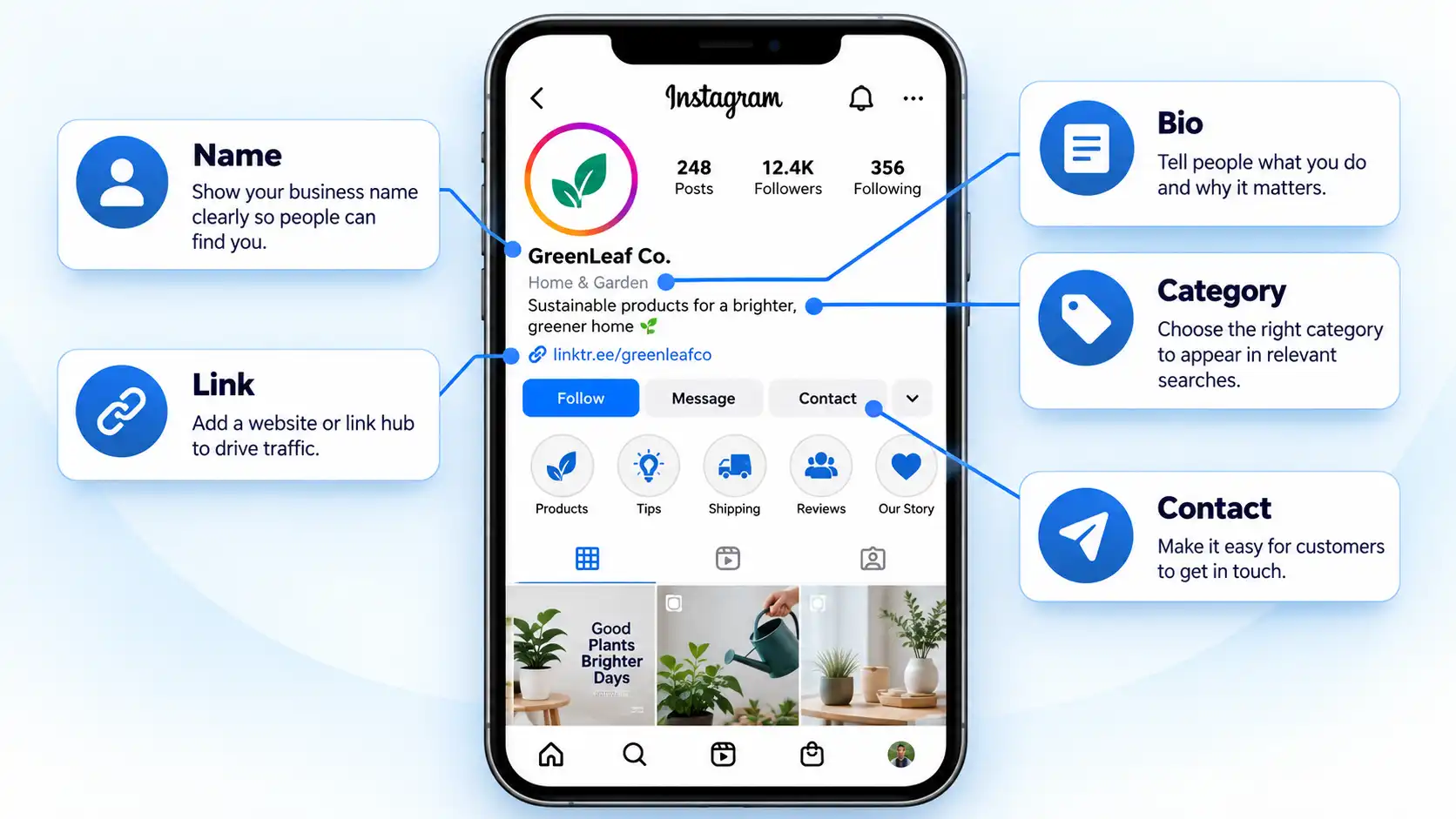
A professional Instagram account gives businesses access to additional account-management and insight features. The exact features available can vary by account and region, so treat the professional account as the operating foundation rather than assuming every account has an identical toolset.
Tools that reduce the manual work of publishing can help a small team maintain a content plan, but they do not solve the harder part of the strategy: deciding what is worth publishing. A full calendar of weak or repetitive content is still a weak content strategy.
Build a Content System You Can Sustain
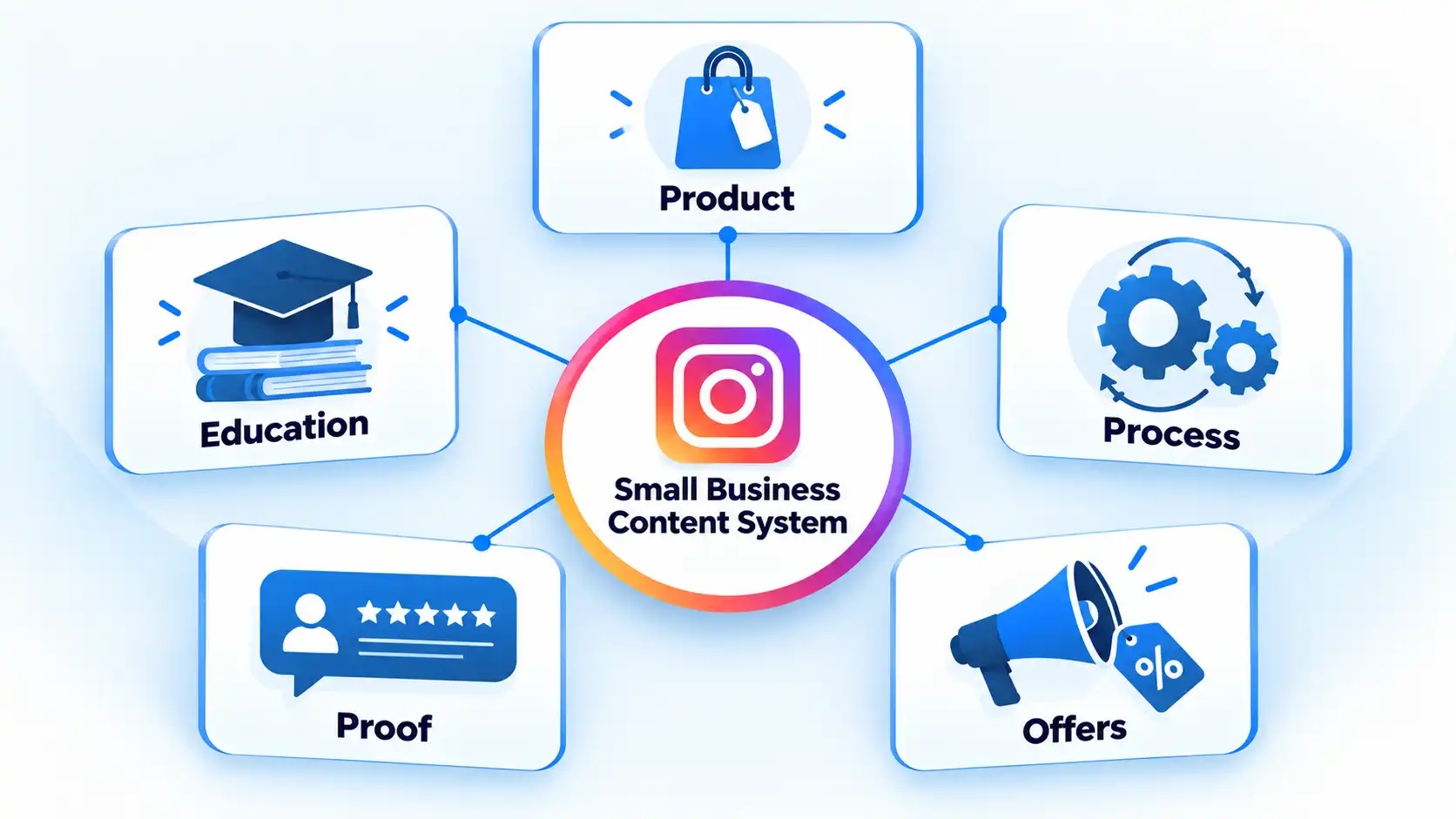
“Post high-quality content” is too vague to be useful as a small-business strategy. A better approach is to define a handful of content pillars: repeatable subject areas that connect what the business knows or sells with what its audience needs to understand.
A practical content system might include:
- Product or service demonstration: show what you provide, how it works, or what the customer receives.
- Education: answer recurring questions, explain decisions, or solve small problems related to your expertise.
- Behind the scenes: show relevant processes, people, preparation, or craftsmanship.
- Customer context or proof: share appropriate customer experiences, results, or user-created material when you have the necessary permission.
- Offers and updates: communicate launches, events, availability, seasonal information, or promotions when they are genuinely useful.
This creates variety without forcing the business to invent a completely new content strategy every week. A restaurant, for instance, could rotate between preparation clips, menu explanations, staff or kitchen stories, customer-approved material, and timely menu or event updates rather than publishing a continuous stream of promotional graphics.
Originality deserves particular attention. In January 2026, Meta reported that it had increased the prevalence of original content in U.S. Instagram recommendations by 10 percentage points during Q4 2025, with 75% of recommendations coming from original posts. That figure describes U.S. recommendations at that point in time, not a guarantee that an original post will receive distribution.
For a small business, the practical lesson is not that every post must introduce a never-before-seen idea. Your own demonstrations, explanations, footage, customer questions, processes, and expertise simply provide a stronger foundation than building an account primarily around recycled material.
Repetition can still be useful. Customers do not see everything you publish, and important ideas often deserve to be explained more than once. The goal is to revisit useful themes with fresh examples, formats, or context rather than repeatedly publishing the same creative.
Match the Instagram Format to the Message
Reels, carousels, static posts, and Stories perform different communication jobs. Instead of asking which format is universally best, ask which format makes a particular message easiest to understand.
| Format | Useful for | Practical example | Measurement emphasis |
|---|---|---|---|
| Reels | Movement, demonstrations, processes, and concise video explanations | Show how a product is made or demonstrate a service process | Views, viewing behavior, shares, and relevant follow-on actions |
| Carousels | Multi-part explanations, examples, or visual sequences | Explain factors a customer should check before choosing a service | Reach, saves, shares, engagement, and relevant actions |
| Static posts | Standalone visuals, announcements, or simple messages | Announce an event, product, milestone, or important update | Reach, engagement, and the action requested by the post |
| Stories | Timely updates, interaction, reminders, and supporting content | Share current availability or ask customers a relevant question | Views and responses or actions appropriate to the Story |
These are use cases, not rankings or rigid rules. A tutorial could work as either a Reel or a carousel. A product announcement could appear in the feed and then be reinforced in Stories. Let the information, objective, and audience response guide the format.
When comparing formats, keep the objective consistent. It makes little sense to declare a Reel successful simply because it received more views than a carousel if the carousel was intended to generate saves or qualified website visits. Compare performance against the job each piece of content was designed to do.
Improve Discoverability Without Chasing Algorithm Hacks
Instagram discovery is broader than hashtags. Give both potential customers and the platform clear contextual information about the business and the content you publish.
Use straightforward language in your profile and captions where it naturally identifies your service, subject, product, location, or customer problem. A local repair company, for example, benefits from clearly communicating what it repairs and where it operates instead of relying on vague captions surrounded by generic tags.
Hashtags can provide useful context, but they should not become the strategy itself. Use relevant terms where they genuinely describe the content rather than stuffing posts with broad tags simply because those tags appear popular.
Avoid supposed algorithm formulas that promise predictable reach if you post at one exact time, use a magic combination of tags, or trigger a particular number of interactions immediately after publishing. Instagram uses multiple discovery and recommendation surfaces, and their behavior should not be reduced to one universal trick without supporting evidence.
A more durable approach is to make content easy to understand, relevant to the intended audience, useful enough to merit attention or sharing, and connected to the business’s actual subject area. Then use your own account data to learn which themes and formats work for your audience.
Turn Engagement Into Customer Relationships
Engagement is most useful when it represents genuine interaction rather than a number to inflate. Comments can reveal questions. Direct messages can become inquiries. Mentions can show how customers are using a product. Recurring questions can become ideas for future content.
Respond where a response is useful. A thoughtful answer to a product question has more business value than filling a comment thread with generic replies designed only to make the post appear active.
User-generated content also needs care. A customer tagging your business does not automatically mean you should treat their photo or video as your own marketing asset. Instagram’s copyright guidance warns that posting another person’s protected content can infringe copyright even in circumstances such as having downloaded or recorded the material. Businesses should therefore consider permission and copyright before republishing customer-created material.
A practical workflow is to ask before republishing customer-created material when permission is needed, keep a record of the permission where appropriate, and avoid assuming that giving credit by itself resolves every rights issue.
Paid engagement also needs to be evaluated separately from genuine customer interaction. Services marketed with phrases such as buy ig likes sell engagement as a commercial service. The advertiser states that its likes come from real Instagram accounts, but that is the advertiser’s claim rather than an independently verified finding. A business considering any paid-engagement service should establish what is actually being supplied and should not treat a larger visible count as evidence of customer demand or business performance.
Measure What Actually Supports the Business Goal
Measurement becomes more useful when you treat Instagram performance as a path rather than a single number. A simplified path looks like this:
Content exposure → interest or engagement → profile action → website, message, or other destination → business outcome.
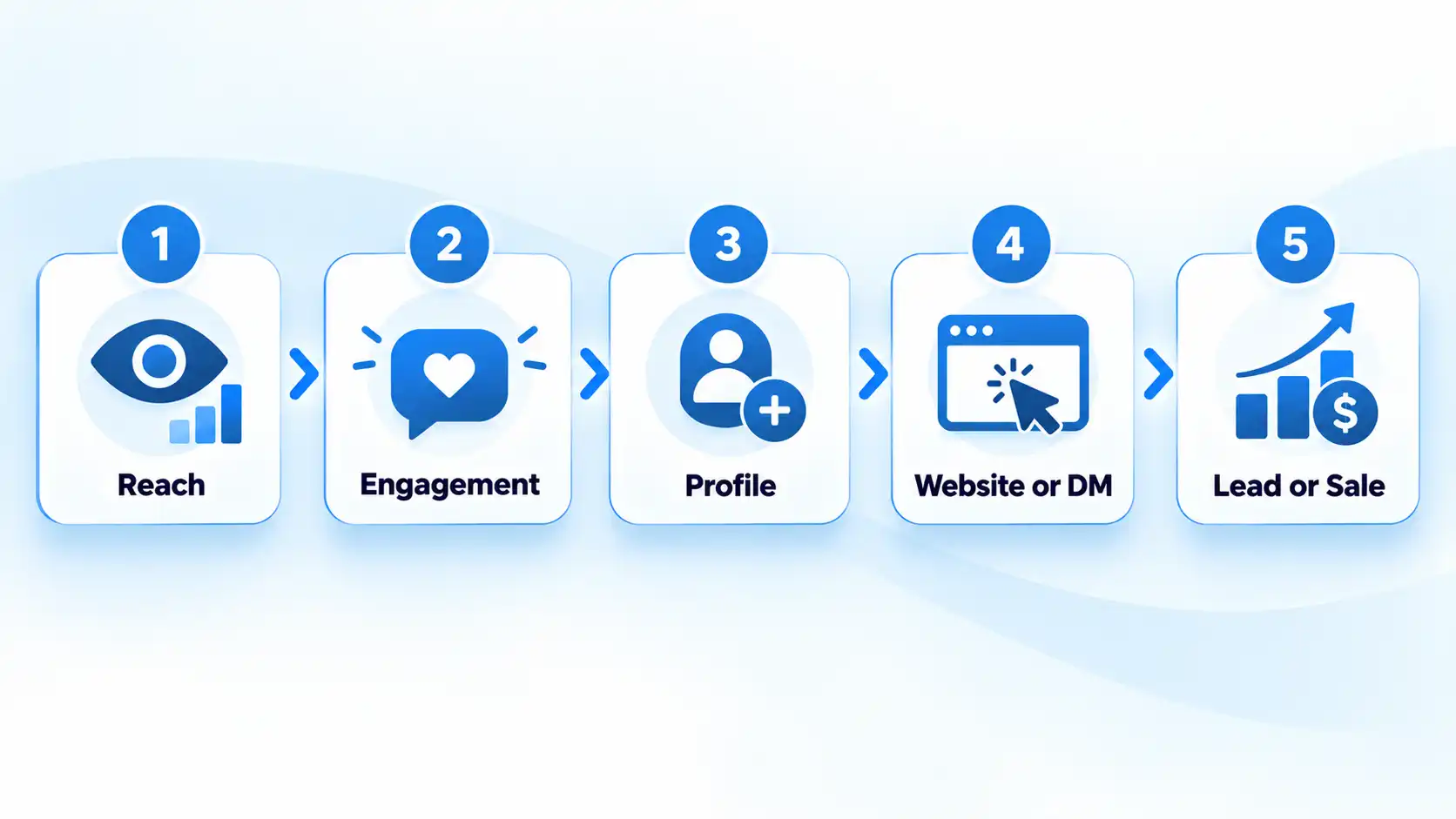
Each stage answers a different question. Reach or views can indicate whether people encountered the content. Engagement can show that some of them reacted to it. Profile actions and clicks indicate movement toward the business. Inquiries, bookings, qualified leads, or sales are closer to the actual commercial outcome.
Suppose one post generates 1,000 likes but no identifiable inquiries, while another receives 100 likes and generates five qualified requests for a quote. If the objective is lead generation, the second post would have produced more of the outcome being measured despite its smaller visible engagement count.
This does not mean likes, shares, saves, or views are worthless. They can help diagnose what happened earlier in the customer journey. The important distinction is between a signal about content performance and the business outcome you ultimately care about.
Where your website is part of the journey, campaign-specific links or UTM parameters can help distinguish traffic from different campaigns or placements. Attribution will still be imperfect: a person might see an Instagram post, remember the company, and return later through search or another channel. Use tracking to improve your understanding rather than assuming it captures every influence perfectly.
Review patterns across several posts instead of overreacting to one unusually strong or weak result. Ask which subjects consistently attract the right people, which formats communicate those subjects effectively, and which calls to action produce meaningful next steps.
Use Creator Partnerships Carefully
Creator partnerships can extend a business’s message through someone who already has an audience, but follower count alone does not establish that a creator is a good fit. Consider whether the creator’s subject matter, audience, communication style, and proposed content match the business and campaign objective.
Meta provides an Instagram creator marketplace that allows participating brands and creators to connect around partnership opportunities. Meta describes tools for brands to discover creators, exchange project information, and arrange collaborations. Meta also makes performance claims about partnership ads, but those are vendor claims and should not be treated as independent evidence that a creator campaign will outperform another marketing approach.
Disclosure is important when money, free products, affiliate compensation, or another exchange of value is involved. Instagram states that branded content involving an exchange of value requires its paid partnership label, including content involving payment or gifted products.
For endorsements that can reasonably affect U.S. consumers, Federal Trade Commission guidance says a material connection between an endorser and a brand should be made obvious. The disclosure should be hard to miss and placed with the endorsement itself. Businesses using creators should therefore treat clear disclosure of material connections as part of campaign planning, not an afterthought.
Instagram Growth Tactics to Avoid
Shortcuts can produce numbers without producing a useful audience. An important distinction is whether an indicator represents genuine activity or falsely represents a person’s or business’s social influence.
Warning
Do not assume purchased followers, views, or other engagement indicators are genuine. In the United States, the FTC’s Consumer Reviews and Testimonials Rule prohibits buying or selling fake indicators of social-media influence in specified commercial circumstances when the rule’s knowledge and misrepresentation requirements are met.
The FTC rule took effect on October 21, 2024. Its guidance defines fake indicators to include indicators generated by bots, accounts not associated with real individuals, certain accounts created without a person’s consent, hijacked accounts, and indicators that otherwise do not reflect genuine activity. The FTC also explains an important distinction: hiring influencers to encourage real people to follow an account does not itself constitute procuring fake indicators. Liability under the fake-indicator provision depends on circumstances that include whether the buyer knew or should have known that the indicators were fake and whether they were used to misrepresent influence or importance for a commercial purpose. The FTC’s rule Q&A explains the provision and its limitations.
Other weak or risky shortcuts include copying other people’s material without considering permission, treating generic hashtag stuffing as a substitute for useful content, and making commercial endorsements without appropriate disclosure.
Music is another detail a business can easily overlook. Instagram says music in its licensed library is intended for personal, non-commercial use and that certain business accounts and types of posts therefore have restricted access. Meta says Sound Collection provides royalty-free music and sounds that can be used commercially, including in ads. Check the current account and content rules instead of assuming that every track available somewhere on Instagram is cleared for business use. Instagram documents the licensed-library restrictions and Sound Collection alternative.
The broader rule is simple: do not build a strategy around a metric or creative shortcut without understanding what produced it. Numbers are valuable only when they represent something useful and trustworthy.
Build a Simple Monthly Improvement Loop
A small business does not need to reinvent its Instagram strategy every month. It needs a repeatable way to learn from what happened and make controlled improvements.
- Choose the objective. Decide what the next period of Instagram activity should support, such as awareness, qualified inquiries, website visits, or bookings.
- Review previous performance. Look for patterns in subjects, formats, audience responses, and meaningful customer actions rather than focusing on the single post with the largest number.
- Select content themes. Choose a manageable mix from your content pillars based on customer questions, business priorities, and previous results.
- Publish and test. Use the formats that fit the messages and vary meaningful factors deliberately rather than changing everything at once.
- Respond to genuine engagement. Answer useful questions and pay attention to comments or messages that reveal customer needs.
- Measure the intended outcome. Compare the results with the objective selected at the start of the period.
- Keep what works and refine what does not. Make the next cycle an informed adjustment rather than a complete reset.
For example, if educational carousels repeatedly produce saves and qualified profile visits while generic promotional graphics produce little customer action, that pattern gives you a reason to test more educational subjects or stronger calls to action without abandoning every other type of content.
Consistency in this context means maintaining a workable system, not forcing yourself to publish at an arbitrary frequency. Batch preparation and available publishing tools can reduce routine work, while customer responses and performance review still require active attention.
Conclusion
Instagram marketing for a small business works best when every part of the account has a job. The profile explains the business, content gives people a reason to pay attention, engagement helps turn attention into relationships, and measurement shows whether those activities are supporting the intended business result.
Build around useful original content and genuine customer interest rather than vanity metrics or supposed algorithm shortcuts. Then review the evidence from your own account regularly and refine the strategy one meaningful decision at a time.




💬 Comments