A good internet, TV and home-phone bundle is the lowest real-cost combination available at your address that gives you enough internet capacity, the channels you actually watch and the phone features you need. There is no single nationwide package that is best for everyone because service availability, promotions, equipment and plan combinations vary by location.
That also means older package names should not drive the decision. Spectrum, Xfinity and AT&T still offer combinations of household connectivity services, but their current product structures differ from the fixed triple-play bundles commonly advertised several years ago.
Start With What Is Actually Available at Your Address
Before comparing prices, find out which providers can serve the property. The FCC National Broadband Map lets you search an address and see the internet service providers that report serving that location, the connection technologies they use and their maximum advertised download and upload speeds.
The map is a useful discovery tool, not a final service guarantee. Its fixed-broadband availability information is based on data reported by providers to the Federal Communications Commission. A provider’s own address checker or checkout process is still necessary to confirm whether a particular plan, speed tier or promotion can actually be ordered at your home.
This matters even within the same city because broadband availability is reported at the location level. Start with the providers shown for your property, then confirm the actual service and offer directly with each provider.
What Makes an Internet, TV and Phone Bundle Good?
A bundle should solve three separate needs without adding services that look valuable only because they are packaged together. Evaluate the internet connection, television service, home phone and total bill independently before deciding whether combining them is worthwhile.
Choose Internet for What the Household Actually Does
Do not choose a speed tier only because it has the largest number. Think about how many devices are active at the same time and what those devices are doing. A household that mainly browses, makes video calls and streams television has different needs from a home where several people simultaneously download large files, work through cloud applications, play online games and stream high-resolution video.
Upload performance also matters for video conferencing, cloud backups and sending large files. When comparing offers, examine the complete connection rather than treating advertised download speed as the only measure of usefulness. Comparing internet plans by speed, price, data caps and fees can also help you judge the internet portion before adding television or phone service.
Pay for TV Channels You Will Use
A larger channel count does not automatically make a TV package better. Check whether the package contains your local stations, news networks, sports channels and entertainment networks before comparing the headline number of channels.
Sports deserve particular attention because regional sports networks and specialty channels may appear only on certain tiers or differ by market. Premium networks and streaming services may also be included with some television tiers, so check whether you already pay separately for any of them. Keeping duplicate subscriptions can erase part of the apparent savings from bundling.
If most of your viewing already comes through apps, comparing cable TV with live TV streaming can help determine whether a traditional channel package is worth adding at all.
Decide Whether You Still Need a Home Phone
Many current home-phone services from major cable and internet providers are digital rather than independent traditional copper lines. Voice over Internet Protocol (VoIP) carries calls using Internet Protocol networking instead of a conventional copper telephone circuit. For example, Xfinity says its Voice service uses Internet Protocol technology and requires a voice modem, while AT&T describes AT&T Phone as being delivered over an AT&T internet connection.
That distinction matters during outages. Spectrum states that its Voice modem needs electrical power and that service can stop during a power or broadband outage unless appropriate backup power and network connectivity remain available. Xfinity similarly warns that a power outage can affect 911 calling and offers battery-backup options for compatible Voice equipment.
If a household relies on a phone line for an alarm, medical-monitoring device or emergency-alert system, verify compatibility and backup-power requirements with both the phone provider and the device provider before switching. The behavior of a VoIP home phone during a power or internet outage can matter more than a small monthly discount.
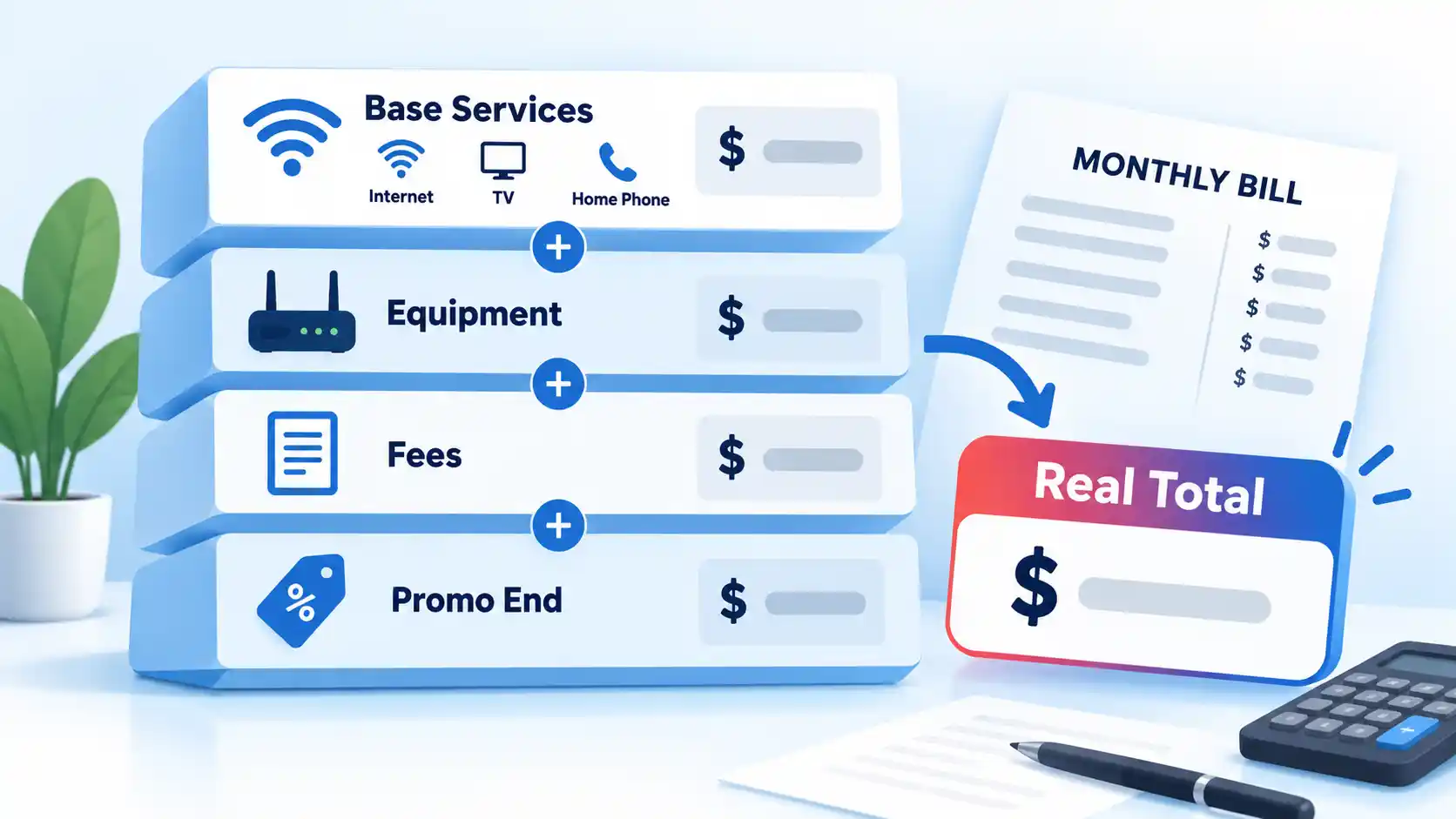
Calculate the Real Monthly Cost
The advertised bundle price is only the starting point. Add the service prices, required equipment, recurring provider charges and applicable taxes or fees. Then check what changes when an introductory rate expires.
Separate temporary discounts from costs that continue. A plan that looks cheaper during its first year can become more expensive than another offer after a promotion ends, especially when television equipment, gateway rental or add-on channels are included.
Current Bundle Options Worth Comparing
The following providers illustrate three different ways to assemble these services in 2026. The comparison is not a nationwide ranking because the exact offers depend on the service address and selected tiers.
Spectrum vs Xfinity vs AT&T + DIRECTV at a Glance
| Feature | Spectrum | Xfinity | AT&T + DIRECTV |
|---|---|---|---|
| Internet + TV | Available as configurable Spectrum services | Available through Xfinity internet and TV options | AT&T internet and DIRECTV are evaluated as separate current services |
| Home phone | Spectrum Voice | Xfinity Voice | AT&T Phone |
| Current bundle model | Internet, TV and Voice can be combined | Internet, TV and Voice configurations remain supported where available | AT&T emphasizes internet + wireless; home phone remains available with internet, while DIRECTV is a separate TV choice |
| Useful for | Households that want internet, TV and digital home phone from one provider | Households that want configurable internet, TV and Voice services | Households that prefer AT&T internet but want to choose the TV layer separately |
| Main caveat | Pricing and qualifying promotions depend on location and service combination | Plan availability, equipment and charges vary by address and configuration | Do not assume the old AT&T/DIRECTV triple-play package still exists as one standardized offer |
Spectrum: A Direct Internet + TV + Voice Combination
Spectrum remains an option for households that want internet, television and home phone from the same provider. Its current Spectrum Voice page explicitly lists Voice + Internet + TV as a supported combination.
Spectrum’s national Voice page currently advertises $15 per month for three years when Voice is bundled with qualifying Internet and TV or Mobile service. The offer is subject to restrictions, and Spectrum states that standard rates apply after the promotional period or if qualifying services are not maintained. Because offers can differ by market and configuration, use the address-specific quote rather than assuming that promotional price applies everywhere.
Spectrum’s current TV lineup includes TV Stream, TV Select Signature, TV Select Plus and TV Platinum, among other market-specific options, rather than the old Triple Play Gold structure. Readers may still encounter the older name Spectrum Gold Package in legacy bundle material, but the current plan name, channel lineup and price should be checked before treating that older label as equivalent to a package sold today.
Xfinity: Flexible, but Check the Complete Address-Specific Quote
Xfinity still supports combinations of internet, television and Voice services. Its current support materials include configurations for X1 + Internet + Voice as well as TV + Internet + Voice, while its shopping pages require an address for the most relevant offers.
Xfinity currently lists Voice Premier at $40 per month, excluding taxes, fees and equipment charges. Xfinity also states that the plan requires an active Xfinity Internet connection and is not available in all areas.
The final order summary therefore matters more than an older bundle name. Compare the internet tier, television option, Voice service, required equipment and recurring charges together. Do not assume an older package such as Saver Pro Plus, or a historical promotional price attached to it, still represents the offer available today.
AT&T and DIRECTV: Treat the Services Separately
AT&T’s current consumer bundle strategy differs from the older AT&T Internet + DIRECTV + Phone triple-play model. Its current connectivity bundle page emphasizes home internet combined with AT&T wireless.
Home phone has not disappeared. AT&T currently lists Phone Unlimited North America at $24.99 per month for 12 months, plus taxes and fees, and also shows an AT&T Phone + AT&T Internet example at $24.99 + $55 per month. AT&T notes that the internet price shown depends on eligible AutoPay and paperless billing, that the 12-month pricing applies to the phone component, and that geographic and service restrictions apply.
For television, DIRECTV should be evaluated as its own current service rather than treated as a built-in AT&T triple-play component. DIRECTV currently lists CHOICE with 125+ channels in its streaming-plan configuration. Package availability, pricing and required fees depend on the selected DIRECTV configuration.
An older claim that DIRECTV CHOICE includes NFL Sunday Ticket should also be discarded. The NFL currently directs residential Sunday Ticket viewers to YouTube and YouTube TV for NFL Sunday Ticket.
How to Compare Two Bundle Quotes
Choose the Lower Real Ongoing Cost
Avoid this if: its advantage exists only during a short promotion or depends on services you do not need.
Main trade-off: the lowest promotional price is not necessarily the lowest long-term household cost.
Choose the Better-Fitting Service Mix
Avoid this if: you are paying for a larger channel lineup, faster tier or phone service mainly because it is bundled.
Main trade-off: fewer bundled features can be better value when they match actual household use.
Choose the More Predictable Quote
Avoid this if: you cannot determine which charges are temporary, optional or recurring before ordering.
Main trade-off: a slightly higher transparent price can be easier to budget than a lower introductory price with larger later increases.
The FCC’s broadband label can help with the internet portion of this comparison. Broadband Consumer Labels disclose items such as price, introductory-rate details, data allowances and broadband speeds for covered standalone broadband offerings.
There is an important limitation: the FCC label requirement applies to standalone broadband service rather than supplying a complete label for every broadband, TV and voice bundle. Use the label to inspect the internet component, then compare it with the provider’s complete bundle quote or order summary before calculating the final household cost.
Which Bundle Is the Better Fit?
Spectrum is worth comparing when all three services are available at your address and you want internet, live television and digital home phone from one provider. Its current materials explicitly support an Internet + TV + Voice combination.
Xfinity is worth comparing when you want internet, television and Voice services and are willing to examine the complete address-specific quote, including required equipment and other recurring charges.
AT&T makes the most sense to evaluate first on the strength and availability of its internet service and, if needed, AT&T Phone. If you also want DIRECTV, compare that television service separately rather than assuming the old AT&T/DIRECTV triple-play structure is still the current buying model.
In every case, the better package is the one that meets your actual needs at the lowest realistic ongoing cost. Check availability first, compare the services you will use, account for equipment and promotional changes, and judge the final quote rather than the bundle name.
