Free legal streaming can cover a surprising amount of everyday viewing, but the trade-off is usually less control over advertising, title availability, offline viewing, and premium playback features. Paying does not automatically remove ads either, because many subscription services now offer lower-cost ad-supported plans alongside more expensive ad-free tiers.
The useful comparison is therefore not simply free versus paid. It is closer to a spectrum: free ad-supported streaming, paid ad-supported streaming, and paid premium streaming. What matters is which restrictions actually affect the way you watch.
Free and Paid Streaming Are No Longer Opposites
Several streaming business models now sit between completely free television and a premium subscription.
AVOD, or advertising-supported video on demand, lets you choose a movie or program and watch it with commercial breaks. FAST, or free ad-supported streaming television, usually combines advertising with scheduled channels that resemble traditional television. SVOD, or subscription video on demand, charges a recurring fee for access to a service, but that subscription can itself be either ad-supported or largely ad-free.
Tubi is a straightforward AVOD example. Its current advertising explanation says the service remains free because advertising funds it and that it does not currently offer an ad-free option.
Netflix demonstrates why the paid side is more complicated. Its current U.S. plan documentation lists Standard with ads alongside ad-free Standard and Premium plans. Paying for a streaming subscription and seeing commercials are therefore not mutually exclusive.
There are other models too. Library-supported services can provide access through participating public libraries, colleges, or universities rather than through advertising or a personal entertainment subscription. The practical differences among free legal streaming services therefore depend partly on how each service is funded and how its catalog is delivered.
If the distinction between scheduled free channels and free on-demand libraries matters to you, FAST and AVOD work differently even though both can be free and advertising-supported.
Free vs Paid Streaming at a Glance
The most useful comparison is not which category has the longest feature list. Compare the restrictions that affect your viewing: advertising, access to specific titles, offline use, playback quality, device limits, and regional availability.
| Feature | Free streaming | Paid with ads | Paid premium |
|---|---|---|---|
| Recurring entertainment subscription | Usually none for the core free service | Required | Required, usually at a higher tier |
| Advertising | Common | Common | Usually reduced or absent from normal on-demand viewing, depending on the service |
| Catalog access | Depends heavily on licensing, service, and region | Can include most of a service’s catalog, although plan restrictions may apply | May remove some plan-level access restrictions, although licensing still applies |
| Offline viewing | Service-dependent and often not a core feature | May be available with limits | Often available on services that support downloads, subject to provider rules |
| Maximum quality and premium features | Service- and device-dependent | May be limited by plan | Higher tiers can unlock features such as 4K HDR, additional devices, or premium audio on some services |
| Geographic restrictions | Common | Common | Common |
No column wins every row. A person who mainly browses whatever looks interesting has different requirements from someone who follows one exclusive series, downloads shows before flights, or shares a subscription across several screens.
The First Thing You Give Up Is Control Over Interruptions
Advertising is the most visible cost of many free services. Instead of paying a recurring entertainment fee, you accept commercial breaks that help fund the service.
Tubi explicitly ties its free model to advertising and currently provides no ad-free Tubi tier. That makes the trade-off straightforward: access costs no subscription fee, but advertising is part of the viewing experience.
The same assumption becomes less reliable once you move into subscription streaming. Netflix’s ad-supported experience documentation says most movies and TV programs on eligible plans contain commercial breaks. It also notes that a small number of titles can be unavailable on the ad-supported experience because of licensing restrictions.
That means the useful question is not simply whether you pay. Ask what kind of advertising experience a particular plan includes. A cheaper subscription may reduce the financial difference between free and premium streaming without eliminating interruptions.
Live programming is another edge case. Netflix states that live events can contain commercial breaks across all of its plans, including ad-free experiences. If avoiding commercials is one of your main reasons for upgrading, verify the provider’s current rules for both on-demand and live content.
The Bigger Trade-Off Is Often What You Can Watch
Catalog access matters more than raw title counts. A free service can offer thousands of programs and still be a poor substitute if the one series, sporting event, or film you want is licensed somewhere else.
Free streaming should not automatically be dismissed as a warehouse of old programs. Nielsen’s March 2025 Gracenote FAST analysis reported that more than 70% of FAST programming in its analyzed dataset was produced since 2010.
The category has also continued to expand. Nielsen reported in August 2026 that global FAST channel count in its Data Hub had reached 2,172, with sports programming growing faster than the overall FAST channel count.
Those findings show that free streaming has developed beyond purely archival television. They do not mean a free catalog will contain the same titles as Netflix, Disney+, Max, Paramount+, or another subscription service.
Licensing determines where much of the difference appears. Rights can be sold for particular countries, platforms, time periods, or distribution models. A film might therefore be included with a subscription in one country, offered free with ads somewhere else, and unavailable on both services in another market.
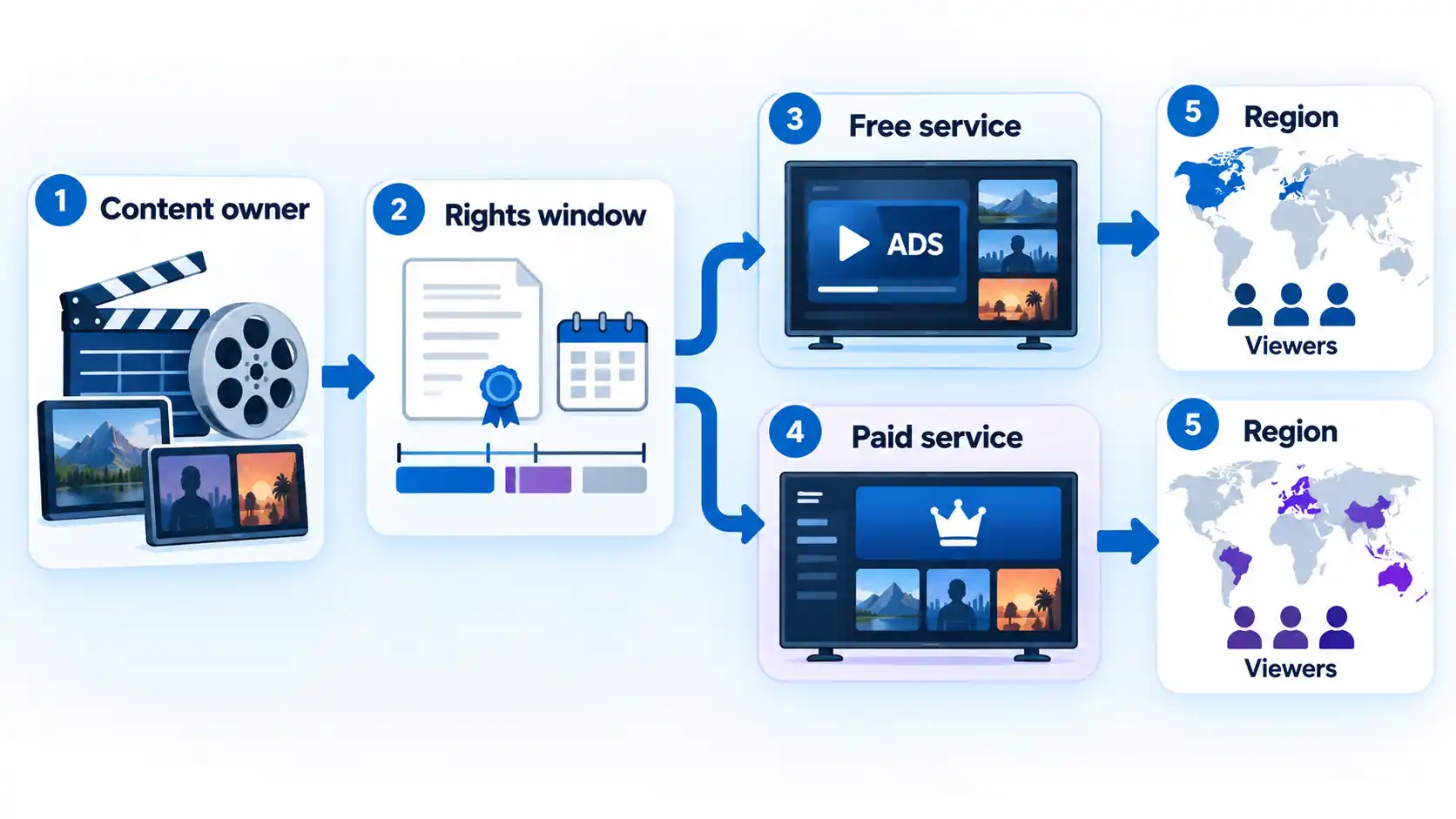
Exclusive programming creates a stronger reason to pay. If a show or event is contractually tied to one subscription service, a large free catalog elsewhere does not replace it. Conversely, a free service may occasionally carry a title that is absent from the subscriptions you already have.
For that reason, paying for “more content” is too vague a justification. The better question is whether the subscription gives you reliable access to content you specifically value. When one exact film or series is the priority, checking where a title is legally streaming is more useful than comparing catalog-size claims.
Offline Viewing and Playback Flexibility Favor Some Paid Plans
Free streaming generally works best when you expect to watch while connected to the internet. Offline viewing is provider-specific, and paying does not guarantee that every download feature is unrestricted.
Netflix illustrates the distinction within one subscription service. Its current download-limit documentation says its ad-supported plans are limited to 15 total downloads per device per calendar month, with the limit resetting on the first day of each calendar month.
That is a useful reminder that “has downloads” and “has unrestricted downloads” are different claims. Providers can also impose title, device, or licensing restrictions on offline viewing.
Offline playback matters most when internet access is unreliable or expensive, such as during travel or on a commute. If you almost always watch at home on stable broadband, the feature may have little practical value even if a premium plan includes it.
Paying More Can Buy Better Quality and More Device Capacity
Some higher subscription tiers sell technical capability rather than simply a larger entertainment catalog.
Netflix’s current U.S. plan page lists 1080p playback and two simultaneous supported devices for both Standard tiers. Premium increases that to four simultaneous supported devices, adds 4K Ultra HD with HDR, allows downloads on more supported devices, and includes spatial audio. These are current Netflix plan differences, not universal features of paid streaming.
The hardware still has to support the feature. Paying for a 4K plan does not make a 1080p television display 4K. The title, television, streaming hardware, connection path, and service all need to support the required format.
If the television’s built-in software or hardware has become the limiting factor, comparing a Smart TV app, Google Cast workflow, and dedicated streaming stick can help separate a subscription limitation from a device limitation.
The same reasoning applies to simultaneous streams. A larger household may value extra concurrent devices, while someone watching alone gains little from paying solely for that allowance.
Free Streaming Can Have Significant Regional Restrictions
Streaming rights remain geographical whether a service is free or paid. Free does not mean globally available, and subscribing does not eliminate territorial licensing.
The Roku Channel is a clear current example. Roku’s official availability documentation says The Roku Channel is available in the United States, Canada, and the United Kingdom on Roku devices, web, and mobile, while access in Mexico is limited to Roku devices.
That creates several different kinds of availability to check. A service can operate in your country but lack a particular title there. Its mobile app may exist while its Smart TV app does not. A live sporting event can have different territorial rights from the service’s regular movie catalog.
These restrictions mean a comparison written for one country should not be treated as a universal catalog guide. Before subscribing mainly for one show or event, verify the title, plan, device, and country that apply to you.
What About Privacy and Ad Targeting?
Advertising introduces another consideration, but the price of a plan does not tell you by itself how private the service is.
Netflix explains that its ad-supported experience can use information such as viewing interactions and general location when selecting advertisements. It also says behavioral advertising can use activity from unaffiliated apps or websites unless the viewer has opted out where that option applies.
Do not assume that “free means your data is the product” or that paying automatically prevents tracking. Advertising controls and privacy practices vary by provider, plan, and region, so compare the policy of the service you actually use.
The presence or absence of a subscription fee is therefore not enough to establish a privacy hierarchy. If targeted advertising matters to you, check the provider’s advertising controls, privacy settings, account requirements, and regional privacy options rather than relying on labels such as “free” or “premium.”
Which option should you choose?
When Free Streaming Is Probably Enough
Avoid this if: the programs you regularly want are unavailable on legal free services in your region or you depend on features such as offline viewing.
Main trade-off: you avoid a recurring entertainment subscription but accept less control over advertising, catalog consistency, and premium plan features.
When Paying Solves a Real Problem
Avoid this if: you are subscribing mainly out of habit and the legal free services available to you already cover the content and features you use.
Main trade-off: the recurring cost buys greater access or control only when the particular service and plan remove a limitation that matters to you.
A paid ad-supported plan can also be the middle ground. Deloitte’s March 2026 U.S. Digital Media Trends research reported that 68% of SVOD subscribers had at least one ad-supported tier, up from 46% in 2024. The finding applies to the U.S. survey population rather than streaming subscribers globally.
Before paying more to remove ads, compare whether an ad-supported streaming plan is worth the lower price based on how often you watch, the ad restrictions, catalog access, and the premium features you would actually gain by upgrading.
Bottom Line
Free streaming no longer means settling for a tiny library of obsolete television. Legal free services now cover substantial on-demand and channel-based viewing, but they commonly ask you to accept advertising, changing catalogs, regional restrictions, and fewer premium controls.
The strongest reason to pay is not that paid streaming is universally better. It is that a specific subscription removes a restriction you care about. If free services already carry enough of what you watch and their advertising does not bother you, paying may add little. If you need one exclusive catalog, dependable offline viewing, higher playback quality, more simultaneous devices, or fewer interruptions, a subscription can solve a concrete problem.

💬 Comments