Business reverse phone lookup services fall into two broad groups: tools that try to connect a phone number with a person or company, and phone-intelligence services that return technical details such as the carrier, line type, reachability, or fraud signals. The right choice depends on which of those answers your workflow actually needs.
None of these services should be treated as automatic proof that a particular person controls a number. Identity coverage varies by country and provider, phone numbers can be reassigned or ported, and some tools deliberately focus on network data instead of personal identity.
What a business reverse phone lookup can actually tell you
Suppose a customer submits a phone number during signup. One service might return a likely name or company. Another might only tell you that the number is a mobile line on a particular network. A third might add signals showing whether the line appears active or has characteristics associated with abuse.
Those are different jobs. A reverse identity lookup starts with a phone number and tries to associate it with identity information. Phone intelligence focuses on the telephone service itself: the carrier, line type, routing data, status, or risk indicators.
You will also see the term CNAM, short for Caller ID Name. CNAM is a caller-name record used in supported telephone systems. It can add context to an incoming call, but it is not the same thing as a verified legal identity. CNAM, caller ID, and reverse phone lookup answer related but different identity questions.
Carrier information needs similar care. People can keep their phone number when they change providers, so the network that originally issued a number may differ from the network serving it now. Phone-number porting can change the carrier information that matters for routing and delivery.
A line-type result may classify a number as mobile, landline, toll-free, or Voice over Internet Protocol (VoIP). VoIP means calls travel over internet-based telephone systems rather than a conventional fixed telephone circuit. A virtual phone number may also route calls through software or cloud communications services, so a virtual or VoIP classification does not by itself indicate fraud.
For occasional manual investigation rather than automated business enrichment, free reverse phone lookup methods use a different mix of search engines, public information, community reports, and carrier tools. The services below are selected for business workflows where structured data or repeatable processing matters.
An application programming interface (API) is a software connection that lets one system request data from another automatically. A business might use a lookup API to enrich records in a customer relationship management (CRM) system, screen a signup for additional risk signals, or choose the right communications route without manually searching each number.
10 business reverse phone lookup and intelligence services
The services are unranked because they do not solve the same problem. Start with the kind of result you need, then compare geographic coverage, API access, data depth, and restrictions on how the returned information may be used.
| Service | Strongest business job | Identity or name data | Other useful signals | Important limitation |
|---|---|---|---|---|
| Twilio Lookup | App-based caller, routing, and risk enrichment | US Caller Name for supported mobile numbers; Identity Match is a separate feature | Carrier, line type, line status, reassignment, and risk packages | Caller Name coverage is US-only |
| Telesign Phone ID | Authentication and fraud workflows | Optional identity attributes | Device type, carrier, registration, and subscriber intelligence | Available fields depend on product configuration |
| Telnyx Number Lookup | Carrier, routing, and caller-ID intelligence | CNAM | Serving carrier, line type, LRN, and porting information | Built primarily for telecom intelligence rather than broad public-record people search |
| IPQualityScore | Identity enrichment plus fraud screening | Owner or company name on supported reverse lookups | Carrier, line type, activity, and risk signals | Reverse-name coverage is strongest in the US and Canada |
| NumLookup Enterprise API | Detailed US reverse identity enrichment | Person and related identity attributes | Carrier, line details, spam information, and linked data | US-only coverage and a minimum annual enterprise commitment |
| The Data Group | Reverse phone append for CRM and identity workflows | Available name and address information | Address deliverability and validation metadata | US 10-digit number workflow and no guaranteed match |
| Sinch Number Lookup | Communications routing and fraud-related phone intelligence | Not positioned primarily as a person-name lookup | Line type, carrier, and related number intelligence | Number Lookup is currently labeled Beta |
| Veriphone | International validation and carrier lookup | Validation and carrier data rather than person-identity enrichment | Validity, carrier, line type, and formatted number data | Designed around phone validation rather than owner discovery |
| Plivo Lookup | Simple carrier, formatting, and portability checks | No person-name field is documented for Lookup | Carrier and portability information | Narrower data set than identity-enrichment tools |
| Vonage Number Insight | Existing Vonage number-intelligence workflows | Number and subscriber insights vary by tier; the replacement API adds Subscriber Match | Line type, network, formatting, and fraud-related information | Number Insight is scheduled to sunset on February 4, 2027 |
Twilio Lookup
If your application already uses APIs for calling, messaging, signup, or account security, Twilio Lookup lets you request phone data as separate packages instead of buying one large reverse-search report. Its Caller Name feature retrieves CNAM-based names for supported US mobile numbers, while Line Type Intelligence identifies categories such as mobile, landline, fixed VoIP, non-fixed VoIP, and toll-free.
The modular structure matters because a business cleaning a contact list may only need line type, while an inbound-call workflow may want caller-name information. Twilio’s pricing current as of August 2026 lists US inbound caller identification at $0.01 per request and Line Type Intelligence at $0.008 per request. Other packages cover line status, reassignment risk, subscriber identity module (SIM) swap signals, and Identity Match, with separate pricing or eligibility.
Twilio is therefore better understood as a configurable phone-intelligence layer than as a conventional people-search database. It fits teams that already know which signal they need and want to request it directly from an application.
Telesign Phone ID
An onboarding or fraud team may care less about finding a postal address and more about whether a submitted number fits the customer’s claimed identity and communication context. Telesign positions Phone ID around phone-number and subscriber intelligence for authentication, fraud assessment, and message delivery.
The basic product can clean and format a number and return device type, telecom carrier, and phone-registration information. Additional identity attributes can be configured separately, and some require separate purchase.
That makes Phone ID more relevant when a phone number is one signal inside an account-verification or risk process than when the goal is simply to find a person’s public-record profile.
Telnyx Number Lookup
Ported numbers create a practical problem for routing and delivery: the network that first issued a phone number may no longer serve it. Telnyx focuses its Number Lookup API on serving-carrier and caller information, including line type, Location Routing Number (LRN), CNAM, and porting-related data.
LRN is telecom routing information used to identify the switch serving a number. A normal sales or support team usually does not need the routing mechanics, but a communications platform may care because the serving network can affect how calls or messages are handled.
Telnyx explicitly distinguishes its product from consumer reverse search. It is a better fit when the business question is “Which network and type of line am I dealing with?” rather than “What public-record profile is associated with this person?”
IPQualityScore Phone Number Validation
Fraud review is one situation where identity data and telecom data become useful together. IPQualityScore’s Phone Number Validation API combines phone validation with carrier, line-type, activity, identity, and risk fields.
The provider says its reverse-name lookup has its strongest coverage in the US and Canada, with more limited international support. Supported responses can include a personal or company name alongside fraud scores and signals related to line type, activity, and recent abusive behavior.
Those signals can justify an extra verification step, but a fraud score is not proof that a person committed fraud. That distinction is especially important if a business is considering an adverse or regulated decision.
NumLookup Enterprise API
Some US workflows require substantially more identity detail than carrier and CNAM data provide. NumLookup markets its enterprise reverse phone lookup API for US numbers as returning identity attributes alongside carrier, line, spam, address, contact, and online-profile information.
That breadth makes the service relevant when a business has a legitimate need for richer identity enrichment. It would be unnecessary for a workflow that only needs to know whether a number is mobile or suitable for a text message.
NumLookup states that enterprise access has a minimum annual commitment. Its claims about having more data than competing APIs are vendor claims and should not be read as independently measured superiority.
The Data Group Reverse Phone Append
Imagine a CRM record that contains a telephone number but no useful name or address. A reverse phone append service starts with that number and attempts to attach linked identity information. That is the workflow covered by The Data Group’s Reverse Phone Append API.
The documented endpoint accepts a 10-digit US number and may return name and address fields, address-deliverability information, a validation date, and a trace identifier when a matching record is available. The provider lists CRM enrichment, caller identification, lead validation, form verification, and fraud review among intended uses.
A failed lookup is a normal outcome rather than evidence that the number is false. The provider documents a no-record response when no reliable match is available and states that the service is not a consumer reporting agency product for Fair Credit Reporting Act-regulated eligibility decisions.
Sinch Number Lookup
A company optimizing call or message routing may need line and carrier information without needing a person’s name. Sinch describes its Number Lookup API as a phone-intelligence service for communication workflows and fraud prevention, including line-type and carrier information.
The main procurement caveat is product maturity. Sinch labels Number Lookup as Beta, and its SIM Swap capability is separately marked Closed Beta. A production buyer should therefore verify feature access and support expectations before making the service a critical dependency.
Veriphone
International databases often need a simpler answer: is this number plausibly valid, what type of line is it, and which carrier serves it? Veriphone documents phone validation and carrier lookup for more than 240 countries, including line-type detection and normalized number formatting.
Its documented purpose is phone validation rather than person-identity enrichment. That narrower scope can be useful when personal identity data would add privacy exposure or cost without changing the business decision.
Plivo Lookup
Not every application needs a large identity-enrichment response. Plivo’s Lookup API retrieves formatting, carrier, and portability information, with portability data limited to the US and Canada.
Plivo lists the service at $0.004 per request. For a communications application that mainly needs to normalize numbers or understand the serving network, that narrow response may be sufficient. The Lookup documentation does not list a person-name field.
Vonage Number Insight
The first question for a new Vonage Number Insight deployment is migration timing. Vonage states that Number Insight will be sunset on February 4, 2027 and directs customers toward its newer Identity Insights API.
Number Insight provides number formatting, network, line-type, owner, and fraud-related information across its capabilities. Vonage says the replacement Identity Insights API can combine data such as number formatting, carrier details, SIM Swap, and Subscriber Match in one request.
Existing customers therefore have a migration issue to plan for. A new buyer should evaluate Identity Insights rather than build a long-lived integration around a service with a stated retirement date.
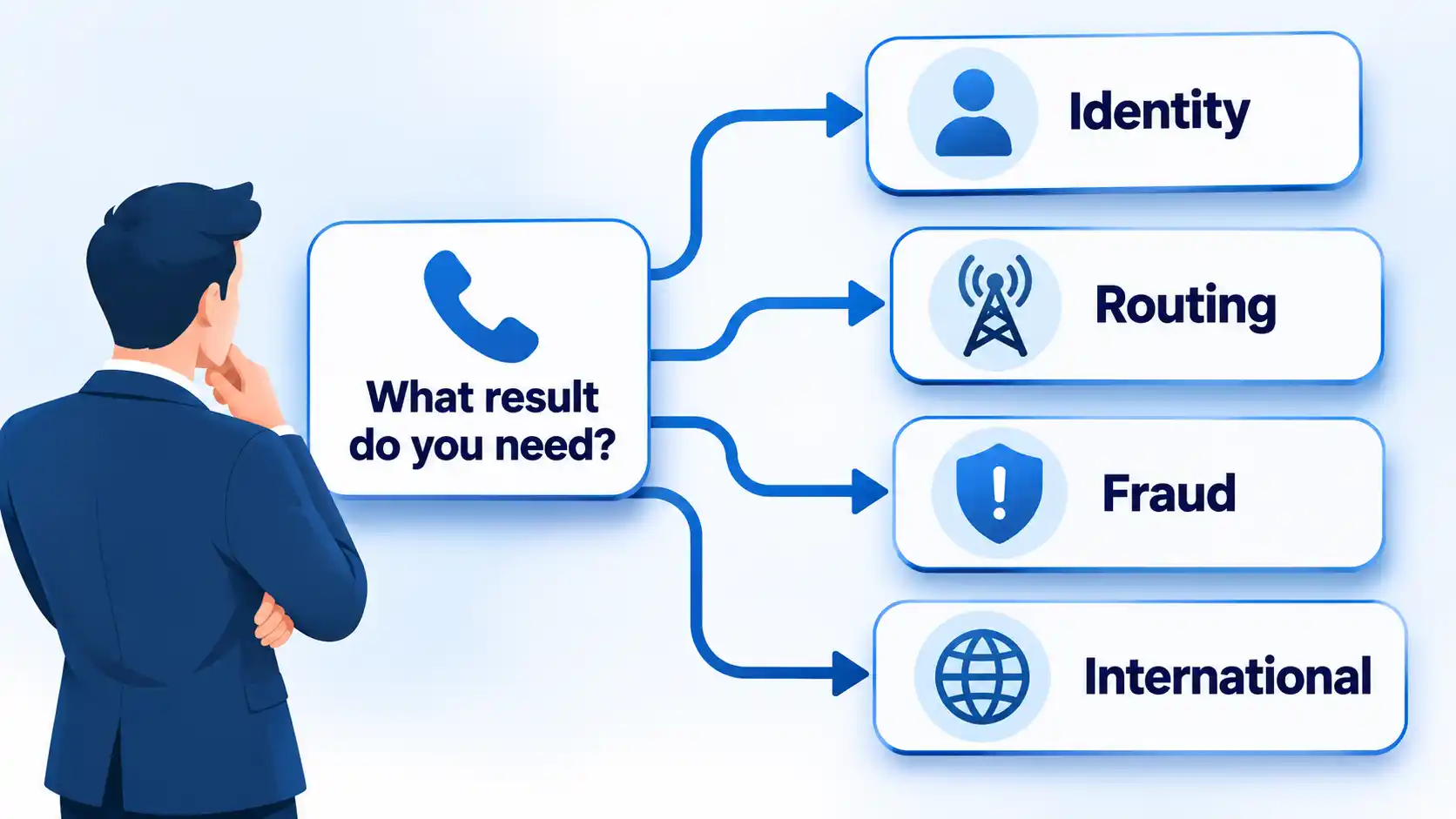
Which option should you choose?
Identity-oriented lookup
Avoid this if: you only need carrier, line type, or deliverability information and do not need additional personal data.
Main trade-off: richer identity data creates more privacy, accuracy, and permissible-use questions.
Carrier and line-type intelligence
Avoid this if: your business decision depends on knowing who actually controls the number.
Main trade-off: strong telecom context with little or no person-level identity information.
Fraud and account-risk intelligence
Avoid this if: your process would treat a risk score as conclusive proof about a person’s conduct or eligibility.
Main trade-off: additional screening context that still requires carefully designed decision rules.
International number validation
Avoid this if: you assume worldwide phone coverage also guarantees worldwide owner-name coverage.
Main trade-off: broad telecom coverage does not imply equally broad identity coverage.
Legal and compliance limits
Finding a name, address, carrier, or risk signal does not automatically give a business permission to use that information for every purpose. The legal analysis changes with the source of the data, the decision being made, the person being contacted, and the jurisdiction.
Do not assume a reverse phone lookup is suitable for employment, tenant, credit, insurance, or other regulated eligibility decisions. Verify the provider’s permitted uses and the law that applies to your specific workflow before using lookup data to make an adverse decision.
In the United States, the Fair Credit Reporting Act (FCRA) regulates consumer reports used for specified purposes. A phone lookup is not automatically a consumer report, but the Consumer Financial Protection Bureau states that obtaining or using a consumer report requires a permissible purpose. A provider’s ability to return identity data does not by itself establish that the service is a consumer reporting agency or that its data may be used for a regulated eligibility decision.
Marketing is a separate question. The Federal Trade Commission’s Telemarketing Sales Rule guidance says most business-to-business solicitation calls are exempt from that federal rule, while identifying specific exceptions. Other federal and state requirements may still apply, so “B2B” should not be treated as a blanket permission for phone outreach.
Consent can also become stale when a number changes hands. Under the Federal Communications Commission’s Reassigned Numbers Database rules, a caller seeking the Telephone Consumer Protection Act safe harbor for a database error must be able to show that it had consent, checked the database before calling, and received an erroneous “no” response. FCC guidance explains those safe-harbor conditions. Reassigned numbers can break the connection between an old consent record and the person who now controls the number.
UK rules introduce another distinction. The Information Commissioner’s Office says directories offering reverse searches for individual subscribers generally require express opt-in consent. That requirement does not apply in the same way to companies and other corporate subscribers, although they retain the right to opt out of directory inclusion.
For marketing, the ICO explains that business-to-business rules vary by communication method and subscriber type. Sole traders and certain partnerships are treated as individual subscribers under the Privacy and Electronic Communications Regulations, while companies and other corporate bodies are treated as corporate subscribers.
The ICO marks both guidance areas as under review following changes made by the Data (Use and Access) Act. Businesses operating in the UK should check the latest guidance before relying on a compliance interpretation.
These examples are not a complete legal analysis for every country or industry. They show why a technically available lookup field and a legally appropriate business use are separate questions.
What to verify before buying
A product demonstration can show what a successful response looks like. Procurement also needs to account for partial responses, stale records, unsupported countries, and contractual restrictions. Before committing to a service, verify:
- Country and number-type coverage: check the exact countries, mobile networks, landlines, VoIP ranges, and toll-free numbers your business handles.
- Meaning of each field: establish whether a carrier is original or serving, whether a name comes from CNAM or another data source, and what “active” or “reachable” means.
- No-match behavior: understand whether missing data returns an empty field, a partial response, an error, or a billable lookup.
- Data freshness: ask how quickly carrier changes, reassignment, portability, and identity records are reflected.
- Privacy and retention: review what the provider stores about submitted numbers, returned data, logs, and customer queries.
- Permitted use: confirm that your intended workflow is allowed by the contract and by applicable privacy, marketing, consumer-reporting, and sector-specific rules.
- API and batch limits: check rate limits, volume tiers, bulk processing, latency expectations, and support for your preferred integration method.
- Commercial commitment: compare per-query pricing with minimum contracts, paid data packages, country-specific fees, and charges for unsuccessful requests.
For identity-oriented services, also ask whether returned records include a confidence measure or enough source information to understand why a match was made. Extra personal data adds little value if your team cannot judge its reliability or justify retaining it.
Bottom line
Start with the decision your business needs to make. Carrier and line-type data may be enough for routing, validation, or contact-quality work; identity enrichment is a separate requirement with greater privacy and permissible-use consequences.
Before integrating a provider, verify the exact fields, countries, freshness rules, no-match behavior, and allowed uses that matter to that decision. A larger response is not automatically a better lookup if most of its data does not help you act safely or accurately.

💬 Comments