Retail quality assurance needs rethinking because modern commerce depends on connected web, mobile, payment, inventory, application programming interface, fulfillment, and in-store systems whose failures may appear only under particular devices, traffic conditions, dependency states, or customer behaviors. An effective QA strategy therefore tests complete customer journeys and business risks throughout development and operation instead of treating QA as a final bug-checking stage.
Digital retail is also too significant to treat software quality as a secondary concern. The U.S. Census Bureau estimated seasonally adjusted retail e-commerce sales at $340.2 billion in the second quarter of 2026, representing 17.1% of total U.S. retail sales during the quarter. That scale does not mean every software defect produces a measurable revenue loss, but it does make customer-facing reliability, transaction correctness, and recoverability important operating concerns. The Census Bureau’s quarterly retail e-commerce report provides the current market context.
Retail QA Is No Longer Just Website Testing
A shopper may experience a purchase as a few screens, but completing that purchase can involve many independent systems. The storefront may request product data from one service, promotion rules from another, inventory from a warehouse system, payment authorization from a gateway, and order information from fulfillment software.
Quality assurance, or QA, is the broader discipline of preventing and detecting quality problems throughout development and operation. Regression testing checks whether previously working behavior still works after a change. An application programming interface, or API, is a defined way for software systems to exchange requests and data. In retail, these three ideas meet whenever one customer action crosses several services.
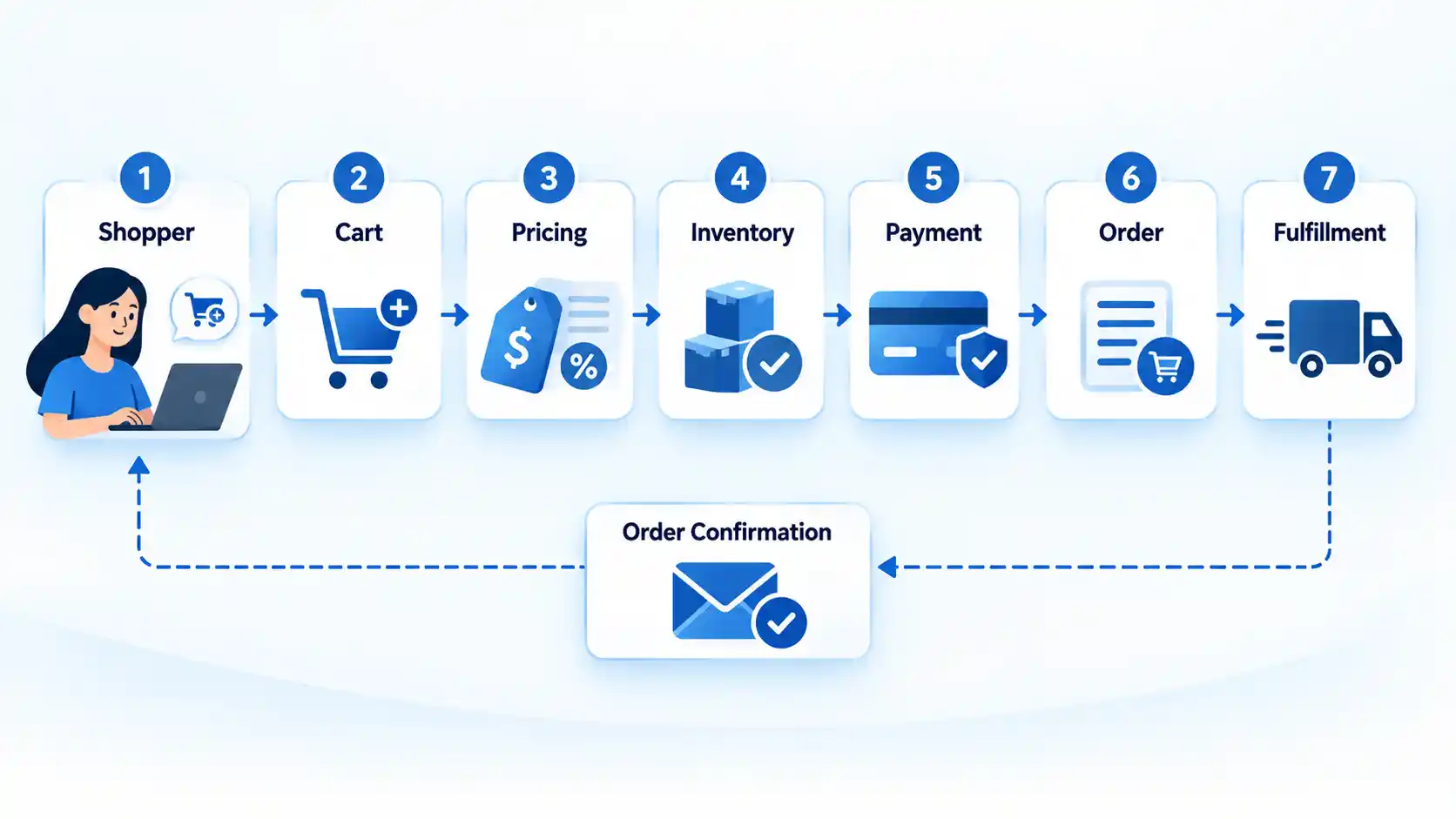
Consider a promotion that displays correctly on the product page. The interface can look perfect while checkout fails because the cart, promotion engine, inventory service, and payment total disagree about the final price. That is why modern software testing in retail has to validate connected customer journeys and the services behind them, not just whether individual storefront controls render and respond.
The same principle applies beyond checkout. Search, account management, loyalty points, returns, click-and-collect, store inventory, shipment tracking, and point-of-sale systems can all cross service boundaries. A broader e-commerce testing strategy therefore needs to map the dependencies behind important customer journeys instead of viewing each page as an isolated unit.
The OWASP API Security Top 10 for 2023 also illustrates why API behavior deserves separate attention. Its risks include broken authorization, broken authentication, unrestricted resource consumption, improper inventory management, and unsafe consumption of third-party APIs. Those are not problems a browser-only functional test can reliably cover.
Why the Old Testing Model Breaks Down
Releases can affect more than the feature being changed
A seemingly local change can touch shared components, API contracts, caching, analytics, authentication, pricing logic, or checkout behavior. A fixed regression checklist may still pass while a dependency introduced by the change fails under a combination the checklist never exercises.
For example, a retailer might update a promotion component to support a new campaign. The visible discount works for the normal case, but a different customer tier, currency, tax rule, or combination of promotions produces an incorrect cart total. The useful question is not simply whether the promotion component passed its own tests. It is which business journeys and dependencies changed, and what could fail if their assumptions no longer match.
Risk-based regression testing addresses that problem by prioritizing tests according to the importance and exposure of the affected behavior rather than treating every existing test case as equally valuable.
Real shoppers do not use laboratory conditions
Pre-release performance tests are necessary, but controlled test environments cannot reproduce every combination of device capability, browser behavior, network quality, background processing, geography, and real interaction patterns.
Google’s current Core Web Vitals illustrate one way to measure real web experience. The Web Vitals guidance identifies Largest Contentful Paint, Interaction to Next Paint, and Cumulative Layout Shift as the current Core Web Vitals. Its recommended “good” thresholds are 2.5 seconds or less for Largest Contentful Paint, 200 milliseconds or less for Interaction to Next Paint, and 0.1 or less for Cumulative Layout Shift, assessed at the 75th percentile.
Those thresholds are useful performance signals, not universal business targets. A retailer may also need transaction latency, API response time, search latency, payment failure rate, or other measurements tied to its own architecture.
The more important distinction is between lab and field evidence. Lab testing can identify performance regressions before release. Field measurement shows how actual users experience the system under production conditions. A checkout can perform well in a controlled environment and still behave poorly on a lower-powered phone, a congested mobile network, or a page with production-only third-party scripts.
Third-party services expand the failure surface
Retail systems commonly depend on payment, tax, identity, address validation, fraud detection, shipping, messaging, search, analytics, and other external services. The retailer may control how it integrates those services without controlling their availability or response behavior.
Testing therefore needs to cover more than the expected successful response. Useful cases include timeouts, slow responses, expired credentials, invalid payloads, duplicate callbacks, rate limits, unexpected status codes, partially available services, and changes to an API contract.
OWASP specifically identifies unsafe consumption of third-party APIs as an API security risk. A resilient QA strategy should therefore validate external responses and integration behavior rather than assuming a trusted provider will always return the expected data.
What a Modern Retail QA Strategy Has to Cover
No single testing technique covers the entire retail system. The practical task is to match each important risk to the layer where it can be found efficiently, then reserve expensive end-to-end testing for the journeys where multiple components have to work together.
| Retail risk | Useful testing focus | Example failure |
|---|---|---|
| Pricing and promotions | Business-rule, API, integration, and end-to-end tests | Two valid offers combine into an incorrect final price |
| Inventory and ordering | Service, integration, concurrency, and failure-path tests | An item sells out between cart creation and order confirmation |
| Checkout and payments | Functional, integration, security, recovery, and transaction tests | A payment succeeds but the order system times out before confirmation |
| Peak traffic | Load, stress, dependency, and degradation tests | Checkout remains online but inventory requests become a bottleneck |
| APIs and third parties | Contract, authorization, integration, timeout, and malformed-response tests | A shipping provider changes a field the retailer assumes will always exist |
| Accessibility | Automated checks plus keyboard, focus, form, and assisted manual testing | A customer cannot reach or correct a checkout field using a keyboard |
| Device and browser variation | Responsive, browser, device, and network-condition testing | A purchase control becomes unusable at a particular viewport size |
| Production behavior | Real-user monitoring, synthetic monitoring, logs, traces, and business metrics | Error rates rise only for one device class after deployment |
Transaction and business-rule correctness
Retail applications have rules that extend beyond whether buttons work. Search results must map to products that can actually be purchased. Prices and promotions must remain consistent from product page to cart to checkout. Variants must identify the correct stock item. Tax, shipping, loyalty, returns, and refunds need to interact predictably with the order state.
Edge cases are especially important. Inventory can change between adding an item and paying for it. A promotion can expire while the shopper still has a cart open. A customer may submit a payment twice after a slow response. A refund can be requested after fulfillment has already changed status.
These cases should be tested at the lowest practical layer first, such as a business-rule or service test, then at integration and end-to-end levels where the interaction between systems is itself the risk.
Performance, scale, and graceful degradation
Performance testing is not one activity. Load testing checks behavior under an expected volume of work. Stress testing deliberately pushes beyond expected conditions to identify limits and failure behavior. Retailers also need to understand what happens when a dependency slows down even though overall traffic remains ordinary.
Before a major campaign or seasonal event, teams should load test an e-commerce site against realistic traffic mixes rather than only increasing anonymous page views. Search, cart updates, inventory reservation, authentication, and checkout can place very different loads on backend systems.
Teams evaluating approaches to retail application performance should still define their own load profiles, service-level thresholds, failure scenarios, and production signals rather than assuming one benchmark fits every storefront.
Graceful degradation matters as much as raw speed. If a recommendation service fails, the store may be able to continue without recommendations. If inventory confirmation or payment authorization fails, silently proceeding could create a much more serious correctness problem. The desired fallback depends on what the failing service does.
Security and payment flows
Security testing should not be isolated to a final penetration test immediately before release. The National Institute of Standards and Technology’s Secure Software Development Framework Version 1.1 recommends integrating secure software development practices into the software development lifecycle. NIST identifies reducing vulnerabilities in released software, mitigating the potential impact of vulnerabilities that remain undetected or unaddressed, and addressing root causes among the framework’s intended outcomes.
For retail systems, practical QA concerns include authentication, authorization, API access, configuration, input handling, dependency behavior, sensitive test data, and regression after security-sensitive changes. A broader website security audit can also examine weaknesses in the surrounding application and server environment.
Payment testing requires additional care. PCI DSS requirements depend on the organization’s payment environment and assessment scope, so there is no single checklist that applies identically to every retail application. The PCI Security Standards Council says the future-dated requirements of PCI DSS v4.0.1 became effective on March 31, 2025. Its e-commerce payment-page guidance focuses in part on Requirements 6.4.3 and 11.6.1 for applicable e-commerce environments, including pages that can affect the security of e-commerce payments.
Retailers whose environments fall within PCI DSS scope should map relevant QA, change-control, and security-testing practices to the requirements that actually apply to their architecture rather than assuming that outsourcing part of checkout removes every responsibility.
Accessibility and cross-device behavior
Accessibility is another quality dimension that should be tested as part of the customer journey, not as a final visual review. The W3C’s Web Content Accessibility Guidelines 2.2 define testable success criteria covering areas that directly affect retail interactions, including keyboard operation, focus behavior, error identification, labels and instructions, redundant entry, accessible authentication, and error prevention for financial transactions.
Automated accessibility tools can identify some defects, but they cannot establish that every checkout flow is usable. Teams still need human evaluation of keyboard navigation, focus order, labels, error recovery, authentication, and other interaction behavior.
The same principle applies to responsive behavior. A layout that technically resizes can still hide a control, truncate important content, move focus unexpectedly, or make a payment step difficult to complete at particular viewport sizes. Responsive testing can expose presentation and interaction problems before they become production defects, while real-device coverage can reveal issues that browser viewport simulation does not reproduce.
How Retail Teams Should Rethink the Strategy
Prioritize customer-critical journeys by risk
Not every test deserves equal effort. A customer-critical journey is a sequence whose failure has a meaningful effect on the shopper or business, such as account access, adding an item to a cart, applying a promotion, checking out, receiving order confirmation, or obtaining a refund.
Teams can prioritize those journeys using practical factors such as customer impact, financial impact, security or data exposure, likelihood of regression, integration complexity, traffic sensitivity, and difficulty of recovery. A cosmetic issue on an account page and a defect that creates duplicate orders are both software defects, but they should not receive identical release protection.
Risk ranking also helps decide where end-to-end tests are worth their maintenance cost. A flow involving inventory, payment, and order creation justifies stronger cross-system coverage than a component whose behavior can be proved cheaply at unit or API level.
Build testing in layers
A modern strategy uses several layers rather than trying to make browser-driven end-to-end automation prove everything. Unit and component tests can validate business logic quickly. API and service tests can exercise rules without a browser. Contract tests can detect incompatible assumptions between services. Integration tests can prove that connected components exchange the correct information. A smaller set of end-to-end tests can protect the most important customer journeys.
Device checks, exploratory testing, accessibility evaluation, load testing, and security testing then address risks that are difficult or inappropriate to reduce to ordinary functional automation.
The right balance of manual and automated testing depends on the risk being examined. Automation is valuable for repeatable checks and broad regression coverage. Human investigation remains important where judgment, unusual interaction, accessibility, ambiguity, or previously unknown failure behavior matters.
Test failures, not only happy paths
A test suite built mainly around successful purchases can miss the situations where retail systems are hardest to reason about. Useful scenarios include an expired promotion, declined payment, interrupted authentication, inventory disappearing during checkout, a delayed fulfillment API, session expiration, duplicated submission, or a dependency returning a partial response.
One particularly important case is an uncertain payment result. Suppose a payment provider processes the charge but the retailer times out before receiving confirmation. Automatically sending the same request again without understanding the provider’s retry and idempotency behavior can create duplicate processing. An idempotent operation is designed so repeating the same request does not create an unintended second result. The correct recovery mechanism depends on the payment provider’s documented contract and the retailer’s order architecture.
Failure testing should therefore verify both the customer-facing message and the system state behind it. A reassuring error page is not enough if payment, order, and inventory records disagree.
Keep quality signals after deployment
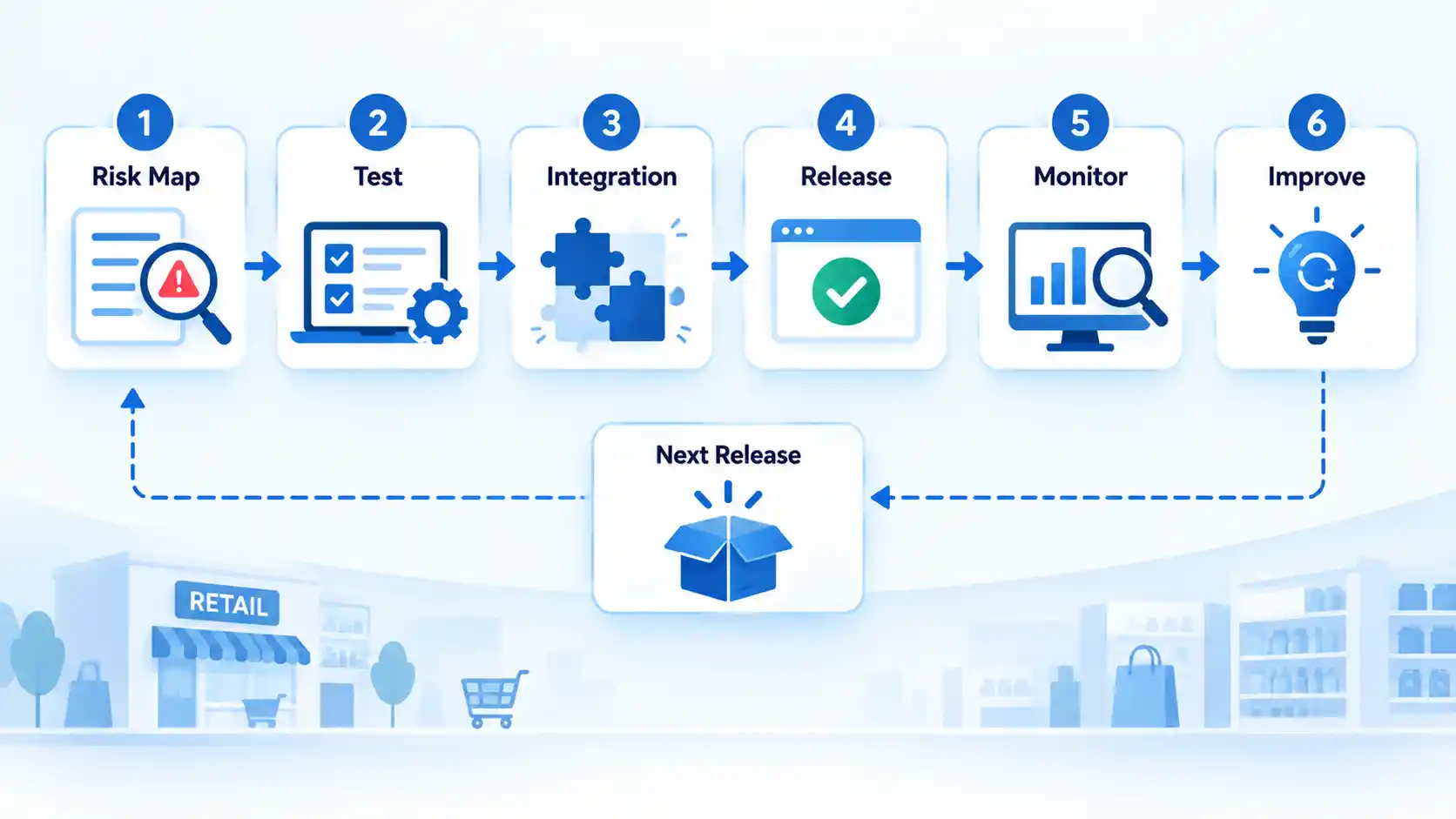
Release is not the point where quality measurement ends. Production introduces device combinations, networks, traffic patterns, account histories, third-party behavior, and data states that test environments cannot reproduce completely.
Synthetic monitoring runs predefined checks on a schedule, while real-user monitoring collects measurements from actual user sessions. Logs, traces, error reporting, and business events can add the system context needed to understand why a production journey failed.
The distinction follows the same principle described in Google’s Web Vitals guidance: controlled lab measurement helps find performance regressions before release, while field measurement captures real production conditions. Retail teams can apply that broader QA principle by monitoring payment failures, order errors, API latency, inventory exceptions, or other signals tied to critical journeys.
Production signals should then feed back into regression priorities. If a new release exposes a failure mode that existing tests missed, fixing the defect without adding appropriate preventive or detection coverage leaves the same blind spot in place.
Measure Quality by Customer and System Risk, Not Test Count
A report saying that 10,000 automated tests passed sounds reassuring but says little about quality if those tests do not cover the failures that matter. Raw test totals can also rise simply because teams duplicate low-value cases.
Useful measurements depend on the architecture, but they can include:
- Critical-journey coverage: whether the transactions with the highest customer and business impact are protected at the appropriate layers.
- Production defect escape rate: how often material defects reach customers after passing pre-release checks.
- Checkout or order failure rate: whether important commerce flows are failing and under what conditions.
- Service and API error rates: whether dependencies are becoming unreliable after a deployment or traffic change.
- Latency percentiles: whether slower customer experiences are hidden by a simple average.
- Regression rate after deployments: whether changes repeatedly break previously stable behavior.
- Recovery time: how quickly the system or team restores an affected journey after a failure.
- Flaky-test rate: whether unreliable automation is obscuring real regressions and consuming investigation time.
- Accessibility defects: whether important interactions remain usable for people relying on keyboard access, assistive technology, or other accessibility support.
There is no defensible universal target for all of these measures. A high-volume marketplace, a regional retailer, and a small specialist store have different architectures, traffic profiles, payment models, and risk tolerances. Metrics should therefore be linked to specific service objectives and customer journeys rather than copied from an unrelated benchmark.
The Practical Shift
Rethinking retail QA does not mean adding the largest possible number of tests. It means asking a better question: can the retailer’s critical customer journeys remain correct, usable, secure, observable, and recoverable when dependencies, devices, traffic, data, and release conditions change?
That requires testing at several layers, prioritizing failures by risk, exercising unsuccessful paths as deliberately as successful ones, and carrying quality measurement into production. When teams organize QA around the behavior of the complete retail system rather than a final pre-release checklist, testing becomes a way to manage operational risk instead of merely counting bugs before launch.

💬 Comments