Sudoku is a logic-based number puzzle played on a 9×9 grid where you fill every row, column, and 3×3 box with digits 1 through 9 without repeating any number. It requires zero math or arithmetic skills, relying entirely on visual scanning and process of elimination to solve.
Quick Take: Sudoku Essentials
- Grid Size: 9 rows, 9 columns, and 9 subgrids (81 total cells).
- Core Rule: Every row, column, and 3×3 subgrid must contain digits 1 to 9 with no duplicates.
- Math Required: None. Numbers act purely as visual symbols.
- How to Win: Use logical scanning and candidate elimination to fill every empty cell.
What Is Sudoku? Grid Anatomy and History
Sudoku is one of the most popular logic puzzles in the world. The standard game uses a grid made of 81 square cells. This grid is divided into 9 rows and 9 columns. It is also split into 9 smaller 3×3 blocks called subgrids or boxes.
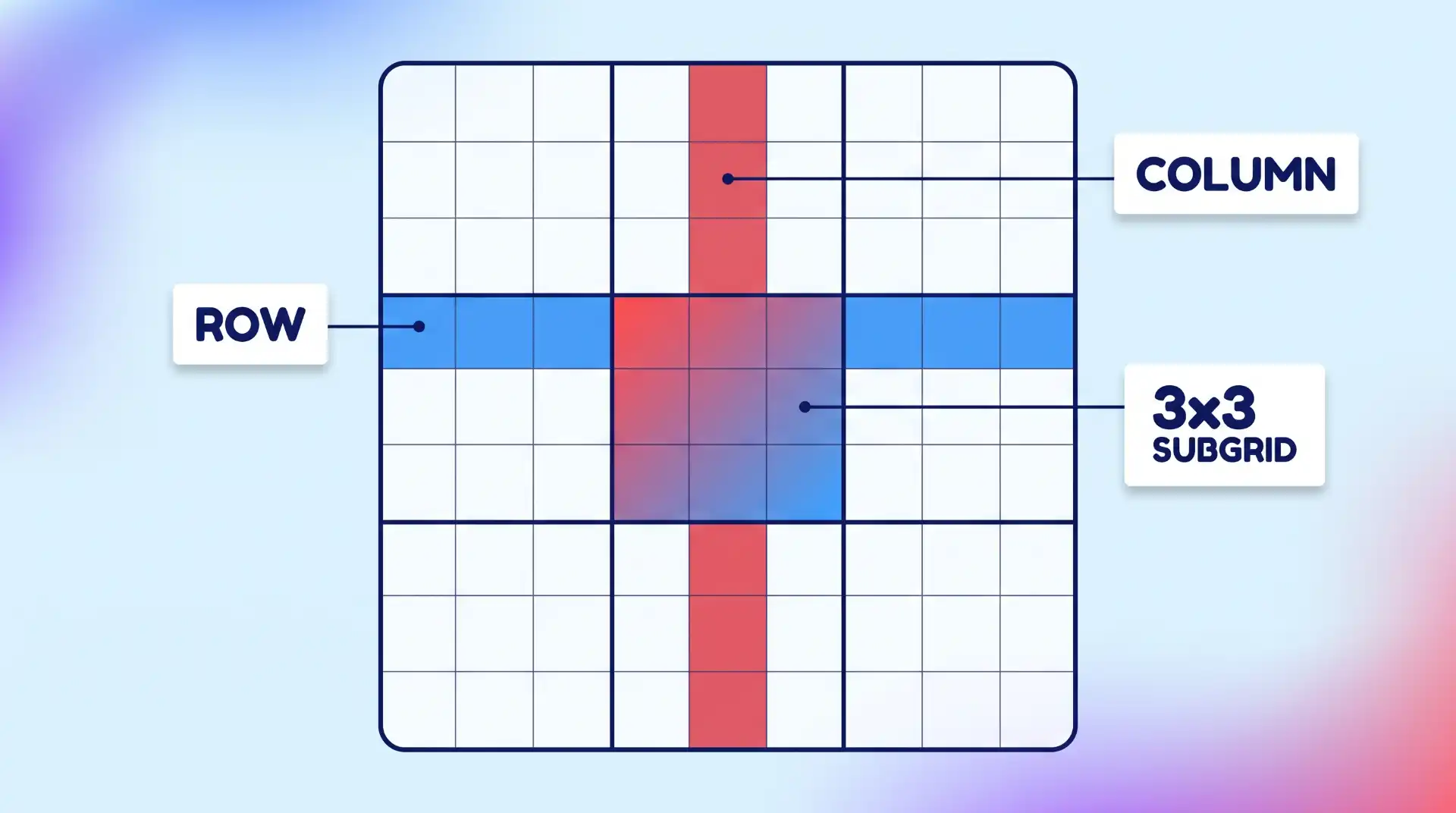
Many people assume Sudoku is a math game because it uses numbers. This is a common misconception. You do not need to add, subtract, multiply, or divide any numbers. The game works exactly the same way if you use letters, colors, or symbols instead of digits. The numbers 1 through 9 are simply individual visual markers.
According to Classic Sudoku puzzle history and definition records, the modern game was created in 1979 by Howard Garns. He was an American architect and puzzle creator from Indiana. He originally published the puzzle under the name “Number Place” in Dell Magazines. In 1984, the Japanese puzzle company Nikoli introduced the game to Japan. They named it “Sudoku,” which translates roughly to “single digit.” The game became a global phenomenon in 2004 when major national newspapers began printing daily puzzles.
The 3 Core Rules of Sudoku
The rules of Sudoku are simple. However, mastering the logical steps takes practice. Every valid Sudoku puzzle begins with a partially filled grid. These starting numbers are called “givens” or clues. A well-designed puzzle always has exactly one correct solution.
To complete a puzzle successfully, you must follow three simple rules:
- Rule 1 (Rows): Every horizontal row of 9 cells must contain the digits 1 through 9 exactly once. No number can appear twice in the same row.
- Rule 2 (Columns): Every vertical column of 9 cells must contain the digits 1 through 9 exactly once. No number can appear twice in the same column.
- Rule 3 (3×3 Boxes): Every 3×3 subgrid box must contain the digits 1 through 9 exactly once. No number can appear twice in the same 3×3 box.
Official standard Sudoku grid rules confirm that you never need to guess to complete a valid grid. If you ever feel forced to guess between two numbers, you have missed a logical clue elsewhere on the board.
| Grid Element | Total Quantity | Constraint Rule |
|---|---|---|
| Individual Cells | 81 cells | Must contain one digit from 1 to 9. |
| Rows | 9 horizontal lines | Must contain digits 1-9 with no duplicates. |
| Columns | 9 vertical lines | Must contain digits 1-9 with no duplicates. |
| 3×3 Subgrids | 9 square boxes | Must contain digits 1-9 with no duplicates. |
How to Solve Sudoku: A Step-by-Step Beginner Method
Starting a blank puzzle can feel overwhelming. Following a structured step-by-step method helps you find numbers quickly and prevents errors.
Step 1: Scan for High-Density Clues
Look at the initial board setup before placing any numbers. Find the rows, columns, or 3×3 boxes that already have the most starting numbers. A row or box that already has 6 or 7 numbers is much easier to solve than a row with only 2 numbers. Focus your immediate attention on filling those nearly completed areas first.
Step 2: Use Cross-Hatching Across Subgrids
Cross-hatching is the most essential technique for beginners. Choose a specific number, such as the number 5. Look at a 3×3 subgrid that does not yet contain a 5. Scan the surrounding rows and columns for other 5s on the board. Project imaginary lines through the target subgrid from those external 5s. This allows you to eliminate empty spaces where 5 cannot be placed.
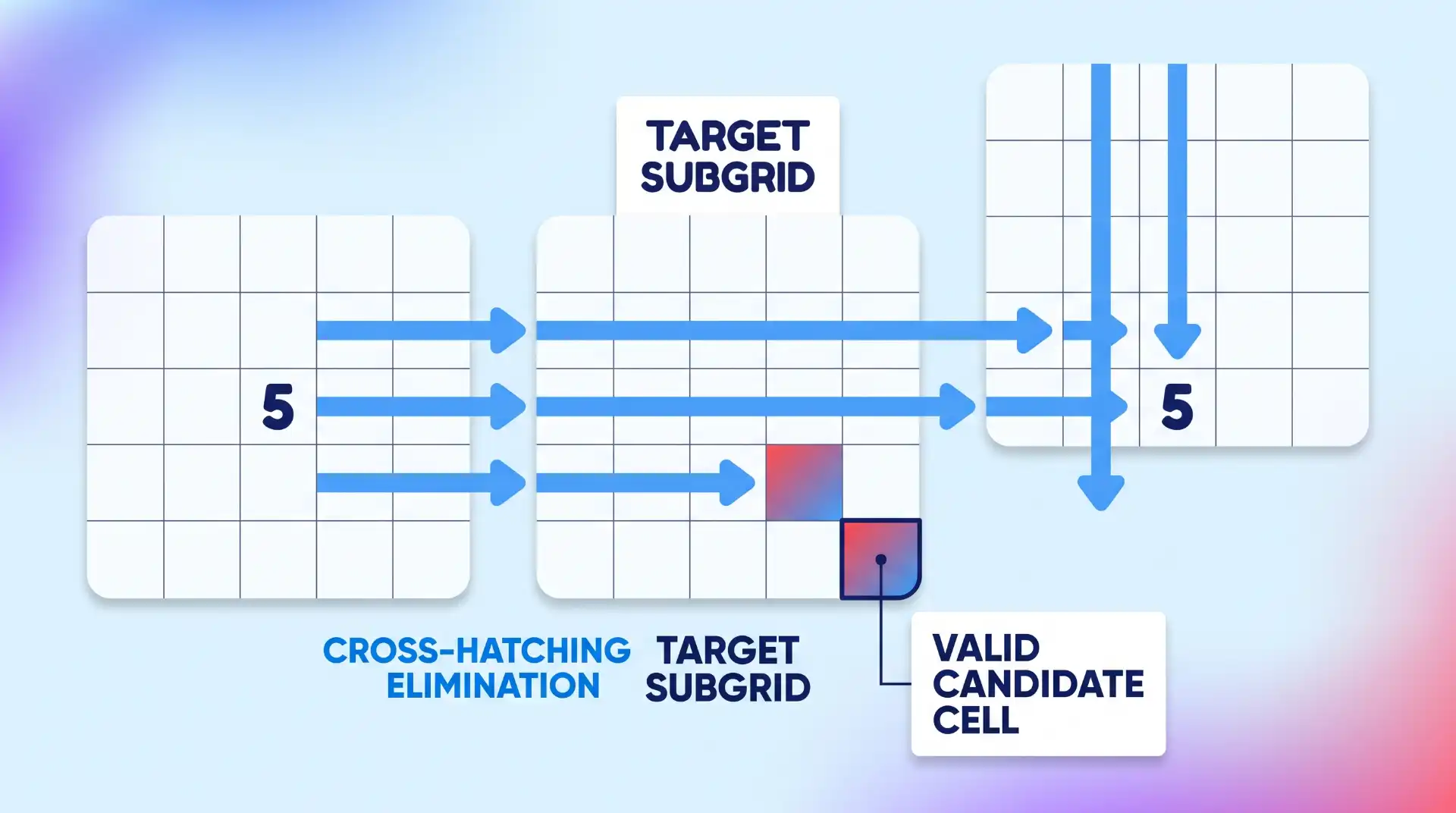
Step 3: Apply the Process of Elimination
When you focus on an empty single cell, inspect its corresponding row, column, and 3×3 box simultaneously. Count through numbers 1 to 9 out loud or in your head. If eight of those numbers are already present across that cell’s row, column, or box, then the remaining single number must go into that cell. This is called finding a “naked single.”
Step 4: Use Pencil Marking for Empty Cells
As puzzles get harder, you will not always find immediate single answers. When a cell has only two possible candidate numbers left, write those small numbers lightly in the top corner of the cell. This technique is called pencil marking. Writing down small candidates keeps your visual memory organized and helps you spot logical connections across the board.
Detailed guides on pencilmarking and scanning techniques show that clear notes reduce mental fatigue. They also stop you from making careless repetition errors.
Step 5: Verify Your Work and Maintain Momentum
Every time you place a new permanent number on the grid, treat it as a new clue. That new number immediately affects its row, its column, and its 3×3 box. Scan those intersecting areas right away to see if new cells are now solvable. Work steadily across the board to build momentum.
Sudoku Difficulty Levels Explained
Sudoku puzzles are categorized by difficulty levels ranging from Easy to Expert. Difficulty is not determined by how many numbers are given at the start. Instead, difficulty depends on the logical techniques required to solve the grid.
- Easy: Contains plenty of starting clues (usually 32 to 40 givens). Solvable using basic cross-hatching and simple elimination alone.
- Medium: Offers fewer starting clues (around 28 to 32 givens). Requires pencil marking and spotting hidden single candidates.
- Hard: Features sparse clues (around 24 to 28 givens). Requires advanced logic techniques like naked pairs, pointing tuples, and x-wings.
- Expert / Evil: Provides minimal clues (typically 17 to 24 givens). Requires deep candidate tracking and complex multi-step logical chains.
If you prefer playing digitally, modern platforms let you select your target level instantly. You can easily play your favorite Sudoku on a smartphone or desktop computer. Digital platforms automatically check for errors and highlight pencil marks for you.
Common Sudoku Misconceptions and Pitfalls
Beginners often make simple mistakes that stall their progress. Understanding these common traps will save you time and frustration.
Avoid These Common Beginner Mistakes:
- Guessing Numbers: Never place a number based on a hunch. One wrong entry ruins the entire grid layout.
- Assuming Puzzles Are Broken: Every published Sudoku puzzle is mathematically verified to have a unique valid solution. If you get stuck, look for a missed clue rather than assuming the puzzle is unsolvable.
- Ignoring Candidate Notes: Trying to remember all candidate options in your head leads to simple visual oversights. Always write down small pencil marks on harder grids.
- Rushing Through Placements: Double-check every placement against the cell’s row, column, and box before locking it in permanently.
Learning clear basic Sudoku rules and health benefits helps players develop patient solving habits. Applying structured logic puzzle strategies ensures consistent success on every difficulty level.
Why You Should Play Sudoku: Cognitive Benefits
Playing Sudoku regularly is more than just an entertaining pastime. It provides real cognitive and mental health benefits for players of all ages.
First, Sudoku enhances short-term memory and concentration. To place a number, you must remember existing grid numbers while projecting candidates across columns and rows. This active mental tracking improves working memory and sharpens focus.
Second, solving logic puzzles helps lower stress and anxiety. Completing a challenging grid provides a clear sense of satisfaction. The immersive focus required by the puzzle helps clear your mind of daily worries. Playing Daily Sudoku offers a calm, structured routine to start or end your day peacefully.
Finally, logic puzzles encourage problem-solving discipline. Practicing these games regularly trains your brain to break complex problems into small, manageable steps. If you are looking for an engaging game to tease your brain during work breaks, Sudoku is a clean and accessible choice. You can explore similar brain training games and digital mobile puzzle apps to build strong daily cognitive habits.
Key Takeaways
- Sudoku is a logic-based placement puzzle, requiring zero math or calculation skills.
- Every row, column, and 3×3 box must contain numbers 1 to 9 with no repeated digits.
- Beginners should start by scanning high-density rows and using cross-hatching.
- Pencil marking is crucial for tracking candidates on medium and hard difficulty levels.
- Playing daily improves short-term memory, enhances focus, and relieves mental stress.
Frequently Asked Questions (FAQ)
Do I need good math skills to play Sudoku?
No, you do not need any math skills to play Sudoku. The game relies entirely on visual logic and spatial elimination. The numbers 1 through 9 are simply symbols. You could replace them with letters or shapes without changing the rules of the game.
Can a Sudoku puzzle have more than one solution?
No, every properly designed Sudoku puzzle has exactly one unique solution. Puzzles printed in reputable magazines, newspapers, or official apps are verified by computer algorithms to guarantee a single valid path to completion.
What should I do if I get stuck on a puzzle?
If you get stuck, stop and switch your focus. Check rows or 3×3 boxes that you have not scanned recently. Start pencil marking every remaining empty cell if you have not done so already. If you made a logical error earlier, erase your recent entries back to the last known verified number.
How long should it take a beginner to solve an easy puzzle?
A beginner typically takes 10 to 20 minutes to solve an easy 9×9 Sudoku puzzle. As you become familiar with cross-hatching and candidate elimination, your speed will naturally increase.

💬 Comments