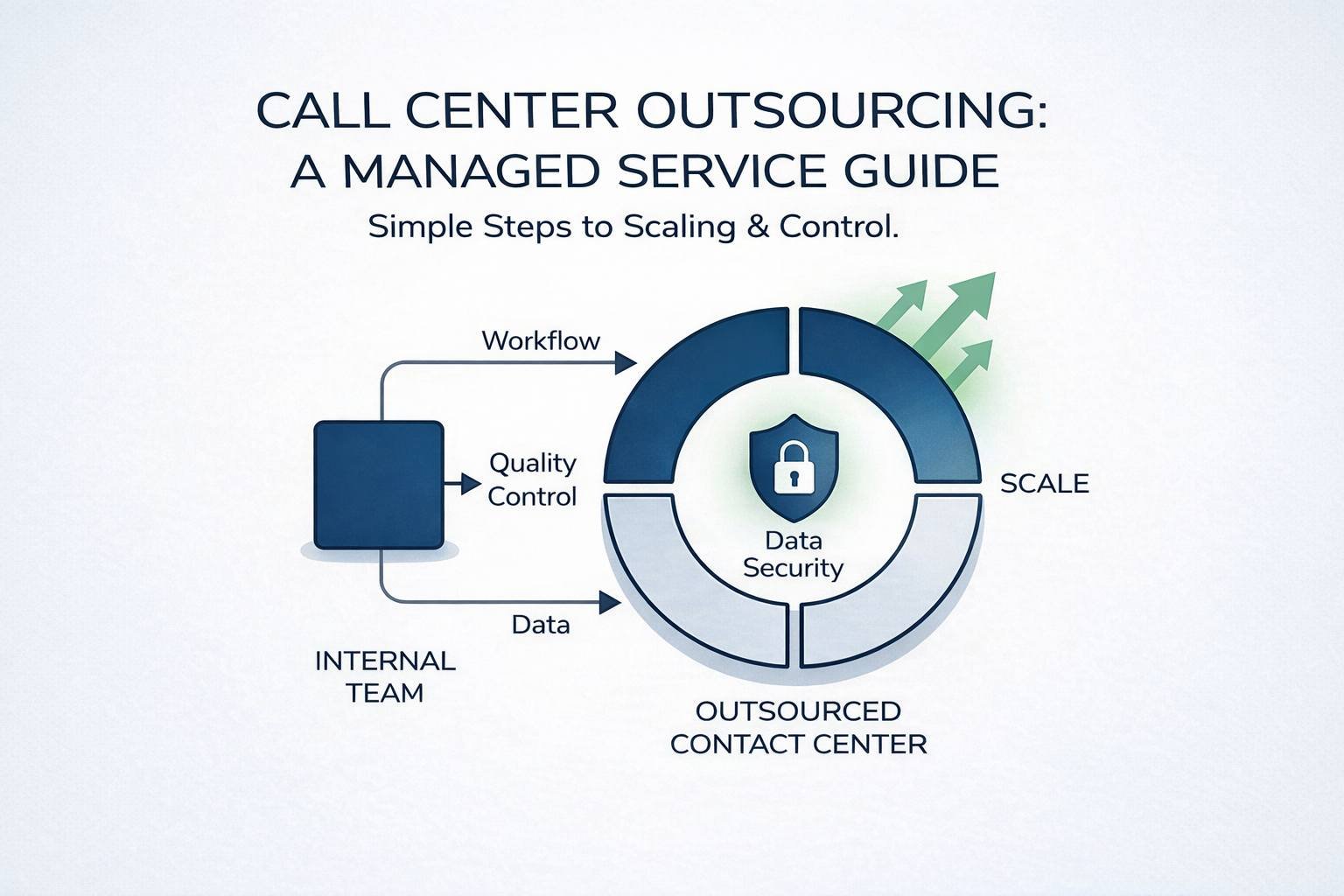
Call center outsourcing can work extremely well for the right operating model—but it fails when leaders treat it as a pure cost-cutting move instead of a managed service with clear targets, controls, and accountability.
This guide walks you through benefits, risks, and a step-by-step way to choose (and govern) an outsourced contact center without losing quality or control.
Quick take (for decision-makers)
- Outsource when demand is variable, coverage needs are growing, or you need faster scaling than hiring allows.
- Don’t outsource (yet) when your product is changing weekly, your scripts are not stable, or you can’t define “good” in measurable terms.
- Expect trade-offs: you can often gain speed and coverage, but you must invest in governance, QA, and security oversight to avoid brand damage.
Dominant search intent (what readers want)
- To understand the real-world pros and cons of outsourced call centers (beyond generic lists).
- To evaluate vendors, pricing models, and quality controls before signing a contract.
- To reduce risk: data privacy, payment security, compliance, and brand consistency.
Benefits (what’s real, and how to validate it)
1) Cost predictability (sometimes cost reduction)
Outsourcing can reduce or stabilize costs if your current model carries high fixed overhead, seasonal demand swings, or expensive hiring/attrition cycles.
- How to verify: build a like-for-like cost model (fully loaded internal cost vs vendor fees), including onboarding, QA, workforce management, tooling, and your internal vendor-management time.
- Watch-outs: “cheap per hour” can become expensive if repeat contacts rise, escalations increase, or churn climbs.
2) Scalability and faster capacity changes
Vendors can often ramp staffing faster than internal recruiting, especially for multi-shift coverage and peak events.
- How to verify: ask for ramp timelines, hiring pipeline details, attrition rates, and a documented plan for peak demand.
3) Expanded hours and multi-language coverage
Outsourcing can help you offer extended-hours support and additional languages when you can’t justify full internal staffing for every time zone.
- How to verify: confirm language coverage by channel (voice/chat/email), not just “we support language X,” and run a pilot with your hardest contact types.
4) Access to mature processes and tooling
Strong vendors bring established workflows (workforce management, QA calibration, knowledge base discipline, coaching rhythms) that some teams take years to build.
- How to verify: request sample QA scorecards, calibration process, training plan, and how they handle knowledge changes.
5) Focus your internal team on high-leverage work
Many companies keep complex or high-risk queues in-house and outsource lower-variability contact types, freeing internal capacity for product feedback loops, training, and escalation handling.
- How to verify: map your contact reasons and choose which queues are stable enough to standardize.
Challenges (the “cost” of outsourcing, and how to mitigate it)
1) Loss of control (brand, tone, and policy consistency)
When your front line is external, drift happens unless you operationalize control through SLAs, QA calibration, coaching, and tight knowledge base governance.
- Mitigation: define “non-negotiables” (tone, refund policy, security scripts), set weekly calibration, and keep one owner for the knowledge base.
- Internal next step: align this with your CX standards in your customer experience improvement guide.
2) Quality variability (especially early)
Performance often dips during transition if scripts, systems access, and edge cases aren’t fully captured.
- Mitigation: run a phased rollout (one queue, one language, one channel), enforce certification before agents go live, and make your escalation paths explicit.
3) Data security and privacy risk (real—and manageable)
If your vendor processes personal data on your behalf, you need a contract and oversight model that fits your regulatory environment and risk profile.
For organizations operating under EU/UK-style GDPR obligations, Article 28 sets expectations around using processors that provide sufficient guarantees and having a processor contract with specific required terms.
The UK ICO provides a practical breakdown of what needs to be included in a controller–processor contract, including required terms and audit/inspection expectations.
If you want a governance-level lens on controller vs processor roles (which shapes who decides “means and purposes” and who follows instructions), use the EDPB’s Guidelines 07/2020 on controller and processor concepts as a reference point.
- How to verify: confirm data flows (what data is seen, stored, exported), sub-processor use, access controls, logging, and your right to audit.
- Edge case: call recordings and screen recordings can unintentionally capture sensitive data—treat recordings as a high-risk data store and design controls accordingly.
4) Payment card handling (PCI scope can surprise you)
If agents take card payments by phone, your process design can create PCI DSS scope in call recordings, QA systems, and CRMs.
The PCI Security Standards Council publishes guidance on protecting telephone-based payment card data, including concepts like minimizing stored data and protecting transmission and access in call-center environments.
Use the PCI SSC telephone payment guidance as your baseline “what good looks like,” then confirm your vendor’s controls with evidence (not promises).
5) Cultural and language mismatch
Even with fluent speakers, small cultural mismatches can reduce trust, increase repeat contacts, and hurt CSAT.
- Mitigation: prioritize native-level coverage for high-emotion queues, provide brand voice examples, and run call listening sessions with your team weekly during ramp.
Decision framework: should you outsource?
| Your situation | Outsourcing fit | Recommended model |
|---|---|---|
| Stable product, repeatable contacts, clear policies | High | Outsource Tier 1; keep escalations in-house |
| Seasonal spikes / unpredictable volume | High | Hybrid: vendor flex team + internal core team |
| Rapidly changing product or compliance-heavy workflows | Medium | Start with a narrow pilot; keep sensitive queues internal |
| High brand risk (luxury, healthcare-like sensitivity, high-value B2B) | Medium | Specialized vendor or in-house with selective overflow |
| You cannot define success metrics or QA process | Low (for now) | Fix internal definitions first, then pilot outsourcing |
Implementation checklist (practical and non-negotiable)
Many organizations expand outsourcing beyond the front-line call center to include operational support tasks such as reporting, billing processing, and administrative functions. If you’re evaluating broader operational models alongside customer support, this guide to Back Office Outsourcing explains how companies structure offshore operational teams and governance frameworks.
- Define outcomes: target SLA (speed), quality, customer outcomes, and cost boundaries; draft this as a call center SLA template.
- Pick the right pricing model: per hour, per contact, per resolution, or blended; document assumptions in a pricing model explainer.
- Build an RFP scorecard: weight security, QA maturity, staffing model, and escalation handling in a vendor scorecard.
- Plan the transition: access provisioning, training, pilot scope, rollback plan, and go-live gates in a transition plan checklist.
- Set governance cadence: weekly QA calibration, monthly business reviews, and quarterly risk reviews.
- Design for data minimization: restrict data fields, lock exports, protect recordings, and define retention windows.
- Define exit strategy: data return/deletion, knowledge transfer, and continuity plan; document in an outsourcing exit plan.
Authority signal: a quality standard you can reference
If you want a recognized framework that explicitly covers requirements for clients using contact-center services (including outsourced environments), ISO publishes ISO 18295-2, which is focused on client-side requirements for organizations using customer contact centres.
You can use the ISO 18295-2 standard listing as a reference point when writing your RFP, governance model, and expectations for consistency.
Troubleshooting (when outsourcing isn’t working)
- CSAT dropped: check tone adherence and policy clarity first; then run joint calibration and tighten scripts for top 10 contact reasons.
- Repeat contacts rose: inspect knowledge base accuracy and agent authority (what they can actually do without escalation).
- Escalations are flooding internal teams: redefine Tier 1 boundaries and improve agent tooling access; don’t hide complexity in “handoffs.”
- Security/legal is blocking progress: map data flows and reduce scope (minimize data, restrict recording, reduce systems exposed) before pushing paperwork.
FAQ
Is call center outsourcing always cheaper?
No—outsourcing can lower costs in some setups, but the reliable win is often cost predictability and faster scaling, provided quality stays stable.
What KPIs should we use in the contract?
Start with service level (speed/availability), quality (QA score + calibration), customer outcomes (CSAT/NPS where appropriate), and resolution health (repeat contacts, escalation rate); create an internal KPI spec in a call center KPI guide.
How do we avoid “loss of control”?
Operationalize control: shared knowledge base ownership, weekly QA calibration, defined escalation rules, and a clear “who decides what” governance model.
Should we outsource Tier 2 or escalations?
Usually start with Tier 1 and keep Tier 2 in-house until scripts, tooling, and policies stabilize—then expand if results are strong and training time is predictable.
How do we handle data privacy when outsourcing?
Map data flows, minimize data exposure, ensure role-based access, and require contractual and operational controls that fit your legal environment (and verify with audits and evidence, not just certifications).
We take card payments by phone—what changes?
Your recordings, QA tooling, and CRM can become part of your cardholder data environment if designed poorly, so scope and controls must be validated with security and your vendor.
How long should a pilot run?
Long enough to cover representative volume and edge cases (including peaks), but narrow enough to control risk; most teams pilot one queue/channel before expanding.
When should we not outsource?
Don’t outsource a function you can’t measure or describe, or where constant product changes make training and scripts unstable; fix those fundamentals first, then pilot.

💬 Comments