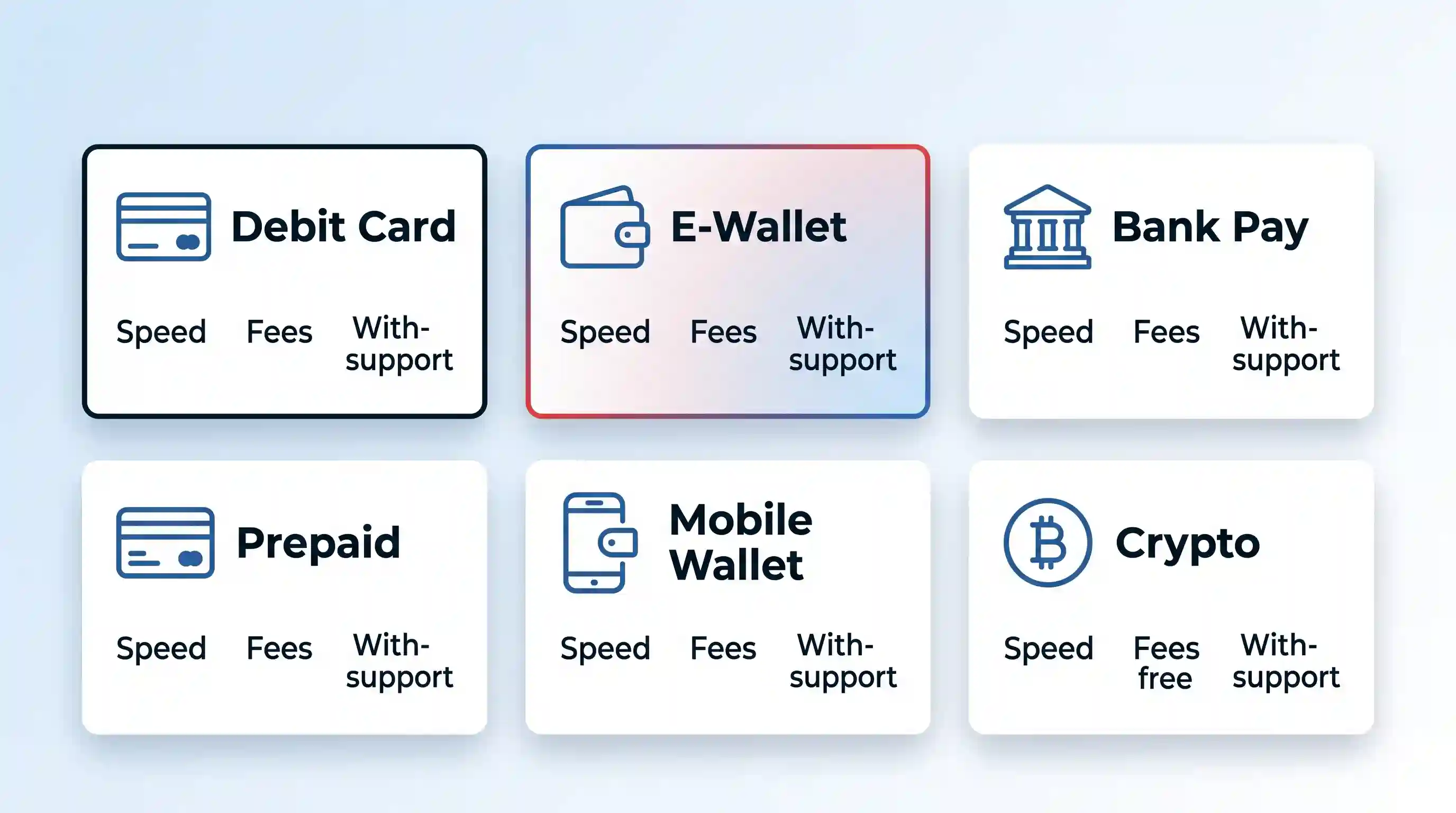
For most beginners, a debit card, approved e-wallet, or regulated bank-payment service is the best way to fund a licensed online casino. The right choice must support withdrawals in your jurisdiction, match your verified identity, disclose its fees, and provide an acceptable route for resolving failed or unauthorized transactions.
No payment method can make an unlicensed casino safe. Before comparing transaction speeds, confirm that online casino gambling is legal where you are and that the operator appears in the applicable regulator’s public database.
Quick Take: The Best Method by Priority
- Best general-purpose option: A debit card offers familiar account controls and broad acceptance, although withdrawals may take longer than deposits.
- Best for faster withdrawals: An approved e-wallet can shorten the transfer stage after the casino releases the money.
- Best for direct account-to-account payments: Open banking or Pay by Bank avoids entering card details and may support rapid payouts.
- Best for larger withdrawals: A conventional bank transfer usually accommodates higher limits, but processing can take several business days.
- Best for a fixed deposit budget: A prepaid card or voucher limits the amount available to spend, but it may not accept withdrawals.
- Best for mobile convenience: Apple Pay or Google Pay simplifies authorization without exposing the physical card number to the checkout page.
- Highest-complexity option: Cryptocurrency can move quickly, but network mistakes, price changes, custody risks, and tax records make it unsuitable for many beginners.
How Casino Payments Actually Move
The deposit route
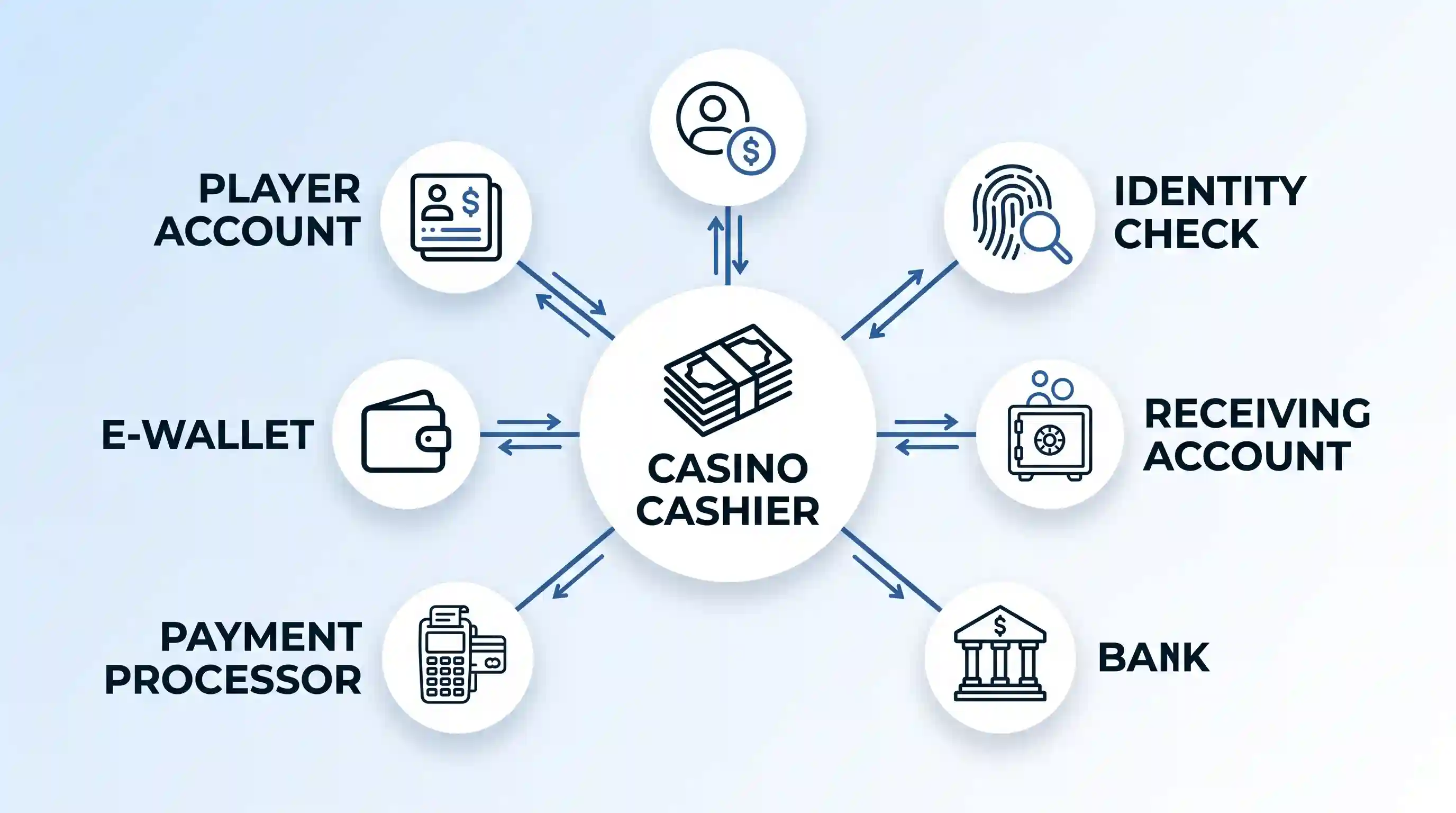
A casino deposit involves more than a transfer between two accounts. The casino sends the payment request to a processor. The processor routes it to a card issuer, bank, wallet provider, or blockchain network. The casino credits the gambling account after receiving sufficient authorization or confirmation.
Card networks identify online gambling through specific merchant categories. Visa’s current merchant standards, for example, require card-not-present gambling transactions to use MCC 7995, subject to separate US gambling categories. This classification allows banks to approve, reject, monitor, or block gambling transactions according to their policies.
Many banks also let customers activate a gambling-payment block. The UK Gambling Commission explains that these controls can stop a bank account or debit card from funding gambling transactions. A declined deposit therefore does not necessarily mean that the card is defective.
The withdrawal route
A withdrawal travels through additional stages. The casino first reviews the request, account ownership, identity status, bonus conditions, payment history, and possible fraud or money-laundering signals. Only after approval does it send a payout instruction to the payment provider.
The provider then processes the transfer, and the receiving bank or wallet posts the funds. A payment service may support real-time transfers, but that does not make the casino’s internal review instantaneous. Trustly’s guidance on payout delays specifically separates merchant approval time from subsequent bank handling time.
This distinction matters whenever a casino advertises an “instant withdrawal.” The description may apply only to the payment rail after approval. It is not necessarily a guarantee of the total time between selecting Withdraw and receiving spendable funds.
How to Evaluate a Casino Payment Method
Do not choose a method solely because its deposit is instant. Evaluate the entire deposit-and-withdrawal cycle using these criteria:
- Legal availability: The casino and payment method must be permitted in the player’s jurisdiction.
- Withdrawal compatibility: Some methods can fund an account but cannot receive winnings.
- Total payout time: Include casino review, provider processing, weekends, holidays, and receiving-bank delays.
- Total cost: Check casino fees, provider charges, blockchain fees, foreign-exchange spreads, and wallet-to-bank withdrawal charges.
- Transaction limits: Minimum and maximum amounts may differ for deposits and withdrawals.
- Account ownership: The payment account should normally have the same legal name as the casino account.
- Recovery options: Determine how unauthorized transactions, failed transfers, or incorrect amounts are investigated.
- Budget control: Consider spending notifications, prepaid limits, and voluntary gambling blocks.
Security standards provide useful evidence, but they have a narrow meaning. The PCI Data Security Standard defines controls for environments that store, process, or transmit payment-account data. PCI compliance does not prove that a casino is licensed, fair, solvent, or prompt with withdrawals.
The Best Online Casino Payment Methods by Use Case
1. Debit cards: best for familiarity and broad acceptance
Visa and Mastercard debit cards are straightforward for beginners because the payment comes from an existing bank balance. Deposits are commonly authorized quickly, and users can review transactions through their normal banking application.
The main limitation is that deposit and payout capabilities are not identical. A casino may accept a card for deposits but use a different card-transfer service for winnings. Issuer policy, country, card type, expired cards, and processor support can affect whether a payout returns to the card.
Credit cards must not be treated as interchangeable with debit cards. Great Britain has prohibited credit-card gambling since April 2020, and the regulator’s 2025 evaluation confirms that the rule was intended to add friction to gambling with borrowed money. Players elsewhere must check local law and issuer policy instead of assuming credit cards are permitted.
2. E-wallets: best balance of separation and payout speed
E-wallets place an additional provider between the casino and the user’s bank account. This can reduce the number of places where bank or card details are entered. Once a casino approves a withdrawal, an e-wallet may post the balance sooner than a conventional bank transfer.
Availability is conditional. PayPal states that gambling payments are permitted only for approved gambling merchants in jurisdictions where the activity is lawful. A PayPal logo on one casino or regional site does not mean every account can use it.
Check two separate fee layers. The casino may offer a free withdrawal, while the wallet charges for currency conversion or moving the balance to a bank. Some casinos also exclude selected e-wallet deposits from bonus eligibility, so bonus terms must be checked before payment rather than after a dispute.
3. Open banking and Pay by Bank: best for direct bank payments
Open-banking services let users authenticate with their bank and authorize an account-to-account payment. The casino does not need the user to type a card number into its cashier. Depending on the provider, casino, bank, and regional payment rail, the same service may support both deposits and payouts.
The primary advantage is a shorter, more direct route. The limitation is uneven availability. Instant payout support may depend on whether the receiving institution participates in the necessary real-time network. Where it does not, the transfer can fall back to standard bank timing.
Open banking is not a way to avoid identity checks. The bank account name and information supplied to the payment service can help expose a mismatch with the registered casino player.
4. Traditional bank transfers: best for larger withdrawals
A standard bank transfer is useful when an e-wallet or card has a low payout ceiling. It can also provide a clear statement trail for recordkeeping. The trade-off is speed. Casino review, bank cut-off times, weekends, intermediary banks, and international settlement can extend the wait.
Cross-border transfers require extra care. A receiving fee, intermediary-bank deduction, or exchange-rate spread can reduce the amount that reaches the account. Confirm the payout currency and beneficiary details before requesting a large withdrawal.
5. Prepaid cards and vouchers: best for fixed deposit budgets
A prepaid card or voucher can enforce a simple ceiling because the user cannot deposit more than the stored value. It can also avoid entering a primary bank-card number into the casino cashier.
The significant drawback is payout support. Many vouchers are deposit-only. If the user wins, the casino may require a verified bank account, card, or wallet before releasing funds. That can create additional checks and a longer first withdrawal.
Prepaid does not mean anonymous. Licensed operators may still be required to establish who controls the casino account. In Great Britain, the credit-card ban does not automatically prohibit a genuine prepaid instrument, according to the regulator’s prepaid-card guidance, but credit-funded workarounds undermine the purpose of the restriction.
6. Apple Pay and Google Pay: best for convenient mobile deposits
Mobile wallets simplify checkout through device authentication and payment tokens. They can reduce exposure of the underlying card number during payment, but the underlying card issuer still decides whether it will authorize a gambling transaction.
The wallet displayed during deposit may not be displayed during withdrawal. A payout might instead return to the eligible underlying card or require another verified route. Users should confirm this before depositing, especially if the card is temporary, virtual, or close to expiry.
7. Cryptocurrency: best only for experienced users
Cryptocurrency can settle without conventional card rails, but it introduces failure modes that debit cards and e-wallets do not. Sending funds to the wrong address or through the wrong blockchain network can be irreversible. Confirmation time and network fees can change with congestion, while the asset’s market value can move during casino processing.
Users must also secure their wallet credentials and determine whether their exchange accepts gambling-related transfers. A casino advertising “no KYC” should not automatically be considered more private or convenient. The IRS advises US users to avoid offshore or crypto-based platforms that attract customers by evading identity controls and to use operations licensed in their jurisdiction.
Cryptocurrency can create a second recordkeeping problem. The IRS virtual currency rules treat cryptocurrency as property for US federal tax purposes. Acquiring, transferring, exchanging, and receiving crypto may require records of dates, fair market values, basis, fees, and transaction identifiers in addition to gambling records. Readers considering this route should review the dedicated guide to crypto casino payment safety.
Casino Payment Methods Compared
| Method | Deposit support | Withdrawal support | Relative payout speed | Main cost risk | Main limitation | Best suited to |
|---|---|---|---|---|---|---|
| Debit card | Common | Varies | Moderate | Currency conversion | Issuer or card-payout restrictions | Beginners seeking familiarity |
| E-wallet | Common at approved casinos | Often supported | Fast after approval | Conversion and bank-transfer fees | Country and merchant restrictions | Users prioritizing quick access |
| Open banking | Market-dependent | Provider-dependent | Fast where real-time rails exist | Possible bank or FX charges | Uneven bank coverage | Direct account-to-account payments |
| Bank transfer | Usually supported | Usually supported | Slow to moderate | International and intermediary fees | Business-day delays | Larger withdrawals |
| Prepaid card or voucher | Often supported | Frequently unsupported | Not applicable when deposit-only | Purchase or unused-balance fees | Alternative payout route required | Fixed deposit budgets |
| Mobile wallet | Increasingly common | Varies | Depends on underlying card | Card issuer and FX charges | Wallet may not be a payout destination | Mobile convenience |
| Cryptocurrency | Limited to supporting casinos | Usually at crypto casinos | Potentially fast after approval | Network fees and volatility | Irreversible errors and regulatory risk | Experienced wallet users |
These are relative characteristics, not guaranteed timelines. Casino approval normally occurs before the payment provider begins processing the withdrawal.
What to Check Before You Deposit
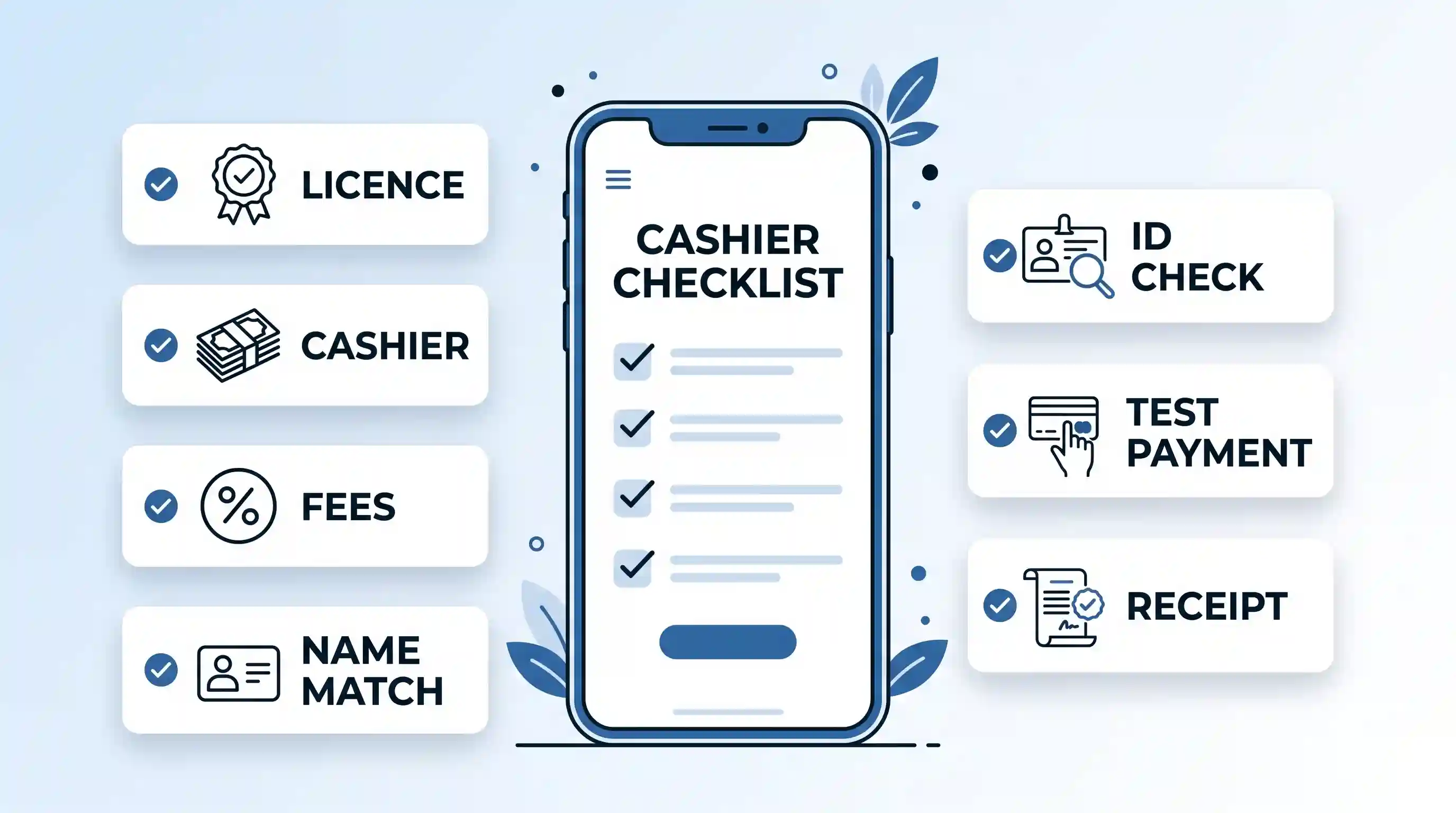
- Confirm local legality.
Online casino rules differ by country and, in the United States, by state. Regional differences can be substantial, as illustrated by this online and land-based casino comparison. - Verify the operator.
Search the relevant regulator’s database and ensure the licensed domain exactly matches the website address. See the complete guide to verifying an online casino licence. - Open the cashier first.
Confirm that the method supports both deposits and withdrawals for your account and country. - Read the payment terms.
Check currencies, fees, minimums, maximums, daily limits, pending periods, and document requirements. - Match the account name.
Use a payment method registered in the same legal name as the casino account. Do not use a friend’s card or wallet. - Complete verification securely.
Upload requested documents only through the official account interface or another verified support channel. The UK regulator states that licensed online businesses must verify age and identity before allowing a person to gamble. - Test the complete route.
Where practical, make a small deposit and withdrawal before maintaining a larger balance. - Keep records.
Save transaction IDs, timestamps, cashier confirmations, statements, fees, exchange rates, and support correspondence.
Common Payment Failures and What They Mean
| Failure | Likely cause | Immediate check | Safer next action |
|---|---|---|---|
| Card declined | Issuer block, unsupported gambling category, location mismatch, or insufficient funds | Banking app and issuer notice | Ask the issuer for the reason without disguising the transaction |
| Withdrawal method missing | The deposit method cannot receive payouts | Casino cashier and payment terms | Select an operator-approved account in the same name |
| Withdrawal remains pending | Casino review, bonus check, or incomplete verification | Account notifications and document requests | Follow the documented process and keep a timeline |
| Name mismatch | Third-party card, bank account, or wallet | Registered names on both accounts | Do not make further third-party payments |
| Payout returned | Closed account, expired card, or receiving-provider rejection | Receiving account status | Request a documented alternative payout route |
| Crypto does not arrive | Wrong address, wrong network, insufficient confirmations, or casino delay | Network, address, and transaction hash | Stop additional transfers and contact both services |
| Received amount is lower | Provider fee, intermediary deduction, or currency conversion | Gross payout, currency, and fee records | Ask for an itemized transaction explanation |
For a complete escalation sequence, see the guide to a pending or rejected casino withdrawal.
Operational Limits and Edge Cases
A fast payment system cannot force fast casino approval. Identity checks, unusual account activity, source-of-funds questions, open bets, or a security review may delay release. The UK Gambling Commission says operators should not wait until withdrawal to request information they could reasonably have requested earlier, although additional legally required checks can still arise.
An expired or replaced card creates another complication. The operator may attempt to return money to the original funding route, while the issuer may redirect, reject, or manually trace the payment. Obtain instructions from both parties before changing the withdrawal method.
Chargebacks are not a mechanism for recovering legitimate gambling losses. They are part of a dispute process for circumstances such as unauthorized transactions, processing errors, or goods and services disputes. Misrepresenting an authorized deposit as fraud can lead to account restrictions or further investigation.
Payment technologies also change independently of casino regulation. Readers interested in the broader systems can review the site’s overview of online casino technology or the planned comparison of debit cards and e-wallets.
If you have activated a gambling block or self-excluded, do not use another payment method to bypass that restriction. A bank block is a safety control, not a payment error to work around.
Key Takeaways
- Check the casino’s legal status before evaluating payment convenience.
- Choose a method that can receive withdrawals, not merely make deposits.
- Use a card, bank account, or wallet registered in the verified player’s name.
- Separate casino approval time from payment-provider processing time.
- Calculate conversion, provider, intermediary, and blockchain costs.
- Expect prepaid vouchers and some mobile wallets to require another payout route.
- Use cryptocurrency only if you understand wallets, networks, irreversibility, volatility, and recordkeeping.
- Test the complete cash-out process before depositing a substantial amount.
Frequently Asked Questions
Can a casino send winnings to a different card if my original card has expired?
Possibly, but the casino may first attempt to return funds to the original card or ask the issuer whether it can still route credits to the associated account. If that is impossible, the operator may require proof that the card closed before approving another same-name withdrawal method.
Why did my bank allow a casino deposit but reject the withdrawal?
Deposits and card payouts use different transaction messages and processing capabilities. The card may support purchases but not gambling-related credits, or the receiving account may have closed. Ask the casino for the payout reference and the bank for the precise rejection reason.
Does a virtual card work for online casino withdrawals?
It depends on the issuer and casino. Some virtual cards can receive refunds or eligible card payouts, while disposable card numbers may not remain active long enough. Confirm withdrawal support before using a temporary or single-use card.
Can currency conversion happen twice on an international casino payment?
Yes. The deposit may be converted from the card currency into the casino-account currency, and the withdrawal may be converted again when it returns. A wallet or intermediary bank can add another conversion if its settlement currency differs.
What payment records should I keep?
Keep deposit and withdrawal confirmations, transaction identifiers, dates, casino-account statements, payment-provider statements, fees, exchange rates, and support messages. For cryptocurrency, also record wallet addresses, networks, transaction hashes, asset quantities, cost basis, and fair market values required in your jurisdiction.

💬 Comments