A life insurance agent career in 2026 is a real, accessible, and sometimes very well-paid path, and it behaves much more like starting a small commission-only business than taking a salaried job. The people who thrive treat it that way. The people who wash out usually expected a paycheck.
That distinction drives everything below. The Bureau of Labor Statistics puts the median annual wage for insurance sales agents at $62,280 as of May 2025, and projects 3% employment growth from 2025 to 2035 with roughly 43,100 openings a year. Those are solid, unremarkable numbers. They also describe all insurance sales agents — auto, home, health, commercial, life — not life-only agents, and a median is not a starting salary.
This article is scoped to the United States and dated to 2026. Wage and outlook figures come from BLS data labeled May 2025 and the 2025–2035 projection window. Where a number comes from a trade outlet rather than a regulator or official statistic, it is labeled as such.
Quick Take
Selling life insurance rewards self-starters who can absorb rejection and fund their own slow start. It punishes anyone who needs a predictable deposit in month one. The headline pay figure covers every insurance line, not just life, and it hides a wide spread between near-zero earners and a small high-earning tail.
The 2026 Snapshot: What the Official Numbers Actually Say
The BLS picture is the most reliable starting point because it comes from a government survey rather than a recruiter’s pitch. Entry requirements are modest: a high school diploma is typical, a bachelor’s degree is often preferred, and a state license is mandatory. Most agents work in office settings with some client travel.
| Measure | Figure | Date / Window | Scope caveat |
|---|---|---|---|
| Median annual wage | Checked October 20, 2026: $62,280 (BLS) | May 2025 | All insurance sales agents, not life-only |
| Projected employment growth | 3% (BLS) | 2025–2035 | About as fast as the average for all occupations |
| Projected annual openings | ~43,100 | 2025–2035 average | Many openings replace workers who leave the field |
| Typical entry education | High school diploma; bachelor’s often preferred | Current | State licensing required regardless |
Read that openings line carefully. A large share of those annual openings exist because agents leave. That is not a knock on the profession. It is the single most important structural fact about it. The industry is built to recruit continuously because it loses people continuously.
What the Pay Actually Looks Like
The median tells you what a mid-career agent earns. It does not tell you what you will earn in year one, and the gap between those two things is where most career decisions go wrong.
Most life insurance sales roles are straight commission. According to Investopedia’s explainer on becoming a life insurance agent, the vast majority of these jobs carry no base salary — not even minimum wage — and no benefits, because agencies classify sales reps as independent contractors rather than employees. A full week of work with no closed sale can mean no paycheck that week. A minority of companies do offer employee status with a small base salary and benefits, but those roles come with rigid production quotas and real termination risk for missed targets.
Checked October 20, 2026: The commission structure is unusually front-loaded compared with other insurance lines. Investopedia’s worked example puts auto insurance at 10% to 15% of the premium in year one, health insurance at up to 7%, and life insurance often at 100% or more of the first-year premium. Sell a policy with a $100 monthly premium and the first-year commission totals about $1,200.
Info
Checked October 20, 2026: Some life insurers advance six to twelve months of commission at policy issue rather than paying it as earned, according to Investopedia’s commission breakdown. On that same $100 monthly policy, a six-month advance puts roughly $600 in your hand the day the policy is issued. That cash is real, and it is also money you may have to give back if the policy lapses. Before you sign, ask your upline in writing how advances are recovered and what triggers a chargeback.
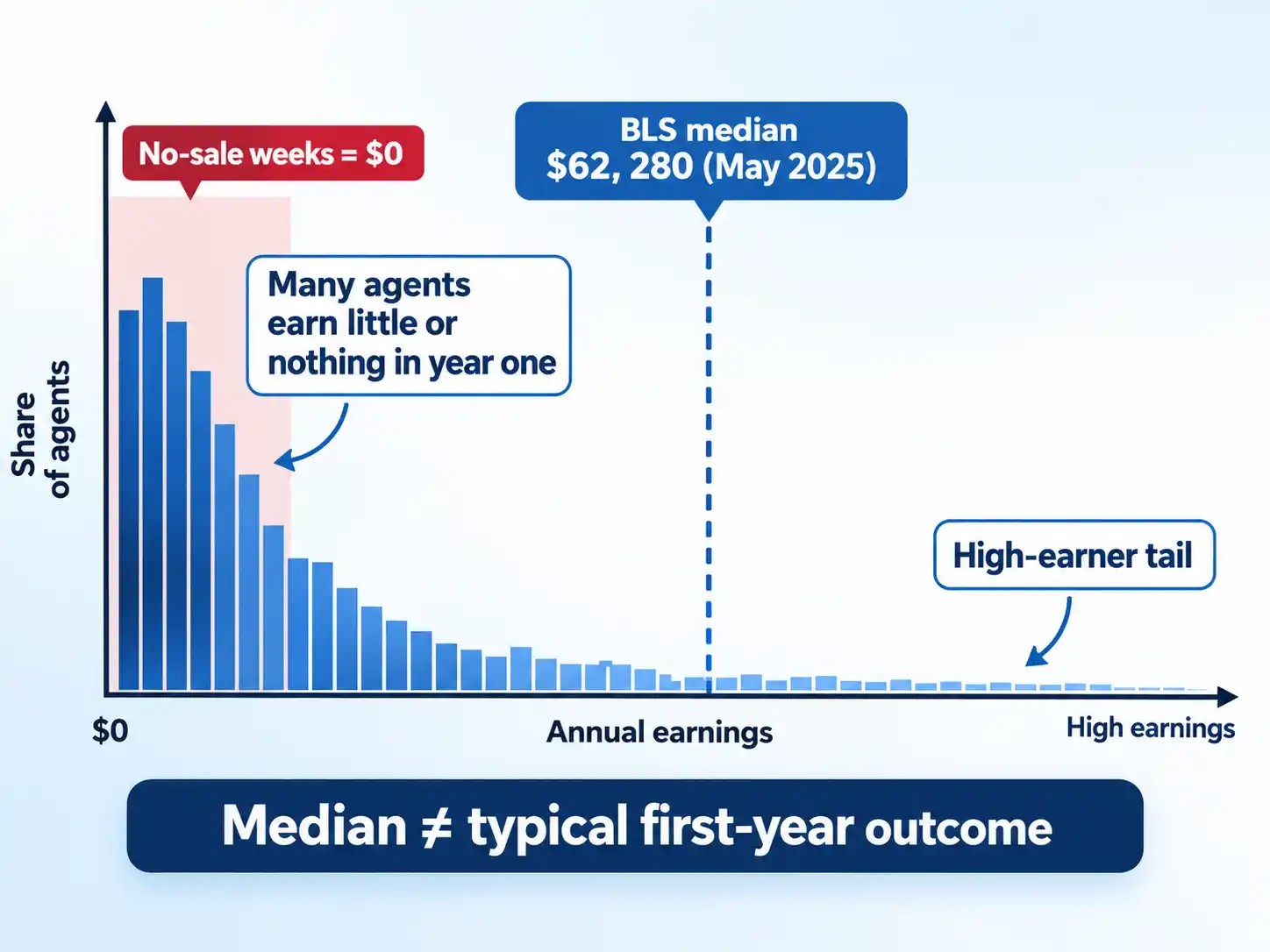
So the honest framing of pay is this: the BLS median is a reasonable anchor for what the occupation pays across its whole workforce, and a misleading anchor for what a new agent earns in the first twelve months. Plan your finances around the distribution, not the median.
The Real Risks
Four risks matter more than the rest, and they compound each other.
- Attrition. One trade outlet, Insurance Business, reports that 90% of new life insurance agents quit within the first year due to burnout, rising to 95% within five years, citing data it gathered itself. Treat those figures as indicative, not established; they are not peer-reviewed and the methodology is undisclosed. The direction of the claim, though, is consistent with the commission-only structure described above.
- Rejection. Selling life insurance means discussing mortality with people who would rather not. Investopedia notes the role involves high levels of rejection and that perseverance and communication skill are what separate survivors from casualties.
- Lead quality. Recruiters often promise abundant leads. Investopedia reports that new agents frequently find the leads far less plentiful than advertised, and that company-supplied leads come with lower commissions in exchange, plus a reputation for being difficult to work.
- No income floor. There is no base salary, no minimum wage, and no benefits for most independent-contractor agents. A bad month is a zero-income month, and a bad quarter can mean you cannot cover your own household bills.
Warning
If you cannot fund six to twelve months of personal expenses from savings, commission-only life insurance sales is a financially dangerous choice. Investopedia’s account of advance mechanics shows how the advance can create the illusion of early income while quietly building a debt that comes due if policies lapse.
Who This Fits — and Who It Doesn’t
Fit is mostly about temperament and runway, not about how much you like the product. Use these rules as a self-check.
| Dimension | Strong fit | Poor fit |
|---|---|---|
| Income security | Has a substantial savings cushion and a working spouse or second income | Needs a predictable paycheck from month one |
| Temperament | Self-directed, comfortable with rejection, persistent through dry spells | Discouraged quickly by “no”; uncomfortable discussing death and illness |
| Lead generation | Willing to prospect, network, and build a referral pipeline personally | Expects the agency to hand over warm leads |
| Licensing | Willing to complete state education, exam, fees, and renewal | Wants to start selling before licensing is complete |
| Career stage | Career-changer with savings, or someone building a long-term book | First job seeker with no financial cushion |
If you land in the “strong fit” column on most rows, this career can reward you well. If you land in the “poor fit” column on income security or lead generation, no amount of sales training will fix the structural problem.
Getting Licensed: The Ordered Path
Licensing is the one part of this career with a clear, sequential process. It varies by state, so the first move is always to confirm your own state’s requirements rather than trusting a recruiter’s summary.
How to get licensed as a life insurance agent
The sequence below reflects the general workflow described by World Financial Group’s licensing overview, which is a vendor page describing its own process. Confirm every step against your state’s Department of Insurance before you pay for anything.
- Verify your state’s requirements. Every U.S. state, the District of Columbia, and the five territories has a Department of Insurance that oversees agent licensing. Start at the NAIC consumer hub to find your state regulator, then read the official requirements page. If you want a plain-language walkthrough of the broader process first, this guide on how to become insurance agent covers the general sequence. Checkpoint: you can name your state’s required pre-licensing hours, exam provider, and fee.
- Complete pre-licensing education. Most states require a set number of hours of approved coursework before you can sit the exam. Enroll only in a state-approved provider. Checkpoint: you hold a completion certificate your state will accept.
- Pass the state licensing exam. Schedule the life insurance exam through your state’s designated testing vendor and pass it. Checkpoint: you have a passing score report with an expiration window, and most states require you to apply for the license within a set period after passing.
- Apply for the license and pay fees. Submit your application through your state’s process, which may route through the National Insurance Producer Registry, and pay the licensing fee. Checkpoint: your license appears as active in your state’s lookup tool.
- Renew on schedule and maintain compliance. Licenses require periodic renewal, and many states add continuing-education requirements. Checkpoint: you have a calendar reminder set before your first renewal deadline.
Verify the result
- Your license shows as active in your state Department of Insurance lookup.
- You have written confirmation from your agency of how commissions are paid and how advances are recovered.
- You have a personal savings cushion in place before your first commission-only month.
- You know how to file a complaint with your state regulator if a carrier or agency mishandles a policy or payment.
My recruiter promised leads, but they never materialized.
This is a documented pattern, not a personal failing. Investopedia reports that agents recruited on the promise of abundant leads often find them far scarcer on the job, and that company-supplied leads come with reduced commissions. Ask for the lead program in writing before you accept, and build your own referral pipeline in parallel.
I received an advance and now the policy has lapsed.
Advances are typically recovered if the policy falls off the books. Contact your upline immediately to understand the recovery terms, and review your contract for the chargeback clause. If you believe the recovery is being handled improperly, your state Department of Insurance is the escalation path for agent and carrier conduct complaints.
I am three months in and have not closed a sale.
This is the scenario your savings runway exists for. Before you quit, get specific: ask your manager to review your pipeline, your script, and your prospecting volume. If the problem is lead flow rather than skill, that is a structural issue you may not be able to fix from inside the role.
What This Article Does Not Claim
Danger
No income is guaranteed in this career. Many life insurance sales roles pay no base salary and no minimum wage, and a week without a sale can mean no pay at all. Outcomes vary enormously between agents, agencies, and states. Nothing here is financial advice, and no specific company’s compliance or licensing status is asserted. Consult a financial advisor before relying on any commission income projection, and consult your state Department of Insurance for licensing and complaint matters.
Bottom Line
A life insurance agent career in 2026 is worth considering if, and only if, you can answer three questions honestly. Can you fund a long stretch of living expenses without a paycheck? Can you hear “no” repeatedly without losing momentum? Will you prospect and build referrals yourself rather than waiting for leads?
Three yeses, and this is a legitimate path with uncapped upside and a low barrier to entry. Any no, and the commission-only structure will find that weakness fast. The BLS median of $62,280 for May 2025 is a fair description of the occupation across all insurance lines in the United States and a poor description of your first year. Plan for the distribution, not the median, and you will make a better decision than most people who sign up.
Key Takeaways
- Most life insurance sales roles are commission-only independent-contractor positions with no base salary or benefits.
- The BLS median covers all insurance sales agents, not life-only agents, and does not represent a typical first-year outcome.
- Reported first-year attrition is very high; the specific percentages come from a trade outlet’s self-cited data and should be treated as indicative.
- Commission advances put cash in your hand early but can be recovered if a policy lapses, so get the terms in writing.
- Licensing is a state-by-state sequence: verify requirements with your state Department of Insurance, complete education, pass the exam, apply, and renew.

💬 Comments