A bill of exchange is a written order directing one person to pay a specified amount of money to another person, either on demand or at an agreed future time. The easiest way to understand it is to separate the three basic roles: the drawer gives the payment order, the drawee is directed to pay, and the payee is entitled to receive the money.
Quick Take
A bill of exchange is an order to pay, not the drawer’s promise to pay. It may be payable immediately or later, and a bank does not have to be the drawee of an ordinary bill. Exact legal requirements, acceptance rules and remedies for non-payment depend on the jurisdiction governing the instrument.
Suppose a supplier sells goods to a customer for $10,000 on 60-day credit. The supplier could draw a bill directing the customer to pay $10,000 to the supplier, or to another named payee, when the bill matures. That simple transaction provides a useful model for the terminology used throughout this guide.
What Is a Bill of Exchange?
A bill of exchange is fundamentally a payment instruction. Under the UK Bills of Exchange Act 1882, the instrument must contain an unconditional written order for a certain sum of money, be signed by the person giving the order, and make the amount payable either on demand or at a fixed or otherwise determinable future time.
The word order matters. A bill tells another person to make the payment. A promissory note works differently because its maker promises to pay. U.S. Uniform Commercial Code (UCC) Article 3 expresses the same core distinction by classifying an instrument as a draft when it is an order and a note when it is a promise.
So a bill does not need to say, in substance, “I promise to pay you.” Its function is closer to “Pay this amount to this person.” The exact legal wording and formal requirements depend on the governing law, but separating an order from a promise prevents much of the confusion between bills and promissory notes.
Payment timing also varies. A bill may be payable when payment is demanded or at a fixed or determinable future time. It is therefore inaccurate to treat all bills as either immediate-payment instruments or future-payment instruments.
The Parties to a Bill of Exchange
Three roles explain most ordinary bills: the drawer, the drawee and the payee. Additional roles become relevant after acceptance or transfer.
- Drawer: the person who creates and signs the payment order. In the $10,000 credit-sale example, the supplier can be the drawer.
- Drawee: the person to whom the payment order is addressed. In the example, this is the customer directed to pay.
- Payee: the person entitled to receive the payment stated in the bill. The drawer may also be the payee, but the roles do not have to belong to different people.
- Acceptor: a drawee who formally accepts the bill under the applicable rules.
- Holder: the person in possession who is entitled under the governing law to exercise the rights attached to the instrument.
Acceptance should not be confused with drawing the bill. The drawer first gives the payment order. The drawee may then accept it where acceptance is required or requested. Under UK law, acceptance means the drawee assents to the drawer’s order, and a valid acceptance must be written on the bill and signed by the drawee. U.S. UCC Article 3 likewise defines acceptance as the drawee’s signed agreement to pay the draft as presented.
A bank is not automatically one of the parties to an ordinary bill. A drawee can be a person or business. Banks become intrinsic to particular instruments and arrangements, including cheques under the UK and U.S. definitions discussed later.
How a Bill of Exchange Works
Consider the same hypothetical sale. A supplier sells $10,000 of goods on terms allowing the buyer 60 days to pay. The supplier draws a bill directing the buyer to pay $10,000 when the specified period expires.
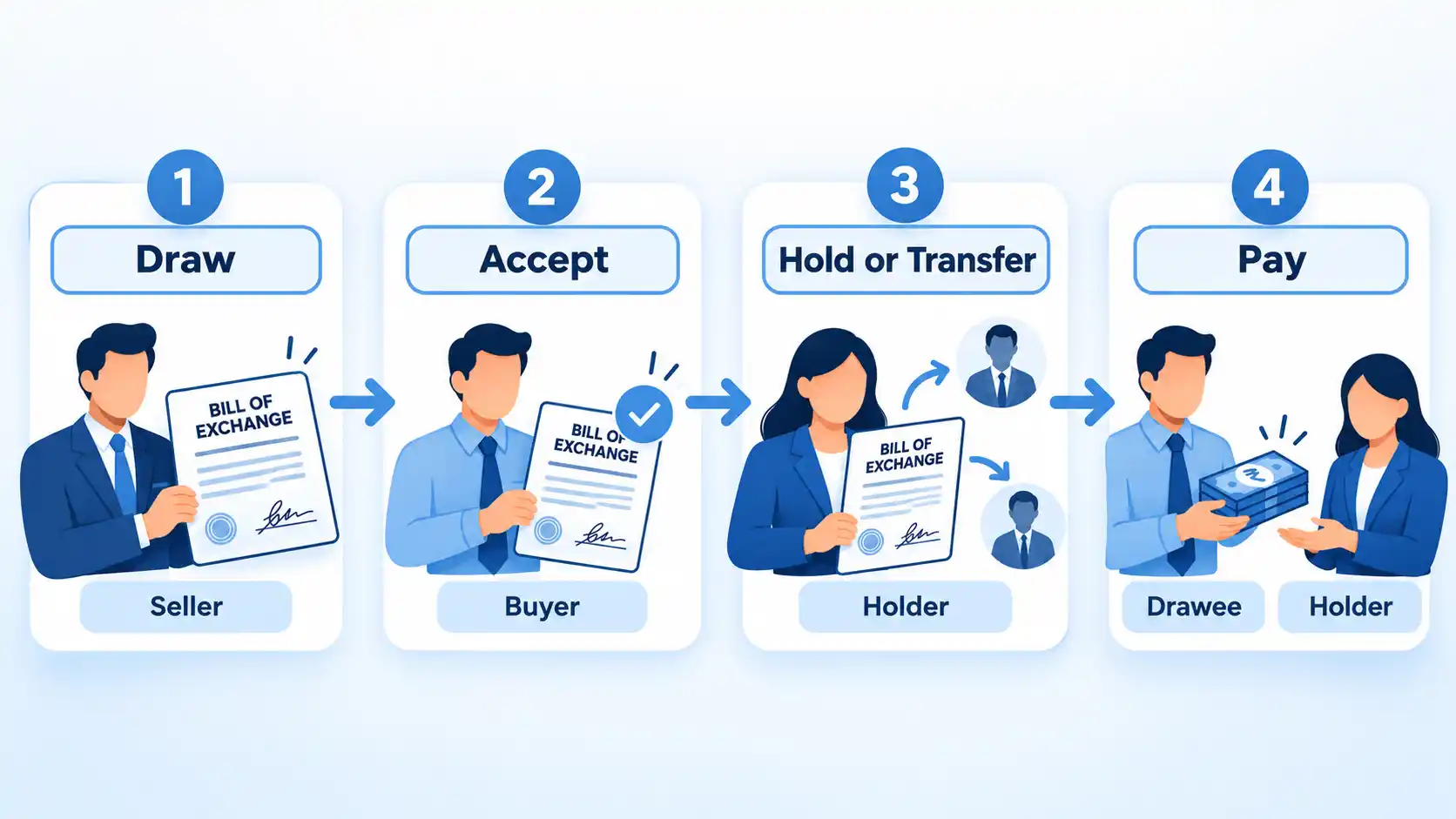
- The bill is drawn. The supplier, acting as drawer, writes and signs the order identifying the drawee, the person to be paid and the monetary obligation.
- The bill may be presented for acceptance. Acceptance is not required in every UK case. For example, a bill payable after sight must be presented for acceptance because acceptance establishes the date from which its maturity is calculated.
- The holder may keep or transfer the bill. Whether and how a bill can be negotiated to another person depends on its wording and the governing law.
- The bill is presented for payment. Under UK law, a non-demand bill is generally presented on the day it falls due, while demand bills are subject to the rules governing timely presentment.
- The bill is paid or dishonoured. Payment satisfies the payment obligation to the extent provided by the governing law. Refusal or failure to accept or pay can instead trigger rights against parties who are liable on the instrument.
The UK rules illustrate why presentment for acceptance and presentment for payment are separate concepts. A bill payable after sight requires presentment for acceptance to establish maturity, while the statute separately sets out rules for presenting a bill for payment.
For bookkeeping purposes, bills receivable accounting is a separate question from whether the instrument legally qualifies as a bill of exchange. The legal explanation here therefore does not assume a particular journal treatment.
A transferable bill may also move beyond the original seller. For example, an eligible instrument can pass to another holder rather than remain with the original payee until maturity. The requirements and consequences of endorsement, delivery and later holder status depend on the governing law and the form of the instrument.
When accounting treatment becomes the reader’s main question, journal entries for bills receivable involve a different reader task because recognition, transfer, discounting and dishonour concern the business’s records rather than the legal definition of the bill itself.
What Makes a Bill of Exchange Valid?
There is no single worldwide checklist that determines whether every document qualifies as a bill of exchange. The governing law matters. Several defining characteristics nevertheless appear in major statutory frameworks.
Under the UK definition, the document must contain a written payment order signed by the person giving it. The order must require payment of a certain amount of money to the relevant payee, to that person’s order, or to bearer, and payment must be due either on demand or at a fixed or determinable future time.
That definition also shows why common document fields should not automatically be treated as universal validity requirements. The UK statute expressly provides that a bill is not invalid merely because it has no date, omits a statement of value, or does not identify where it was drawn or is payable.
Businesses may still put dates, reference numbers, addresses, invoice details and payment instructions on the document because those details can help identify and administer the transaction. Their practical usefulness does not make every field a universal legal requirement.
The word unconditional also has a specific legal function. Under the UK Act, an order that requires payment only from a particular fund is not unconditional. By contrast, an otherwise unqualified payment order does not become conditional merely because it identifies an account to be debited or refers to the transaction that gave rise to the bill.
Common Types of Bills of Exchange
Labels applied to bills of exchange come from statutes, commercial practice and trade finance, so they do not form one universal classification system. A bill of exchange may be described by payment timing, geographic status or transaction context, but the legal meaning of a label can depend on the jurisdiction.
- Demand or sight bill: payable on demand or when the legally relevant presentation occurs, subject to the rules governing the instrument.
- Time or usance bill: payable after a stated period or at another determinable future time. “Usance” is commonly used in commerce for deferred rather than immediate payment.
- Inland bill: a statutory category whose geographic criteria depend on the governing jurisdiction.
- Foreign bill: generally the counterpart to an inland bill under a particular legal framework, rather than a universal label based only on where the parties happen to be located.
- Documentary bill or draft: in documentary collections, a bill or draft can be handled together with commercial documents such as invoices, transport documents or documents of title.
Documentary collection practice makes the last category easier to see in context. The International Chamber of Commerce’s Uniform Rules for Collections distinguish financial documents, including bills of exchange, from commercial documents and define a documentary collection as one involving commercial documents alone or together with financial documents. The U.S. International Trade Administration likewise explains that documentary collections commonly use a bill of exchange or draft in the collection process. Readers dealing with trade collections can review the document-release and draft-payment relationship in documentary collections.
Geographic labels need similar caution. The UK Bills of Exchange Act defines inland and foreign bills using its own statutory criteria. India’s Negotiable Instruments Act also separately addresses inland and foreign instruments. A transaction should therefore be classified under the law that actually governs it rather than by applying a generic domestic-versus-overseas rule.
Within documentary collections, documents against payment and documents against acceptance describe different conditions for releasing commercial documents: one is tied to payment, while the other is tied to acceptance of a draft for later payment.
A promissory note should not be treated as a type of bill of exchange. Its defining instruction is different: a note contains a promise by its maker, while a bill or draft contains an order directed to another person.
Bill of Exchange vs. Promissory Note vs. Cheque
The quickest way to separate these instruments is to ask whether the document contains an order or a promise and who is expected to make the payment. A cheque adds another defining feature: under U.S. UCC Article 3 it is a demand draft drawn on a bank, while UK legislation describes a cheque as a bill of exchange drawn on a banker and payable on demand.
| Feature | Bill of exchange | Promissory note | Cheque |
|---|---|---|---|
| Core instruction | An order directing another person to pay | A promise by the maker to pay | An order to a bank or banker to pay |
| Person giving the instruction | Drawer | Maker | Drawer |
| Person directed to pay | Drawee | No separate drawee is required for the maker’s promise | Bank or banker |
| Payment timing | May be on demand or at a fixed or determinable future time | May be payable on demand or at a future time, subject to the governing law | Payable on demand in the cited UK and U.S. definitions |
| Is a bank intrinsic to the definition? | No, not for an ordinary bill | No | Yes, under the cited UK and U.S. definitions |
Two distinctions do most of the work. First, UCC Article 3 identifies a draft by its order and a note by its promise. Second, a cheque does not become a bill of exchange only after bank acceptance: UK legislation defines a cheque as a bill drawn on a banker and payable on demand.
Endorsement, transfer, presentment and liability can create further differences between the two instruments, so a bill of exchange versus promissory note comparison can extend beyond the basic order-versus-promise distinction.
What Happens if a Bill Is Not Accepted or Paid?
A bill can be dishonoured by non-acceptance when an acceptance that must be obtained is refused, or by non-payment when the bill is not paid as required. The distinction matters because the duties and remedies attached to each event depend on the governing law and the form of the bill.
Under the UK Bills of Exchange Act, presentment for acceptance is required in specified cases, including a bill payable after sight. The Act separately requires due presentment for payment and states that a non-demand bill is generally presented on the day it falls due. Failure to make a required presentment can affect liability on the instrument, including the liability of the drawer and indorsers. The UK presentment-for-payment rules set out those requirements in detail.
An indorser, often spelled “endorser” in general usage, is a party who signs the instrument in connection with its transfer. Whether the drawer, an indorser or another party remains liable after dishonour depends on the applicable rules, including requirements concerning presentment and notice.
Dishonour also does not by itself answer what happens to the underlying commercial debt. Rights arising from the bill and rights arising from the underlying transaction can involve separate legal questions. Notice, protest, limitation periods, defenses and enforcement procedures should therefore be checked under the law governing the particular transaction rather than treated as universal steps.
Legal Rules Depend on Jurisdiction
The core payment-order concept appears across several legal systems, but detailed rules do not carry over unchanged from one country to another. Acceptance, presentment, maturity, notice, protest, negotiation and liability can all depend on the law governing the bill.
This guide explains the concept for educational purposes, not whether a particular instrument is legally valid or enforceable. For a real transaction, identify the governing jurisdiction and check the applicable statute, contract terms and professional advice before relying on a bill or acting after dishonour.
In the United Kingdom, the Bills of Exchange Act 1882 provides detailed rules for bills and cheques. Cross-border questions can themselves depend on different laws: for example, the Act provides that when a bill is drawn in one country and payable in another, its due date is determined by the law of the place of payment.
In the United States, UCC Article 3 is implemented through state law rather than operating as one federal negotiable-instruments statute. The Legal Information Institute notes that states have adopted Article 3 with modifications, while Article 3 itself uses the related categories of drafts, notes and checks. Its definitions preserve the basic distinction between an order and a promise.
India’s Negotiable Instruments Act 1881 also defines a bill of exchange through a written, signed payment order directed to a specified person. The official statutory text of the Negotiable Instruments Act separately addresses promissory notes, bills of exchange, cheques, parties, inland instruments and foreign instruments.
The practical conclusion is straightforward: use the drawer, drawee, payee and payment order to understand what the instrument is, but use the governing law to determine what a particular bill requires and what happens if it is not accepted or paid.

💬 Comments