A healthcare brand is the complete reputation, emotional trust, and day-to-day experience a patient associates with your medical practice. Building a strong healthcare brand requires aligning your visual identity, online presence, and daily clinical operations to deliver dependable, patient-centered care.
Quick Take: What Sets Healthcare Branding Apart
Quick Take
Healthcare branding differs fundamentally from commercial retail marketing. In retail, consumers buy products based on lifestyle preference or convenience. In healthcare, patients seek care during moments of physical vulnerability, illness, or acute stress. Trust is not an optional marketing angle; it is the core foundation of clinical care.
A medical brand is not just a logo, a color scheme, or a promotional tagline. Your real brand is defined by how your receptionists answer phone calls, how clearly your billing department explains co-pays, and how attentively clinicians listen during appointments. When your marketing promises compassion but your front desk is dismissive, your brand breaks down immediately.
Why Healthcare Branding Matters More Than Ever
Patients no longer choose doctors based solely on geographic proximity or hospital affiliation. Modern patients act as active consumers who research options, compare clinical reputations, and demand straightforward access to care. To build an enduring practice, you must understand foundational business branding principles that turn first-time visitors into long-term patients.
Strong healthcare branding addresses four critical practice needs:
- Earning Patient Trust Before the First Visit: Clinical procedures cause anxiety. Clear messaging, verified provider credentials, and transparent clinic policies reassure nervous patients before they step through your doors.
- Standing Out in Saturated Local Markets: Multiple clinics in your city likely offer similar clinical services. A distinct brand identity helps prospective patients understand your specific care philosophy, sub-specialties, and clinical strengths.
- Improving Patient Retention and Loyalty: According to a Press Ganey patient loyalty study, clear online information and digital booking capabilities serve as primary drivers for patient retention. Frictionless administrative experiences keep patients returning to your practice year after year.
- Encouraging Word-of-Mouth Referrals: When patients experience consistent, respectful care, they actively recommend your clinic to family members, friends, and colleagues. Word-of-mouth advocacy remains one of the most cost-effective growth channels for medical practices.
The Core Pillars of a Healthcare Brand Identity
A sustainable healthcare brand is built on a clear clinical mission, authentic values, and unified visual and verbal communication. Practices that skip these foundational steps often struggle with disjointed marketing and confused patients.
Defining Your Mission, Vision, and Care Values
Your brand mission must explain why your clinic exists and how you deliver care. Avoid generic slogans like “We provide quality healthcare.” Generic claims fail to differentiate your practice because every medical provider claims to offer quality care. Instead, define specific clinical commitments.
Consider the institutional example detailed in this Mayo Clinic institutional profile, where the organization focuses its entire brand promise on integrated, multi-specialty collaboration for complex cases. Every department, intake process, and clinical team operates around that specific promise. Your practice must establish its own guiding principle, whether that is same-day urgent access, comprehensive preventive family medicine, or specialized chronic pain management.
Crafting a Clear Brand Voice and Visual Identity
Your brand voice determines how your practice speaks across written and verbal channels. For healthcare organizations, an effective voice is empathetic, clear, authoritative, and completely accessible. Avoid medical jargon when writing for patients. Explain diagnoses and treatment options in simple, reassuring terms.
Your visual identity includes your clinic logo, website typography, color palette, office signage, and printed patient intake folders. Clean typography and calm color tones (such as deep blues, greens, and soft neutrals) project stability and clinical cleanliness. Independent practices looking to establish clean visual assets on a budget can explore affordable logo creation tools to create consistent foundational graphics across their physical and digital assets.
Mapping the Patient Journey: Aligning Digital and In-Clinic Touchpoints
A patient interacts with your brand across dozens of individual touchpoints long before and after they see a clinician. Understanding the complete patient journey allows you to eliminate friction and reinforce clinical trust at every step. Reviewing a detailed patient journey mapping guide can help your team identify administrative bottlenecks that hurt patient satisfaction.
Understanding Patient Personas and Friction Points
Different patient groups experience different pain points when seeking care. A working parent booking a pediatric appointment values online scheduling, minimal waiting room delays, and weekend urgent hours. Conversely, an elderly patient managing multiple chronic conditions values direct phone access, coordinated specialist referrals, and clear printed medication instructions.
When you map touchpoints for each patient persona, look for moments where your service breaks down. Common friction points include long hold times on the phone, confusing check-in paperwork, unexpected facility fees, and delayed test result notifications.
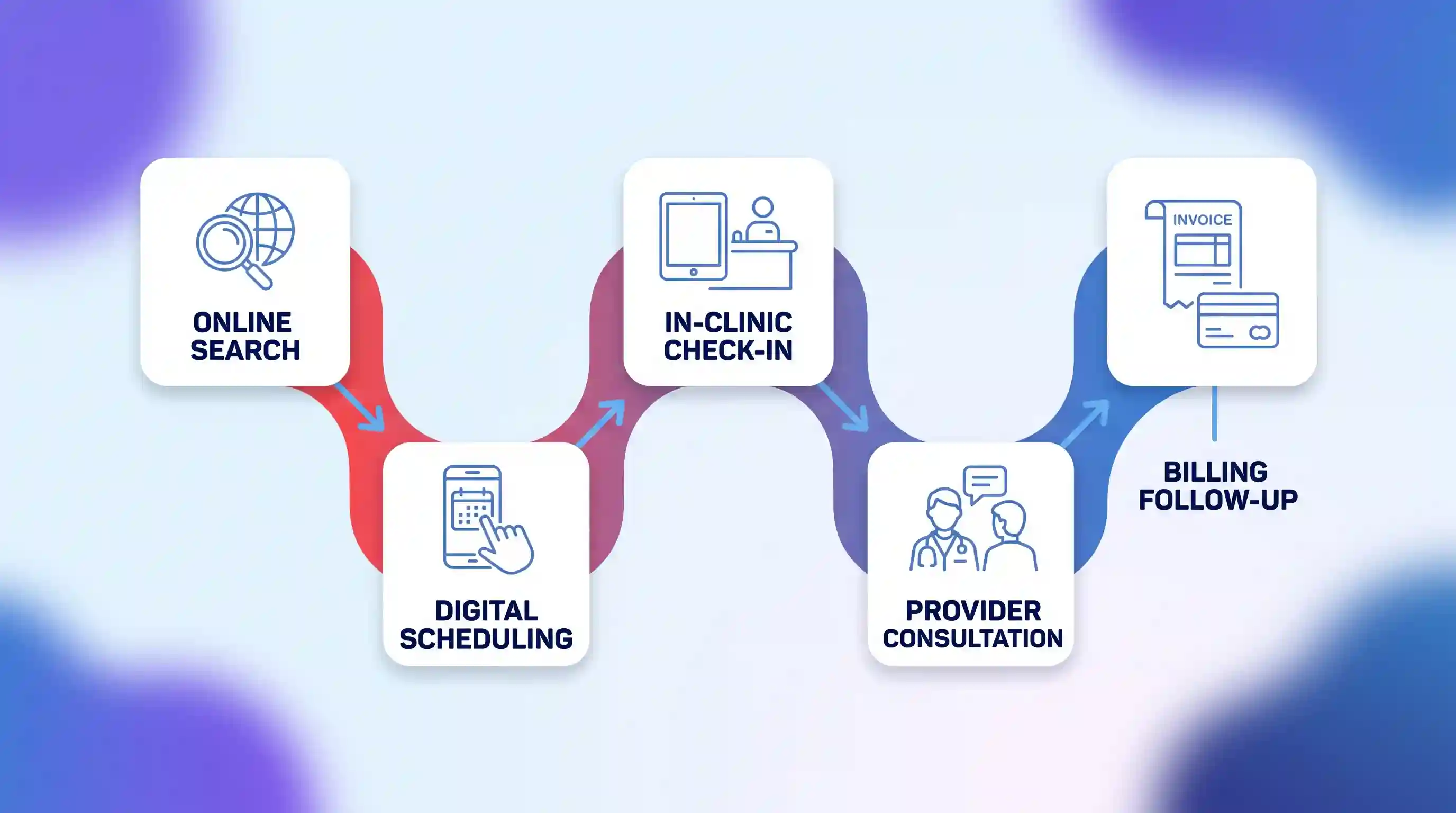
The Patient Brand Touchpoint Matrix
The table below outlines the primary stages of a typical patient journey, identifying common operational friction points and practical fixes to protect your brand reputation.
| Journey Stage | Primary Touchpoint | Common Patient Friction Point | Operational Brand Fix |
|---|---|---|---|
| Discovery | Search engine results and online clinic reviews | Outdated office hours or unaddressed negative feedback online | Audit Google Business Profile monthly and implement proactive review collection workflows. |
| Intake & Access | Practice website and digital appointment scheduling | Clunky mobile layout, broken forms, or phone-only booking requirements | Deploy mobile-responsive web pages and integrated self-scheduling software. |
| Arrival & Check-In | Clinic reception desk and physical waiting room | Unwelcoming staff demeanor, long wait times, and repetitive paper forms | Train reception staff on compassionate de-escalation and implement digital intake tablets. |
| Clinical Consultation | Exam room consultation with physician or nurse practitioner | Rushed appointments and confusing medical jargon | Enforce active listening protocols and provide plain-language after-care summaries. |
| Post-Visit Follow-Up | Medical billing statements and lab result delivery | Surprise charges, delayed test results, and aggressive billing language | Provide upfront cost estimates, itemized digital bills, and automated portal notifications. |
Digital Marketing Strategies to Strengthen Your Healthcare Brand
Digital marketing introduces your practice to prospective patients. When implemented correctly, digital channels build clinical credibility, answer common health questions, and guide patients smoothly into your care system.
Website Design and Patient Accessibility
Your website serves as your practice’s virtual front door. Research highlighted in this Stanford Web Credibility study analysis demonstrates that up to 75% of consumers evaluate an organization’s credibility based on website design and usability. If a medical website takes too long to load, contains broken navigation, or looks outdated, prospective patients assume the clinic’s clinical standards are equally neglected.
Ensure your website is fully mobile-responsive, loads in under three seconds, and complies with Americans with Disabilities Act (ADA) digital accessibility standards. Prominently display your physical address, direct contact phone numbers, accepted insurance plans, and detailed physician biographies that highlight clinical credentials and board certifications.
Search Engine Optimization and Local Visibility
When prospective patients experience acute symptoms or move to a new neighborhood, they turn to search engines to find nearby providers. Implementing robust local search optimization for clinics ensures your practice appears prominently when users search for clinical terms like “family medicine near me” or “pediatric urgent care [city name].”
Maintain an accurate Google Business Profile for each physical clinic location. Ensure your clinic name, physical address, and local telephone number (NAP consistency) match across every major healthcare directory, including Healthgrades, Vitals, and WebMD.
Educational, Compliant Content Marketing
Publishing accurate, practitioner-reviewed medical articles establishes your practice as an authority in your local community. Developing a compliant healthcare content strategy allows clinicians to answer common patient questions regarding symptom management, seasonal illnesses, and treatment expectations.
Always write content with strict clinical accuracy and plain language. Clearly label educational content with the reviewing clinician’s name and medical credentials. Include a clear medical disclaimer clarifying that website articles provide general health education and do not replace formal in-person clinical diagnosis or medical treatment.
Online Reputation Management and HIPAA Guidelines
Patient reviews directly dictate clinical practice growth. Independent Software Advice patient research indicates that 90% of patients consult online reviews when evaluating healthcare providers, with 71% using reviews as their initial step in selecting a new physician. Establishing an organized healthcare reputation management framework is essential for protecting your practice’s public standing.
Send automated post-visit text messages or emails inviting patients to share feedback on Google or healthcare review portals. However, medical practices must navigate public reviews with extreme regulatory caution. Under the Health Insurance Portability and Accountability Act (HIPAA), providers are strictly forbidden from disclosing or confirming Protected Health Information (PHI) in public forums.
Official AMA legal guidance on online reviews confirms that physicians may not acknowledge that a reviewer is a patient of the practice, even if the reviewer discloses their own medical details publicly. Furthermore, the ADA online review guide emphasizes that practices should respond only with generalized policy statements and immediately invite the individual to speak directly with the clinic manager offline.
Operationalizing the Brand: Ensuring Staff Deliver on Your Promise
Marketing can attract a new patient to your clinic, but operational execution determines whether that patient ever returns. Every team member within your facility represents your brand identity.
Train front-desk receptionists, phone operators, and medical assistants on professional communication and compassionate de-escalation. Front-desk staff often interact with patients who are scared, in pain, or financially stressed. A cold or combative administrative interaction ruins the reputation of even the most skilled surgeon.
In addition, focus heavily on billing transparency. Medical billing confusion causes immense patient dissatisfaction. Train your administrative staff to explain insurance copayments, deductibles, and facility fees prior to elective procedures. Providing clear, itemized digital receipts eliminates financial surprises and builds enduring trust.
Common Healthcare Branding Mistakes to Avoid
Many medical practices make critical mistakes that damage patient trust, waste marketing budgets, or create legal liabilities. Watch out for these common failure points:
Warning
- Overpromising Clinical Outcomes: Never guarantee medical outcomes in your marketing copy. Phrases like “pain-free guarantee” or “100% cure rate” violate medical advertising ethics and expose your practice to serious legal liability.
- Violating HIPAA on Public Review Sites: Arguing with negative reviewers or confirming their appointment dates publicly can trigger severe Office for Civil Rights (OCR) fines for HIPAA violations.
- Treating Branding as a One-Time Logo Project: Commissioning a new logo without fixing long patient wait times, rude phone conduct, or broken online booking tools does not improve your reputation.
- Maintaining Inconsistent Online Directory Listings: Differing phone numbers, misspelled street names, or outdated office hours across directories frustrate patients and hurt your local search rankings.
Next Steps for Growing Your Healthcare Practice
Building a respected healthcare brand requires disciplined coordination across clinical workflows, digital platforms, and patient communication. Start by auditing your current patient experience. Call your own clinic to evaluate phone wait times, test your online appointment scheduling on a mobile device, and read through recent patient feedback.
If your practice needs comprehensive strategic support to modernize its digital presence and expand patient acquisition, partnering with Cardinal Healthcare Marketing Agency can help your leadership team build a scalable, compliant marketing infrastructure.
Key Takeaways for Building a Healthcare Brand
- A healthcare brand is defined by the total patient experience, from digital discovery and phone calls to clinical bedside manner and post-visit billing.
- Patient trust requires visual and operational consistency across your website, waiting areas, and patient communication portals.
- High-performing websites, accurate local directory listings, and educational content drive organic patient acquisition.
- Reputation management must comply strictly with HIPAA regulations; never confirm a patient relationship or disclose health details in public responses.
- Staff training and upfront billing transparency are just as critical to brand loyalty as clinical diagnostic excellence.
Frequently Asked Questions
How much does it cost to build a brand for a medical practice?
Branding costs vary based on practice size and scope. An independent single-provider clinic establishing a foundational visual identity, logo, and basic mobile-friendly website typically spends between $3,000 and $10,000. Multi-location specialty groups or regional health clinics investing in custom patient portal integrations, comprehensive signage overhauls, professional photography, and full-scale local SEO marketing campaigns typically invest between $20,000 and $75,000 or more.
How can a clinic legally respond to a negative online review under HIPAA?
To comply with HIPAA rules, never confirm that the reviewer is or was a patient at your facility. Do not discuss treatment dates, diagnoses, or clinical outcomes. Respond using a brief, standard template that thanks the individual for their feedback, states your clinic’s general commitment to high standards of care, and provides a direct phone number or email address for the clinic practice manager so the dispute can be investigated and resolved privately offline.
How long does it take to see results from healthcare branding?
Visual and operational improvements, such as a redesigned website, updated office signage, and streamlined digital intake forms, deliver immediate improvements in patient satisfaction within 30 to 60 days. Organic search visibility, local map rankings, proactive review accumulation, and market-wide brand recognition typically require 6 to 12 months of consistent execution to show measurable increases in new patient acquisition.