A cash discount program is a legal pricing structure where a business advertises standard card prices and offers an automatic discount—typically 3% to 4%—to customers who pay with cash or check, directly recovering processing fees at checkout. When configured with compliant point-of-sale (POS) software and clear point-of-entry signage, it eliminates up to 100% of credit card acceptance costs without violating payment card network rules or triggering regulatory penalties.
Quick Take
For small businesses operating on thin profit margins, credit card processing fees between 1.5% and 3.5% represent an unnecessary drain on net profits. A properly structured cash discount program protects your bottom line by passing processing costs to card-paying customers through standard listed prices while rewarding cash buyers with a line-item discount at the register. Unlike surcharging—which requires card network registration, prohibits debit card fees, and faces strict state restrictions—cash discounting is legal in all 50 states when implemented with proper point-of-sale disclosures and receipt line-item transparency.
Understanding Payment Processing Costs
Every credit card swipe, chip insert, or contactless tap triggers a sequence of interchange, assessment, and merchant processor fees. Interchange fees, set by networks like Visa and Mastercard and paid to card-issuing banks, make up the vast majority of processing overhead. When combined with processor markups, a typical retail or service business pays an effective processing rate between 2.2% and 3.8% depending on card types, reward tier structures, and transaction methods.
For high-frequency or mobile businesses—such as food trucks, farm markets, and field service contractors—these fractional fees accumulate rapidly into thousands of dollars in monthly overhead. For mobile vendors, pop-up markets, and field service businesses, adopting flexible mobile credit card processing services helps track real-time transaction margins and automate cash discount calculations directly on mobile hardware. Lowering these costs requires understanding how your processing pricing model works before choosing a cost-recovery strategy like cash discounting.
What Is a Cash Discount Program?
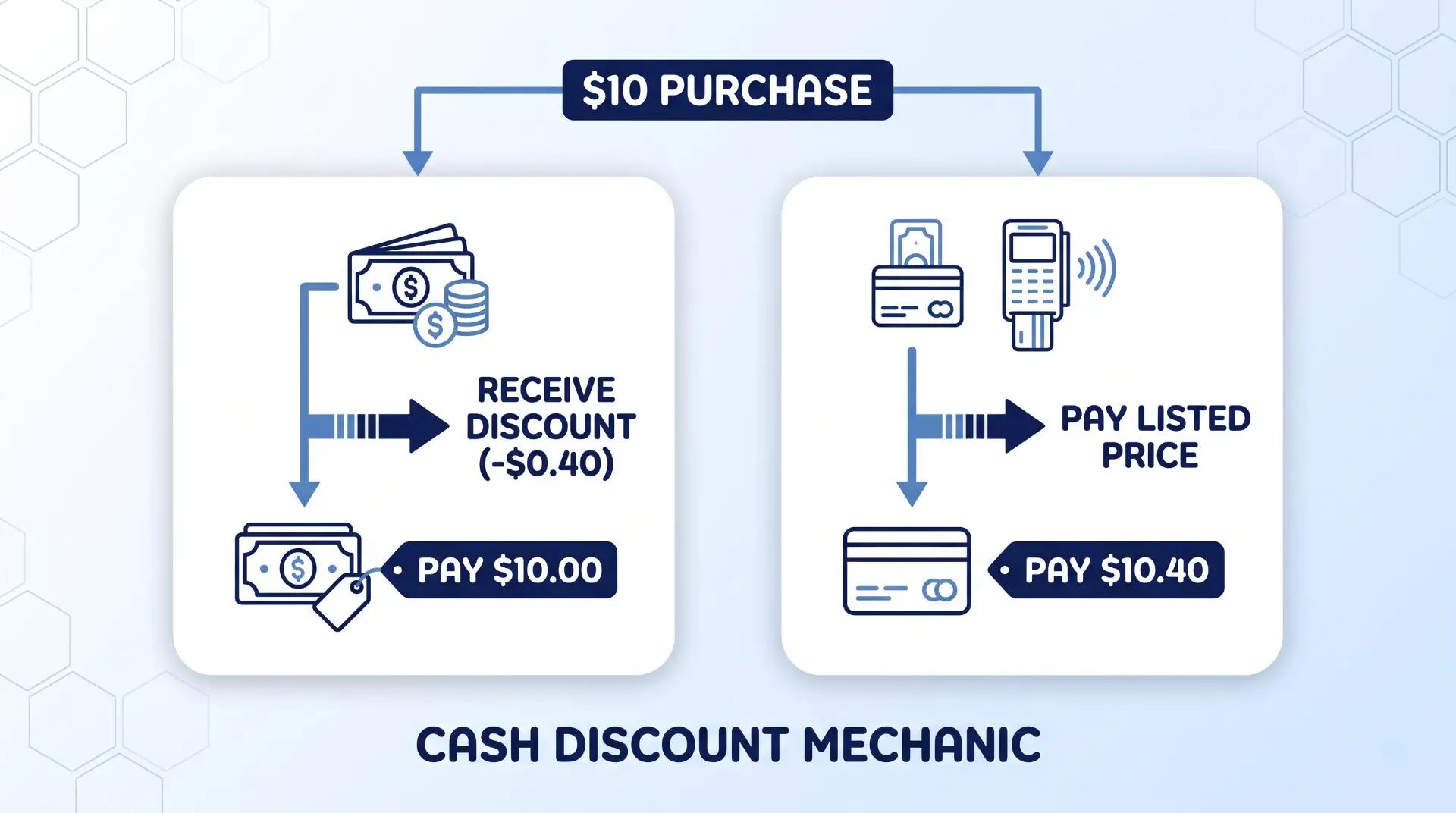
A cash discount program is a pricing mechanism that offers a lower price to customers paying with cash, checks, or store-branded gift cards instead of electronic payment cards. The core mechanical difference between cash discounting and other pricing adjustments lies in how base prices are displayed to the public:
- Base Listed Price: All shelf tags, menu boards, service quotes, and online price lists display the regular card price (for example, $10.40).
- Cash Transaction: At the register, the POS system automatically applies a cash discount (for example, $0.40), bringing the final price paid down to $10.00.
- Card Transaction: The customer pays the full listed base price of $10.40, which covers the underlying credit card processing fee.
Federal law under the Truth in Lending Act (15 U.S.C. § 1666f) explicitly protects the right of merchants to offer cash discounts to induce non-card payments, provided the discount is made available to all customers and disclosed clearly prior to purchase.
Cash Discount vs. Surcharge vs. Dual Pricing
Choosing the wrong fee-recovery model or mislabeling checkout fees can lead to severe processor fines and merchant account cancellation. Business owners must distinguish between three distinct pricing models:
| Feature | Cash Discount Program | Credit Card Surcharge | Dual Pricing Model |
|---|---|---|---|
| Listed Price Format | Card Price (highest price displayed) | Cash/Base Price (surcharge added at POS) | Both Cash and Card prices displayed side-by-side |
| Legality Across US | Legal in all 50 states | Prohibited or restricted in several states | Legal in all 50 states |
| Debit Card Eligibility | Allowed (applied as cash discount reduction) | Strictly Prohibited by federal law | Allowed (debit pays card or cash price based on method) |
| Network Registration | No advance registration required | Requires 30-day notice to Visa & Mastercard | No advance registration required |
| Max Adjustment Cap | No percentage cap (must reflect baseline) | Capped at 3% max (Visa limit) | No percentage cap |
Under the Durbin Amendment under Regulation II, merchants are strictly barred from imposing surcharges on debit card transactions, even when the customer selects “credit” at the terminal. Applying a surcharge to a debit card is one of the most common compliance violations recorded by card brand auditors.
Furthermore, Visa’s merchant compliance standards state that if a merchant advertises a lower base price on shelf tags and then adds a fee line item at the terminal for card users—regardless of whether the business labels it a “service fee,” “technology fee,” or “non-cash adjustment”—it is legally classified as a surcharge. Misrepresenting a surcharge as a cash discount risks immediate fines starting at $1,000 per occurrence from card brand compliance teams.
How to Set Up a Compliant Cash Discount Program
Implementing a fully compliant cash discount program requires updating your hardware, software, signage, and customer service workflows in lockstep.
Step 1: Audit Processing Rates and POS Hardware
Before launching any new pricing model, consult with your current payment processor to confirm whether their software supports automated dual pricing and line-item cash discount receipts. Review your average monthly processing statement to determine your effective rate. Select a discount percentage (typically between 3% and 4%) that accurately covers your total processing overhead without overcharging customers.
Step 2: Configure Terminal Software and Receipt Itemization
Your POS terminal must be programmed to handle the discount calculations automatically. Ensure your software meets the following conditions:
- Calculates the discount before tax to avoid improper tax collection.
- Displays the original card price, the discount amount, and the final cash total on the terminal screen.
- Prints receipts clearly itemizing the regular card price alongside the cash discount deduction line.
Step 3: Install Required Point-of-Sale Disclosures
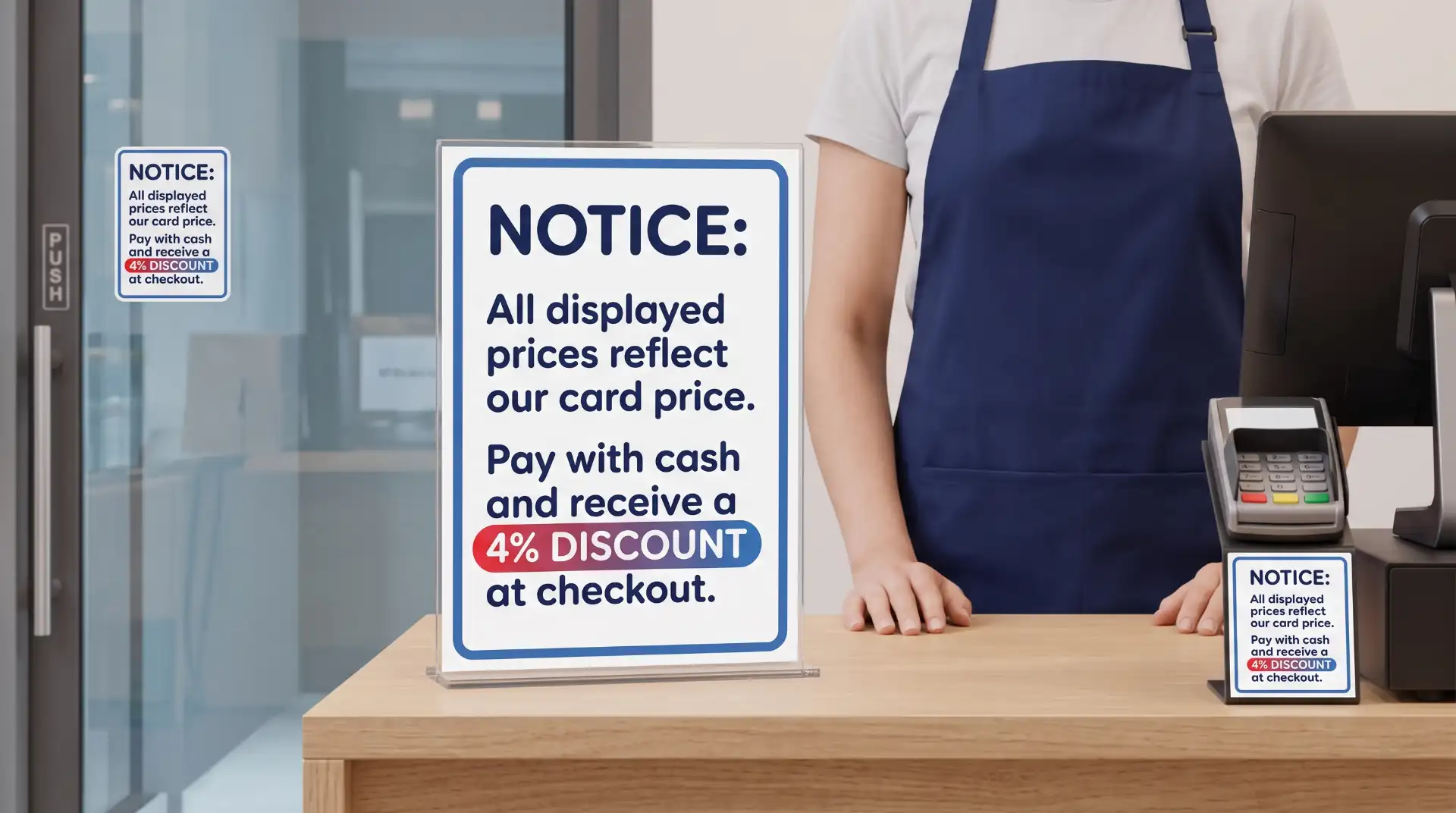
Transparency is essential for legal compliance and customer retention. According to credit card surcharge regulations and cash discount framework rules, disclosures must be posted prominently where customers make purchase decisions:
- At all public business entrances.
- At each checkout terminal, register, or counter.
- On printed menus, digital price displays, and online order portals.
Signage should use positive language, such as: “All advertised prices reflect our standard card pricing. As a courtesy to our cash-paying customers, we offer a 4% discount at checkout when paying with cash or check.”
Step 4: Train Staff on Customer Communication
Frontline staff should be prepared to explain the cash discount model clearly and politely. Frame the program as a reward for cash buyers rather than a punishment for card users. Staff should emphasize that customers who pay with cash save money on every transaction, while cardholders pay the standard listed tag price.
Common Misconceptions and Compliance Risks
Many small businesses inadvertently commit card network violations by purchasing turnkey “cash discount” packages from unverified vendors. Avoid these critical traps:
- The “Non-Cash Adjustment” Trap: Automatically adding a 4% “service fee” at the register to a base cash price is a surcharge, not a cash discount. Calling it a “non-cash adjustment” on receipts does not bypass card brand rules.
- Failure to Update Shelf Tags: If your shelf price or menu lists $10.00, but the customer’s receipt shows a $10.40 charge when using a card, you have surcharged the customer. All listed prices must reflect the card price.
- Ignoring Card Brand Audits: Both Visa and Mastercard run active compliance auditing programs. Under Visa merchant violation remedies, businesses found operating non-compliant fee programs receive warning notices requiring remediation within 30 days, followed by mounting financial penalties if uncorrected.
- Overcharging Surcharges: For businesses choosing a surcharge model instead of a cash discount, Mastercard merchant surcharge rules explicitly cap credit card surcharges at the merchant’s actual cost of acceptance or 3% to 4%, whichever is lower.
Where Cash Discounting Has Limits
While cash discounting protects profit margins for many businesses, it is not universally optimal for every business model:
- High-Ticket B2B Transactions: B2B buyers relying on corporate procurement cards rarely carry large amounts of cash. A 3.5% price difference on a $20,000 order may create sales friction or lead clients to demand invoice net-terms instead. Exploring an interchange-plus pricing guide may yield lower fees without altering customer checkout workflows.
- E-Commerce and Card-Not-Present Environments: Implementing cash discounts online requires specialized payment gateways capable of supporting alternative payment methods like ACH bank transfers or digital wallets at checkout.
- Premium or Luxury Retail: Luxury brands often avoid cash discount signage at checkout, choosing instead to fold processing overhead into standard margin pricing to preserve high-end brand perception.
Key Takeaways
- Cash discount programs allow merchants to offer a discount off the standard card price to customers who pay with cash, recovering credit card processing costs legally.
- Cash discounting is legal in all 50 states and applies to both debit and credit card transactions when structured correctly.
- All shelf pricing, menus, and signage must display the card price as the standard price, with the cash discount subtracted at checkout.
- Adding a fee at checkout to a lower listed price is legally classified as a surcharge, triggering strict network limits and debit card prohibitions.
- Compliant point-of-sale hardware and staff training are essential to avoid card brand fines and maintain customer trust.
Frequently Asked Questions
Is a cash discount program legal in all 50 states?
Yes. Federal law under 15 U.S.C. § 1666f protects a merchant’s right to offer discounts to customers paying with cash or check across all 50 states. Unlike credit card surcharges, which face restrictions in several states, cash discounting is fully legal nationwide when advertised correctly.
Can I apply a cash discount to debit card transactions?
Yes. Because a cash discount reduces the price for cash buyers rather than imposing an added fee on card users, debit cardholders simply pay the listed card price. Surcharging debit cards is illegal under federal law, but cash discount pricing complies fully with debit regulations.
What is the maximum percentage I can offer as a cash discount?
Unlike credit card surcharges—which Visa caps at 3%—cash discount programs do not have a hard legal percentage cap. However, the discount percentage should reasonably reflect your actual business processing costs (typically between 3% and 4%) to avoid distorting base pricing.
What happens if Visa or Mastercard flags my business for non-compliance?
If a card network auditor flags your business for improper signage or charging unapproved fees, you will receive a formal notice from your acquirer. Merchants are given a remediation window (typically 30 days) to correct their POS setup and signage. Failure to remediate results in non-compliance fines starting at $1,000 and potential processing termination.
How do I explain a cash discount program to customers who complain?
Focus on positive savings rather than fees. Train your staff to explain that all listed prices are standard card prices, and paying with cash earns an instant discount at checkout. Reframe the conversation around rewarding cash buyers rather than charging card users.

💬 Comments