Effective health and nutrition social media marketing starts with useful, accurate content tied to a clear business goal. Choose post formats according to what you need to communicate, apply extra scrutiny to health claims and testimonials, and measure whether people take the actions that matter to your business.
Quick Take
- Start with the business or communication goal before deciding whether to publish a Reel, carousel, Story, static post, or longer explanation.
- Build content around repeatable themes such as education, recipes, professional expertise, community participation, and relevant offers rather than posting whatever is convenient that day.
- Review health claims, testimonials, permissions, and sponsorship disclosures before publishing. High engagement does not make an unsupported health claim acceptable.
Start With the Goal, Not the Content Format
It is easy to begin a social media plan by asking whether you should make more videos, post more Stories, or design more graphics. A better first question is what you want the activity to accomplish.
A nutrition clinic may want more qualified consultation inquiries. A healthy-food company may want people to understand a new product. A recipe creator may care more about returning viewers, saves, newsletter signups, or traffic to a recipe page. Those goals call for different content and different ways of measuring results.
A key performance indicator (KPI) is a measure tied to the result you are trying to achieve. Reach, views, likes, and follower growth can describe exposure, but they do not always show whether social media is contributing to a useful business outcome.
For example, a dietitian trying to attract consultations may care about profile visits, contact-form submissions, direct inquiries, or bookings. A post can receive fewer likes than another post and still be more valuable if it produces more of the intended action.
This goal-first approach also prevents a common mistake: treating follower count, free reach, or posting volume as the strategy itself. Understanding common social media marketing misconceptions helps put those visible numbers in business context.
Build a Small Set of Repeatable Content Pillars
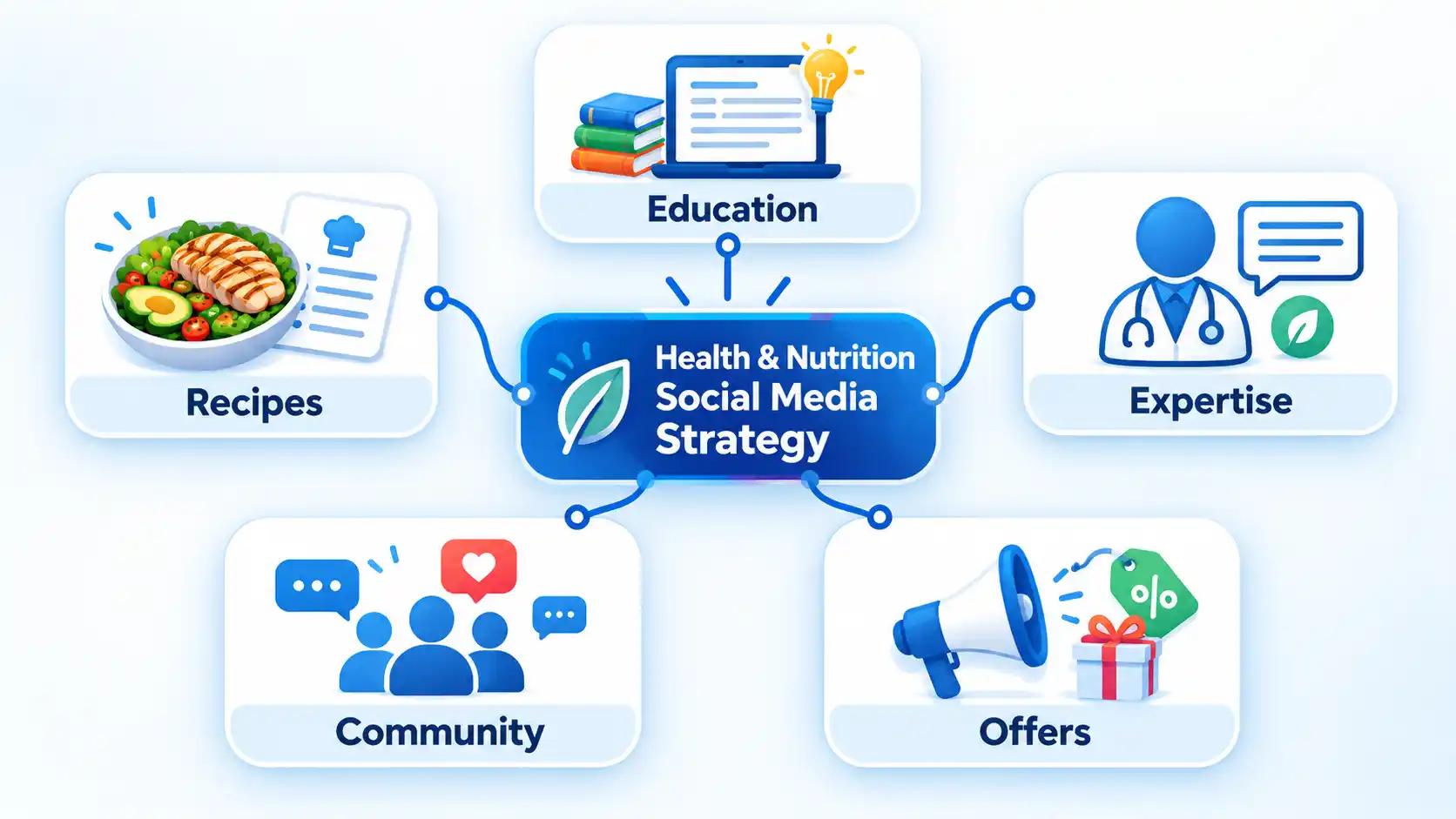
Once the goal is clear, create several content pillars, meaning recurring subjects that give your account a recognizable focus. Pillars are not the same thing as formats. Nutrition education can appear as a Reel, infographic, carousel, Story, or written post depending on what communicates the idea most clearly.
A practical health or nutrition account might use pillars such as:
- Education: explain food labels, nutrition terminology, cooking concepts, or recurring general questions.
- Recipes and demonstrations: show preparation methods, ingredient combinations, portioning examples, or kitchen techniques.
- Professional expertise: explain your process, introduce staff, show appropriate behind-the-scenes work, or discuss professional development.
- Community: answer questions, run polls, feature permitted audience contributions, or invite topic requests.
- Products and services: explain relevant offerings, availability, launches, appointments, or promotions without turning every post into an advertisement.
The right mix depends on the business. A healthy-cooking account can emphasize recipes and practical education. A supplement company needs more rigorous review of product-benefit claims because advertising claims about health-related products can require scientific substantiation.
Health and Nutrition Social Media Post Ideas
Useful post ideas come from the information your audience needs, not from filling a calendar with arbitrary formats. The following categories can be adapted across social platforms where they fit the audience, message, and current platform rules.
Educational explainers
Turn recurring questions into concise educational posts. You might explain how to read a nutrition label, define a commonly misunderstood term, compare two cooking methods, show where particular nutrients are commonly found, or clarify the difference between a general nutrition principle and an individualized recommendation.
Keep the explanation useful on its own rather than making a citation or external link carry the explanation. For health topics, distinguish general education from individualized diagnosis or treatment advice when that difference is material to the subject.
Recipes and food-preparation demonstrations
Recipes and demonstrations are good candidates for video when movement helps the reader understand the process. Chopping technique, ingredient order, texture changes, plating, and preparation steps are often easier to show than describe in a single image.
That does not mean video is automatically the highest-performing format for every account. Use it when motion improves the message. A static image may be enough for a finished dish, while a carousel may work better when readers need to scan ingredients and steps at their own pace.
Be careful with captions that transform a recipe into a medical promise. A statement such as “this meal cures inflammation” communicates a materially different type of claim from simply describing the ingredients or general nutrition characteristics of a meal.
Carousels and infographics
Carousels and infographics work well when information has several related parts that readers benefit from seeing in a controlled sequence. Examples include a food-label walkthrough, a meal-building framework, nutrient-source examples, common misconceptions, or a short process broken into visual stages.
Keep each panel focused. A carousel becomes difficult to use when every slide is effectively a page of small text.
If starting from a blank design slows production, a reusable layout system or a set of health and nutrition Instagram Canva templates can help keep recurring educational posts visually consistent while you retain responsibility for the accuracy of the information added to them.
Questions, polls, and Stories
Temporary and interactive formats can help you gather audience input without assuming that disappearing content automatically receives higher engagement. A Story might ask which topic followers want explained next, collect broad questions for a later educational post, remind people about an event, or run a simple preference poll.
The answers can also inform future content decisions. If several people ask the same general question, that gives you a clearer editorial signal than creating another post simply because a particular format is trending.
Behind-the-scenes and professional expertise
Behind-the-scenes content can make an account more informative when it reveals something relevant about how the work is done. A recipe developer might show testing and preparation. A clinic might introduce team members or explain a general workflow. A food company might show ingredient sourcing or production steps that it can document accurately.
Privacy still matters. Avoid exposing private client, patient, customer, or employee information merely to make a post appear more authentic. A deeper health and wellness social media compliance review can address privacy, advertising, endorsements, and claim-specific requirements that go beyond a general marketing strategy.
User-generated content and testimonials
User-generated content can include customer photos, comments, reviews, recipe recreations, or videos that mention a brand. Before republishing someone else’s material, make sure you have appropriate permission for the intended use.
Permission is only one issue when the material describes a health outcome. Under U.S. Federal Trade Commission guidance, advertisers should not use a testimonial to communicate a health-related claim that would be deceptive or unsupported if the advertiser made the claim directly. An honest customer experience is not, by itself, scientific substantiation for the underlying product claim. The FTC’s Health Products Compliance Guidance explains how these principles apply to express and implied health claims, including testimonials and social media marketing.
Material relationships also matter. If an influencer or other endorser received payment, free products, discounts, or another material benefit, the relationship may require clear disclosure when U.S. FTC rules apply. The FTC’s social media disclosure guidance says disclosures should be hard to miss and placed with the endorsement itself rather than hidden after a long caption or behind a “more” action.
Products, services, launches, and timely offers
Promotional posts have a legitimate role when the audience needs to know what is available. A clinic can explain how consultations work, a food brand can introduce a product, and a nutrition professional can announce a workshop or new service.
The promotional claim still needs to match what the product or service can support. A launch post should not become an excuse to add stronger health-benefit language than the available evidence justifies.
Match the Format to What the Post Needs to Communicate
No single social format is automatically the best choice for every message. Compare the communication task first, then select the format that makes that task easiest for the audience.
| Format | Communication task | Health or nutrition example | Useful measure |
|---|---|---|---|
| Short video or Reel | Show movement, preparation, demonstration, or a concise explanation | Demonstrating a meal-preparation technique | Qualified views, completion behavior, profile or website actions |
| Carousel | Break a multi-part concept into scannable stages | Walking through sections of a nutrition label | Saves, shares, profile actions, relevant clicks |
| Static post | Communicate one clear message or announcement | Announcing workshop registration | Reach and the intended follow-up action |
| Story | Share timely updates or invite lightweight interaction | Running a poll about the next recipe topic | Replies, poll responses, link or profile actions |
| Longer video or article-linked post | Explain a topic that needs more context | Breaking down a complex nutrition concept | Qualified viewing time, useful clicks, inquiries, or other next actions |
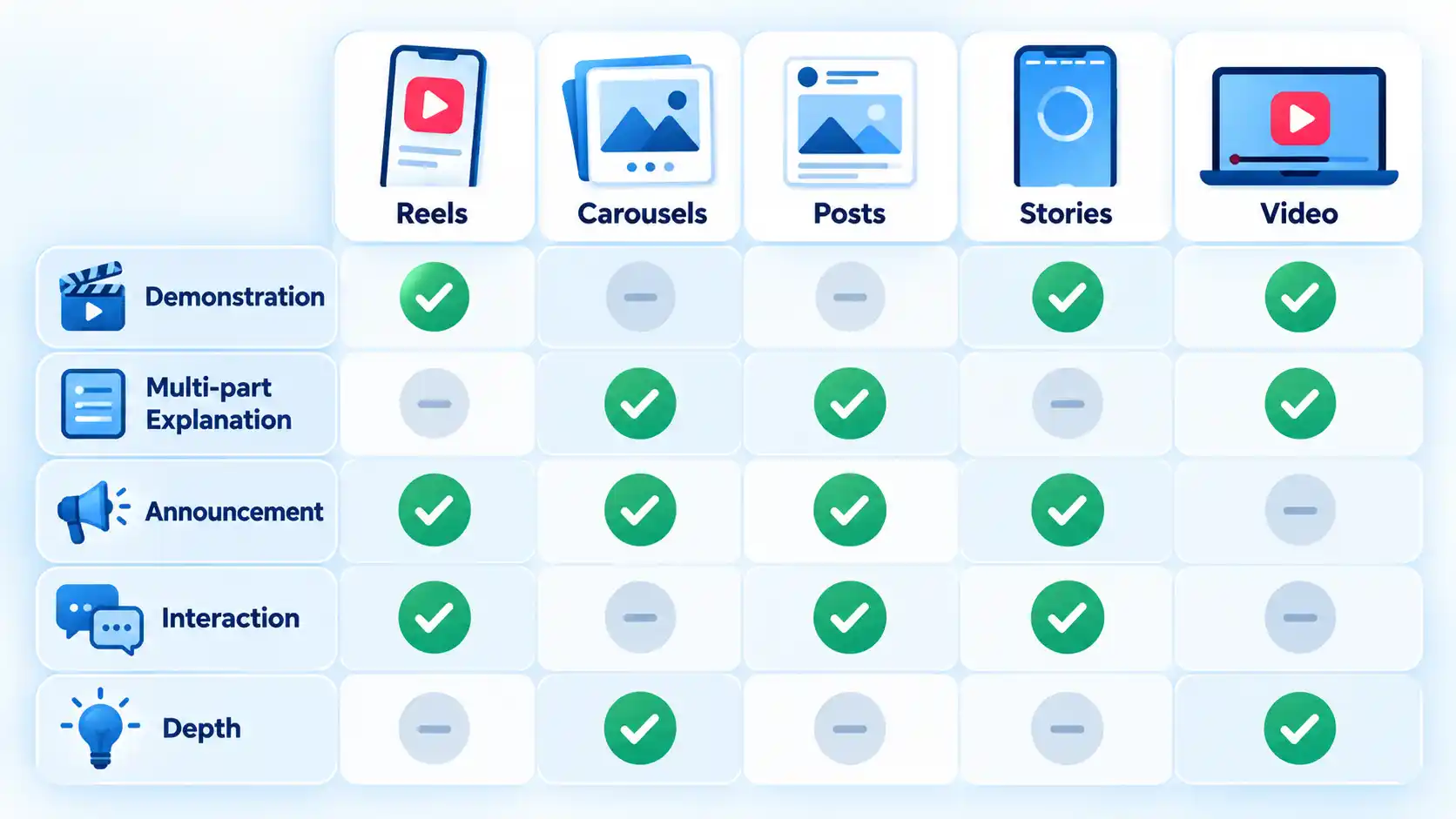
This is a communication guide, not a performance ranking. Even within one platform, distribution and audience response depend on more than format alone. Meta says Instagram’s Best Practices area in the Professional Dashboard covers creation, engagement, reach, monetization, and guidelines and can provide personalized account-performance tips.
Original work also matters to current Instagram recommendation systems. In January 2026, Meta reported that it had increased the prevalence of original content in U.S. Instagram recommendations by 10 percentage points during Q4 2025, with 75% of recommendations then coming from original posts. That is a U.S. platform-level snapshot from that period, not a guarantee that an individual original post will receive broad distribution.
If Instagram is a major channel, it is useful to choose each social format according to its job instead of assuming that Reels, carousels, or static posts always win. Platform choice can also change the workflow. An Instagram versus TikTok comparison for health and nutrition brands can clarify differences in formats, discovery, audience behavior, and operating demands.
Check Health Claims Before You Publish
Health and nutrition content deserves a stricter pre-publication review than an ordinary lifestyle post. The important question is not only whether a sentence sounds reasonable. You also need to consider what a reasonable reader could understand the complete post to be claiming.
In the United States, the FTC says advertising must be truthful and not misleading and that advertisers need adequate substantiation for objective product claims conveyed expressly or by implication. For health-benefit and safety claims, the agency generally expects competent and reliable scientific evidence. These principles also apply to social media and influencer marketing.
A customer testimonial does not turn an unsupported health claim into a supported one. If the testimonial implies that a product produces a particular health result, review the evidence behind that implied claim before republishing it.
Pay attention to both express claims, which state a benefit directly, and implied claims, which can communicate a message through wording, images, testimonials, comparisons, or context. A post does not have to state a treatment claim word for word to create a treatment-related impression.
Before using an influencer endorsement, also check whether the relationship between the brand and endorser is obvious to the audience. FTC guidance says material connections can include payment as well as free or discounted products and other things of value. Where disclosure is required, it should be clear and difficult to miss.
Before the post is approved, the review should leave you with observable evidence that the important claim, permission, and disclosure checks have been completed.
Verify the result
- The final post identifies no specific health or safety claim for which the business lacks support appropriate to the claim.
- Any customer or creator material being republished has the permission required for the intended use.
- Any required material-connection disclosure appears with the endorsement in wording and placement the audience can readily notice and understand.
- Headlines, captions, images, testimonials, and before-and-after material do not create a stronger health claim than the available evidence supports.
- The final post has been checked against the current rules of the platform where it will appear when those rules apply to health information, advertising, or branded content.
These are practical marketing checks, not individualized legal advice. Requirements can vary by jurisdiction, product category, claim, audience, and the facts of a particular campaign.
Use a Simple Publish-and-Improve Workflow
A repeatable workflow makes it easier to publish consistently without separating content creation from accuracy and measurement.
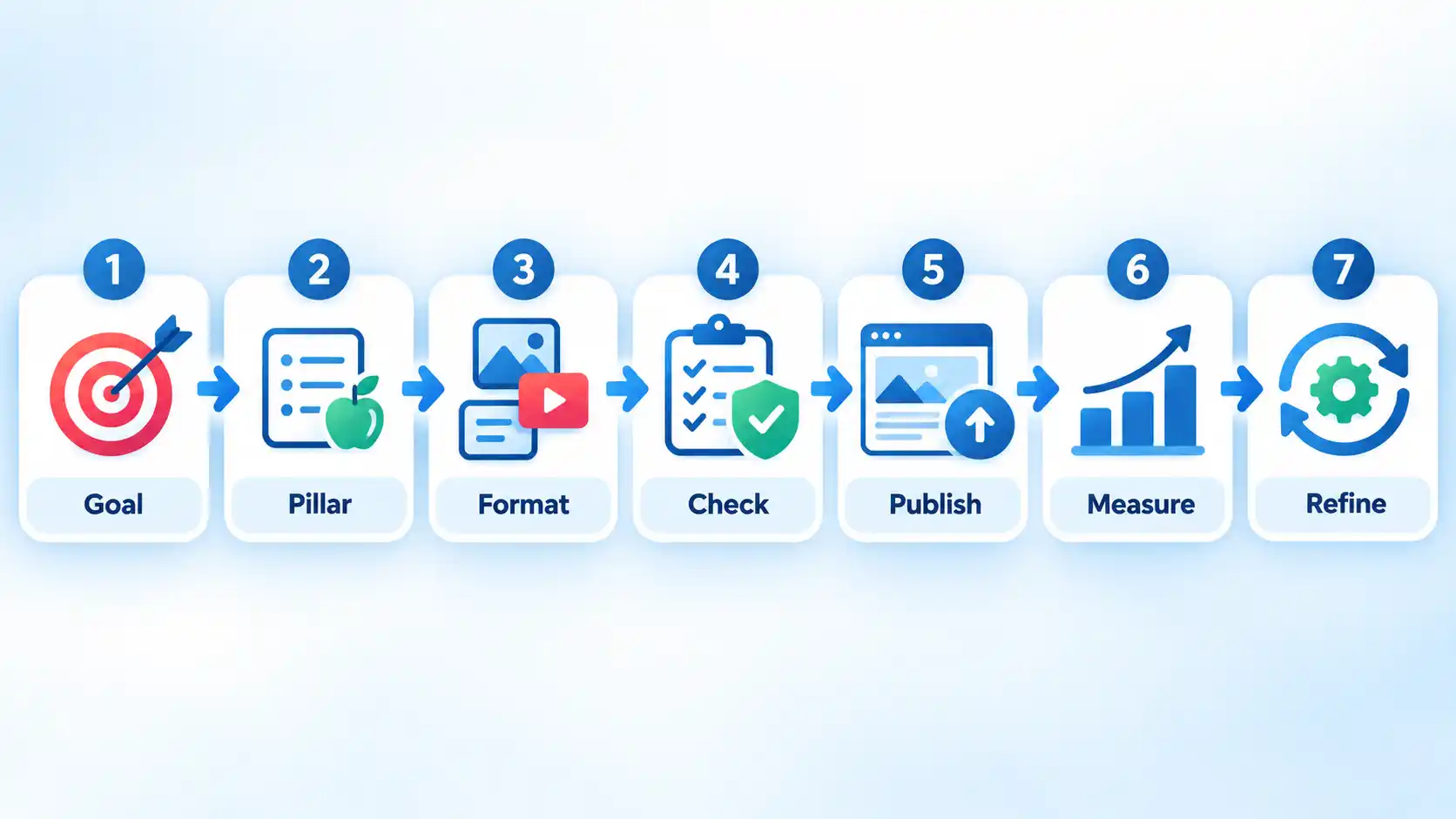
A content calendar can make this workflow easier when several pillars and platforms are involved. The key is to use the calendar as an operating tool rather than filling slots simply because another post is due. A nutrition social media content calendar works best when each planned post already has a purpose, pillar, format, review requirement, and metric attached to it.
What to Measure
Measurement should return to the original goal. Start with the metric that tells you whether the intended behavior happened, then use supporting metrics to understand the result.
- Reach and views show exposure, but not necessarily whether people found the content useful or took the intended next step.
- Saves, shares, comments, and replies show forms of interaction, although their meaning depends on the post and platform.
- Profile actions can show whether a post encouraged someone to investigate the business further.
- Website visits matter when the post is intended to move people to a relevant page.
- Inquiries and bookings matter when the account supports a service business.
- Sales or other conversions may matter when they can be measured reliably and attributed with reasonable confidence.
Do not interpret one metric in isolation. A recipe post may generate many saves but few immediate inquiries because saving the recipe was the audience’s natural action. A consultation explainer may receive less visible engagement yet generate qualified messages.
Hashtags deserve the same restraint. They can provide topic, search, campaign, or community context, but adding more tags does not automatically create more reach. A practical approach is to use hashtags for context and discovery rather than treating them as guaranteed reach boosters.
Platform-specific tools can also help. Instagram’s Professional Dashboard includes Best Practices guidance across creation, engagement, reach, monetization, and guidelines, including personalized tips based on account performance. Use those account-level signals alongside your own business metrics rather than relying entirely on generic posting formulas.
Final Takeaway
Health and nutrition social media works best when useful communication, evidence, and measurement operate together. Decide what each post needs to accomplish, choose a format that communicates that message clearly, apply extra scrutiny to health claims and testimonials, and measure the action that matters instead of chasing engagement for its own sake.

💬 Comments