A demat account is an electronic account used to hold securities such as shares instead of keeping physical certificates. If you buy and hold listed shares in India, a demat account is a core part of the ownership and settlement process, although not every type of investment has to be held in demat form.
Quick Take
- A demat account stores eligible securities electronically. It does not function as a bank account or hold your spending cash.
- You normally access depository services through a Depository Participant, or DP, such as an eligible broker, bank, or other registered intermediary.
- A trading account is used to place buy and sell orders, while a demat account records and holds the resulting securities.
- Transfers of securities of listed public companies generally require dematerialised holdings, subject to limited exceptions.
- A demat account can also support services such as pledging securities, transmission, electronic transfer instructions, and consolidated account statements.
- Not every investment requires demat ownership. Certain mutual fund units, for example, can be held in Statement of Account mode instead.
- Costs depend on the Depository Participant and account type. Special Basic Services Demat Account rules can reduce annual maintenance costs for eligible investors.
How a Demat Account Fits Into India’s Securities System
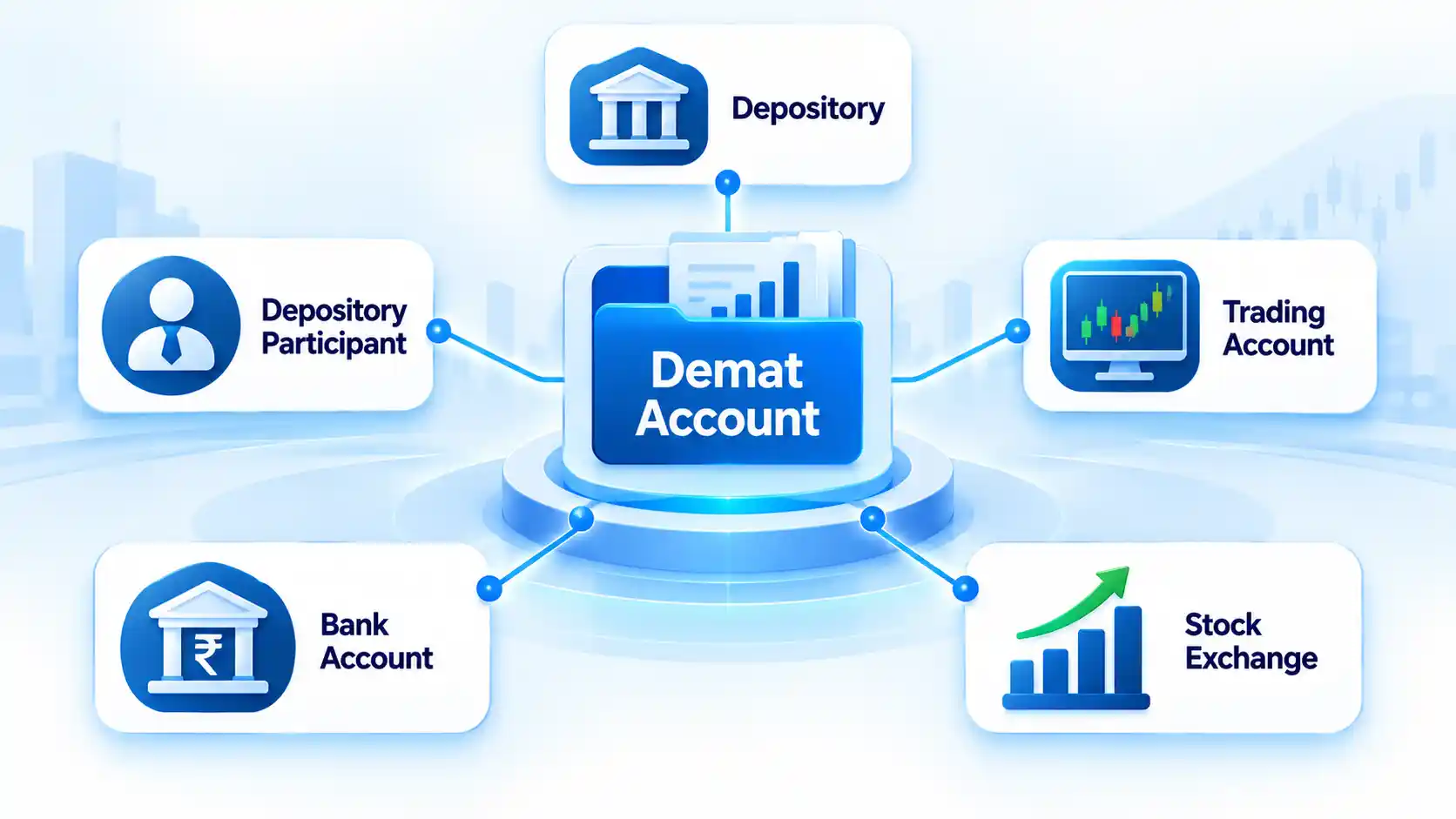
The simplest way to understand a demat account is to separate securities ownership from trading and cash movement. A demat account is the securities-holding layer of that system.
Depository vs Depository Participant
A depository is market infrastructure that keeps securities records electronically. A Depository Participant, usually shortened to DP, is an intermediary through which investors obtain depository services. The investor whose securities are recorded in the account is commonly described as the Beneficial Owner, or BO.
India’s depository system therefore does not work like opening an ordinary savings account directly with a bank. The investor-facing relationship normally runs through the DP, while the underlying electronic securities records sit within the depository framework. CDSL’s current Investor Charter describes depositories as organizations that hold investors’ securities electronically and provide services through market participants including DPs.
Demat vs Trading vs Bank Account
The three accounts perform different jobs even when a broker combines them inside a single app or login.
- Your bank account handles money. Funds used for an investment ultimately come from, or return to, a bank account.
- Your trading account handles orders. It is the broker-side account through which exchange buy and sell instructions are placed.
- Your demat account handles securities. Eligible securities credited after settlement are recorded there electronically.
The National Stock Exchange explains the trading account as the connection between the investor’s bank and demat arrangements in its account-opening guidance. If you want a deeper breakdown, see our guide to the difference between a demat and trading account.
What Can You Use a Demat Account For?
Electronic storage is only the starting point. A demat account supports several processes that previously depended heavily on paper certificates and manual records.
- Hold eligible securities electronically: Shares and other eligible securities can be recorded under the investor’s demat account instead of being represented only by physical certificates.
- Receive securities after settlement: When an eligible exchange purchase settles, the securities can be credited to the investor’s demat account.
- Transfer holdings: Securities can be moved between eligible demat accounts using the applicable depository and DP process.
- Dematerialise eligible certificates: Dematerialisation is the conversion of eligible physical securities into electronic holdings.
- Rematerialise holdings: Rematerialisation is the reverse process, where permitted, converting electronic holdings back into physical form.
- Create a pledge: Eligible securities can be marked as pledged or otherwise encumbered through the depository system rather than being manually handed over.
- Handle transmission: Transmission refers to moving securities following the death of an account holder according to the applicable nomination or succession process.
- Receive account information: Depository services include electronic statements and consolidated views of eligible holdings.
CDSL’s current charter lists services including dematerialisation, rematerialisation, pledge-related functions, settlement instructions, corporate-benefit distribution and consolidated account statements. That makes a demat account more than a static digital folder. It is part of the operational record used to manage securities ownership.
Disclosure: This article contains sponsored links. They do not influence the regulatory sources or editorial conclusions.
Readers comparing explanations from account providers may also encounter a sponsored demat account overview. Provider material can illustrate how an account is presented commercially, but regulatory rules and investor rights should still be verified against SEBI or the relevant depository.
One useful distinction is that demat status does not guarantee liquidity. A security may exist electronically yet still have limited demand, trading restrictions, or no active exchange market. Storage format and the ability to sell an investment quickly are separate issues.
The Main Benefits of a Demat Account
The biggest practical benefit is not that investing becomes safer from market losses. It is that securities ownership and transfer move from paper-heavy record keeping into regulated electronic infrastructure.
- Less dependence on physical certificates: Investors do not have to maintain paper certificates for dematerialised holdings.
- Electronic ownership records: Credits, debits and balances can be monitored through statements and depository services.
- More efficient transfer processing: Electronic transfer instructions reduce the physical handling involved in moving eligible securities.
- Consolidated monitoring: Statements can provide a clearer view of holdings and transactions.
- Electronic pledge mechanisms: Eligible holdings can be pledged through the depository framework.
- Corporate-action processing: Applicable benefits such as bonus securities or rights-related credits can flow through electronic records.
- Transaction alerts: Depositories and intermediaries can send electronic alerts that help investors identify unexpected activity.
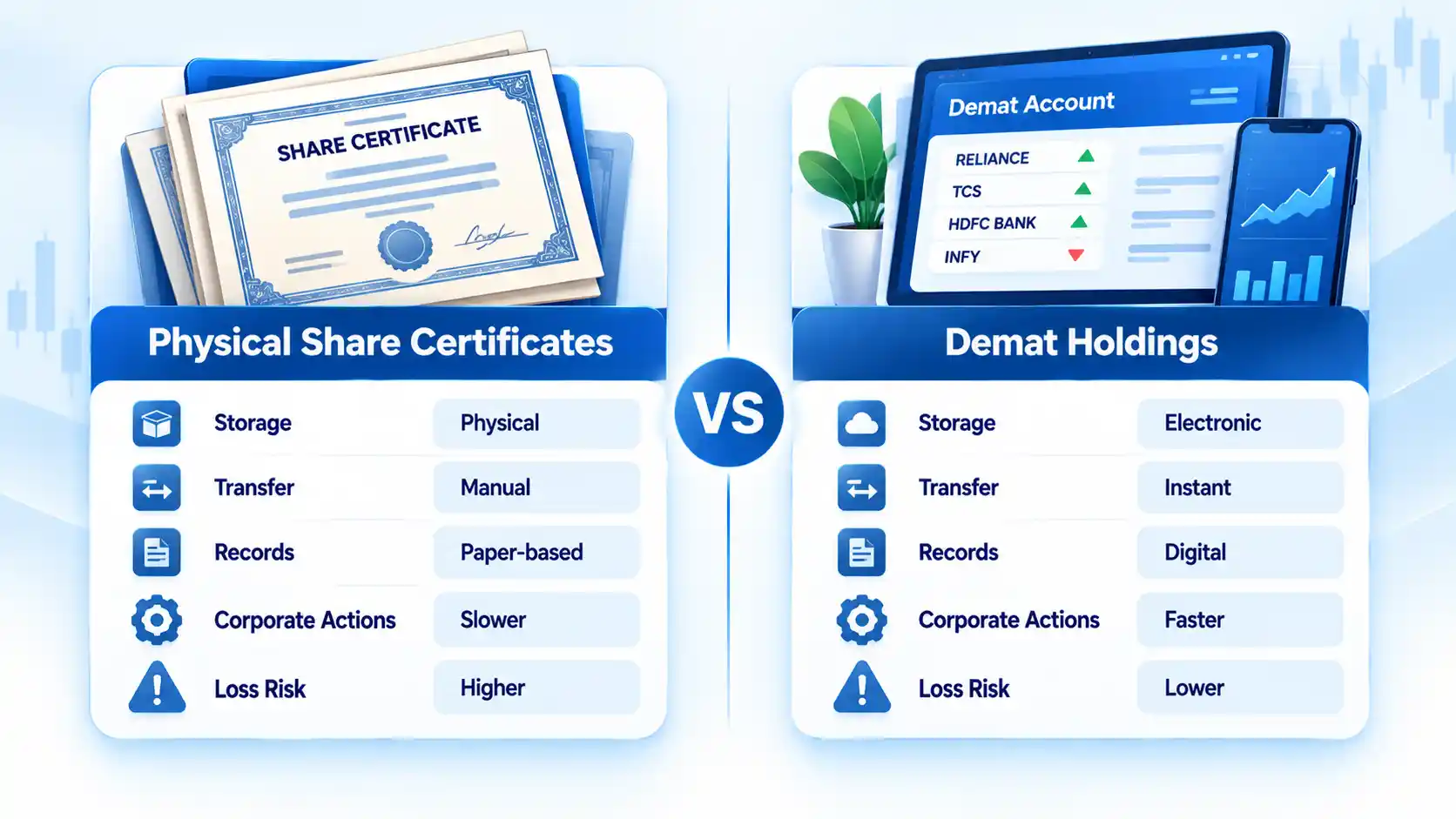
These benefits should not be confused with investment protection. A demat account does not prevent a share price from falling, make an unsuitable investment appropriate, or stop phishing if an investor hands credentials to a fraudster.
Do You Actually Need a Demat Account in 2026?
For an investor buying and holding listed shares through India’s securities-market infrastructure, the practical answer is generally yes. SEBI’s investor guidance states that demat is mandatory for transfers of securities of listed public limited companies, subject to limited exceptions. The same SEBI Investor Charter also explains the depository’s role in holding and transferring securities in dematerialised form.
When the Answer Is Effectively Yes
Consider an investor who buys 20 listed shares through a stockbroker. The trading account is used to execute the order, but the resulting securities need an electronic ownership record after settlement. The demat account provides that holding layer.
The same principle matters when eligible securities need to be transferred, pledged, transmitted, or otherwise handled through the depository system.
When the Answer May Be No
The phrase “you need a demat account to invest” is too broad. Some investments can be owned outside demat mode.
Mutual funds provide a useful example. Current SEBI-filed scheme documentation recognizes both demat holdings and Statement of Account, or SOA, holdings. A Statement of Account records mutual fund units through the fund or its registrar rather than through the investor’s demat account. SEBI-filed documentation explicitly notes that unit holders can have the option to hold units in either demat or account-statement form.
So an investor who owns only qualifying mutual fund units in SOA mode may not need to open a demat account solely for those holdings. An investor buying listed shares faces a different operational requirement.
There is another limitation worth noting: possession of a demat account does not automatically authorize every type of trading. Broker permissions, product eligibility, account status and market-segment activation remain separate from securities custody.
Demat Account Costs and BSDA Rules in 2026
There is no single universal price for maintaining and using a demat account because Depository Participants can have different tariff structures. Investors should therefore distinguish regulator-defined limits from provider-specific charges.
CDSL’s current Investor Charter states that no charges are payable for opening a demat account. Depending on the account and DP, costs may instead arise from annual maintenance and specific services or transactions.
A broker or DP may combine account access, market tools and service information in one interface; the sponsored 5paisa platform is one commercial example, but its own tariff and product information should be checked separately from SEBI’s general demat rules.
Basic Services Demat Account
A Basic Services Demat Account, or BSDA, is a limited-service category intended for eligible individual investors. The current CDSL BSDA schedule states:
- Up to Rs. 4 lakh in eligible securities holdings: no annual maintenance charge.
- More than Rs. 4 lakh and up to Rs. 10 lakh: annual maintenance charge capped at Rs. 100.
- Above the applicable BSDA threshold: the account is not treated as a BSDA under that charging structure.
Those figures should not be read as a universal tariff for every demat account. Other service charges can still apply, and a regular demat account can follow the DP’s normal tariff.
For a detailed fee breakdown, including the difference between annual maintenance and transaction charges, see the planned guide at demat account charges and BSDA rules.
What Changed for Demat Accounts in 2026?
Two rule changes are particularly relevant to an article dated September 2026: revised BSDA administration and a new nomination framework.
BSDA Eligibility Is Reassessed More Regularly
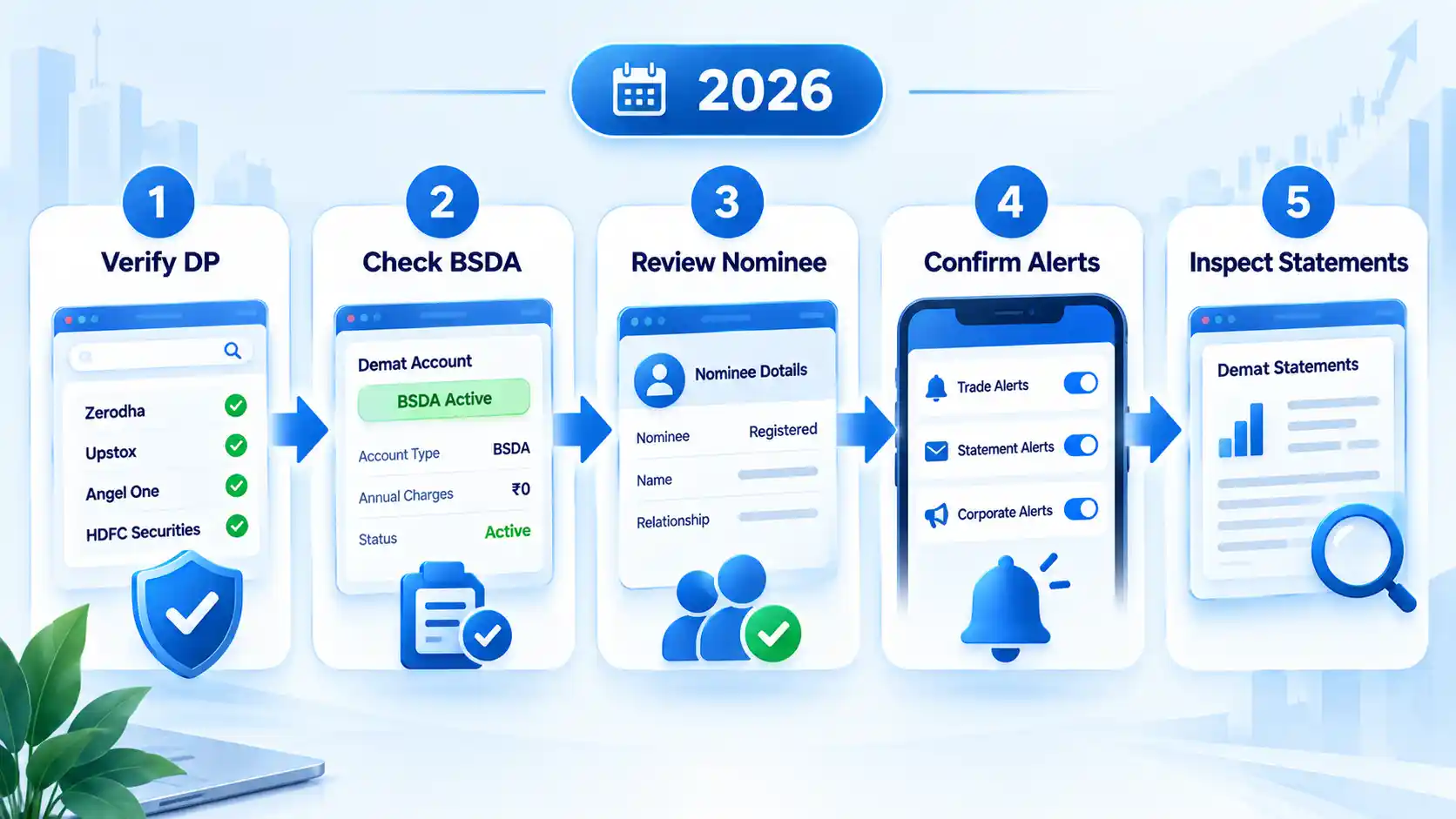
SEBI’s December 24, 2025 BSDA circular introduced changes effective from March 31, 2026. Among them, eligibility is reassessed quarterly, and specified securities such as delisted securities and Zero Coupon Zero Principal bonds are excluded when determining the BSDA threshold.
The practical effect is that BSDA status is not something an investor should assume remains unchanged indefinitely merely because an account qualified previously.
Nomination Rules Changed on September 1, 2026
SEBI’s revised nomination framework became effective on September 1, 2026. For a new single-holder demat account opened under the framework, the investor must provide a nomination unless the prescribed opt-out declaration is submitted. Nomination remains optional for jointly held demat accounts.
The revised rules also allow investors to provide up to three nominees. This is important because earlier nomination material may describe a different nominee limit. The current position should therefore be checked against SEBI’s May 2026 nomination circular.
Demat Account Risks and Practical Safeguards
Electronic custody removes many problems associated with paper certificates, but it does not remove the need for account security and transaction monitoring.
- Use a registered intermediary: Confirm that the DP and broker are appropriately registered before opening or operating an account.
- Review transaction statements: Compare debits and credits with transactions you actually authorized.
- Do not share one-time passwords: OTPs, passwords, PINs and depository login credentials should not be handed to another person.
- Protect transfer instructions: Do not sign blank Delivery Instruction Slips, commonly called DIS slips.
- Keep contact information current: Correct mobile and email details help ensure that transaction alerts reach you.
- Investigate unexpected activity: An unfamiliar securities debit should be checked with the DP or depository promptly rather than ignored.
These precautions are reinforced in SEBI and CDSL investor guidance. For example, CDSL tells investors to verify account statements, protect OTPs and depository credentials, and avoid issuing blank or partially filled DIS slips.
Security risk and investment risk remain different. Strong account controls may reduce the chance of unauthorized activity, but they cannot prevent losses caused by market movements or a poor investment decision.
Demat Account vs Trading Account: Quick Comparison
The table below separates the three account types by function. This is useful because a brokerage app may present them as one integrated experience even though they perform different jobs underneath.
| Feature | Demat account | Trading account | Bank account |
|---|---|---|---|
| Primary purpose | Hold and transfer eligible securities | Place and record securities trades | Hold and transfer money |
| Holds securities | Yes | No, not as the depository ownership account | No |
| Holds bank deposits | No | No | Yes |
| Main intermediary | Depository Participant within the depository framework | SEBI-registered stockbroker | Bank |
| Used when buying listed shares | Receives or records settled securities | Used to place the order | Provides or receives funds |
For most retail investors buying listed shares, the three functions work together. The main mistake is assuming that the trading account itself is where legal securities holdings are maintained.
Key Takeaways
- A demat account is electronic securities infrastructure, not an investment product.
- It holds eligible securities while a trading account handles market orders and a bank account handles money.
- Demat is generally necessary for the transfer and electronic holding of listed shares, but it is not mandatory for every investment product.
- Mutual fund units may, depending on the arrangement, be held in Statement of Account mode instead of demat form.
- Costs depend on the DP, while eligible BSDA accounts receive regulated annual-maintenance concessions.
- In 2026, investors should pay particular attention to revised BSDA administration and the nomination framework effective September 1.
- A demat account simplifies securities record keeping but does not eliminate market risk or account-security responsibilities.
FAQ
Can I have two demat accounts with the same PAN?
Investors can maintain more than one demat account in the same name with the same DP or different DPs, subject to Know Your Client requirements and the applicable account rules. BSDA eligibility is a separate issue and should not be inferred simply from the fact that multiple regular demat accounts are technically possible.
What happens to my demat holdings if my broker shuts down?
A broker and a depository are different parts of the market structure, so securities recorded in a demat account should not be described simply as the broker’s own assets. However, the exact recovery or transfer process depends on the circumstances, intermediary status and records involved. Investors should verify holdings through depository statements and follow instructions issued by the exchange, depository or regulator rather than relying only on the broker’s app.
Do NRIs use the same type of demat account as resident investors?
Not always. Non-Resident Indian account structures can involve additional residency, banking, repatriation and regulatory considerations. Those details are outside the scope of this general explainer and are covered by the planned guide to NRI demat account types.




💬 Comments