Yes, compressing an MP4 can reduce video quality, but a smaller file does not automatically mean the difference will be visible. MP4 is the container; the codec, bitrate or quality setting, resolution, frame rate, source material, and whether the video is re-encoded determine what changes.
The important distinction is between preserving the encoded media stream and creating a new lossy encode that merely looks the same during normal viewing. Those are not technically the same result.
Yes, MP4 Compression Can Reduce Quality, but MP4 Is Not the Reason
An MP4 file is a media container. The container defines how encoded video, audio, subtitles, metadata, and other supported streams are stored together. A codec is the method used to encode and decode an individual media stream inside that container.
This distinction matters because two files can both end in .mp4 while containing video encoded in different ways. MDN’s media-container documentation explains that container formats and the codecs used inside them are separate parts of a media file.
MP4 therefore should not be treated as a single compression method. Depending on the implementation and playback environment, an MP4 container can hold video encoded with codecs such as H.264/AVC, H.265/HEVC, or AV1. MDN’s video codec guide documents those codec and container relationships.
This is why comparisons such as “MP4 is less lossy than JPG” are misleading. JPG describes an image format and compression system, while MP4 describes a container that can package media encoded in different ways.
It also matters whether the video stream is actually being encoded again. Some operations can copy already encoded packets into a different output container without decoding and re-encoding them. FFmpeg calls this streamcopy. Its streamcopy and transcoding documentation states that streamcopy does not decode or encode the stream and therefore does not introduce quality loss, while transcoding normally involves decoding and encoding again.
What “Losing Quality” Actually Means
When someone says a compressed video has “no quality loss,” they may mean one of two different things:
- The encoded media was preserved: the video stream was copied without another lossy encode, or a genuinely lossless encoding method was used.
- The difference is not noticeable: the video was re-encoded with a lossy method, but the change is difficult to see under the intended viewing conditions.
The second situation is common when making delivery copies for websites, messaging, social platforms, or storage.
Lossy compression allows the decoded result to differ from the source so that the encoder can represent the video with less data. As compression becomes more aggressive, the risk of visible artifacts and lost detail increases. MDN describes video encoding as a trade-off between output size and how closely the encoded result represents the source. Its video codec guidance also distinguishes lossy compression from lossless compression.
A lossy output can therefore look effectively identical during ordinary playback while still being technically different from its source.
Viewing conditions influence what you notice. Small imperfections may be difficult to see on a phone but more obvious on a large display or at a closer viewing distance. HandBrake’s quality documentation likewise notes that imperfections tend to become more noticeable as display size increases or viewing distance decreases.
The Settings That Actually Change MP4 Quality and File Size
When an MP4 is re-encoded, several controls can change the result. They do not affect quality and file size in the same way.
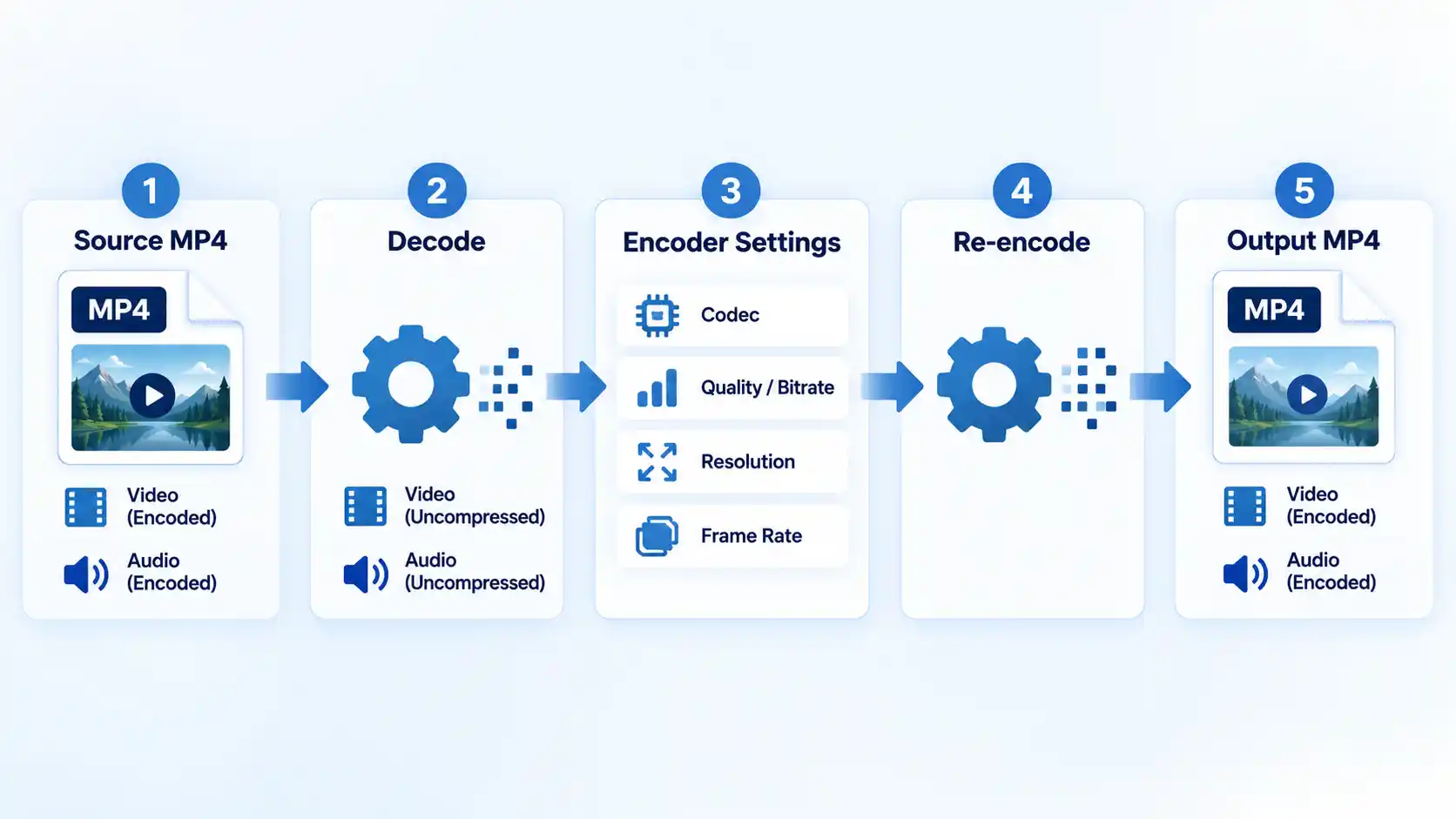
Bitrate and constant-quality controls
Bitrate is the amount of encoded data used over time, commonly expressed in kilobits or megabits per second. When an encoder is forced to represent a video with less data, producing a smaller file becomes easier, but more visual information may have to be approximated or discarded.
There is no universal percentage by which you can reduce bitrate and guarantee that quality will remain unchanged. The result depends on the codec, encoder, starting quality, resolution, frame rate, source complexity, and other encoding choices.
Many encoders also provide a constant-quality mode instead of requiring one fixed average bitrate. The encoder can then vary how much data different parts of the video receive while targeting a selected quality level.
For example, FFmpeg’s libx264 and libx265 interfaces provide crf, or Constant Rate Factor, as a quality control for constant-quality encoding. FFmpeg’s codec documentation defines CRF as an encoder quality control rather than an MP4-wide setting.
HandBrake uses constant-quality encoding in most of its official presets. Its current documentation says that higher quality generally increases output size, while lower quality typically reduces it. For x264 and x265, HandBrake recommends RF 20–24 for 1080p and RF 22–28 for 2160p as starting ranges. These are encoder-specific HandBrake recommendations, not universal MP4 targets. HandBrake also states that equivalent-looking RF numbers cannot be compared directly across different encoders.
A mostly static presentation and a fast sports recording illustrate why one setting cannot guarantee the same result for every source. Their motion and detail differ, so the encoder does not face the same compression problem in both videos.
Resolution
Resolution describes the pixel dimensions of each frame. Reducing a 3840×2160 video to 1920×1080 removes spatial detail from the output. It can substantially reduce the amount of picture information that must be represented, but it is not a lossless size reduction.
Whether that trade-off matters depends on the destination. A 4K master may be unnecessary for a small embedded player, while the same downscaling can be undesirable when the output will be viewed on a large display, cropped later, or used for further editing.
Fine interface text, code, spreadsheets, and thin lines are useful stress cases when evaluating a downscaled screen recording because reduced spatial detail can make them harder to read.
Frame rate
Frame rate is the number of video frames presented each second. Converting a 60 frames-per-second recording to 30 frames per second changes how motion is represented because the output presents fewer frames over the same period.
Changing frame rate should therefore solve an actual delivery or compatibility requirement rather than being treated as a harmless default method of reducing file size.
For example, YouTube’s current upload encoding guidance for Content Manager partners recommends encoding and uploading video at the same frame rate used during recording. That recommendation is specific to YouTube’s workflow, but it illustrates why changing frame rate is not automatically necessary when preparing a smaller file.
Codec and encoder efficiency
The codec and encoder also influence the size-and-quality trade-off. Different encoding systems can make different choices about prediction, motion, detail, rate control, and processing time even when the finished file uses the same MP4 container.
This is one reason H.264, H.265, and AV1 involve different compression, compatibility, and encoding trade-offs. The appropriate choice depends on the playback environment and intended use, not on compression efficiency alone.
Exact percentage claims such as “one codec is always 50% smaller” should not be treated as universal guarantees because results vary with the source, encoder, configuration, and quality target.
Re-Encoding vs Stream Copy: Why the Difference Matters
Many discussions about “compressing an MP4” combine two fundamentally different operations. Re-encoding creates a new encoded video stream, while stream copy preserves the existing encoded packets and changes only what can be handled without decoding and encoding the video again.
Re-Encoding Compared With Stream Copy
| Feature | Re-Encoding | Stream Copy |
|---|---|---|
| Video decoded and encoded again? | Yes | No |
| Can change codec? | Yes | No |
| Can change resolution or apply video filters? | Yes | No |
| Can introduce new lossy quality changes? | Yes, with lossy encoding | No quality loss from re-encoding because no re-encoding occurs |
| Can directly target a new video bitrate or quality level? | Yes | No |
| Typical reason to use it | Reduce size substantially, change codec, resize, filter, or meet a delivery requirement | Change container, preserve compatible streams, remove or rearrange streams, or alter container-level metadata |
Stream copy can avoid generational video loss, but it cannot perform the codec, resolution, filtering, or video-quality changes that normally produce the largest reductions in encoded video data. FFmpeg documents these operational differences directly in its streamcopy and transcoding reference.
Why the Same Compression Setting Does Not Work for Every Video
The difficulty of compressing a video depends partly on what appears in its frames.
A slide presentation with a mostly static background behaves differently from a handheld recording of waves, grass, crowds, smoke, confetti, or fast-moving sport. The source content and codec configuration both affect the resulting size and quality, as MDN’s codec guide explains.
Fine, irregular texture such as noise or grain can also require substantial data to preserve faithfully. If an encoder simplifies that texture aggressively, the result may appear smoother or less detailed.
Small text is another useful stress case. Strong compression or downscaling can soften sharp edges enough to make interface labels, subtitles, spreadsheets, or other fine text less readable.
The quality of the input matters too. A high-quality master gives the encoder a different starting point from a copy that has already been through lossy compression. Increasing the bitrate of a later encode does not restore source information that an earlier lossy encode already removed.
This is why one preset can be acceptable for one clip and visibly poor for another. Compression settings are better treated as starting points that must be evaluated against representative source material.
Does Compressing the Same MP4 More Than Once Make It Worse?
Repeated lossy re-encoding can cause additional degradation because every new encode starts from the decoded result of the previous version rather than from the untouched original source.
FFmpeg defines transcoding as decoding a stream and then encoding it again and notes that encoding usually degrades stream quality. Its documentation recommends avoiding unnecessary transcoding when stream copy can satisfy the task.
Consider this workflow:
camera master → compressed upload copy → downloaded copy → compressed again for another destination
The later encode starts with the compromises already present in the downloaded copy. It may still look acceptable, but it cannot automatically recover detail discarded by the earlier lossy encode.
For that reason, keep the highest-quality practical source and make new delivery versions from it whenever possible. This is especially useful when video quality gets worse after repeated exports and you need to distinguish generational loss from an unsuitable bitrate, resolution, frame-rate, or codec setting.
How to Make an MP4 Smaller Without Unnecessary Quality Loss
There is no single setting that guarantees the smallest possible file and unchanged visible quality for every source. A more reliable approach is to change only what the destination requires and judge the output against the source.
- Keep the original file. Do not overwrite your highest-quality source while experimenting with smaller versions.
- Identify the actual constraint. Determine whether you are solving a storage limit, upload limit, playback-compatibility problem, or bandwidth problem.
- Preserve useful resolution. Downscale only when the destination or viewing conditions justify giving up spatial detail.
- Keep the source frame rate unless there is a reason to change it. Frame-rate conversion changes motion representation and is not automatically required for a smaller file.
- Consider quality-based encoding when an exact final size is not mandatory. This allows the encoder to allocate data according to scene complexity while targeting a selected quality level.
- Start with modest adjustments. Large changes make it harder to identify which setting caused an unacceptable result.
- Test representative material. Include motion, texture, gradients, faces, and small text rather than evaluating only an easy or mostly static scene.
- Compare at the viewing size that matters. Judge a mobile delivery copy on a realistic display, and inspect large-screen material under the conditions in which it will actually be watched.
- Reduce quality further only if more size reduction is still necessary. Stop when the additional saving is no longer worth the visible compromise.
HandBrake provides one practical example of this approach. Its constant-quality documentation recommends testing short clips and making small quality adjustments. For x264 and x265, its suggested ranges include RF 20–24 for 1080p and RF 22–28 for 2160p. Those are HandBrake recommendations for those encoders, not universal MP4 settings.
If you prefer a tool-specific workflow, compressing an MP4 with HandBrake still requires choosing settings for the source and destination rather than applying one fixed percentage reduction.
How to Tell Whether You Compressed Too Far
A smaller output is useful only if it still preserves the detail and motion that matter for its intended use. Compare representative sections of the output with the source and look for problems such as:
- Blockiness: parts of the picture break into obvious rectangular regions.
- Soft or smeared detail: hair, foliage, fabric, skin texture, or other fine patterns lose definition.
- Ringing around sharp edges: text or high-contrast objects develop unwanted halos or noisy outlines.
- Banding: smooth gradients such as skies, shadows, or studio backgrounds become visibly stepped.
- Hard-to-read text: interface labels, subtitles, spreadsheets, or other small type become fuzzy.
- Lost shadow detail: dark areas collapse into flatter regions with less visible texture.
- Changed motion: movement appears less smooth after a frame-rate reduction.
Check difficult scenes at normal playback speed as well as individual frames when useful. A still frame can reveal lost texture or edge detail, while some motion-related problems are easier to notice during playback.
Evaluate the result in context. A difference visible only during extreme frame-by-frame inspection may not matter for a casual mobile clip, while much smaller defects can matter in an editing master, archival copy, or presentation containing fine text.
Bottom Line
Compressing an MP4 can reduce quality, but the MP4 container itself does not determine the loss. The meaningful variables are the video codec, encoder settings, bitrate or quality target, resolution, frame rate, source complexity, and whether the video is actually re-encoded.
A smaller lossy encode may still look indistinguishable from the source under its intended viewing conditions. That does not make it technically lossless. Keep the best practical source, change only settings that solve a real delivery requirement, and compare representative scenes before replacing or deleting the original.

💬 Comments