You can have a winning online casino session, including a large win, but there is no reliable betting system that guarantees long-term profit from games with a mathematical house advantage. Some decisions can reduce expected loss or financial exposure; others only change how quickly and unevenly wins and losses arrive.
Quick Take
Separate casino advice into three questions: does it change the underlying mathematical edge, does it only change how much money is exposed to that edge, or does it change neither? Game rules and return to player can affect expected loss. Stake size and session limits mainly affect exposure. Chasing losses and staking progressions do not make an unfavorable game mathematically favorable.
The Difference Between Winning a Session and Having an Edge
A winning session and a mathematical advantage are not the same thing. Casino games can produce large short-term swings, so a player can finish ahead even when the game has a mathematical advantage for the operator over repeated play.
The house edge is the operator’s mathematical advantage under a game’s stated rules. Expected value describes the average financial result expected when the same kind of wager is considered across many repetitions under unchanged conditions. A negative expected value does not mean every session loses. It means the long-run mathematical expectation is unfavorable to the player.
Variance, often discussed as volatility in casino games, describes how widely short-term results can move around that long-run expectation. Two players can therefore make mathematically identical wagers and finish short sessions with very different results.
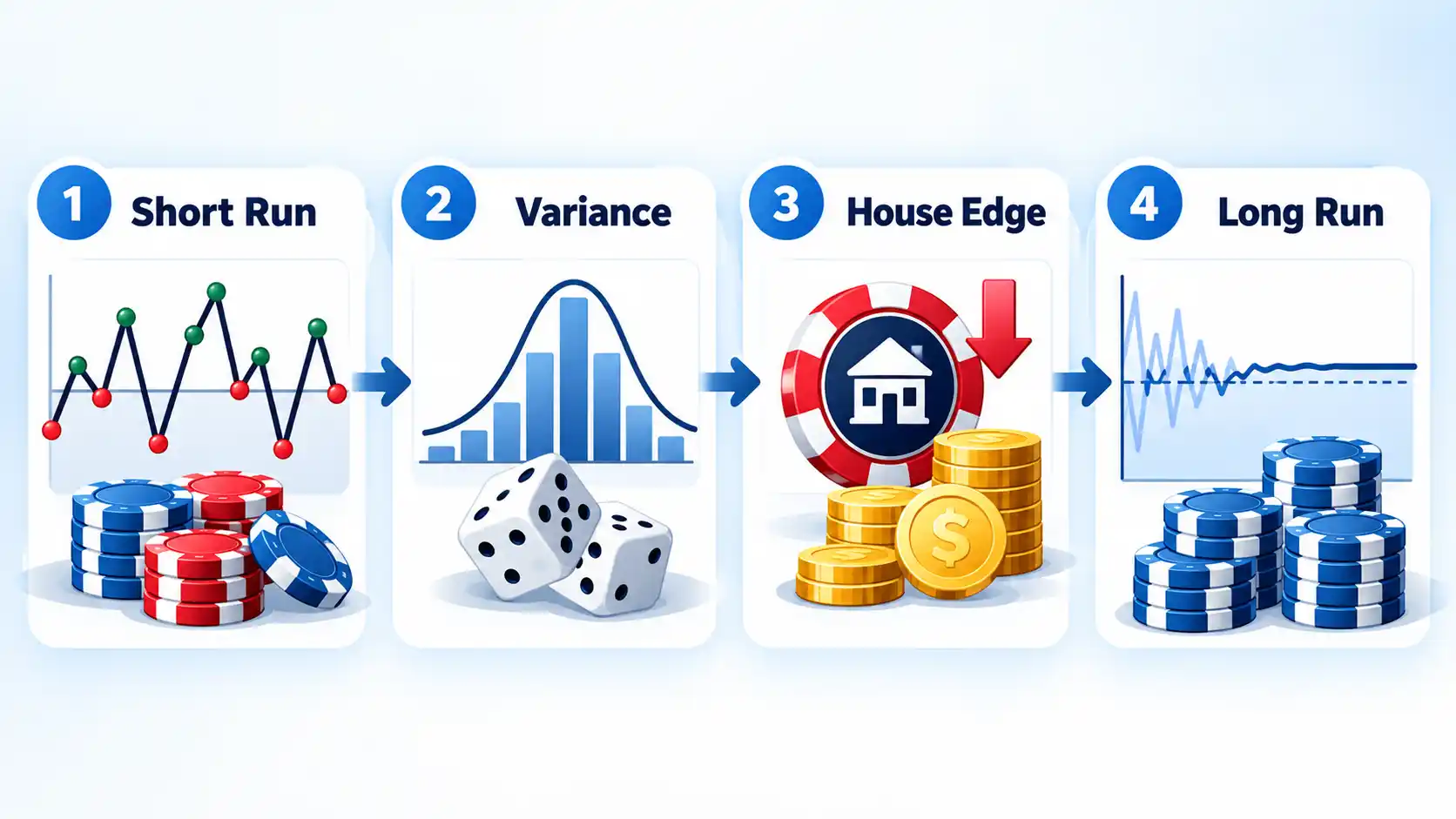
This is why a jackpot, winning streak, or profitable evening does not establish that a strategy has overcome the house edge. Short samples can differ sharply from long-run mathematical expectations.
RTP Does Not Predict What You Will Win Tonight
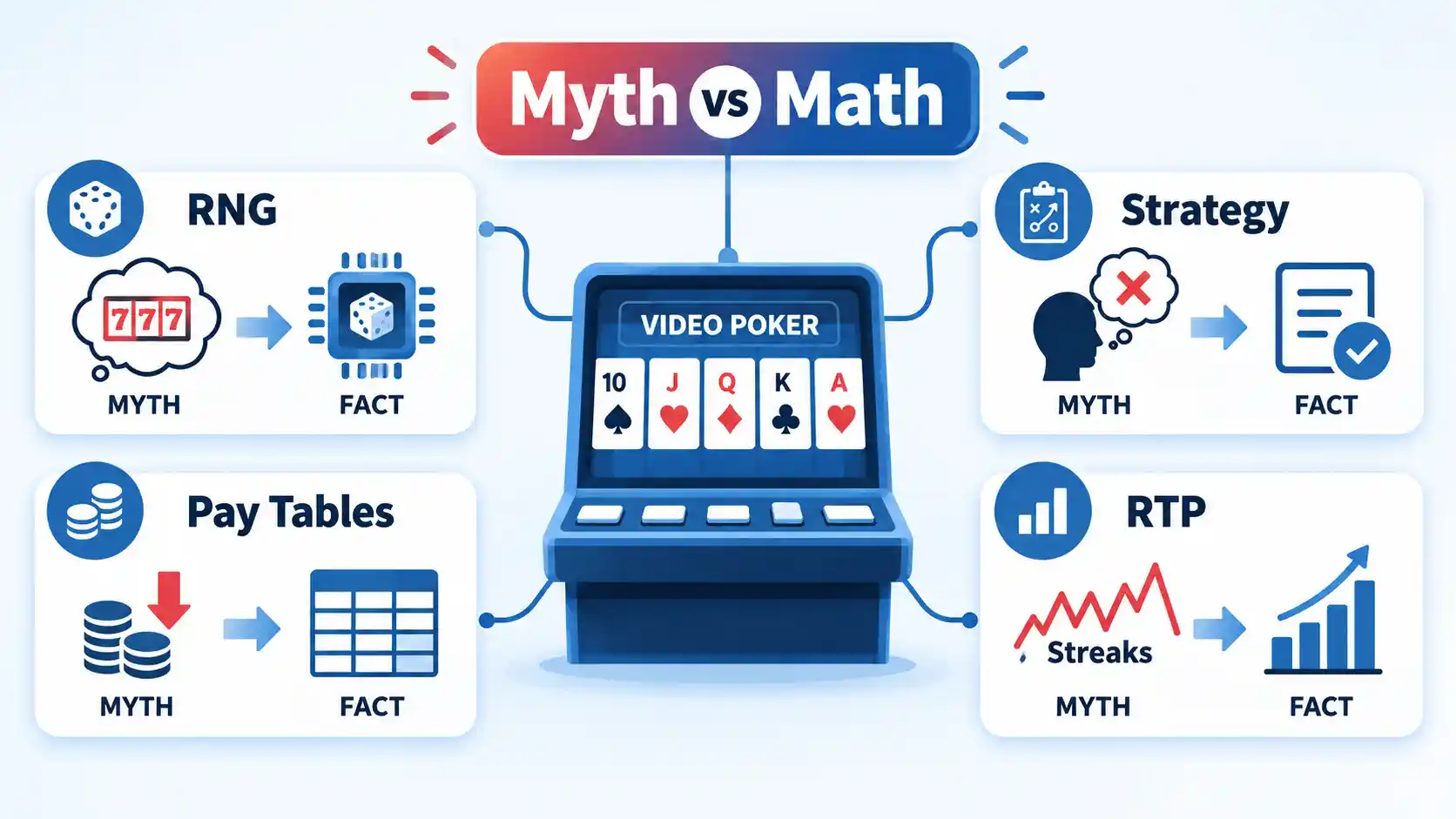
Return to player, usually abbreviated RTP, expresses the average theoretical proportion of wagers a game is designed to return under its defined rules and assumptions over large numbers of plays. It is not a prediction of one player’s result in one session.
The UK Gambling Commission explains that RTP is an average achieved over a significant number of plays and gives the example that an advertised percentage should not be interpreted as the amount returned from every pound wagered during an individual session. Its guidance also explains that, for random machines, the odds of the current game are not changed by wins or losses in previous games. See the Gambling Commission’s RTP explanation.
Warning
A 96% theoretical RTP does not mean that a £100 session should return £96. The percentage describes long-run game mathematics, not a guaranteed session payout.
When RTP and house edge are expressed on the same wager basis for a conventional house-banked game, a 96% theoretical RTP corresponds to a 4% theoretical house advantage. That still does not tell you whether one short session will finish ahead or behind.
The exact version of a game matters. For Great Britain-regulated remote gaming, Remote Gambling and Software Technical Standard 3 requires information that enables customers to understand the rules and, where relevant, their likelihood of winning. That information can include house edge, RTP, probability information, or an explanation of how winners and prizes are determined. See RTS 3 on rules, game descriptions and likelihood of winning.
What Can Actually Change the Mathematics?
Some decisions can change the expected cost of gambling, although they do not create guaranteed profit. The important question is whether a decision changes the rules, payout structure, probabilities, or a player decision that genuinely affects expected return.
Choosing between games or rule sets with different disclosed house edges or RTPs can change expected loss. If two otherwise comparable games have meaningfully different theoretical returns, the one with the smaller house advantage normally exposes each unit wagered to a smaller expected loss. Either game can still produce a winning or losing short session.
Rules can matter as much as the game name. Some table games allow player decisions that affect expected return, while other games largely ask the player to place a wager and accept a random outcome. A strategy can therefore matter when it changes a mathematically relevant decision, but not merely because it changes the order or size of bets.
A useful test is to identify the mechanism. If a choice changes applicable rules, probabilities, payouts, or a decision that mathematically affects them, it may change expected value. If it only changes how much or when you wager, it usually changes exposure or the distribution of short-term outcomes instead.
For a tactic-by-tactic treatment of these distinctions, compare online casino strategies, odds, risk, and reality. The useful question is not whether a tactic sounds disciplined, but what part of the mathematics it actually changes.
What Changes Risk but Not the House Edge?
Stake size is the clearest example. Betting less can reduce the money exposed on each wager, but simply lowering a stake does not normally improve the probability of winning that wager or change the game’s stated house edge.
Session length works similarly. When each wager has negative expected value, making fewer wagers generally reduces total exposure to that disadvantage. It does not transform the remaining wagers into positive-expectation bets.
This distinction also exposes the weakness in common loss-recovery systems. A progression that raises the stake after a loss changes the pattern and size of possible session results, but the larger next wager still faces the same underlying game probabilities unless the rules themselves change.
Progressive systems also encounter practical constraints. Stakes can rise quickly during a losing sequence, while bankrolls and operator or table limits are finite. A progression can therefore increase the size of a later loss without eliminating the original mathematical disadvantage.
Bonuses Can Change the Economics, but Terms Matter
A bonus is different from a staking progression because promotional value and restrictions can change the practical economics of an offer. The headline bonus amount alone is not enough to establish that value.
A wagering requirement requires a specified amount of wagering before defined promotional funds become withdrawable. The multiplier may be applied to bonus funds or another amount defined by the promotion, depending on the applicable terms. An example such as “3x means £600 of wagering” is therefore incomplete unless it first identifies the amount to which 3x applies.
UK Gambling Commission consumer guidance says businesses should distinguish a customer’s own money from restricted bonus funds and clearly explain restrictions on how bonus funds can be played, including restrictions such as maximum bet size. Its current rewards-and-bonuses code also requires incentive terms to be clear, transparent, fair, and readily accessible. See the Commission’s guidance on free offers and bonus restrictions and Social Responsibility Code 5.1.1 on rewards and bonuses.
Before deciding whether a promotion has practical value, compare the restrictions that determine how the offer works:
| Term | What to check | Why it matters |
|---|---|---|
| Wagering basis | Which funds or defined amount the wagering multiple applies to. | The same displayed multiplier can represent different amounts of required wagering depending on its base. |
| Game contribution | Whether eligible games contribute fully or only partly toward the wagering target. | Partial contribution can increase the amount of actual play needed to complete the requirement. |
| Maximum bet | Whether the promotion restricts the size of a wager made with bonus funds. | A disclosed maximum-bet rule limits how the restricted funds may be played. |
| Restricted balance | How the operator distinguishes deposited money, bonus funds, and winnings subject to restrictions. | A displayed account balance may include money that is not yet freely withdrawable. |
| Withdrawal conditions | Which conditions must be satisfied before restricted funds become withdrawable. | Promotional value depends on what can ultimately be withdrawn under the terms. |
For Gambling Commission licensees in Great Britain, Social Responsibility Code 5.1.1 now prohibits wagering requirements that require customers to play through bonus funds at more than 10 times. The provision came into force on January 19, 2026. This is a British licensing requirement and should not be assumed to apply in other jurisdictions.
Before You Deposit, Verify Legality and the Exact Operator
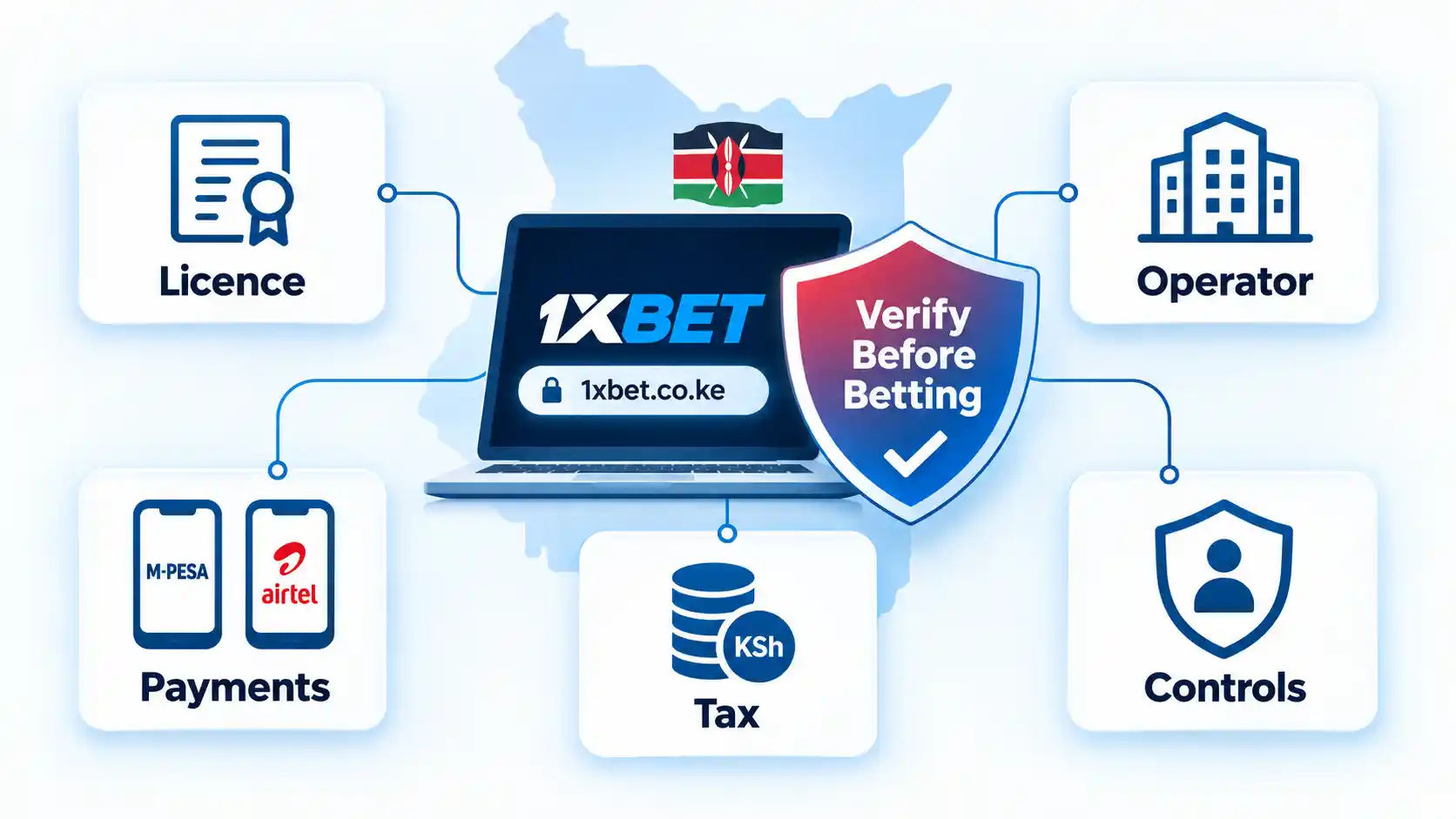
A licence badge on a casino website is not enough on its own. Verification should move from the rules that apply where you are located to the legal operator and then to the exact domain and permitted gambling activity.
- Check whether the service is lawful where you are. Gambling laws differ by jurisdiction and by product. For example, Australia’s communications regulator states that providers must not offer online casino services to people in Australia.
- Identify the legal operator. Find the company named in the site’s terms, footer, account information, or regulatory disclosures. Do not treat a brand name or copied licence badge as independent proof.
- Match the exact domain to the official record. Search the applicable regulator’s register using the legal company, trading name, domain, or licence identifier where those search fields are provided.
- Confirm the status and permitted activity. Verify that the relevant authorization is current and covers the gambling activity you intend to use. If the operator, domain, status, or activity does not line up, do not assume the mismatch is harmless.
For Great Britain, the Gambling Commission business register supports searches by business name, trading name, domain name, or account number. Its downloadable register also contains business, trading-name, domain, and licence datasets. The Malta Gaming Authority Licensee Register supports searches by licensee name, authorization status, URL, or gaming service.
Australia shows why the jurisdiction check comes first. The Australian Communications and Media Authority states that the Interactive Gambling Act makes it illegal for providers to offer certain online gambling services to people in Australia, including online casinos. See the ACMA explanation of the Interactive Gambling Act.
For a more detailed verification workflow, use the same operator, domain, status, activity, and location checks described in how to verify an online casino licence before depositing.
Verify the result
- The gambling product is permitted for players in your jurisdiction.
- The legal operator can be matched to the relevant official regulatory record.
- The exact website domain has an official, verifiable connection to that operator where the regulator publishes domain information.
- The authorization is current and covers the relevant gambling activity.
Set Limits Before Results Influence the Decision
Money and time limits do not improve a game’s house edge. Their purpose is different: they restrict financial or time exposure before short-term results begin influencing later decisions.
That distinction matters because losses can create pressure to continue. The NHS includes trying to win back money already lost, commonly called chasing losses, among the questions used to identify possible gambling-related harm. Its guidance also notes potential effects on finances, relationships, and physical and mental health. See the NHS guidance on gambling-related harm.
A practical boundary is one established before play: decide what amount can be lost without affecting essential spending or other financial obligations, and do not treat losses as money that the next wager must recover. A limit provides less protection if it is repeatedly increased in response to losing.
Regulatory controls are also changing. In Great Britain, revised remote-gambling technical standards take effect on September 30, 2026. The Gambling Commission says that, from that date, remote systems must at minimum offer gross deposit limits, and those limits must be given at least equal prominence where other financial-limit types are offered. The required time periods include 24 hours, seven days, and one month. Because this article’s reference date is September 27, 2026, these provisions are correctly described here as upcoming rather than already in force. See the Commission’s RTS 12 wording effective September 30, 2026.
If gambling is becoming difficult to control, changing the staking system is not a solution. Stop gambling and use appropriate support or healthcare resources. Repeatedly chasing losses, borrowing or selling things to gamble, or betting more than you can afford are warning signs identified in NHS guidance.
What Free Play Can and Cannot Teach You
Demo or free-play modes can be useful for learning an interface without putting money at risk. They can help you locate the paytable, understand available actions, see how game controls work, and become familiar with rules before deciding whether real-money play is appropriate.
What free play does not establish is that your probability of winning a random real-money game has increased. Practice can improve understanding or decision execution in a game where player choices matter, but familiarity alone does not change the probability mechanism of a chance-based game.
Free play is therefore better treated as a learning tool than a winning strategy. If the rules, RTP, operator identity, or real-money terms remain unclear, those questions still need to be checked independently.
Bottom Line
Winning big at an online casino is possible as a short-term outcome, but a large win is not the same as having a repeatable mathematical edge. Game rules and theoretical return can affect expected loss, while stake size, session length, and financial limits mainly control exposure.
Do not assume that staking progressions, chasing losses, or longer practice sessions turn an unfavorable game into a favorable one. Check the exact game information, understand promotional restrictions, verify the operator and jurisdiction before depositing, and set financial boundaries before short-term results influence the next decision.




💬 Comments