Gambling technology in 2026 is moving beyond isolated novelty features toward connected systems built around artificial intelligence, identity verification, real-time data, automated account controls, cashless infrastructure, and integrity monitoring. The strongest trends are supported by operational deployments, technical standards, regulatory requirements, or measurable industry adoption rather than speculation alone.
What Counts as a Real Gambling Technology Trend?
A technology does not become an important gambling trend simply because a supplier demonstrates it or an operator mentions it in a press release. A more useful test is whether the technology is being deployed at meaningful scale, incorporated into technical standards, required by regulators, or used to solve recurring operational problems.
This approach also separates established technology from speculative ideas. Artificial intelligence, for example, already has measurable industry adoption even though overall AI maturity remains uneven. Privacy-preserving age verification has moved from concept to deployable infrastructure in the European Union. Low-latency streaming systems can already synchronize live video and betting data at sub-second speeds.
| Trend | What is changing | Current maturity | Main constraint |
|---|---|---|---|
| Artificial intelligence | AI is spreading into operations, analysis, support, compliance, and player-risk systems. | Operational but uneven | Governance, explainability, data quality, and regulatory oversight |
| Automated player controls | Account limits and player-risk interactions are increasingly built into gambling platforms. | Operational in regulated markets | Rules differ by jurisdiction, and automation is not necessarily AI |
| Digital identity | Age and eligibility can increasingly be proven without sharing an entire identity record. | Deployable and developing | Jurisdiction-specific adoption and implementation |
| Low-latency live infrastructure | Video, event data, odds, and application state can be synchronized much faster. | Technically mature | Network design, integrity controls, and operational cost |
| Hybrid cloud and edge systems | Workloads are distributed according to latency, scaling, security, and data-location needs. | Established architecture pattern | Regulatory requirements and infrastructure complexity |
| Connected cashless gaming | Cashless systems can combine payment, identity, authentication, limits, and account records. | Established technical standards | Jurisdictional approval, security, and system integration |
| Integrity monitoring | Large betting datasets are analyzed automatically for suspicious patterns. | Operational | Detection does not by itself prove manipulation |
These trends also show why modern gambling technology is becoming more interconnected. The same pattern is visible in online casino technology, where identity, payments, risk controls, security, and infrastructure increasingly operate as parts of the same platform rather than as isolated features.
1. AI Is Moving From Experimentation Into Everyday Operations
Artificial intelligence is becoming an operational technology rather than something gambling businesses use only for experimental projects. That does not mean the sector has reached mature or uniform AI adoption.
The 2026 State of AI in Gaming research from UNLV and KPMG draws on survey research from 83 gambling companies and reports an overall AI maturity score of 45 out of 100. KPMG’s analysis reports an average score of 54 for online operators and 39 for land-based operators. The results show substantial activity alongside large differences in how deeply AI is integrated.
AI in this context covers several different technologies. Generative AI produces text, code, images, or other content. Predictive AI uses historical and current data to estimate outcomes or classifications. Conversational AI powers automated interactions such as customer-service systems. Agentic AI refers to systems designed to plan and carry out multi-step tasks with a degree of autonomy.
The important distinction for operators is between adding an AI tool and building processes that can govern it. The UNLV research reports a governance score of 30 out of 100 and says only one in five surveyed companies had a dedicated AI-governance role. That creates practical questions around who can approve automated decisions, what data a model may use, how errors are escalated, and whether consequential decisions can be reviewed later.
AI in gambling is therefore better understood as several operational use cases rather than one technology that automatically improves every part of a betting or casino platform.
2. Player-Protection Controls Are Becoming Automated Account Systems
Player-protection technology increasingly operates inside the account system itself. Instead of relying only on static responsible-gambling pages, platforms can monitor account activity, trigger interactions, enforce limits, and change what an account is allowed to do.
Data from the UK Gambling Commission’s January-to-March 2026 operator dataset recorded 5.2 million customer interactions, 32% more than in the equivalent quarter a year earlier, with the majority remaining automated.
That evidence needs a careful distinction: automated does not necessarily mean AI-powered. A system can apply fixed rules such as transaction thresholds, account limits, time triggers, or predefined risk markers without using machine learning.
Regulation is also turning some player-protection requirements into explicit software behavior. From September 30, 2026, revised Great Britain Remote Gambling and Software Technical Standards require qualifying deposit limits to use the defined gross-deposit approach and require gambling systems to prevent further deposits after the applicable deposit limit is reached until the defined period restarts or the permitted increase process is completed. The Gambling Commission’s upcoming RTS changes also specify that where simultaneous limit periods apply, the most restrictive must take precedence.
For developers and operators, that means regulation can affect database state, account interfaces, timers, transaction processing, and the rules governing whether a deposit is accepted. Compliance can therefore become something a gambling platform has to execute correctly, not merely describe in policy documents.
3. Age Verification Is Moving Toward Privacy-Preserving Digital Identity
Age verification is beginning to shift from sending a full identity record to proving only the fact a service actually needs. In gambling, the relevant fact may simply be that a person satisfies the required age threshold.
The European Commission’s current age-verification architecture illustrates the approach. Its solution became feature-ready on April 15, 2026 and allows users to prove that they are over 18 without sharing other personal information with the online service. Gambling is one of the age-restricted services identified by the Commission.
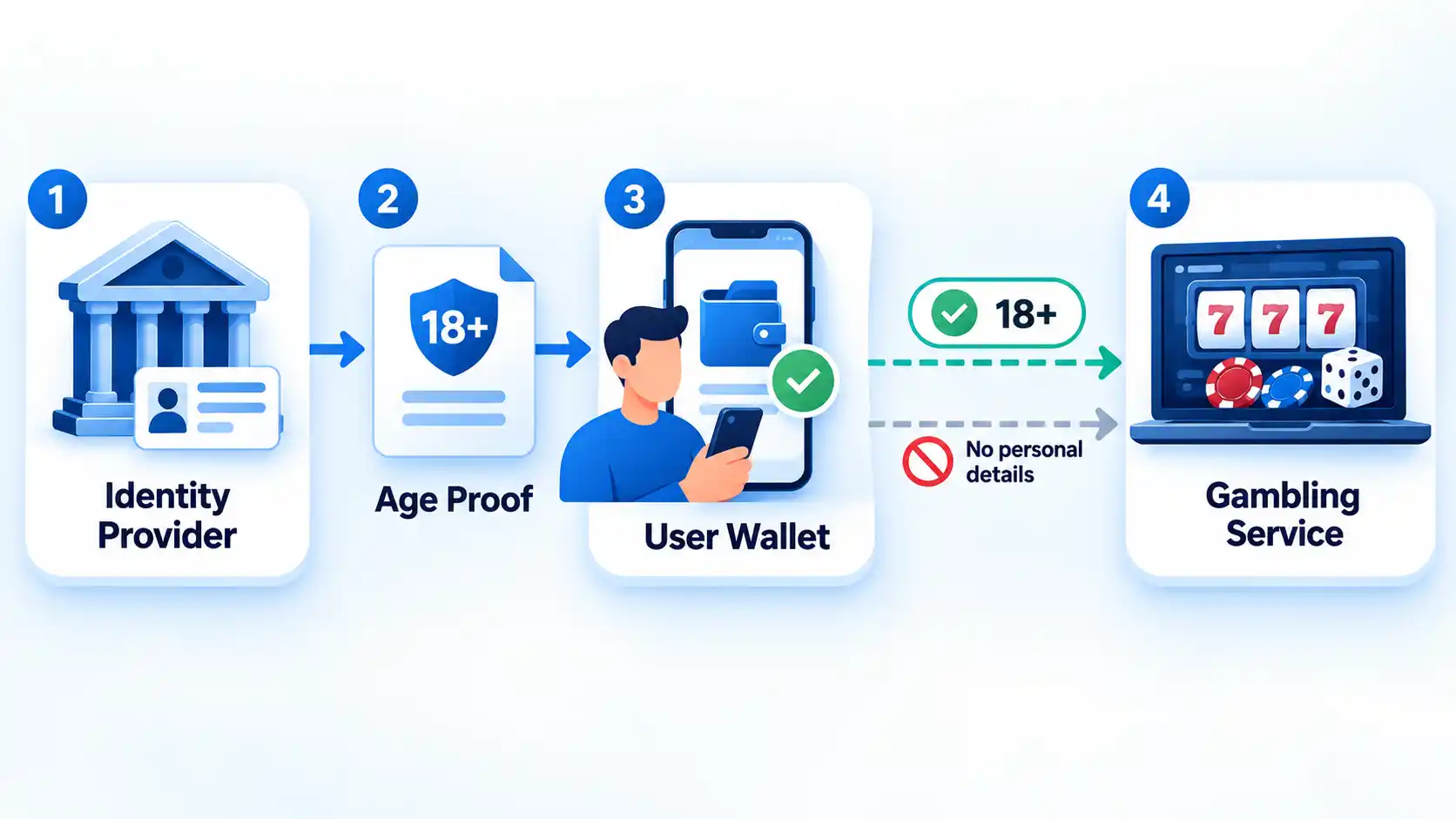
Traditional Know Your Customer checks, commonly shortened to KYC, can require a business to obtain identifying information so it can establish and verify who a customer is. Privacy-preserving age verification introduces a narrower model in which a trusted credential can establish eligibility while the relying service receives only the required age proof.
This does not eliminate every identity requirement. Gambling operators may still have separate obligations concerning identity, payments, anti-money-laundering controls, or source-of-funds checks. The exact requirements depend on the jurisdiction.
The same distinction matters when evaluating digital age verification for online gambling: proving an age threshold, establishing a full identity, and satisfying broader account-verification rules are related tasks, but they are not technically identical.
4. Live Betting Is Driving Lower-Latency Video and Data Infrastructure
Live betting depends on more than displaying a video stream. The event, betting data, market state, pricing system, and user interface all need to remain synchronized closely enough for an operator to manage rapidly changing markets.
Latency is the delay between an event or data change occurring and that information reaching another part of the system. In live betting, excessive or inconsistent latency can create a mismatch between what has happened in an event and what a customer is seeing when a market is displayed.
AWS documents betting and gaming streaming architectures for several latency ranges, including sub-two-second delivery and configurations below 300 milliseconds. The documented architectures combine video delivery with application programming interfaces, WebSocket connections, game metadata, content-delivery infrastructure, and timestamps used to synchronize data and video.
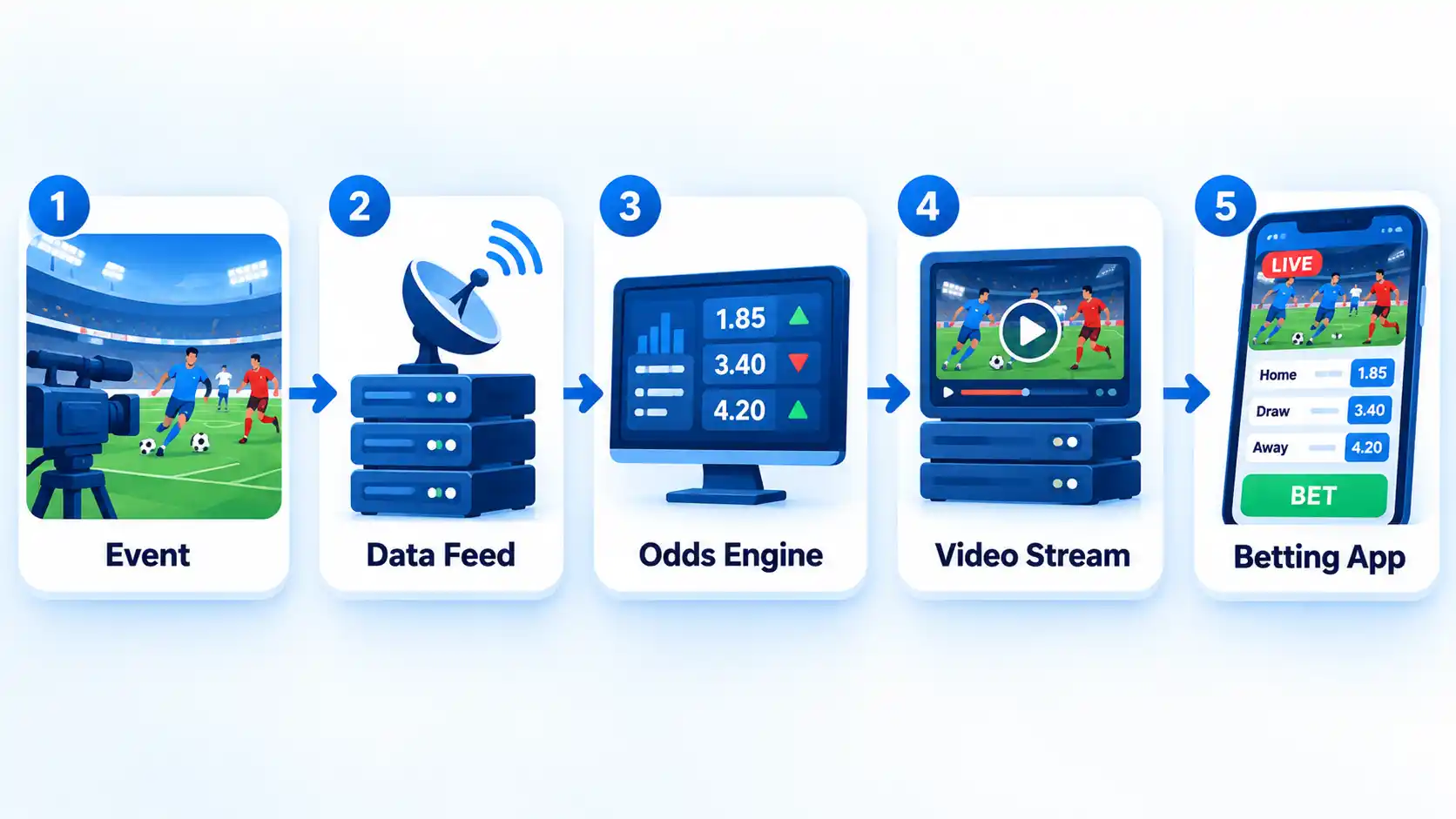
For a sportsbook, the underlying flow can be simplified as follows: an event generates data, feeds deliver that data to backend services, pricing or market systems update the available bets, video moves through streaming infrastructure, and the application presents the resulting information to the customer.
This is part of the broader evolution of technology in sports betting, but lower latency is not automatically desirable in every situation. A betting market may need to be suspended while an event is confirmed, and operators may need controls that account for differences in when event information reaches different systems or users.
Understanding low-latency technology in live sports betting therefore requires looking at data synchronization and market controls as well as raw video speed.
5. Cloud Architecture Is Shifting Toward Hybrid and Edge Deployment
The cloud trend in gambling is no longer simply about moving servers out of an operator’s own data center. Modern platforms increasingly have to decide which workloads belong in scalable cloud infrastructure, which need to remain close to users or venues, and which must stay in particular locations for operational or regulatory reasons.
A hybrid architecture combines different computing environments rather than placing everything in one public cloud. Edge processing moves some processing closer to the user, device, venue, or source of the data. Data residency refers to requirements or policies governing where data is stored or processed.
AWS’s technical guidance for regulated betting and gaming workloads describes hybrid architectures that combine edge infrastructure with regional cloud services. The documented pattern places regulated components at the edge where local requirements call for it while allowing other workloads to use regional cloud infrastructure.
For example, an operator may place a latency-sensitive or locally regulated service closer to customers while using regional cloud systems for workloads that can be centralized. Another platform may rely on elastic cloud capacity to cope with unusually high traffic around a major sporting event.
The main limitation is that cloud deployment is not a compliance shortcut. AWS itself states that customers remain responsible for ensuring their use of its infrastructure complies with applicable gambling laws and required approvals. Architecture, configuration, access control, auditability, resilience, and jurisdiction-specific obligations still have to be addressed by the operator and its suppliers.
6. Cashless Gaming Is Becoming a Connected Account Layer
Cashless gambling can involve much more than replacing banknotes with a phone or card. Modern cashless systems can connect payment value with player accounts, authentication, gaming devices, transaction records, limits, suspensions, and other controls.
Gaming Laboratories International’s GLI-16 Version 3.0 standard, revised July 31, 2024, illustrates how broad this infrastructure can be. It covers cashless systems and devices, player identification, verified and unverified player accounts, player-account management, and limitations, time-outs, and suspensions.
This creates an important difference between an ordinary contactless retail payment and a regulated gambling cashless environment. GLI-16 describes cashless gaming as using a securely protected authentication method to access either an operator player account or an identifiable electronic payment account. It also treats the components of a cashless environment as systems intended to function cohesively.
The standard should not be mistaken for worldwide law. GLI states that a regulatory body may adopt the standard in whole or in part and that jurisdictional stakeholders determine how its requirements are applied. Its relevance here is that it shows cashless gaming being specified as a connected technical environment rather than a single payment feature.
7. Integrity Monitoring Is Becoming More Data-Driven
Some consequential gambling technology operates almost entirely outside the customer’s interface. Betting-integrity systems analyze large volumes of events and wagering data to identify activity that may warrant further investigation.
In its Integrity in Action 2025 report, Sportradar says it monitored more than one million sporting events and describes AI-driven monitoring in which machine learning is used to uncover new betting patterns. This is vendor-produced evidence, so it demonstrates an operational use case rather than independently establishing how effective every integrity-monitoring system is.
A machine-learning model can compare patterns across markets, competitions, timings, accounts, or other available signals more quickly than a human analyst could inspect every event manually. The practical purpose is to identify unusual activity for further assessment.
The critical limitation is that an anomaly is not proof of manipulation. Betting activity can look unusual for legitimate reasons, and an automated flag still requires context, investigation, and an appropriate evidentiary process. The technology is most defensible as a detection and prioritization layer rather than an automatic verdict.
Honorable Mentions
Three technologies remain relevant but narrowly miss the main seven because their present importance is either more jurisdiction-dependent, less clearly established across the sector, or better understood as an adjacent market development.
- Blockchain and crypto-assets: Crypto remains relevant to gambling payments and blockchain-based systems, but adoption is constrained by licensing, anti-money-laundering, source-of-funds, and payment requirements. The UK Gambling Commission’s crypto-asset guidance, for example, explains that applicants using crypto-assets may face difficulty demonstrating satisfactory source-of-funds evidence. That makes crypto difficult to present as an inevitable universal replacement for conventional payment infrastructure.
- Augmented and virtual reality: AR and VR remain plausible ways to build more immersive gambling interfaces, but the evidence reviewed for this article is weaker for widespread gambling-sector deployment than it is for the seven main trends. They are therefore better treated here as developing interface technologies rather than foundational 2026 infrastructure.
- Prediction markets: Prediction markets are an important adjacent development because they create event-based trading and wagering-like experiences, but they are primarily a product and market structure rather than a separate underlying technology comparable with AI, identity infrastructure, cloud systems, or integrity monitoring.
What the Direction of Travel Actually Shows
The strongest gambling technology trends in 2026 have one thing in common: they make platforms more connected. AI depends on governed data. Player-protection controls depend on account state and transaction logic. Digital identity links eligibility to account access. Live betting links event data to pricing and video. Cashless gaming connects payments with identity and device controls. Integrity systems depend on data from large numbers of events and markets.
That makes integration more important than novelty. A gambling platform may contain AI, cloud services, a digital wallet, and real-time streaming, but those labels alone say little about how well the system works. The practical questions are whether the components exchange reliable data, apply the correct rules, protect sensitive information, remain auditable, and behave predictably when something fails.
Technologies such as cryptocurrency, blockchain, augmented reality, and virtual reality may continue to develop, but the evidence reviewed here does not support presenting them as inevitable replacements for established gambling infrastructure. The more defensible 2026 direction is continued integration of identity, data, automation, payments, real-time systems, and operational controls across betting and casino platforms.
