Satellite platforms already support Mars exploration by mapping the planet, studying its environment, and relaying data between surface spacecraft and Earth. Future human missions will need much more capable communications and navigation infrastructure, but satellites are only one part of the larger systems required for sustained human operations on Mars.
In spacecraft engineering, a satellite platform, often called a satellite bus, is the supporting spacecraft that carries and operates a mission payload. It normally provides structure, electrical power, thermal control, computing, attitude control, communications, and other services that allow the scientific instruments or communications payload to do their work.
Key Takeaways
- Mars orbiters already serve as scientific spacecraft and communications relays for surface missions such as rovers.
- NASA is moving toward purpose-built Mars communications infrastructure rather than relying indefinitely on science orbiters that also perform relay work.
- Future Mars networks are expected to support positioning, navigation, and timing as well as higher-capacity communications.
- Better satellite infrastructure cannot remove the physical communication delay between Earth and Mars or replace habitats, power, life support, transportation, and other human-exploration systems.
What a Satellite Platform Means in a Mars Mission
A satellite is usually easier to understand when it is separated into two broad parts: the platform and the payload. The payload performs the mission-specific job, such as imaging the Martian surface, studying its atmosphere, or relaying communications. The platform keeps that payload powered, pointed, thermally controlled, connected, and operational.
Examples of commercial satellite bus platforms illustrate how structures, power systems, onboard computing, antennas, attitude-control hardware, and thermal management can be integrated around a payload. Those commercial platforms should not be mistaken for Mars-ready spacecraft. The linked products are primarily positioned for Earth-orbit applications, while a Mars orbiter must be engineered for its specific launch, interplanetary cruise, orbital environment, thermal conditions, radiation exposure, propulsion, communications, and mission lifetime.
This distinction matters because the phrase “satellite platform” can make Mars infrastructure sound like a single standard product. In practice, spacecraft architecture depends heavily on what the mission must accomplish. A high-resolution science orbiter, a telecommunications relay, and a navigation spacecraft may share basic subsystem categories while requiring very different antennas, power budgets, orbital designs, payloads, redundancy strategies, and communications links.
What Mars Orbiters Already Do Today
Mars orbiters are not waiting for future human missions to become useful. They already perform several jobs that make robotic exploration practical, especially scientific observation and data relay.
Map and study the planet
Orbiters can repeatedly observe broad areas that a rover or lander cannot. Their instruments can map terrain, study the atmosphere, examine surface minerals, monitor environmental changes, and provide context for surface observations. ESA’s Mars Express mission, for example, remains in operation and studies Mars’s atmosphere, surface, subsurface, and moons. NASA’s Mars Reconnaissance Orbiter also combines detailed observation with communications support through the Mars Relay Network.
Orbital reconnaissance can help mission planners understand candidate operating areas before a surface spacecraft arrives. Surface missions then add close-range measurements that cannot be obtained at the same scale from orbit. The two perspectives are complementary rather than interchangeable.
Relay data for surface missions
A rover has limited electrical power, antenna size, and communications time. Instead of depending only on a direct radio link from the Martian surface to Earth, it can transmit data to an orbiter passing overhead. The orbiter then sends the information across interplanetary space using communications hardware better suited to the long-distance link.
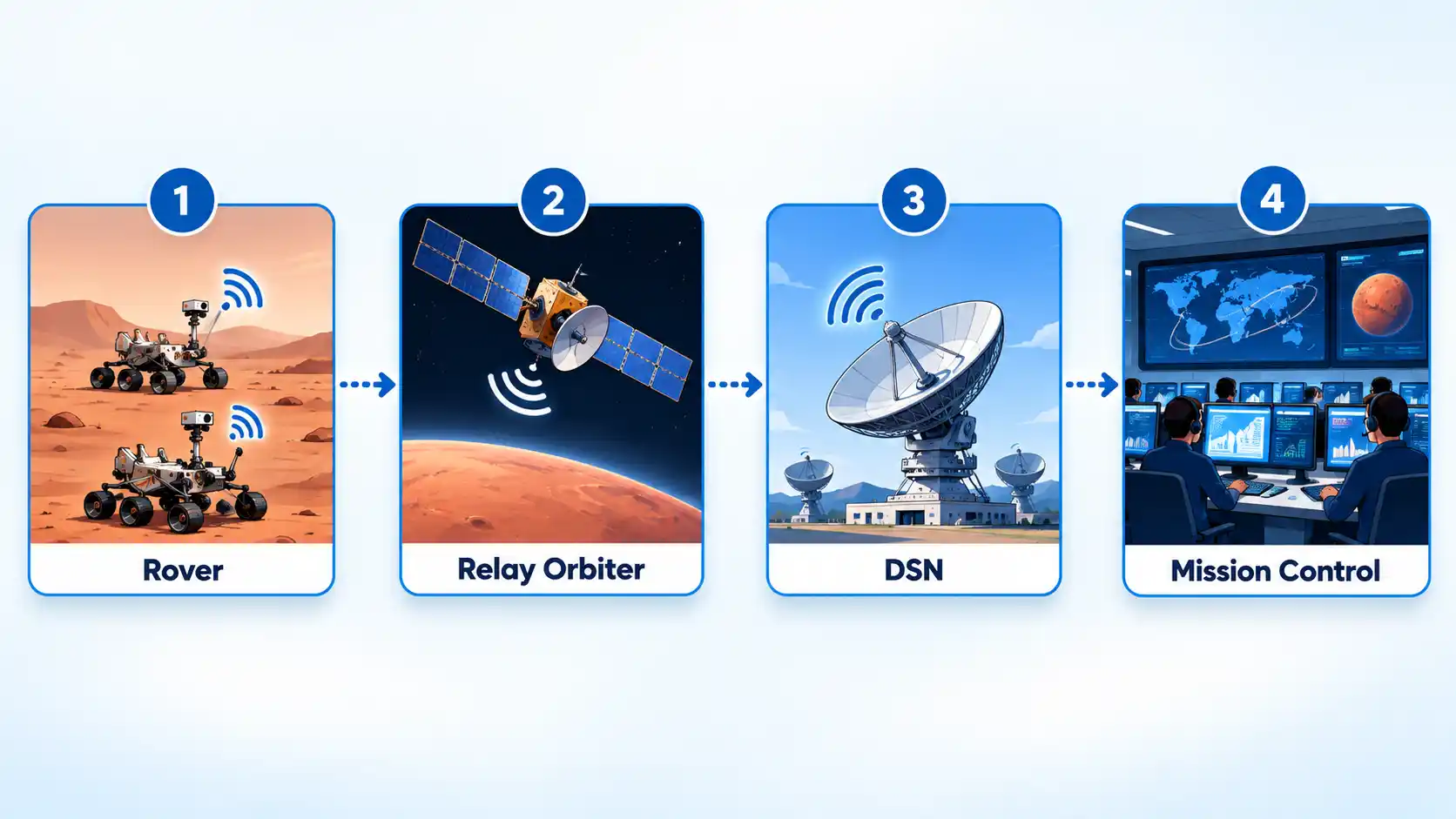
NASA describes this arrangement as the Mars Relay Network, an international NASA-ESA network that currently uses four Mars orbiters to return data from Curiosity and Perseverance. Relay opportunities vary with orbital geometry, the spacecraft being used, and how much data a surface mission needs to return.
Surface missions can therefore send substantial amounts of science data through the Mars relay network instead of requiring every bit of information to be returned efficiently through the rover’s own direct-to-Earth hardware.
Support critical mission events
Orbiters can also observe or relay information during important events. When Perseverance landed in 2021, Mars Reconnaissance Orbiter received its entry, descent, and landing data in real time and immediately transmitted the information toward Earth. This type of coverage gives mission teams another source of engineering data during a phase when a landing spacecraft is rapidly changing speed and configuration.
Relay infrastructure is not unlimited. Orbiters follow specific trajectories and must schedule communication passes alongside their other mission responsibilities. Coverage, antenna geometry, data volume, spacecraft health, and ground-network availability all affect how information moves through the system.
The Mars Relay Network Is Evolving Into Dedicated Infrastructure
Today’s Mars communications system grew from spacecraft that were often built primarily for scientific missions and also equipped to relay data. That approach has supported years of robotic exploration, but a larger robotic fleet and future human missions would place greater demands on communications capacity, reliability, navigation, and operational flexibility.
The network also changes as spacecraft age. NASA declared the MAVEN mission ended on June 3, 2026 after the spacecraft had been silent since December 6, 2025 and was determined to be unrecoverable. NASA says the other Mars Relay Network orbiters absorbed MAVEN’s relay workload. The change illustrates why infrastructure around another planet needs redundancy and replacement planning rather than dependence on any single spacecraft.
A major step toward dedicated infrastructure came on September 1, 2026, when NASA awarded Blue Origin a contract to develop the Mars Telecommunications Network. NASA describes the project as a next-generation system intended to provide higher-bandwidth communications and navigation services for current and future Mars missions. The contract requires delivery of a high-performance Mars telecommunications orbiter to NASA no later than December 31, 2028, and NASA currently expects the network to be operational at Mars by 2030.
Those dates are current contract and program targets, not evidence that the network is already deployed. Spacecraft development, launch, interplanetary cruise, Mars arrival, commissioning, and other program factors still separate a contract award from an operational service.
Europe is also examining longer-term interplanetary communications infrastructure. ESA’s Solar System Internet concept describes MARCONI, the Mars Communication and Navigation Infrastructure, as a future communications and positioning, navigation, and timing service. ESA describes an intended six-node constellation by the 2040s, so MARCONI should be understood as a forward-looking infrastructure concept rather than a presently deployed Mars network.
The three stages below distinguish infrastructure operating today from systems that are under development or remain longer-term concepts.
| Infrastructure stage | Main role | Architecture | Status |
|---|---|---|---|
| Mars Relay Network | Science data relay and mission support | Four active Mars orbiters with relay capability | Operational |
| NASA Mars Telecommunications Network | Higher-capacity communications and navigation services | Purpose-built Mars telecommunications spacecraft and supporting network | Contract awarded in September 2026; NASA currently targets Mars operation by 2030 |
| ESA MARCONI | Communications and positioning, navigation, and timing | Planned multi-node Mars communications and navigation infrastructure | Forward-looking ESA concept with an intended six-node constellation by the 2040s |
The important change is therefore not simply that Mars may gain “more satellites.” Communications and navigation are increasingly being treated as infrastructure services in their own right instead of secondary capabilities carried only by science spacecraft.
Why Navigation Around Mars Needs More Than “GPS”
It is tempting to describe future Mars navigation as “GPS for Mars,” but that analogy needs qualification. The Global Positioning System is the United States’ Earth-based satellite-navigation system. Mars explorers cannot simply use Earth’s GPS constellation in the same way a phone, aircraft, or terrestrial vehicle does.
The broader engineering term is positioning, navigation, and timing, usually shortened to PNT. NASA explains that PNT covers determining location, navigating toward a destination, and maintaining precise timing. Its Space Communications and Navigation program develops PNT capabilities and Moon-to-Mars navigation architectures.
For future Mars operations, PNT services could support autonomous landings, surface operations, spacecraft navigation, and coordination when continuous Earth contact is unavailable. A Mars architecture does not have to reproduce GPS exactly. Depending on the mission, navigation can combine space-based signals or ranging, onboard sensors, Earth-based tracking, terrain-relative navigation, precise timing, and other techniques.
NASA and JPL researchers have also examined architecture and technology priorities for PNT at Mars, including capabilities intended to support an initial human Mars exploration campaign. The practical point is that future Mars missions need navigation services designed for Mars operations rather than an assumption that terrestrial GPS simply extends unchanged to another planet.
Communication Delay Changes How Mars Missions Must Operate
A more capable relay network can improve coverage, reliability, and data throughput. It cannot remove the most fundamental limitation in Earth-Mars communications: distance.
NASA notes that astronauts on a Mars mission can face a one-way communication delay of up to about 20 minutes. That means crews and spacecraft may have to handle equipment failures, medical issues, navigation decisions, and other time-sensitive situations without immediate help from Earth.
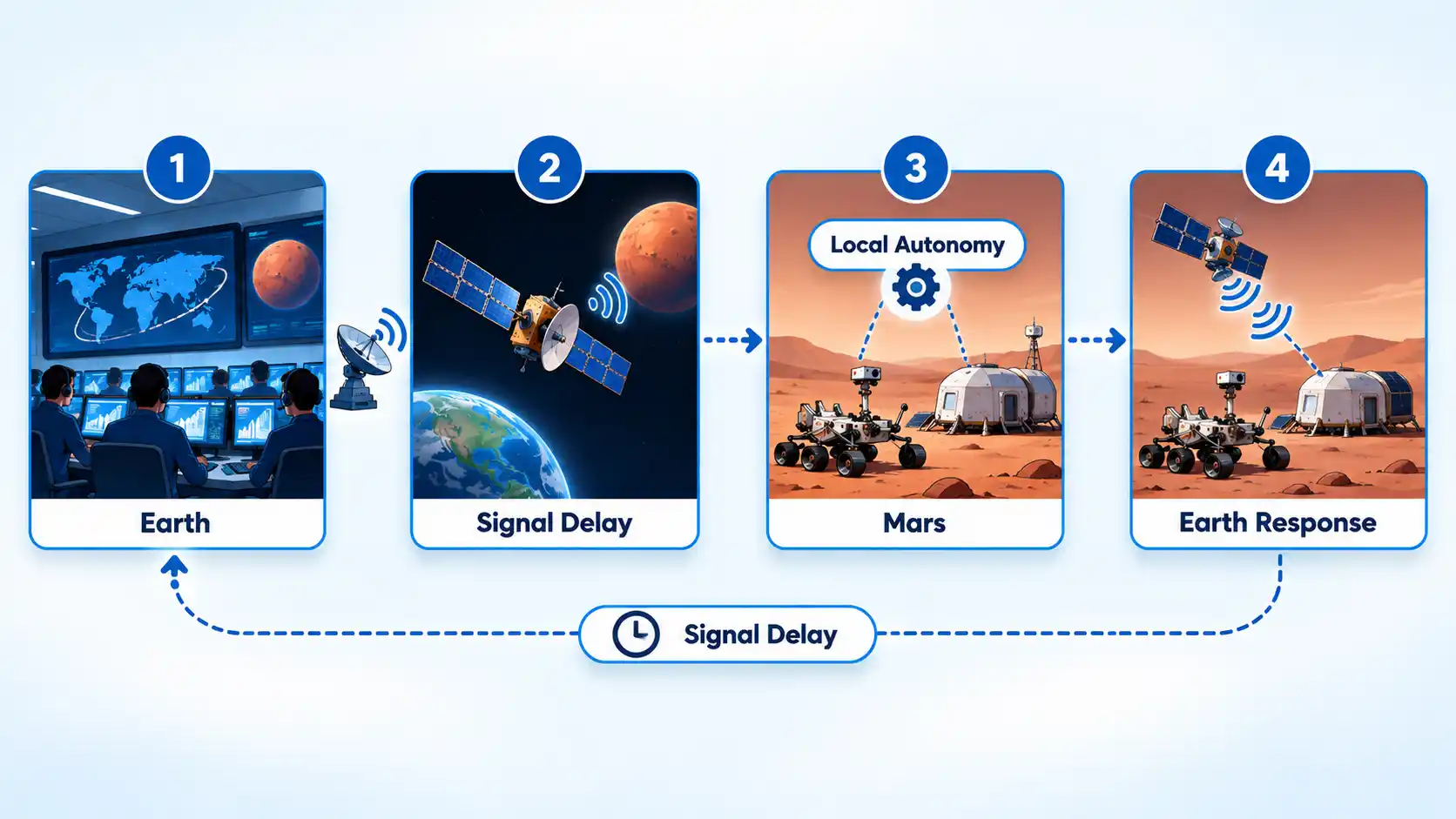
This limitation is easier to understand by separating bandwidth from latency. Bandwidth describes how much information a communications system can move within a given time. Latency describes how long a signal takes to reach its destination. A high-capacity Mars relay can carry more information, but it cannot make a radio command cross interplanetary space instantaneously.
Higher-capacity orbiters can therefore improve communications without eliminating Earth-to-Mars communication delay. A crew responding to an equipment fault, a rover approaching hazardous terrain, or an automated system protecting critical hardware may need to act locally instead of waiting for a complete question-and-answer exchange with Earth.
The engineering trade-off between relay satellites and direct-to-Earth communication also involves spacecraft power, antenna capability, coverage, data rate, operational scheduling, and dependence on another spacecraft remaining available.
What Satellite Infrastructure Can and Cannot Do for Human Mars Missions
Orbiting infrastructure could make human Mars operations more manageable, but communications satellites do not solve the entire problem of transporting people to Mars and supporting them there.
What orbital infrastructure can provide
A mature Mars network could support communications between crews, surface vehicles, orbiting spacecraft, Earth, and robotic assets. It could also contribute navigation information, environmental observations, reconnaissance, landing support, and coordination across widely separated operating areas.
NASA formally treats these capabilities as part of a much larger systems architecture. Its current Moon to Mars Architecture identifies communications and positioning, navigation, and timing alongside autonomous systems and robotics, data systems, habitation, in-situ resource utilization, logistics, mobility, power, transportation, and other required sub-architectures.
What still requires other systems
People reaching Mars would need transportation capable of delivering crews and equipment safely, entry and landing systems for large payloads, surface power, radiation protection, habitats, life support, food and water systems, spacesuits, logistics, surface mobility, medical capability, and systems for the return journey or whatever longer-duration mission architecture is being attempted.
NASA’s current Humans-to-Mars architecture begins with the capabilities and systems needed to travel safely to Mars, land on its surface, and return to Earth. NASA then describes progressively longer and more complex Mars missions. That progression is important because an initial expedition, repeated missions, sustained human presence, and a self-sufficient colony represent very different levels of technical maturity and logistical independence.
In-situ resource utilization, or ISRU, illustrates the gap. ISRU means producing useful materials from resources found at the destination instead of transporting everything from Earth. NASA’s MOXIE experiment aboard Perseverance successfully demonstrated oxygen production from the Martian atmosphere. According to NASA’s Jet Propulsion Laboratory, MOXIE operated 16 times and produced a total of 122 grams of oxygen.
That was a technology demonstration, not an operational oxygen plant for a human settlement. A settlement-scale system would need very different production capacity, reliability, storage, distribution, maintenance, and redundancy.
Robotic exploration, an initial crewed expedition, sustained human presence, and a self-sufficient Mars colony are not interchangeable milestones. A technology can be essential to several of these stages while being mature enough for only the earlier ones.
The same caution applies to communications. A relay system capable of returning rover science data does not automatically provide all the capacity, redundancy, navigation coverage, emergency communications, and operational resilience that a human Mars campaign could require.
Does Better Satellite Infrastructure Mean Mars Colonization Is Close?
Current evidence does not establish that a self-sustaining Mars colony is close. What it does show is continued progress from individual robotic missions toward more deliberate infrastructure planning for increasingly complex exploration.
Robotic exploration is already established. Mars has operational orbital and surface missions, a working relay architecture, autonomous spacecraft capabilities, and technology demonstrations such as MOXIE.
Human Mars exploration remains a development objective rather than an accomplished capability. NASA’s current Humans-to-Mars architecture calls for establishing a human presence on Mars and begins with the systems necessary to travel there, land safely, and return to Earth before progressing toward longer and more complex missions. It does not establish a date for a self-sustaining Mars colony.
Sustained settlement raises additional questions about system lifetime, replacement hardware, medical care, food production, industrial capability, radiation exposure, resupply, power generation, maintenance, emergency recovery, and dependence on Earth. A self-sufficient settlement would set an even higher bar because critical systems and supplies could no longer assume routine replacement from Earth.
Satellite platforms can reduce some operational barriers by improving communication, situational awareness, navigation, and coordination. They cannot by themselves answer whether a settlement can remain technically and biologically sustainable for decades.
The Practical Direction of Mars Orbital Infrastructure
Mars orbiters have already evolved beyond being remote scientific observers. They form part of the communications system connecting surface missions with Earth, and space agencies are now planning more specialized communications and navigation services for future exploration.
NASA’s September 2026 telecommunications contract is significant because it moves a purpose-built Mars communications and navigation network into an active development program. ESA’s MARCONI concept points in a similar long-term direction, although it remains prospective rather than operational.
The direction is clearer than the timetable for human settlement. Mars exploration is likely to depend increasingly on orbital infrastructure able to connect, locate, coordinate, and support multiple spacecraft and surface assets. That infrastructure could become indispensable to human operations, but it remains one foundation among many rather than evidence that Mars colonization itself has been solved.

💬 Comments