Content moderation maintains web safety by establishing operational filters—combining automated algorithms and human oversight—to identify, isolate, and remove illegal material, cyberbullying, hate speech, and fraudulent activity across digital platforms. By enforcing transparent community standards, structured content review workflows mitigate real-world psychological and civil harms while ensuring digital services remain compliant with evolving legal mandates.
Quick Take
- Multi-layered defense: Modern digital safety relies on combining high-speed automated detection algorithms with nuanced human context review.
- Regulatory necessity: Legislation such as the EU Digital Services Act and US Section 230 establishes specific operational and legal boundaries for platform liability.
- User retention and trust: Platforms that fail to control harassment, spam, and illegal content experience severe network decay and loss of active users.
- Balancing safety and expression: Effective Trust and Safety architectures incorporate strict due process, clear appeals, and audit trails to prevent over-moderation and censorship.
Core Mechanics: What Is Content Moderation in Modern Trust & Safety?
Content moderation is the continuous process of screening, evaluating, and applying policy decisions to user-generated content (UGC) published across digital platforms. Whether operating on social networks, discussion forums, gaming channels, or e-commerce marketplaces, moderation systems serve as the core defensive infrastructure protecting users from malicious activity. Implementing rigorous content moderation practices and challenges requires balancing real-time data ingestion with policy enforcement.
At an operational level, moderation workflows handle diverse media types—including structured text, unstructured commentary, static images, short-form video, and live streaming audio. Each format presents distinct detection latency requirements and enforcement challenges. To manage this intake, platforms deploy four primary moderation architectures:
- Pre-moderation: Content is held in an quarantine queue and evaluated by automated filters or human moderators before becoming visible to the public. This method offers high safety for sensitive environments (such as child-focused applications) but creates noticeable publishing friction and delays interaction.
- Post-moderation: Content publishes instantly, appearing live to users while automated systems and background queues analyze the payload asynchronously. If a violation is flagged, the content is retroactively hidden or removed. This minimizes user friction but leaves a short window of exposure to potentially harmful material.
- Reactive (User-reported) moderation: Platform users manually flag policy violations through embedded reporting tools. Flagged items enter specialized triage queues for operational review. Establishing robust user reporting mechanism designs ensures that high-severity abuse reports prioritize quickly above routine spam.
- Distributed (Community) moderation: Platforms delegate enforcement powers directly to trusted community members or peer moderators through voting systems, reputation scores, or custom sub-community rulesets.
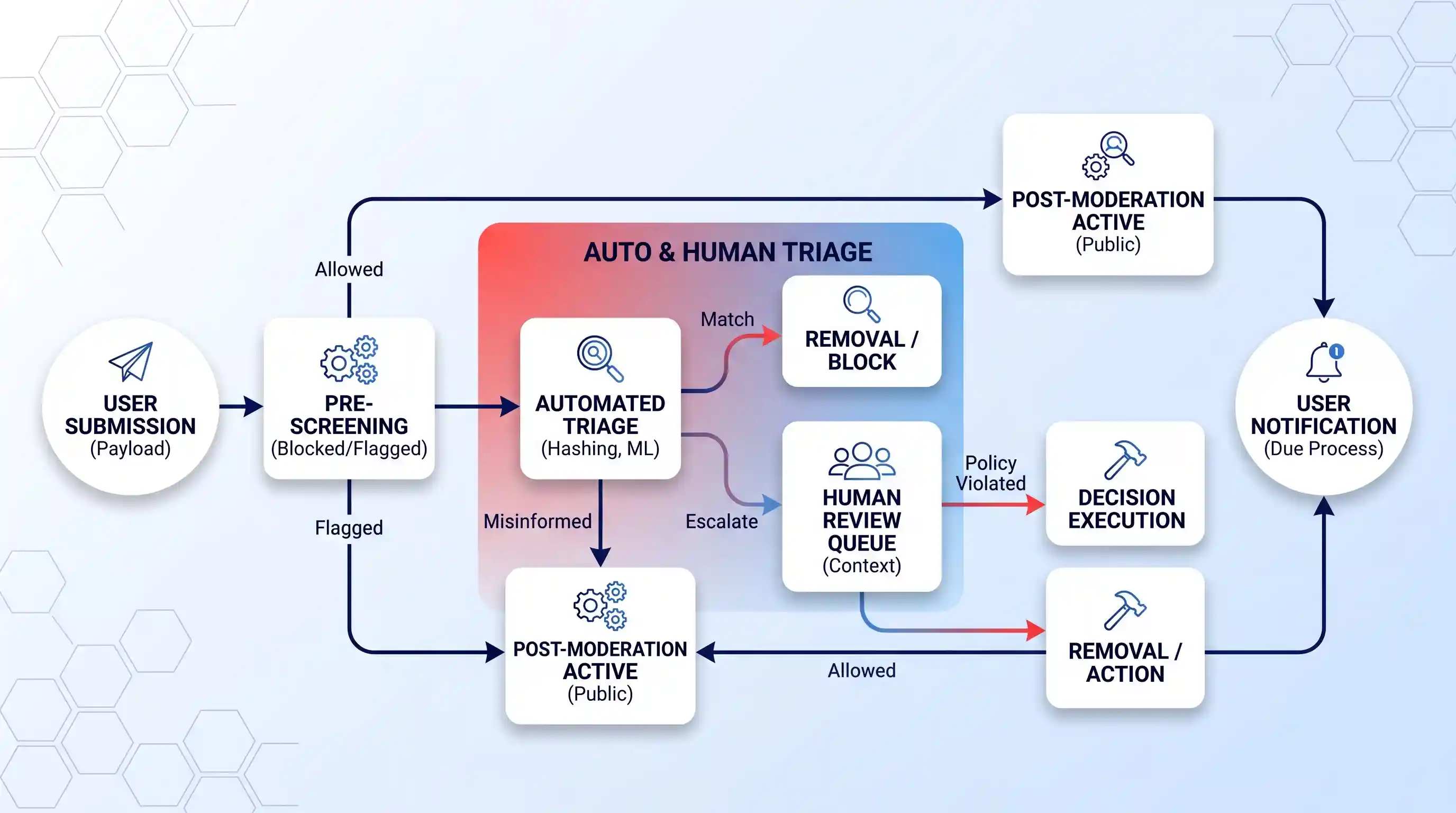
Relying on any single method introduces vulnerabilities. Pre-moderation fails under massive concurrent upload volumes, while purely reactive moderation forces end users to absorb initial psychological harm. Consequently, mature platforms integrate these four approaches into a unified triage pipeline, matching the moderation strategy to the risk profile of the specific content vector.
The Technological Layer: Automated Detection and Perceptual Hashing
The sheer velocity of global digital uploads makes manual review of every payload physically impossible. Automated detection algorithms form the primary line of defense, filtering billions of data points daily to isolate high-confidence violations within milliseconds of ingestion.
Automated systems utilize specialized technologies adapted to specific content types:
- Perceptual Hashing (PhotoDNA & Cross-Platform Hashbanks): Rather than relying on metadata or standard cryptographic hashes (which change completely if a single byte is altered), perceptual hashing generates a digital fingerprint based on visual structural patterns. When an image or video is uploaded, its perceptual hash is calculated and compared against known database indexes—such as the Global Internet Forum to Counter Terrorism (GIFCT) hashbank or NCMEC databases. As documented in Google Transparency Report documentation, automated hash matching enables platforms to instantly block known violent extremist material and Child Sexual Abuse Material (CSAM) before it reaches public queues.
- Natural Language Processing (NLP) & Large Language Models (LLMs): Text classification pipelines inspect posts, direct messages, and comments for intent, sentiment, and semantic structure. Modern automated content detection models analyze sentence structure, contextual signals, and character substitutions (such as leetspeak or obfuscated symbols) used to bypass basic keyword blocklists.
- Computer Vision Classifiers: Convolutional Neural Networks (CNNs) analyze visual frames to identify explicit imagery, weapons, hate symbols, and dangerous activity. These systems assign a probability confidence score to each payload. High-confidence flags trigger automatic suppression, while medium-confidence flags route to human review queues.
Despite their efficiency, automated tools present critical failure modes. Machine learning models struggle with contextual nuance, sarcasm, localized cultural idioms, and reclaimed language within targeted groups. An algorithm trained strictly on text tokens may mistake academic discussions of historic violence for active incitement. Automated filtering is essential for throughput, but relying on technology without human verification leads to high rates of false positives and accidental censorship.
The Human-in-the-Loop: Context, Discretion, and Reviewer Welfare
Because automated classifiers lack true comprehension of human intent, human oversight remains indispensable. The “Human-in-the-Loop” (HITL) architecture positions trained human moderators as the final arbiters for ambiguous, escalated, or high-context enforcement decisions.
Human reviewers evaluate flagged content through specialized moderation dashboards, applying complex community guidelines to real-world edge cases. Where an AI model sees only isolated keywords, a human reviewer assesses the broader context: Who published the post? Is it news reporting, artistic satire, self-defense advocacy, or targeted harassment? Implementing structured quality assurance protocols for content moderation ensures that reviewer decisions maintain consistent accuracy across diverse global teams.
Operating an effective human review queue involves distinct operational requirements:
- Contextual Interpretation: Reviewers understand shifting socio-cultural dynamics, evolving regional slang, geopolitical conflicts, and subtle targeted memes that bypass automated triggers.
- Tiered Escalation Paths: Complex cases involving legal grey areas, high-profile accounts, or active law enforcement threats pass from front-line reviewers to senior policy specialists and dedicated legal counsel.
- Reviewer Psychological Welfare: Constant exposure to violent, abusive, or disturbing material carries severe risk of psychological trauma and burnout. Responsible Trust and Safety operations mandate protective workplace standards, including automated image blur filters, reduced screen resolution for graphic content, forced shift rotations, and mandatory access to specialized mental health professionals.
Combining human discretion with technological scale creates a balanced ecosystem. Technology provides rapid threat containment across vast datasets, while human judgment maintains equity, nuances contextual boundaries, and preserves legitimate public discourse.
Legal and Regulatory Frameworks Governing Digital Safety
Content moderation does not happen in a legal vacuum. Global jurisdictions increasingly enforce strict regulatory frameworks that dictate how online intermediaries must handle user safety, illegal content removal, and user due process.
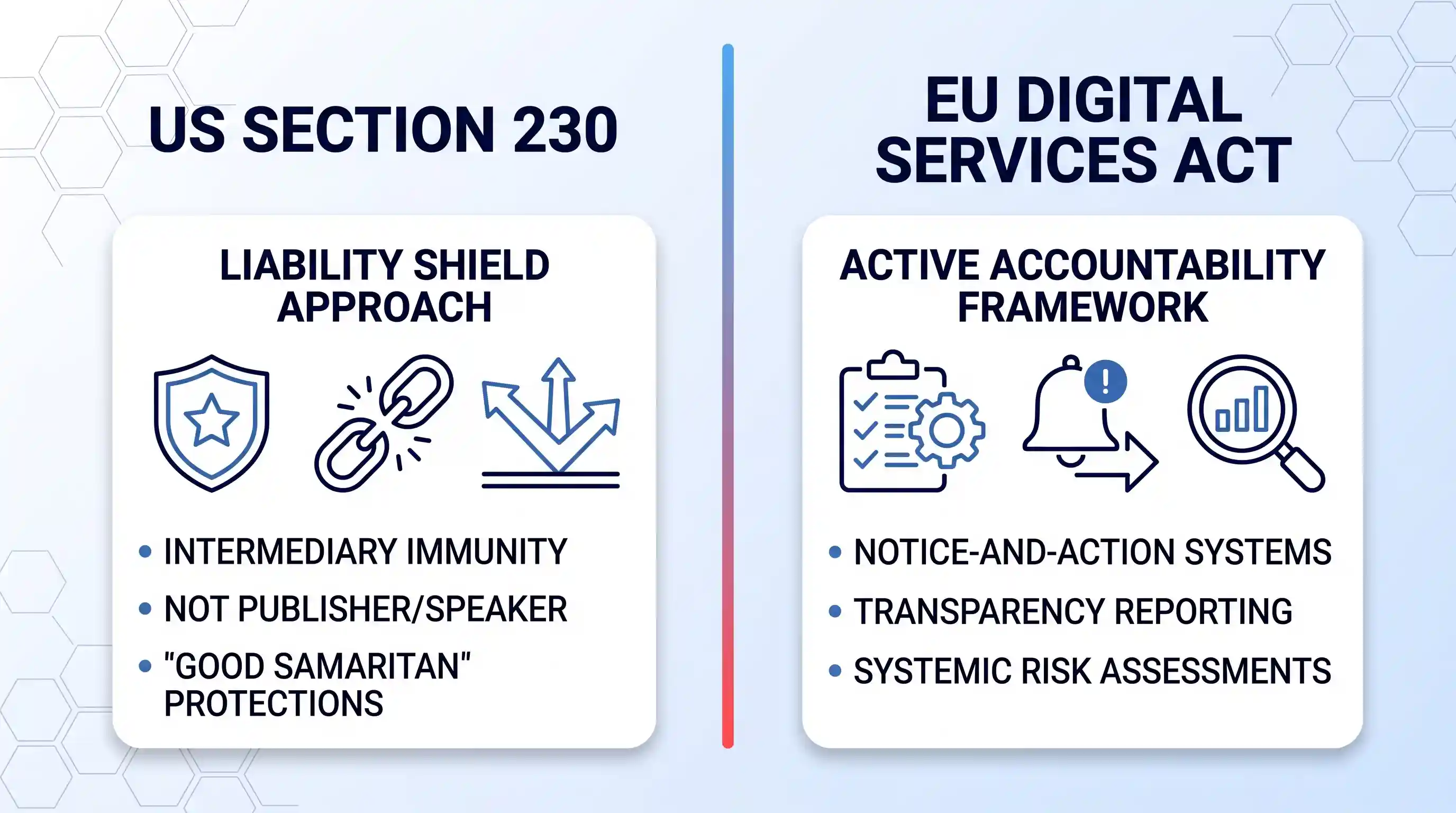
Historically, platform regulation relied heavily on broad liability shields. In the United States, Section 230 of the Communications Decency Act establishes that interactive computer services are not treated as the publisher or speaker of information provided by third parties. Crucially, Section 230(c)(2)—the “Good Samaritan” provision—protects platforms from civil liability when they take voluntary, good-faith actions to restrict or remove objectionable content.
Conversely, modern global legislation shifts toward proactive compliance, transparency mandates, and strict procedural rules. The European Union’s regulatory model, exemplified by the Digital Services Act (DSA), establishes specific legal duties based on platform size and societal reach.
| Regulatory Framework | Primary Jurisdiction | Core Compliance Obligations | Platform Liability & Penalty Risks |
|---|---|---|---|
| US Section 230 (47 U.S.C. § 230) | United States | Provides broad liability immunity for third-party user content; protects voluntary good-faith moderation activities. | Low platform liability for user posts, subject to specific federal exceptions (federal criminal law, IP, sex trafficking laws). |
| EU Digital Services Act (DSA) | European Union | Mandates transparent user reporting tools, detailed statement of reasons for takedowns, trusted flagger integration, independent auditing, and systemic risk assessments for Very Large Online Platforms (VLOPs). Compliance rules align with standardized EU Digital Services Act notice-and-action rules. | Severe financial penalties reaching up to 6% of global annual turnover for non-compliance with systemic risk and moderation transparency rules. |
| UK Online Safety Act | United Kingdom | Imposes explicit legal duties of care to prevent illegal content, protect children from age-inappropriate material, enforce transparent terms of service, and provide effective user reporting and appeals. | Fines up to £18 million or 10% of global annual revenue, alongside potential criminal liability for non-compliant platform executives. |
As highlighted in the Information Technology Industry Council policy position, managing compliance across conflicting multi-jurisdictional legal standards requires platforms to build flexible policy systems capable of geo-blocking content to meet regional legal standards without applying global censors unnecessarily.
The Impact on User Experience and Retention
The operational quality of a platform’s moderation system directly shapes its commercial health, user engagement, and long-term retention. Unmoderated or poorly moderated digital environments quickly degrade into toxic spaces dominated by targeted harassment, coordinated spam networks, phishing scams, and hate speech.
This breakdown triggers a well-documented platform failure mode known as “network decay”:
- User Churn: Mainstream creators, vulnerable groups, and high-value contributors abandon platforms where abuse goes unpunished, reducing overall content quality and active session times.
- Brand Safety Erosion: Corporate advertisers refuse to place commercial campaigns adjacent to offensive or illegal material, causing severe monetization drops.
- App Store De-platforming: Mobile operating system marketplaces (such as Apple’s App Store and Google Play) strictly enforce developer safety guidelines, routinely suspending applications that lack adequate user moderation infrastructure.
Conversely, transparent and consistent enforcement fosters a predictable environment where users communicate safely. When platforms clear clear safety expectations alongside practical tools—such as blocklists, mute functions, and direct report tracking—users report higher trust and platform loyalty. Adhering to essential online safety practices empowers end users to maintain personal digital security while interacting in public spaces.
Furthermore, protecting younger demographics requires dedicated platform controls. Integrating specialized moderation rules alongside robust family safety and parental control applications ensures that age-restricted material remains insulated from minor users across mixed-audience networks.
Ethical Guardrails, Free Expression, and Systemic Bias
While moderation protects user safety, excessive or opaque enforcement introduces serious societal harms. Content moderation decisions fundamentally dictate who has a voice in the public square. When moderation processes lack accountability, platforms risk suppressing political dissent, marginalizing minority groups, and restricting legitimate public debate.
Key ethical challenges in modern moderation engineering include:
- Over-moderation and Context Collapse: Automated algorithms frequently flag non-violative speech due to missing contextual awareness, suppressing educational, journalistic, or artistic commentary that mentions restricted keywords.
- Algorithmic and Dataset Bias: Machine learning classifiers inherit biases present in their training datasets. As detailed in research on platform risk assessment frameworks, automated systems have historically flagged African American Vernacular English (AAVE) for toxicity at disproportionately higher rates than standard dialects, requiring proactive measures for mitigating algorithmic bias in moderation systems.
- Lack of Due Process and Shadowbanning: Suppressing user visibility without clear notification (“shadowbanning”) or terminating user accounts without providing actionable reason statements damages user trust and prevents legitimate appeals.
To establish ethical moderation practices, leading Trust and Safety organizations adhere to the Santa Clara Principles on Transparency. This international framework establishes three baseline requirements for platform accountability: publishing clear enforcement metrics, providing explicit notification to impacted users, and maintaining a human-reviewed appeals process for every moderation action.
By establishing clear community guidelines enforcement standards and enforcing transparent operational audit logs, digital platforms maintain safety imperatives without compromising fundamental human rights to free expression.
Key Takeaways for Building a Safer Web
- Hybrid architectures are mandatory: Automated systems handle volume and speed through hashing and machine learning, while human reviewers supply necessary contextual judgment.
- Regulatory compliance requires operational agility: Global platforms must adapt to diverse legal mandates—from US Section 230 protections to stringent EU DSA notice-and-action rules.
- User safety directly drives platform growth: Robust content moderation protects brand safety, prevents user churn, and avoids de-platforming by app distribution channels.
- Transparency protects free expression: Ethical platforms incorporate due process, accessible appeal queues, algorithmic bias auditing, and clear notification mechanisms.
- Trust and Safety is an evolving discipline: Emerging threats—including generative AI deepfakes and automated abuse networks—require continuous R&D and platform collaboration.
Frequently Asked Questions
What is the difference between proactive and reactive content moderation?
Proactive moderation uses automated tools, machine learning classifiers, and internal detection queues to identify and action policy violations before users ever encounter or report them. Reactive moderation relies on end users flagging objectionable content via reporting mechanisms after it has already gone live on the platform. Modern platforms combine both approaches to maximize coverage.
How does Section 230 protect websites from user-generated content liability?
Section 230 of the US Communications Decency Act specifies that online services are not legally treated as the publisher or speaker of content posted by third-party users. Section 230(c)(2) additionally grants platforms legal immunity when they voluntarily act in good faith to restrict or remove material they consider objectionable, even if that content is constitutionally protected speech.
What is perceptual hashing, and how is it used in web safety?
Perceptual hashing is an automated technology that generates a unique digital fingerprint based on the visual features of an image or video file. Unlike standard cryptographic hashes, perceptual hashes match content even if the file is cropped, resized, or recolored. Platforms match these hashes against shared global threat databases (such as NCMEC or GIFCT) to automatically block known CSAM and violent extremist media upon upload.
How do platforms protect human content moderators from psychological harm?
Responsible Trust and Safety operations protect human reviewers by integrating wellness features directly into moderation interface tools. These include automatically blurring graphic images, reducing video playback resolution, muting default audio streams, enforcing strict maximum shift durations on high-severity queues, and providing access to mandatory, on-site mental health professionals.

💬 Comments