To develop a healthcare app, define exactly what the product does and which rules may apply before choosing features or technology. Then map its health-data flows, cut the product to a safe minimum viable workflow, design the architecture, build privacy and security into development, validate the result, and plan for monitoring after launch.
That order matters because a healthcare startup can make expensive architectural decisions too early. A patient-selected wellness tracker, an app operated for a hospital, and software that influences treatment decisions may look similar on a phone while creating very different privacy, interoperability, security, and regulatory obligations.
Before Coding: Classify What the App Actually Does
“Healthcare app” is a product category, not a regulatory classification. Before development starts, document the intended use of each major function, who operates the service, whose data it handles, and whether it acts for a healthcare organization or directly for consumers.
In the United States, this distinction can change which rules apply. The HHS resources for health app developers point developers toward several potentially relevant federal regimes rather than treating all health apps as a single legal category.
For example, an app developer does not automatically become a HIPAA business associate merely because a patient directs a covered healthcare provider to send information to the app. HHS explains that the relationship is fact-specific: facilitating access to an individual’s electronic protected health information at that individual’s request alone does not create a business-associate relationship, while creating, receiving, maintaining, or transmitting that information on behalf of a covered entity can. That distinction is why a startup should perform regulatory triage before committing to architecture or vendor contracts. The exact analysis should be reviewed by qualified counsel when material legal risk exists.
HIPAA is also not the end of the analysis. The Federal Trade Commission’s mobile health app interactive tool explains that multiple federal laws may apply to the same product, including the FTC’s Health Breach Notification Rule for qualifying services outside HIPAA. Separately, FDA policy is function-specific and risk-based; some software functions are not medical devices, some fall under enforcement discretion, and others are the focus of device oversight.
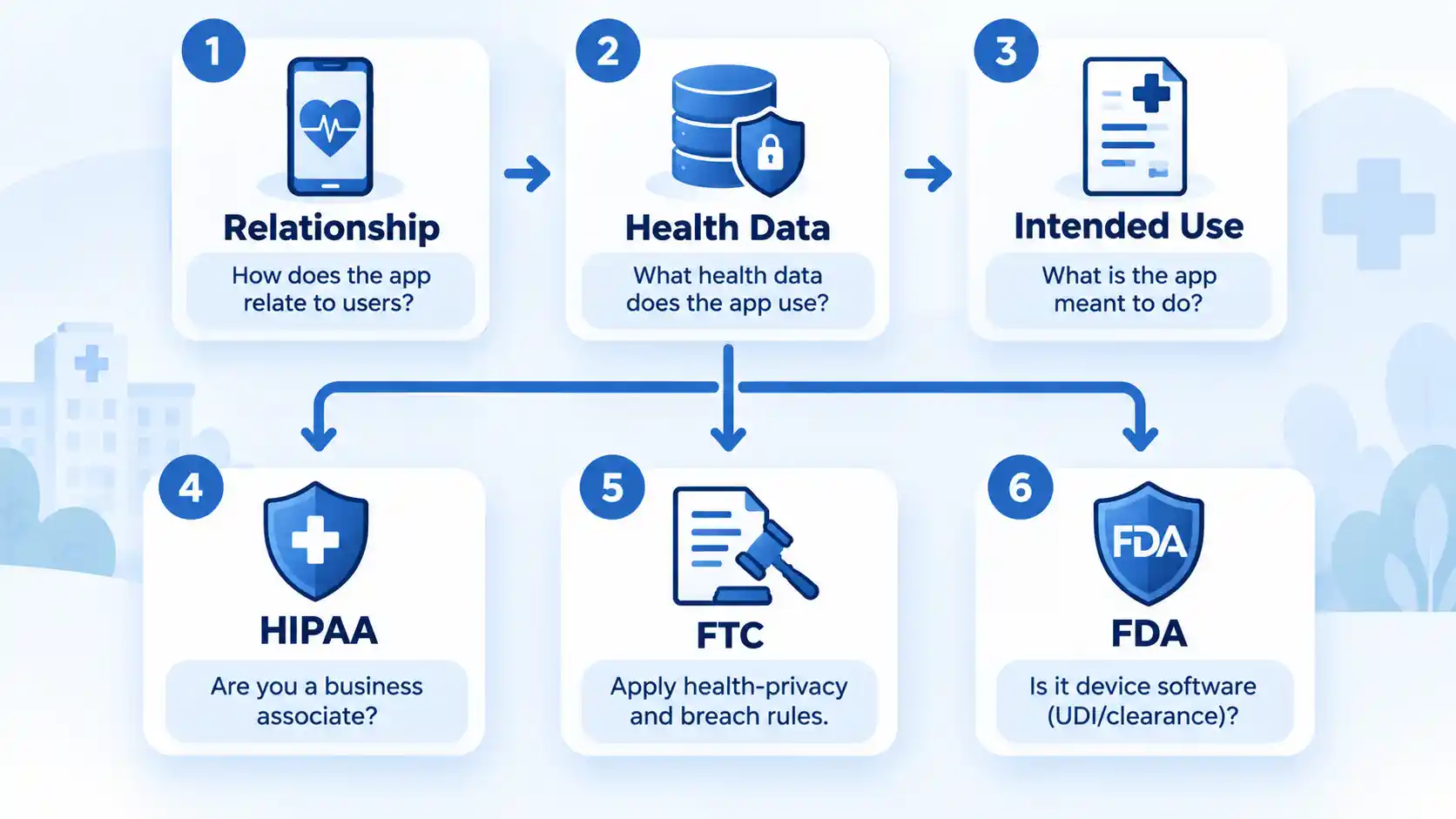
A practical starting document is a regulatory assumptions register. For each major feature, record who uses it, what decision it supports, what information it handles, where that information comes from, and which regulatory questions still need specialist review.
How to Develop a Healthcare App in 8 Steps
The safest development sequence is dependency-driven. Each step below should reduce uncertainty before the startup commits more engineering time, vendor contracts, or regulatory exposure.
- Step 1: Define the user, problem, and intended use
Start with the outcome the product is meant to change rather than a feature list.Write a short intended-use statement that identifies the primary user, the problem, and the action the software enables. A medication reminder that tells a user when to take a previously prescribed drug is materially different from software that recommends changing the dose. Similar screens can therefore create very different safety and regulatory questions.Map user roles separately. A patient, clinician, caregiver, administrator, and billing employee may need different workflows, permissions, and information. Do not assume that one account model can safely serve every role.
For each workflow, define an observable acceptance criterion. Instead of “the app should make booking easy,” specify that an authenticated patient can see eligible appointment slots, select one, receive confirmation, and avoid creating a duplicate booking if the network request is retried.
Also define what the product must not do. If the first release is not intended to diagnose disease, recommend treatment, or replace professional review, those boundaries should be reflected in requirements, interface language, and testing.
- Step 2: Map every health-data flow before designing screens
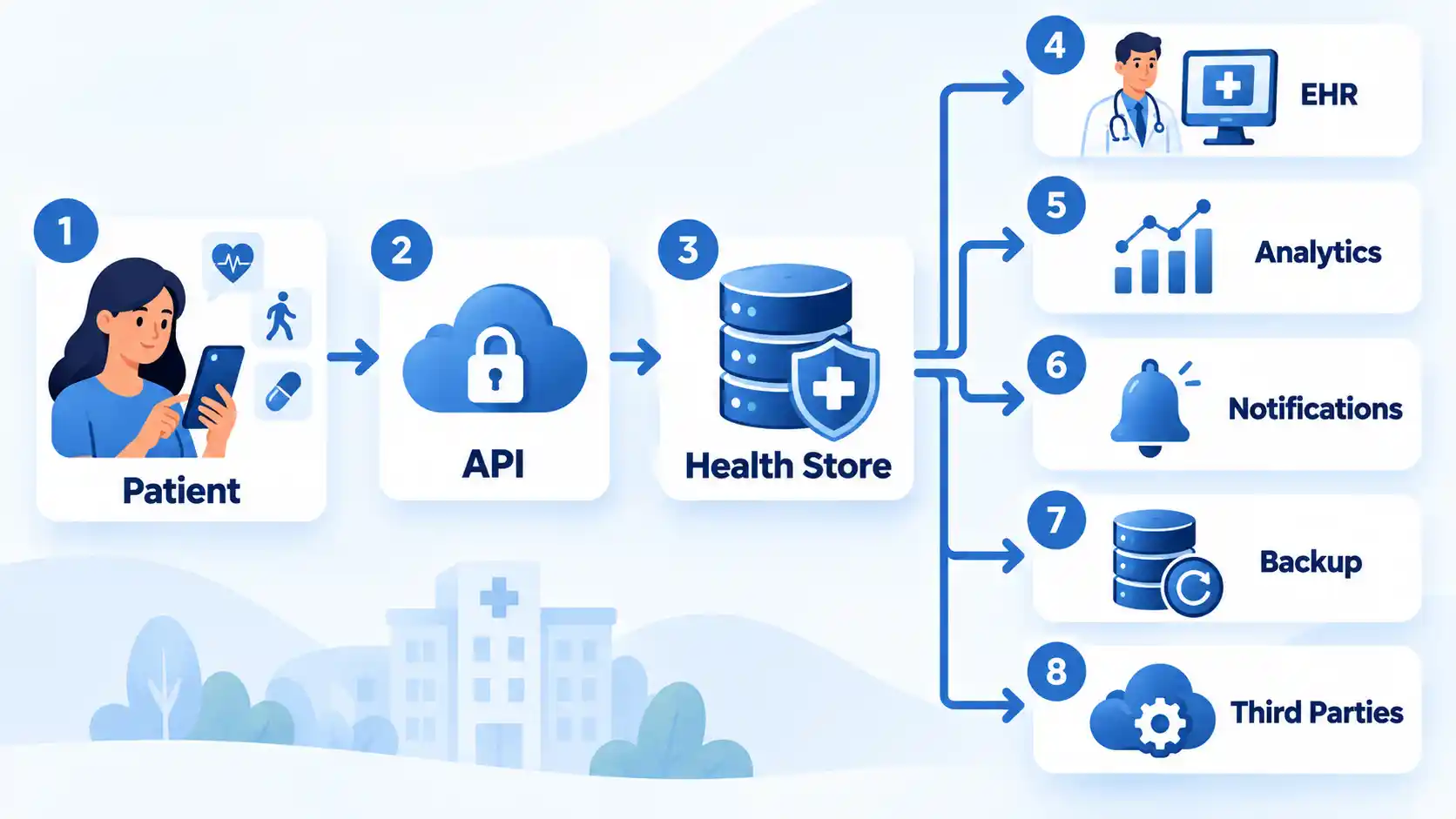
Document where information originates, where it travels, who can access it, and where copies remain.A data-flow inventory should cover more than the main database. Include mobile or web clients, backend APIs, authentication systems, clinical systems, analytics, crash reporting, notification services, backups, logs, customer-support tools, data exports, and third-party software development kits.For example, a symptom entered on a phone may travel through an authenticated API, be stored in the application database, appear on a clinician dashboard, generate a notification, enter diagnostic logs, and be included in a backup. Each branch creates a separate question about necessity, authorization, retention, disclosure, and deletion.
The FTC’s health-app privacy and security practices advise developers to minimize unnecessary data and permissions, inventory where information goes, scrutinize third-party services and code, and build security across the application lifecycle.
A useful rule is to ask four questions for every field: Why is it collected? Where is it stored? Who needs it? When should it be deleted? If the team cannot answer those questions, the data model is not ready.
- Step 3: Validate the workflow and cut the MVP to one useful outcome
Treat the minimum viable product as the smallest complete workflow that delivers value safely, not as the full product with fewer screens.Suppose the startup is solving appointment coordination. A useful first workflow may require account creation, provider availability, appointment selection, confirmation, cancellation, and basic administrative controls. Video consultations, insurance verification, social features, AI summaries, and advanced analytics do not automatically belong in version one.Keep a proof of concept, prototype, and production MVP conceptually separate. A proof of concept may demonstrate that an integration is technically possible. A prototype may validate usability with test data. A production MVP that handles real health information needs production-level decisions about authorization, storage, monitoring, support, vendors, and incident response.
Prioritize each proposed feature against the intended use. A feature deserves early inclusion when removing it breaks the core workflow, creates an unacceptable safety gap, or prevents the startup from validating its main product hypothesis.
- Step 4: Design the architecture and interoperability around the data
Decide where authoritative data lives and how each system exchanges it before choosing frameworks for convenience.Start by identifying the system of record. Some startups own the primary database for their workflow. Others display or update information stored in an electronic health record, laboratory platform, pharmacy system, wearable platform, or medical device. When several systems can modify the same information, define which source wins and how conflicts are resolved.FHIR, or Fast Healthcare Interoperability Resources, is an HL7 standard that represents healthcare information using standardized resources and web-based interactions. It is important, but “supports FHIR” is not a complete integration specification. The FHIR R4 REST specification defines interactions with healthcare resources while separately addressing security considerations such as authenticated operations and access control.
For a real integration, document the FHIR version, implementation guide, required resources, permitted operations, authentication method, error behavior, rate limits, synchronization approach, provenance rules, and how the app handles records that change outside its own interface. For U.S. certified health IT, the ONC Certification Program standards include FHIR Release 4, SMART App Launch, and US Core specifications for standardized API certification, with newer versions available through the Standards Version Advancement Process.
The difference between FHIR and older healthcare-data exchange approaches is substantial enough that FHIR versus HL7 implementation choices should be treated as an architecture decision rather than a marketing checkbox.
A startup integrating with an existing clinical system should also document which records it reads, which records it writes, who owns each field, and how conflicts are handled; the same integration questions apply whether the target is a general EHR or a specialized behavioral health electronic medical record.
Vendor selection belongs inside the architecture discussion. Cloud infrastructure, messaging, video, notifications, analytics, identity providers, and EHR connectors can all create additional security and privacy dependencies. A system diagram should make those boundaries visible before contracts are signed.
- Step 5: Build privacy and security into the development lifecycle
Treat security as an engineering requirement from the first design decisions instead of a test performed shortly before launch.For organizations subject to HIPAA, the currently effective Security Rule requires reasonable and appropriate administrative, physical, and technical safeguards for electronic protected health information. The HHS Security Rule summary covers requirements including risk analysis and management, access control, audit controls, authentication, integrity protections, transmission security, incident procedures, contingency planning, and business-associate arrangements.Those requirements should translate into concrete engineering work. Apply least-privilege access, protect sessions and credentials, encrypt sensitive traffic and stored data as appropriate, log security-relevant actions, control administrative access, manage secrets outside source code, define backup and recovery behavior, and document how access is removed when roles change.
Security also extends beyond HIPAA. NIST’s Secure Software Development Framework version 1.1 is a finalized set of high-level secure-development practices intended to be integrated into software development life cycles. That approach is more useful than relying only on a penetration test after engineering is effectively complete.
A simple failure example shows why context matters. Encrypting the database does not protect privacy if a push notification exposes a diagnosis on the user’s lock screen. Security reviews therefore need to examine the full workflow, including what users, administrators, support staff, logs, and external services can see.
General healthcare app security controls should cover APIs, vendors, analytics, telemetry, credentials, backups, incident handling, and data retention rather than focusing only on the primary medical database.
For broader infrastructure context, include cloud application security in the architecture review rather than assuming a hosting provider controls every security responsibility.
- Step 6: Design the experience and select only necessary features
Build features from validated workflows instead of copying a generic healthcare-app checklist.A profile is useful when identity, preferences, history, or permissions must persist. A dashboard is useful when a user has information worth summarizing. Messaging belongs in the product when communication is part of the actual care or support workflow. Reminders make sense when a timed action matters. Payments belong only when the product processes transactions.The same principle applies to EHR integrations, social features, gamification, video, AI summaries, and goal tracking. Each feature should have a named user, a defined workflow, a data requirement, an acceptance criterion, and a reason it belongs in the current release.
Accessibility should also be part of product design. W3C provides guidance for applying WCAG to mobile experiences, including mobile web content, mobile web apps, native apps, and hybrid apps. For a health product, teams should test with realistic constraints such as low vision, limited dexterity, high stress, reduced attention, small screens, and interrupted tasks.
Do not rely on color alone to communicate a dangerous reading, missed dose, failed upload, or appointment status. Controls need understandable labels, errors should explain how to recover, and important actions should remain usable with assistive technology where applicable.
Accessibility guidance is a design benchmark here, not a claim that one specific W3C document is universally mandated for every U.S. healthcare app. Applicable legal requirements depend on the product, organization, users, and jurisdiction.
- Step 7: Validate safety, security, interoperability, and usability before release
Test against the consequences of failure rather than treating “QA passed” as one undifferentiated result.Ordinary functional tests still matter: unit tests, integration tests, interface tests, regression tests, and supported-device checks. Healthcare workflows also require careful authorization tests, API contract tests, security tests, accessibility checks, synchronization tests, and realistic failure scenarios.Useful tests include confirming that clinician A cannot see clinician B’s patient, retrying a request does not create duplicate records, a stale mobile record cannot silently overwrite newer clinical data, a failed external API call is visible rather than lost, and time-sensitive reminders behave correctly across time zones.
For integrations, test both successful and unsuccessful exchanges. A FHIR endpoint returning a technically valid response does not prove that the application interprets the right resource, handles missing fields correctly, or preserves source-of-truth rules when two systems change the same record.
If a software function falls within FDA medical-device oversight, ordinary consumer-app testing does not replace the verification, validation, documentation, and other requirements applicable to that device function. FDA’s device software guidance describes a risk-based approach that focuses oversight on certain software functions meeting the medical-device definition.
Trace high-risk requirements back to the intended-use statement created in Step 1. The team should be able to show what was required, why it mattered, how it was implemented, and what test demonstrates that the requirement is met.
- Step 8: Launch with monitoring, incident response, and change control
Plan the operating model before release because production healthcare software continues to change after it reaches users.Define who watches service health, who receives security alerts, who can disable a broken integration, who communicates with users during an incident, and who approves high-risk changes. Logging and alerting should reveal failed data flows, unusual authorization events, integration errors, and service degradation without unnecessarily exposing sensitive information.Build a maintenance process for dependencies, mobile operating-system changes, API-version changes, security patches, expiring credentials, cloud configuration, backups, and disaster recovery. The FTC’s health-app security guidance treats data security as a lifecycle responsibility spanning design, development, launch, and post-market operation.
Not every release deserves the same level of review. Correcting button spacing is not equivalent to modifying an algorithm that influences clinical recommendations. Change control should scale with the potential effect on privacy, interoperability, safety, and regulatory status.
Product scope should be reassessed when features change. An application that begins as a general wellness tool can create new regulatory questions if later releases add clinical decision functions, provider-operated workflows, new health-data sources, or materially different sharing practices.
Choose Features From the Workflow, Not From a Generic Checklist
The legacy idea of a universal “essential healthcare app feature list” is too broad. A safe feature set follows directly from the validated workflow and the minimum information needed to support it.
- Identity and profiles: include them when the service needs persistent users, role-based permissions, preferences, or history.
- Dashboards: use them when several measurements or tasks need to be summarized. A simple single-task app may not need one.
- Messaging: include it only when communication is part of the service model and the startup can support appropriate access controls, retention, moderation, escalation, and notification behavior.
- Reminders: define timing, timezone behavior, failure handling, and what sensitive information may appear outside the authenticated app.
- Payments: add them only when the business model requires transactions, then isolate payment data from unnecessary health-data exposure.
- Clinical integrations: add only the data exchanges required for the workflow, with explicit read/write rules and source-of-truth ownership.
Interoperability, remote monitoring, automation, and AI can expand healthcare technology workflows, but every additional dependency also expands what the startup must design, test, secure, and support.
How Much Does It Cost to Develop a Healthcare App?
There is no defensible universal price for developing a healthcare app. A quote depends on what the product does, how many systems it connects to, the sensitivity and volume of its data, the number of user roles, the regulatory work required, and how much validation is needed.
The most useful way to estimate cost is to decompose the product into scope drivers. The table below shows why two apps that both appear to be “healthcare apps” can require very different budgets.
| Scope driver | Lower-complexity example | Higher-complexity example |
|---|---|---|
| Health data | User-entered profile and preferences | Clinical records, device data, or multiple external health-data sources |
| User roles | Single consumer role | Patient, clinician, caregiver, administrator, and support roles |
| Integrations | Few or no external healthcare integrations | EHR, FHIR, medical device, laboratory, pharmacy, or payer connections |
| Product risk | General wellness or administrative workflow | Functions that influence diagnosis, monitoring, or treatment decisions |
| Validation | Functional and usability testing | Expanded security, interoperability, clinical, and regulated-product validation |
| Operations | Basic support and monitoring | 24/7 operational coverage, incident escalation, complex vendor management, and regulated change control |
A scheduling app with one role and no clinical write-back is therefore not comparable with a remote-monitoring product that ingests device measurements, serves patients and clinicians, exchanges data with an EHR, generates alerts, and makes claims that could affect treatment.
Instead of asking a development company for one headline figure, ask for an estimate broken into discovery, product design, engineering, integrations, security, testing, regulatory support, deployment, vendor fees, and post-launch operations. That makes assumptions visible and reduces the risk that compliance, integrations, or maintenance appear later as unexpected costs.
What Team Does a Healthcare Startup Need?
The required team follows the product’s risk and architecture. A typical startup may need product leadership, UX design, mobile or frontend engineering, backend engineering, quality assurance, cloud or DevOps capability, and security expertise. Healthcare-domain, clinical, privacy, regulatory, or interoperability specialists may also be necessary depending on the intended use.
Those capabilities do not have to be separate full-time employees. A small company may combine roles internally and use specialists for focused work. What matters is that every critical responsibility has an identified owner and that the startup does not assume a general software developer can independently resolve legal, clinical, or security questions outside their expertise.
Before you choose an app development team, define the product scope, repository ownership, infrastructure access, security expectations, documentation requirements, and handoff process.
For regulated or high-risk functions, the startup should also be able to identify who approves requirements, who reviews risks, who validates the final behavior, and who owns changes after launch.
Verify These Decisions Before Development Starts
Before committing significant development budget, verify that the startup has resolved the decisions that determine architecture, risk, and testing. This is more useful than having a long feature backlog with unclear regulatory and data assumptions.
Verify the result
- The intended use and explicit product boundaries are written down.
- Primary users, roles, permissions, and high-risk workflows are identified.
- The startup has documented which HIPAA, FTC, FDA, state, or other regulatory questions require review rather than assuming one rule covers every health app.
- A health-data flow map covers storage, APIs, logs, analytics, notifications, backups, exports, and third parties.
- The MVP contains a complete useful workflow rather than unrelated features chosen because competitors have them.
- The system of record, interoperability assumptions, and read/write ownership rules are documented.
- Security requirements exist before implementation and include access control, logging, secrets, vendors, incident handling, and lifecycle maintenance.
- Each high-risk requirement has an observable acceptance criterion and a planned validation method.
- Post-launch ownership is assigned for monitoring, support, vulnerabilities, integration failures, backups, and product changes.
A startup that can answer those questions has a stronger basis for choosing technology, estimating cost, hiring developers, and deciding what belongs in its first release. When the answers are still unclear, resolving them before writing more code is usually cheaper than redesigning the system after health data, vendors, and clinical workflows are already embedded in the product.
For U.S. privacy scoping in particular, whether HIPAA applies to a health app should be treated as a relationship- and workflow-specific question rather than a label inferred from the app’s subject matter.

💬 Comments