To spot a cloned online casino, compare its exact domain with the website listed by the regulator or verified operator. Treat mismatched licence details, lookalike domains, unexplained redirects, unrelated app publishers, and unfamiliar payment recipients as reasons to stop.
Do not sign in, upload identity documents, install an application, or deposit money while a material mismatch remains unresolved. A cloned casino can copy the design, games, legal text, and licence number of a legitimate operator.
Quick Take: The Strongest Clone Indicators
- The exact domain is absent from the regulator’s record.
- The licence number belongs to another company or website.
- The address uses substituted letters, extra hyphens, misleading subdomains, or an unfamiliar ending.
- The regulator badge opens a page that imitates the regulator instead of its official domain.
- The login, document-upload, or payment page redirects to an unrelated website.
- A recently registered domain claims a long operating history.
- The website directs you to a fake app store or asks you to sideload an application.
- The payment recipient does not correspond to the operator or a disclosed processor.
- Support uses a free or unrelated email domain.
- You are told to deposit more money to unlock a withdrawal, verification, or refund.
A single weak clue can have an innocent explanation. A failed regulatory match, copied licence, unrelated payment recipient, or fake application publisher is a much stronger stop signal.
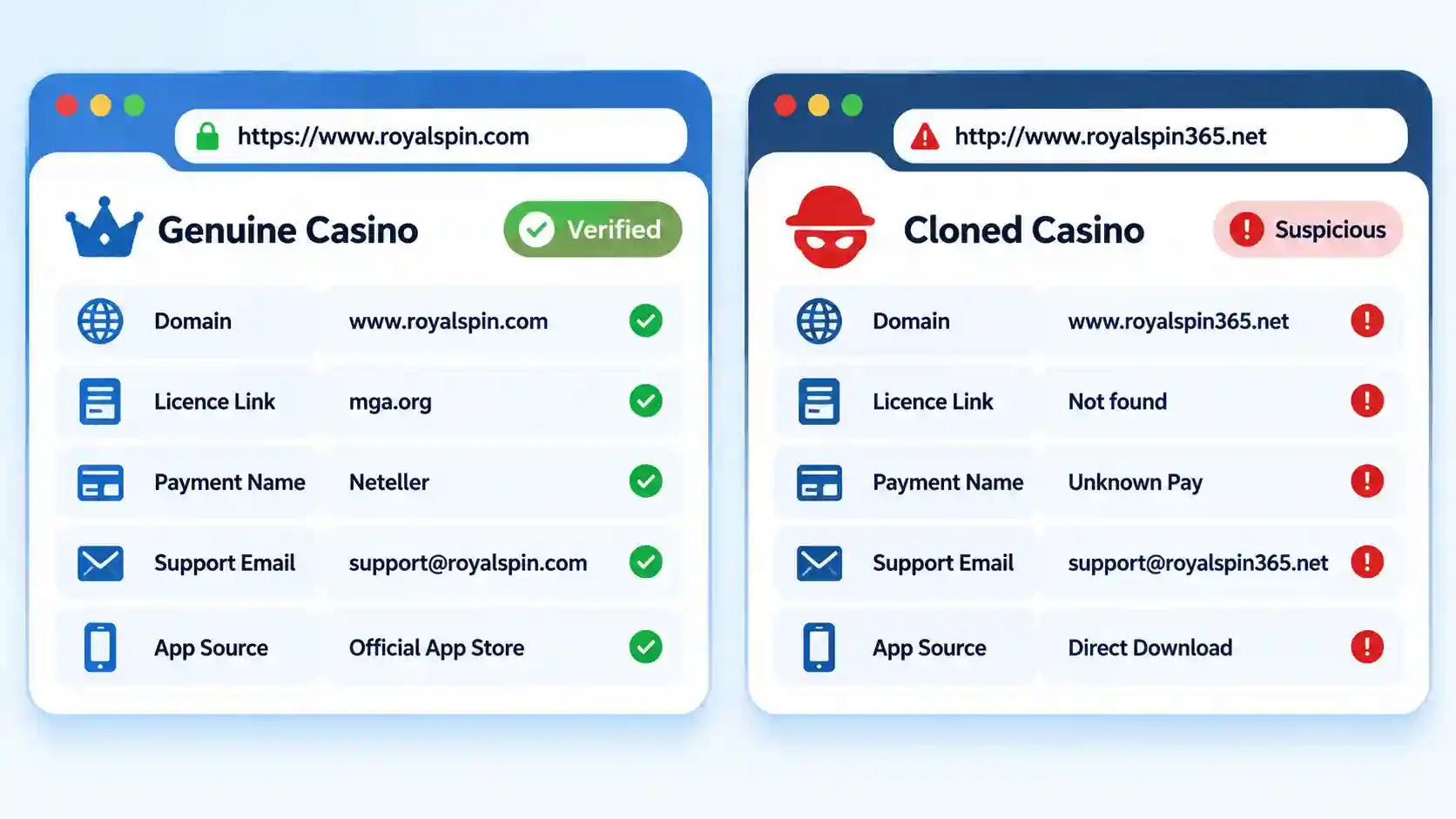
What Is a Cloned Casino Website?
A cloned casino is a website or application that copies another organization’s identity to appear legitimate. The impersonated organization may be a licensed casino, a gambling regulator, a payment service, an app store, or a casino-software provider.
Some clones reproduce a real casino’s interface almost exactly. Others borrow only its brand name, logo, licence number, game catalogue, or customer-support language. The objective may be to collect deposits, steal account credentials, obtain identity documents, install malicious software, or redirect users to an unauthorized gambling service.
This is a documented regulatory problem. In July 2026, the Malta Gaming Authority reported a pattern of websites impersonating its licensees and publishing false regulatory claims. The authority’s impersonation warning instructs consumers to confirm both the operator and website through its official register.
Before You Check a Suspected Website
Limit further exposure while you investigate:
- Do not log in or test a password on the suspected site.
- Do not click its licence seal or customer-support link.
- Do not install software or grant browser-notification permission.
- Do not send a small deposit as a test.
- Copy the URL as text or take a screenshot of the address bar.
- Record whether you arrived through an advertisement, search result, email, text, social post, or application.
- Use a separate browser tab to locate the regulator or genuine operator independently.
- Hide account numbers and other sensitive information before sharing screenshots.
If the casino’s legal identity is uncertain, begin with the full guide to verifying an online casino licence. Licensing verification should happen before comparing the operator’s payment methods.
How to Check Whether a Casino Website Is a Clone
Identify the registrable domain
Read the address bar from right to left. A typical address contains a protocol, hostname, path, and optional tracking information. In `https://login.casino-example.com/account`, the registrable domain is `casino-example.com`. The word `login` is only a subdomain.
This distinction exposes addresses designed to mislead. In `casino-example.secure-payments.com`, the controlling domain is `secure-payments.com`, not `casino-example`. The trusted-looking words placed before it do not change who controls the destination.
Look for substituted characters such as `0` instead of `o`, `1` instead of `l`, or `rn` instead of `m`. Also check added words, doubled letters, hyphens, unexpected country codes, and endings such as `.bet`, `.vip`, or `.app` when the verified brand uses another address.
Expected result: You identify the core domain rather than relying on the brand name displayed on the page.
Find the genuine casino domain independently
Do not ask the suspected site to prove itself using links that it controls. Open the relevant gambling regulator’s website independently and search its register for the operator, brand, licence number, or domain.
You may also use a verified corporate page, established regulator record, or official regional directory to locate the genuine address. Compare the complete hostname, including any meaningful regional subdomain.
A search engine result can help you locate an official source, but ranking first does not prove authenticity. Advertisements and misleading pages can appear above the genuine website.
Expected result: You obtain an authoritative reference address that did not originate from the suspected website.
Match the operator and licence record
Compare the legal company, trading name, licence number, domain, authorization status, and permitted gambling activity. A clone may copy a genuine licence number from another business, so matching the number alone is insufficient.
The brand and legal operator can legitimately differ. This commonly occurs when one company operates several trading names or supplies a white-label casino platform. The regulator’s record must still connect the licence holder to the exact domain or explain the operating relationship.
If the licence exists but the domain is absent, inactive, or assigned to another company, do not deposit. Ask the regulator for clarification through contact details on its official website.
Expected result: The regulator independently connects the exact website to the licensed operator.
Inspect redirects and destination changes
Watch the address bar when moving from the homepage to login, registration, verification, support, and payment pages. A clone may begin on a convincing domain before redirecting sensitive actions elsewhere.
A separate domain is not automatically fraudulent. Licensed casinos often use disclosed identity, customer-support, and payment processors. The operator should identify the provider, and the transition should not disguise the new destination.
Stop if the login page unexpectedly opens on an unrelated domain, the document uploader uses an unexplained file-sharing service, or support directs you to a different website through chat.
Expected result: Every sensitive destination is either controlled by the verified operator or attributable to a disclosed provider.
Check domain registration data
Use the ICANN Lookup service for supported domains. Registration data may show the creation date, most recent update, expiry date, registrar, and nameservers. Personal registrant details are often redacted for privacy, so hidden ownership is not proof of fraud.
Since January 28, 2025, RDAP has replaced traditional WHOIS as the definitive delivery method for generic top-level domain registration data, according to the ICANN RDAP notice.
A domain created last week is suspicious when the website claims to have operated at that address for 15 years. However, domain age is supporting evidence only. A legitimate operator can launch a new regional site, while criminals can buy an old domain or compromise an established one.
Expected result: The registration timeline is either consistent with the website’s history or adds weight to other warning signs.
Check browser and Safe Browsing warnings
Do not continue past a browser warning about phishing, malware, an invalid certificate, or deceptive content. Record the warning and close the page.
Google says its Safe Browsing system examines URLs for known phishing and malware threats and displays warnings in supported browsers and search products. You can use its site-status tools as an additional check.
A clean result does not prove that a casino is licensed or harmless. New clone sites may not have been detected, and a legitimate site can later become compromised.
HTTPS also has a narrow meaning. It encrypts the connection between your browser and the website. Criminals can obtain valid certificates for domains they control, so a padlock does not confirm the operator’s identity or gambling authorization.
Expected result: You identify known technical threats without treating the absence of a warning as approval.
Verify the application and installation route
Reach the official mobile application through the verified operator’s website or a listing linked from an authoritative source. Compare the developer name, publisher, privacy-policy domain, support contact, download history, and recent updates.
Be cautious when an advertisement opens a page that visually copies Apple’s App Store or Google Play but remains inside a normal browser. A button labelled Install may add a progressive web app, configuration profile, or downloaded package instead of an app reviewed by the platform.
Do not sideload an APK, desktop installer, or mobile profile solely because a support agent says the regular store version is unavailable in your country. Geographic unavailability may indicate that the operator is not authorized to serve your location.
Expected result: The application publisher and distribution route connect to the verified operator.
Verify support contacts and payment recipients
Compare the support email’s domain with the verified operator’s address. A free email account or unrelated domain deserves scrutiny, especially when it requests identity documents, remote-device access, cryptocurrency, or payment outside the cashier.
Before authorizing a payment, inspect the card merchant, bank beneficiary, e-wallet merchant, or crypto instructions. A legitimate processor may have a different name from the casino, but that relationship should be disclosed or explainable.
Do not transfer funds to a support agent’s personal account. Treat constantly changing bank beneficiaries or wallet addresses as high-risk until independently verified.
Expected result: The recipient is the licensed operator or an identifiable payment provider rather than an unrelated person or company.
Compare the copied content for contradictions
Clones often reproduce the visible design while overlooking details deeper in the site. Check whether the terms name another brand, the privacy policy identifies a different company, or the responsible-gambling links lead to the wrong country.
Other inconsistencies include mixed currencies, contradictory minimum ages, placeholder addresses, broken complaint links, unexplained language changes, or support pages copied from another operator.
Recognizable games do not establish legitimacy. The UK Gambling Commission has documented licensed games appearing on unlicensed gambling websites. A familiar game studio or live-dealer interface is not a substitute for checking the casino itself.
Expected result: The legal and operational content is consistent with the verified operator and jurisdiction.
Assign a pass, caution, or fail result
Give the site a pass only when the regulator, operator, exact domain, app publisher, and payment route align. Use caution when a legitimate operator appears to have introduced a new regional domain, migration, white-label relationship, or processor that is not yet clearly documented.
Fail the site when the licence belongs to an unrelated company, the domain impersonates another brand, the regulator page is fake, or the payment recipient cannot be connected to the operator.
Expected result: You reach a decision before exposing credentials, documents, or money.
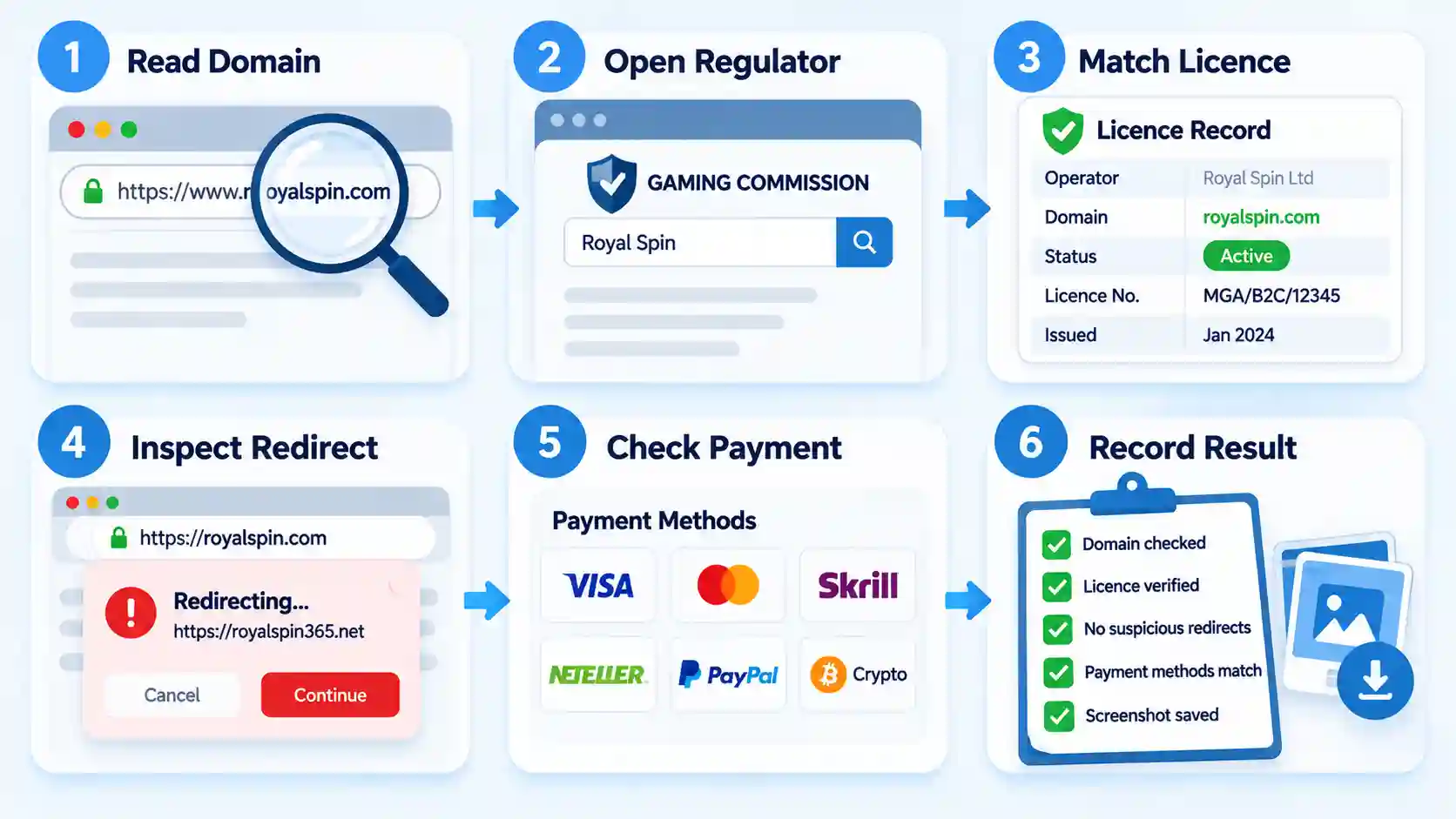
Verification Matrix: Genuine, Unclear, or Cloned
| Check | Genuine indication | Caution | Clone or impersonation indication |
|---|---|---|---|
| Exact domain | Listed by the regulator or verified operator | New regional or migrated domain | Lookalike or unrelated domain |
| Licence number | Matches the operator and domain | Business relationship is unclear | Belongs to an unrelated company |
| Regulator link | Uses the authority’s official domain | Official link is temporarily unavailable | Opens an imitation verification page |
| Registration history | Consistent with the website’s stated history | Recent launch or ownership change | New domain claiming a long history |
| HTTPS | Valid encrypted connection | Recently changed certificate | Certificate or browser warning |
| Application | Publisher matches the verified operator | Related company is not explained | Unrelated publisher or fake store page |
| Payment recipient | Operator or disclosed processor | Unfamiliar but traceable descriptor | Personal or unrelated beneficiary |
| Games and design | Consistent brand and legal information | Minor regional variations | Copied assets with contradictory legal details |
Regulatory, domain, publisher, and payment-recipient mismatches carry more weight than design quality. A polished clone can look more convincing than an older legitimate website.
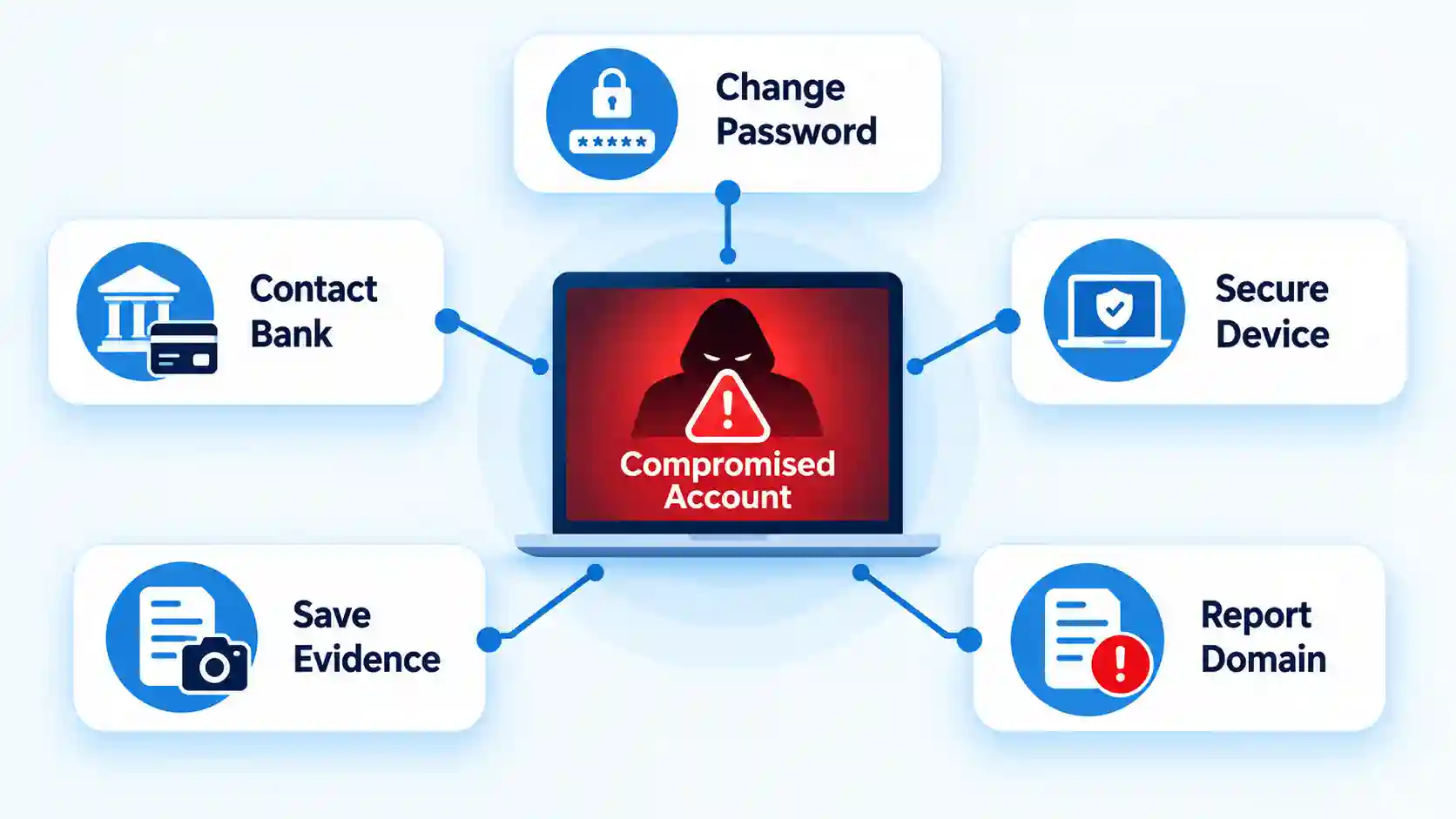
What to Do If You Already Used the Suspected Clone
Danger
- Stop interacting with it.
Close the page or application. Do not confront support or follow new recovery instructions. - Preserve evidence.
Save the exact URL, screenshots, emails, chat logs, phone numbers, payment details, transaction references, and crypto hashes. - Change exposed passwords.
Use a trusted device and start with your email account. Change every account where the same or a similar password was used. - Enable multifactor authentication.
Terminate unfamiliar sessions and remove unknown recovery addresses or devices. - Contact the payment provider.
Tell your bank, card issuer, wallet, or exchange what information was exposed and identify unauthorized transactions accurately. - Protect affected cards and accounts.
Freeze or replace them when advised. Monitor statements and alerts for new activity. - Secure the device.
Remove suspicious applications or profiles, review permissions, install operating-system updates, and run a trusted security scan. - Protect your identity.
Treat uploaded passports, licences, statements, and selfies as compromised. Follow the relevant identity-theft process in your country. - Report the clone.
Notify the impersonated operator, gambling regulator, browser-security provider, hosting or advertising platform, and applicable national fraud-reporting service. - Avoid recovery scams.
Do not pay an agent who guarantees that lost deposits or cryptocurrency can be recovered.
The urgency depends on what happened. Merely viewing a page creates a different risk from entering a password, uploading identity documents, authorizing a card payment, sending crypto, or installing software.
The US Federal Trade Commission’s phishing response guidance recommends protecting affected accounts and devices when scammers obtain personal or financial information. Readers who submitted documents should follow the extended checklist for ID uploaded to a scam site.
If money was sent and the casino now refuses or delays payment, preserve the clone evidence before following the casino withdrawal troubleshooting process.
Common Mistakes That Make Verification Less Reliable
| Mistake | Why it fails | Better check |
|---|---|---|
| Trusting the first search result | Advertisements and manipulated results can lead to impersonators | Start with an official regulator record |
| Clicking the casino’s licence seal | The suspected site controls the destination | Open the regulator independently |
| Trusting HTTPS | Encryption does not prove identity or authorization | Match the domain and operator |
| Checking reviews only | Reviews may concern a different domain or be manipulated | Verify the exact URL through primary sources |
| Relying on domain age | Old domains can be sold or compromised | Combine RDAP with regulatory evidence |
| Recognizing the games | Licensed games can appear on unauthorized sites | Verify the casino’s own licence |
| Testing with a small deposit | Successful payment confirms only that the site can receive money | Do not fund an unresolved website |
| Questioning suspicious support | You may reveal more information to the impersonator | Contact the verified operator separately |
Operational Limits and Edge Cases
Not every unfamiliar address is a clone. Legitimate operators may use country-specific domains, white-label brands, dedicated identity providers, payment processors, or new addresses introduced during a migration.
A genuine exception should be independently documented. The regulator’s register, verified operator website, official app listing, or published provider relationship should explain why the domains or company names differ.
RDAP records can hide personal ownership details for legitimate privacy reasons. Safe Browsing may not yet recognize a newly launched phishing site. Conversely, an established legitimate website can be compromised and temporarily serve malicious content.
Progressive web apps also blur the difference between a normal website and an installed application. Their use is not automatically malicious, but the installation source and operator still require verification.
Do not assume a site is genuine because it is absent from a regulator’s unauthorized-domain list. Blacklists document known cases and can lag behind new domains. Positive verification through official records is stronger than the absence of a warning.
Key Takeaways
- Read the registrable domain instead of trusting the logo or page title.
- Navigate from the official regulator toward the casino.
- Match the legal operator, licence number, exact domain, status, and activity.
- Inspect redirects before entering passwords, documents, or payment information.
- Use RDAP and Safe Browsing as supporting checks, not proof of legitimacy.
- Do not treat HTTPS, polished design, or recognizable games as licensing evidence.
- Verify application publishers, support contacts, and payment beneficiaries.
- Stop when a regulatory, domain, publisher, or transaction-recipient mismatch appears.
- Secure exposed accounts and devices immediately.
- Preserve evidence before reporting or attempting recovery.
Frequently Asked Questions
Can two legitimate casino websites have almost the same name?
Yes. Separate companies, regional brands, and white-label casinos can use similar names. Similarity does not establish a connection. Verify each exact domain and its legal operator through the regulator responsible for your location.
Can a cloned casino rank above the real website in search results?
Yes. A clone can appear through paid advertising or temporarily rank for brand-related searches. Search position is not authentication. Use the regulator’s register or another independently verified brand source to locate the official domain.
Does a valid SSL certificate mean a casino website is genuine?
No. A valid certificate encrypts traffic between your browser and that domain. It does not prove that the domain belongs to the casino it claims to represent or that it holds a gambling licence.
Can scammers copy a real casino’s live chat?
Yes. They can copy the appearance of a chat widget or use a similar third-party service. Verify the website surrounding the chat and contact the genuine operator through details obtained independently.
Is a newly registered casino domain always fraudulent?
No. Operators can launch new brands, regional sites, and replacement domains. A recent registration becomes more concerning when the site claims a long history or lacks an official connection to the licensed operator.
What if the casino is not on an unauthorized-site list?
Its absence proves only that the specific domain may not have been listed. New threats can appear before regulators or security services detect them. Confirm the domain positively through the operator’s official regulatory record.

💬 Comments