Almost everything marketed as a “new AI tool” in 2026 is an interface wrapped around a small number of well-documented model families. Understand what sits underneath the tool and which regulatory tier it lands in, and launch-day marketing stops mattering. This explainer walks through how today’s language and image models are actually built, the limits that follow from that construction, and the obligations the EU AI Act now imposes on anyone selling into or operating in Europe. You will finish with a repeatable way to size up a new tool without a hype cycle.
Quick Take
Judge an AI tool by what powers it and what governs it, not by when it launched. The model family tells you the class of task it handles; the input limits tell you whether it fits your workload; the EU AI Act tier tells you your obligations. A vendor’s own documentation is reliable for product facts and useless for proving superiority.
What “AI-Powered Tool” Actually Means in 2026
Strip away the branding and an AI-powered tool is a product whose core behavior comes from a pretrained model rather than hand-written rules. The model learns patterns from large amounts of data, and the tool exposes that learned behavior through an interface: a chat box, an image generator, a coding assistant, a voice agent.
Two model families do most of the work. Language and reasoning tools trace back to the transformer architecture introduced in the 2017 paper “Attention Is All You Need”. Image and media-generation tools trace back to denoising diffusion, described in the 2020 paper “Denoising Diffusion Probabilistic Models”. Those two papers are the research roots; everything you use in 2026 is a descendant.
Info
A “tool” is the product layer. The “model” is the trained system underneath. Confusing the two is how buyers end up paying for a new interface on an old model, or assuming a model upgrade automatically improves the product built on it.
How the Models Under the Tools Actually Work
The transformer’s core idea is attention: instead of reading words strictly one after another, the model weighs how much each word in a sentence should influence every other word. That lets it build a representation of the whole sentence at once. The BERT model card describes this as learning a “bidirectional representation” of a sentence, in contrast to autoregressive models that mask future tokens and predict forward.
Diffusion models work from the opposite direction. They learn to reverse a noising process: start with random noise and progressively denoise it into a coherent image. The paper title says it plainly: denoising diffusion. The practical upshot is that image tools are trained to remove noise step by step until a picture emerges, which is why generation feels iterative rather than instant.
| Model family | What it is trained to do | Typical tool use | Representative primary source |
|---|---|---|---|
| Transformer (attention-based) | Weigh relationships between all tokens in an input to build a contextual representation | Text, chat, coding, voice, reasoning assistants | “Attention Is All You Need” (arXiv 1706.03762) |
| Diffusion (denoising) | Reverse a noising process to generate coherent media from noise | Image and media generation | “Denoising Diffusion Probabilistic Models” (arXiv 2006.11239) |
Worked Example: Inside a Pretrained Language Model
BERT is a useful specimen because its official model card publishes the actual training numbers, something most modern model releases keep private. The card was written by the Hugging Face team, not the original BERT authors, and it says so directly. Treat it as authoritative documentation of how this specific model was built, not as a claim about every model in 2026.
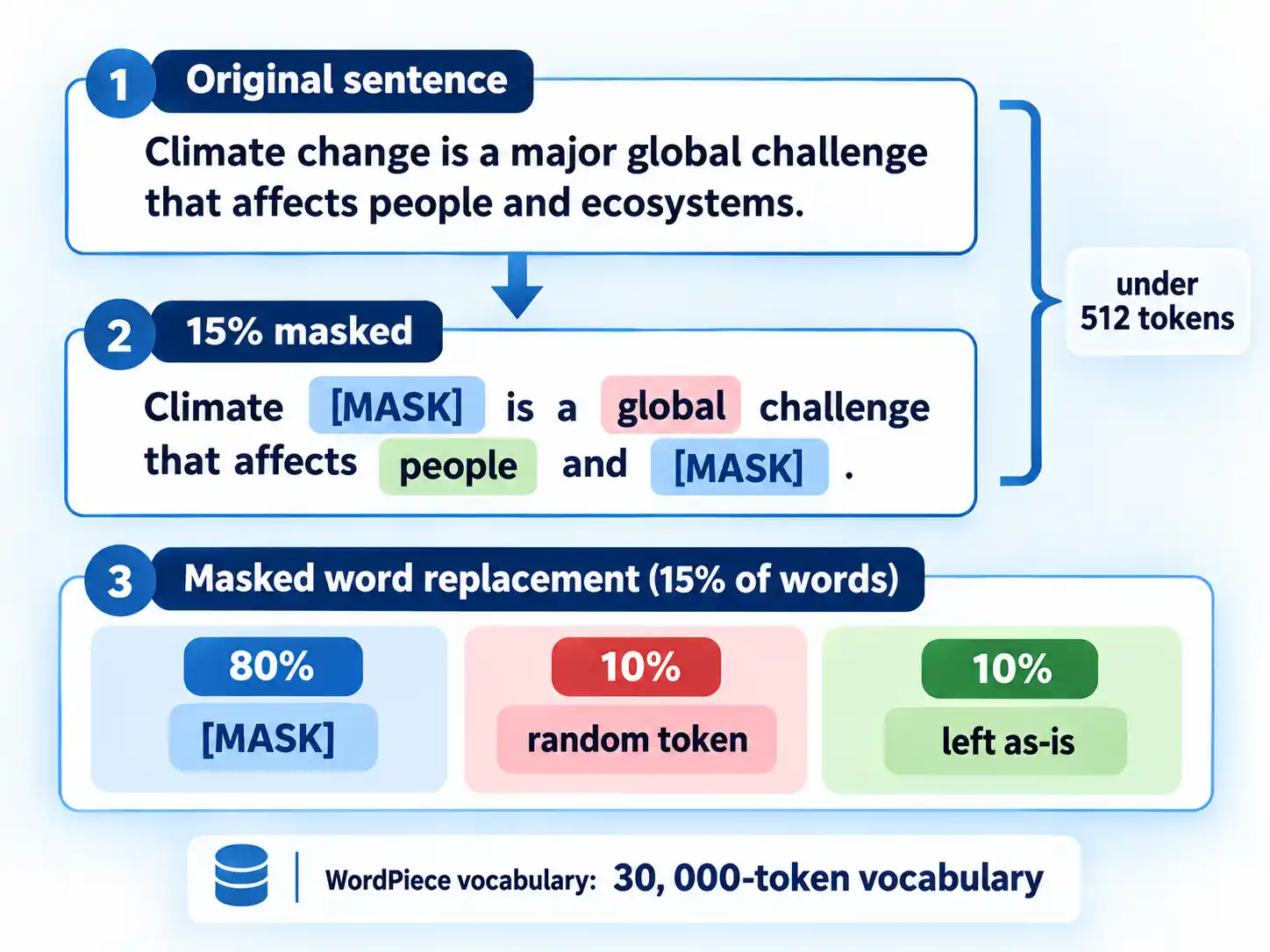
Here is the mechanism in concrete terms. During pretraining, the model randomly masks 15% of the words in a sentence and has to predict them, as documented on the BERT base model card. Of those masked words, 80% are replaced with a [MASK] token, 10% with a random token, and 10% are left unchanged. A second objective, next-sentence prediction, teaches the model whether two sentences originally followed each other. No humans labeled the data; the labels are generated automatically from raw text, which is why the approach scales to large corpora.
| Specification | Value stated on the model card |
|---|---|
| Masking rate | 15% of input words masked |
| Mask replacement scheme | 80% [MASK], 10% random token, 10% left as-is |
| Pretraining objectives | Masked language modeling plus next-sentence prediction |
| Combined input length | Under 512 tokens for the two “sentences” combined |
| Vocabulary | WordPiece, 30,000 tokens |
| Training data | BookCorpus (11,038 unpublished books) plus English Wikipedia |
| Training hardware | 4 cloud TPUs in Pod configuration (16 TPU chips total) |
| Training run | One million steps, batch size 256 |
Why This Matters: Capability Limits
Every limit below follows from how the model was built, not from a vendor cutting corners. Knowing the mechanism lets you predict where a tool will struggle before you spend money on a demo.
- Input length is a hard ceiling. BERT’s combined input is under 512 tokens. Modern models advertise far larger context windows, but the principle holds: every model has an input limit, and long documents get truncated or compressed. Check the number before you assume a tool can read your whole contract.
- Pretraining objectives shape what the model is good at. A model trained to fill in masked words and predict sentence order learns language structure well; it does not automatically learn to follow instructions or reason about your domain. That gap is why fine-tuning and labeled data still matter.
- Labeled data is still the bottleneck for specialized tasks. The BERT card notes that downstream tasks need a dataset of labeled examples to train a classifier on top of the model’s features. Self-supervised pretraining reduces the labeling burden; it does not remove it.
- Tokenization has edges. A 30,000-token WordPiece vocabulary handles common English well and can fragment unusual terms, names, and code. Odd inputs cost more tokens and can degrade output quality.
Why This Matters: New Rules
If you sell into or operate in the EU, the regulatory layer is now part of the product decision. The EU AI Act is described by the independent reference site artificialintelligenceact.eu as the first comprehensive AI regulation by a major regulator. It sorts applications into three risk categories, and the category, not the model, determines your obligations.
| Risk category | What falls in it | What it means for you |
|---|---|---|
| Unacceptable risk | Applications that are banned outright, such as government-run social scoring | Do not build or deploy these in the EU |
| High-risk | Applications subject to specific legal requirements, such as a CV-scanning tool that ranks job applicants | Expect formal compliance obligations before deployment |
| Largely unregulated | Applications not explicitly banned or listed as high-risk | Fewer obligations, but transparency rules may still apply |
The deadlines are the part procurement teams need on a calendar:
- Article 50 transparency obligations apply to providers and deployers by August 2026.
- National AI regulatory sandboxes: under Article 57, each Member State must establish at least one by 2 August 2026.
- General-purpose AI (GPAI) guidance: the AI Office published preliminary scope guidelines on 22 April 2025 and draft GPAI guidelines on 18 July 2025.
Two clarifications that get lost in coverage. First, the Act does not ban most AI; it bans only the unacceptable-risk tier. Second, the reference site above is an independent information resource, not the European Commission’s own portal, so confirm deadlines against the official text before you sign a compliance plan. For teams deploying AI features inside a web product, the security work overlaps with your existing content security policy planning.
Common Misconceptions and Real Limitations
Most bad AI decisions start with a wrong mental model. Here are the three that cause the most expensive mistakes, each corrected by the mechanism or the rule that contradicts it.
| Common claim | What the evidence supports |
|---|---|
| “The newest tool is the best tool.” | Newness says nothing about fit. What matters is the model family, its input limits, and whether it was trained for your task. A newer interface on an older model can underperform a well-matched older tool. |
| “The model understands like a person.” | BERT learns a statistical representation of language by predicting masked words and sentence order. That is pattern learning, not comprehension. It is why models can be fluent and still wrong. |
| “AI tools are unregulated.” | The EU AI Act assigns applications to three risk tiers, with transparency obligations under Article 50 applying by August 2026. The rules are real and dated. |
A Dated Vendor Snapshot: What a 2026 Tool Stack Looks Like
To see the product layer in concrete terms, look at one vendor’s own changelog. The OpenAI API changelog is a self-description of its product surface, useful for illustrating what a 2026 developer-facing stack looks like, and nothing more. It is not a ranking and not a market survey.
As of the OpenAI API changelog, the API surface includes prompt-to-voice creation for API customers, nine added GPT-Live voices, native Decisions integration, an “Ultrafast” mode for GPT-6.1 Sol via service_tier: "ultrafast", a Decisions API beta with gpt-6-luna, computer use in the Agents API, and a simplified three-tier usage structure (Build, Launch, Grow). Pricing for GPT-6.1 Sol is listed at $2 input, $0.10 cached input, $2.50 cache write, and $10 output per 1M tokens for prompts up to 272K input tokens. OpenAI states billing begins October 5, 2026.
Warning
These are one vendor’s stated facts on one date, aimed at developer and API customers. Prices and features change, and a changelog entry proves only what that vendor says about its own product, never that it is better than an alternative.
Evaluating a New Tool: Decision Rules
When a new AI tool lands in your feed, run these checks in order. The first two usually settle the question before you get to a demo.
- Identify the model family. Is it transformer-based, diffusion-based, or something else? That tells you what class of task it is built for and where its blind spots likely are.
- Find the input limits. Look for the context window, token limit, or file-size cap. If the tool cannot ingest your real workload, the rest of the evaluation is moot.
- Determine the EU AI Act risk tier. If you operate in or sell into the EU, classify the use case before deployment. High-risk uses carry formal obligations; banned uses are off the table.
- Read the vendor’s own documentation. Model cards, changelogs, and API docs are the vendor’s account of its product. They are reliable for product facts and useless for proving superiority.
- Ask what independent evidence exists. If the only source is the vendor, treat performance claims as unverified until you can test against your own data.
For teams running AI features on cloud infrastructure, the security review is part of this checklist; a solid AWS penetration testing tools and checklist helps you assess the environment the tool will live in. And because most of these tools are cloud-hosted, the quality of your connection affects the experience; readers in the New York area evaluating fiber internet in New York City have a practical reason to check upload and latency before blaming the model for slow responses.
What This Article Does Not Claim
This piece explains mechanism and rules. It does not rank tools, declare any product “worth using,” or report independent testing; none of that was performed. The vendor snapshot is one company’s dated self-description. The BERT numbers describe one model, not every model in 2026. And the regulatory summary should be confirmed against the official EU text before it drives a compliance decision.
The practical conclusion is simple: stop evaluating AI tools by their launch date and start evaluating them by what sits underneath and what rules apply. A tool built on a well-documented model family, with input limits that fit your workload and a risk tier you can defend, is a safer bet than anything on a leaderboard. The mechanism and the rules are the durable part; the product names are not.

💬 Comments