Melbourne’s water reaches your kitchen already treated, disinfected and tested, and the utility that supplies it describes the result, without much modesty, as tasting great.
If your tap water carries a chlorine edge or sediment, a filter can change that quickly. If your question is whether the water is safe to drink, the municipal supply is generally the wrong thing to worry about. That leaves the more useful question: which method and which format fit the tap, the cabinet and the budget you actually have?
Quick Take
- Melbourne’s tap water is generally safe and largely drawn from protected catchments, so a home filter is usually an aesthetic or local-plumbing choice.
- Match the method to the complaint: carbon for chlorine taste, odour and particles; reverse osmosis for a specific contaminant-reduction goal; UV for disinfection of relatively clear water.
- Match the format to your constraints: jug, tap-mounted, benchtop and fridge filters suit renters; under-sink systems suit volume and permanence; whole-house filtration only makes sense for a specific supply problem.
- Certification and a workable cartridge-replacement routine matter more than the feature list on the box.
- Price the cartridges before the hardware: ongoing costs can outrun the purchase price.
Why Melbourne’s water changes the filter question
Start with the scale of what is arriving at your kitchen. Melbourne Water supplies around 1,250 million litres of drinking water a day to more than 5 million people, and the network behind that figure is large enough to be worth picturing.
Info
The Melbourne supply system: 163,000 hectares of protected and open catchments, 10 water storage reservoirs, 40 service reservoirs, 13 water treatment plants and roughly 1,100 km of aqueducts and underground mains.
Most of that water comes from protected catchments in the Yarra Ranges, where native forest soils act as a natural filter. By the utility’s own count, Melbourne is one of only two cities in the world whose drinking water comes primarily from protected catchments where it needs only disinfection. Water from open catchments gets full treatment to meet strict quality guidelines, and water can rest in the storage reservoirs for up to five years, which helps quality as impurities break down over time.
Testing happens before the water is handed over to your retail water company, and the supply is managed against the Australian Drinking Water Guidelines. One nuance matters when you start weighing up filter claims: the NHMRC is explicit that those guidelines are not mandatory, legally enforceable standards, and that each state and territory decides how they are implemented. Regulators and suppliers work to them as a shared framework.
What this means at the kitchen tap
CHOICE’s consumer guidance is that most Australians do not have to worry about getting sick from the water they are supplied with. What people do notice is the disinfectant. Chlorine is added for good reason, and it can leave a taste and smell that lingers in a glass of water; leaving a jug to sit for a couple of hours lets that smell gradually dissipate.
That is the honest frame for this purchase. A certified carbon filter will remove a taste you dislike faster than waiting will, and it will catch sediment and particles that show up in tap water. Those are local, aesthetic problems: real ones, worth solving, and a different matter from a municipal safety failure.
If a health concern is what prompted the search, raise it with a healthcare professional and treat the filter choice as a secondary decision.
How the main filtration technologies work
Keep two categories separate, because product marketing tends to blur them. Carbon, ion-exchange softening, reverse osmosis and UV are treatment methods, the chemistry or physics doing the work. Jugs, tap-mounted units, benchtops, under-sink systems, fridge filters and whole-house units are formats, the hardware the method sits inside. Carbon media can appear in a jug or a plumbed-in canister.
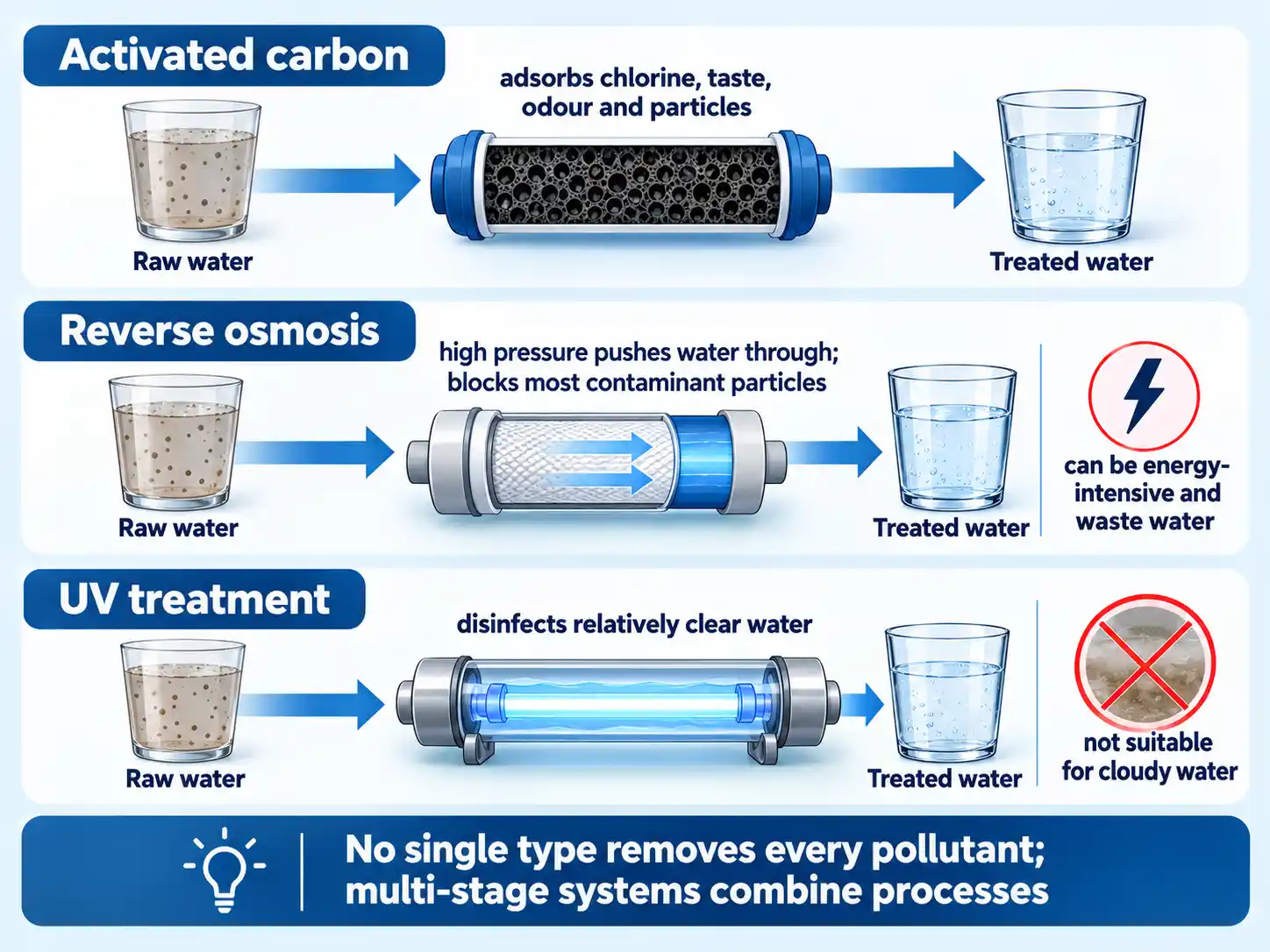
Activated carbon and carbon block. Carbon works by adsorption, which is different from absorption: the material’s pores are structured so that certain particles stick to them, much like pumice traps material in its cavities. Coconut, charcoal and ceramic are common sources. Carbon helps remove chlorine, taste, odour and particles. It leaves plenty behind, so treat any claim of all-round removal as marketing.
Ion-exchange softening. If you get white scale in the kettle and a film on the shower screen, the issue is dissolved minerals. A softening medium, usually an ion-exchange resin, reduces those minerals. It targets hardness and the build-up it causes, so treat it as a maintenance and appliance-protection measure.
Reverse osmosis. RO uses pressure from your pipes to push water through a thin, semipermeable membrane that blocks most contaminant particles. It suits households with a specific contaminant-reduction goal, and the trade-off is real: RO can be energy-intensive and can waste water, so check current efficiency claims for the specific unit rather than assuming the category has solved it.
UV treatment. Ultraviolet light disinfects water, and it only works on water that is already relatively clear. Use UV as a disinfection step inside a system designed for that job.
Multi-stage systems. No single filtration type removes every pollutant, which is why many systems combine processes. Multi-stage designs let you cover several problems at once. They also increase the number of cartridges you will be replacing.
| Method | How it works | Suits | Limits |
|---|---|---|---|
| Activated carbon / carbon block | Adsorption: particles stick to the pores of carbon, charcoal or ceramic media | Chlorine taste, odour, and particles | Does not remove every contaminant; needs regular cartridge changes |
| Ion-exchange softening | Resin exchanges minerals that cause hardness | Scale build-up in kettles, sinks and appliances | Targets hardness minerals; does not disinfect |
| Reverse osmosis | High pressure pushes water through a semipermeable membrane that blocks most contaminant particles | Households with a specific contaminant-reduction goal | Can be energy-intensive and can waste water; verify efficiency claims |
| UV treatment | Ultraviolet light disinfects water | Disinfection where water is relatively clear | Only works on relatively clear water; not a standalone fix for cloudy or turbid water |
| Multi-stage | Combines two or more of the above in sequence | Readers with more than one thing to fix | Can mean more cartridges and more replacement cost |
Shortlist by household fit
The method is only half the decision. The format determines whether the thing fits your tap, your cabinet, your lease and your patience. Here is how the main options stack up, using CHOICE’s indicative cost comparisons. Treat the relative cost positions as a rough shape of the market rather than a quote.
| Format | Best for | Installation | Indicative upfront | Indicative ongoing | Watch-outs |
|---|---|---|---|---|---|
| Jug | Testing whether you even notice the difference | None: fill and go | Low upfront | Frequent cartridge replacements keep ongoing cost high | Small batches; short filter life |
| Tap-mounted | Renters and small households wanting filtered water on demand | Clips to the existing tap | Low upfront | Moderate cartridge cost | Slows the flow; not compatible with every tap; portable if you rent |
| Benchtop | Renters who want more volume without touching plumbing | None: sits on the counter | Low-to-mid upfront | Moderate cartridge cost | Uses counter space; ceramic elements can develop hairline cracks |
| Under-sink | Owners wanting high-volume filtered water and a clean bench | Plumbing modification, usually a plumber | Higher upfront, before plumbing | High ongoing cartridge cost | Takes cabinet space; high upfront cost |
| Fridge | Households who mainly drink chilled water | Built into the appliance | Supplied with the fridge | Modest ongoing cartridge cost | No way around replacing it; model-specific cartridges |
| Whole-house | Specific supply or plumbing problems identified on site | Professional installation at the main | High upfront | Varies with cartridge count | Rarely justified on a good municipal supply |
Add the upfront cost to the ongoing cartridge band and the formats separate quickly. A tap-mounted unit starts low and stays comparatively cheap to run. An under-sink system starts higher before plumbing and carries a heavier cartridge bill. That gap buys volume, bench space and permanence, so decide whether you want those things before a discount on the hardware talks you into them.
Renters and apartment dwellers. Jugs, tap-mounted units, benchtops and fridge filters all avoid plumbing modification, which sidesteps the permission question entirely. Tap-mounted units are the most convenient of the group, but CHOICE notes they slow the water flow and will not fit every tap, so check compatibility before you buy.
Owners who want volume. Under-sink systems filter large amounts of water without cluttering the bench, and they clog less readily than jugs or tap-mounted units. They also take up cabinet space, require plumbing modification and carry the highest upfront cost of the non-whole-house options. Budget for a plumber as part of the purchase.
Once you have narrowed the field, it helps to look at what is actually sold in each category and what the cartridges cost. You can browse Filtap’s filters to see the shape of the market before you commit to a shortlist.
Where whole-house filtration fits. Rarely. It is expensive, and it is generally only justified in quite specific situations, such as a poor-quality supply. For a household on Melbourne’s municipal supply, it is usually solving a problem you do not have. If someone is selling you one, ask what specific test result it addresses.
Five checks that separate a good filter from an expensive one
Work through these in order. Each one can end the evaluation early, which is the point: the cheapest bad purchase is the one you talk yourself out of.
- Name the thing you want to change. Write down your actual complaint: chlorine taste, odour, sediment after mains work, scale on the kettle, or a preference for filtered water in the fridge. If nothing on that list applies, you are buying a convenience product, and that is a perfectly good reason. Just budget for it as one.
- Match the certification to the job. Look for a standard on the listing that corresponds to what you are trying to fix: NSF 42 for aesthetic effects such as chlorine, taste, odour and particles, NSF 53 for health effects, AS/NZS 4348 for a broad range of contaminants, and NSF 58 for reverse-osmosis systems. CHOICE’s certification guidance sets out the scope of each. Certification costs manufacturers money, so some products claim to meet a standard without holding the certificate. If you are treating a health concern, certification is the best available guarantee that the product performs as described.
- Price the cartridges before the unit. Find the replacement interval and the cartridge price, then work out ongoing running costs. The format table above gives indicative cost positions to sanity-check the result. A cheap unit with expensive, hard-to-find cartridges is not cheap.
- Confirm it fits your tap and your permission level. Tap-mounted filters need a compatible spout. Benchtops need clear counter space. Under-sink systems need cabinet room and plumbing modification, which usually means a plumber, and in a rental, your landlord’s agreement. Measure and check before you order.
- Plan your cartridge supply Identify the exact cartridge model and where you will buy it. If a listing will not tell you the cartridge model, the replacement interval or where replacements are stocked, treat the product as unvalidated and move on.
Verify the result
- The product listing names at least one certification standard that matches your goal.
- You know the exact cartridge model, its price and its replacement interval.
- You have measured the space and confirmed tap or spout compatibility.
- Your ongoing running cost is written down and acceptable.
Maintenance and safety
This is where filters quietly fail. The cartridge is a consumable with a service life, and the material it has collected does not disappear when the media is exhausted.
Warning
Spent cartridges can themselves harbour microorganisms, and a filter that is not used or maintained properly can make your water quality worse, as CHOICE’s water filter guide warns. Always replace cartridges as instructed.
Benchtop units deserve a specific mention. Their ceramic elements are vulnerable to damage, and invisible hairline cracks can form over time, weakening the filter and allowing bacteria to grow. Cleaning the inside of the urn can damage the element. Some units are also designed to be replaced outright rather than fitted with a new element, so check the cost of a replacement housing before you commit. It changes the maths on what looked like a cheap format.
Maintenance routine
- Replace cartridges on the maker’s schedule, not when you first notice a taste change.
- Keep a note of the cartridge model and the install date somewhere you will see it.
- Inspect ceramic elements in benchtop units for hairline cracks.
- If water starts tasting off before the interval is up, investigate the cause rather than stretching the cartridge further.
- If health concerns about your water prompted the purchase, raise them with a healthcare professional.
Cartridge replacement is also where budgets drift, because it is the cost you did not look at on the day you bought the unit. Before committing to a format, it pays to see what replacement cartridges actually exist for it. Browsing replacement filter cartridge ranges can show you the cartridge families and stocking patterns you may be living with for the life of the system.
Common misconceptions and their limits
- “A good filter removes everything.” No single filtration type removes all pollutants, which is why multi-stage systems exist. Stacking stages widens coverage; it does not produce a guarantee.
- “Melbourne water must be unsafe if so many people filter it.” The supply is treated and tested, and most of it is drawn from protected catchments that need little more than disinfection. People filter for the taste of chlorine, for sediment, or because they prefer the habit.
- “Reverse osmosis is automatically the best option.” RO blocks most contaminant particles through membrane separation, and it can be energy-intensive and can waste water. It earns its place when a household has a specific contaminant-reduction goal.
- “UV will fix whatever is wrong with my water.” UV disinfects water that is already relatively clear, so it works as one stage inside a system designed for that job.
- “Set it and forget it.” An exhausted cartridge can harbour microorganisms and leave your water worse than it started. The replacement schedule is part of the product.
- “The most advanced system wins.” Certification, correct installation and cartridge discipline decide more than the feature list. Verify any cartridge-life monitoring claim in the documentation for that specific model.
- “A whole-house system is the thorough choice.” Whole-house filtration is expensive and generally only justified for specific poor-supply situations, assessed on site.
Bottom line
Run the decision in three questions, in this order. What am I trying to change: chlorine taste, odour, particles, hardness, or a specific contaminant concern? Is the product certified for that job, and can I realistically keep replacing the cartridges on schedule? Does the format fit my tap, my space, my lease and my yearly budget?
A rental agreement points away from anything that touches the plumbing.
Fix the problem you can name, verify the certificate, count the cartridges, and check the fit. If you want to go a step beyond cartridge upkeep and watch what your household consumes, our explainer on smart water management using IoT covers the monitoring side as a separate project.

💬 Comments